 Learn Arabic
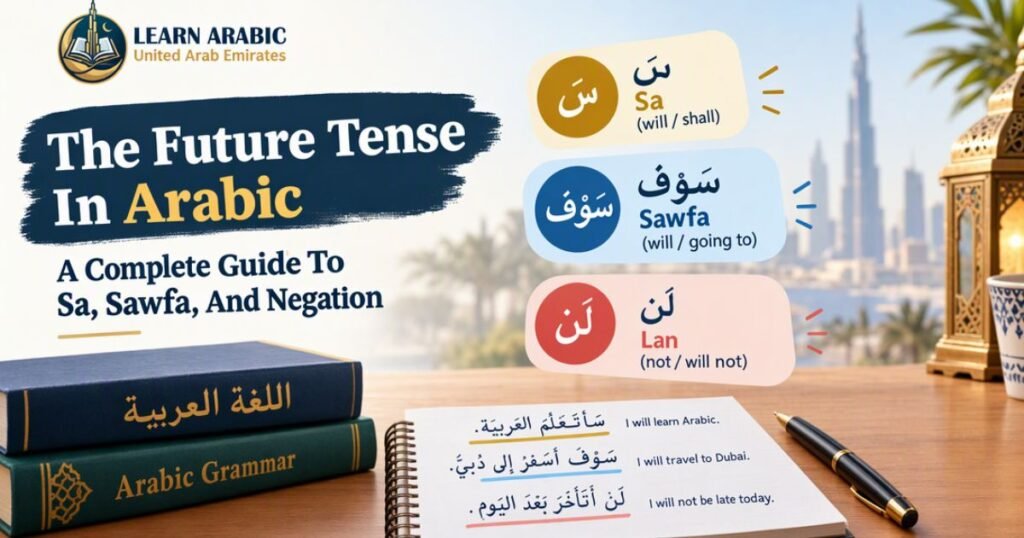
If you can already form the present tense in Arabic, you are one small step away from talking about tomorrow, next month, or ten years from now.
The future tense in Arabic does not use a new verb form at all — it takes the present-tense verb you already know and adds a marker in front of it. That is the whole system, and once you see it, you will not forget it.
This guide walks through both future markers, shows you the full conjugation pattern, explains negation, and clears up the mistakes that trip up most learners at Learn Arabic In the UAE Academy during their first few weeks of grammar study.
What you’ll learn in this article:
- How Arabic builds the future tense without a separate verb conjugation.
- The real difference between سـ (sa-) and سوف (sawfa).
- A full pronoun-by-pronoun conjugation chart.
- How to negate the future correctly with لن (lan).
- The three mistakes that make future-tense Arabic sound off, and how to avoid them.
What Is The Future Tense In Arabic?
The future tense in Arabic is a present-tense verb combined with a forward-looking particle, rather than a verb form of its own. Arabic grammar recognizes two core conjugated tenses — الماضي (al-māḍī, past) and المضارع (al-muḍāriʿ, present) — and future meaning is layered onto the present tense by attaching سـ (sa-) or placing سوف (sawfa) in front of it.
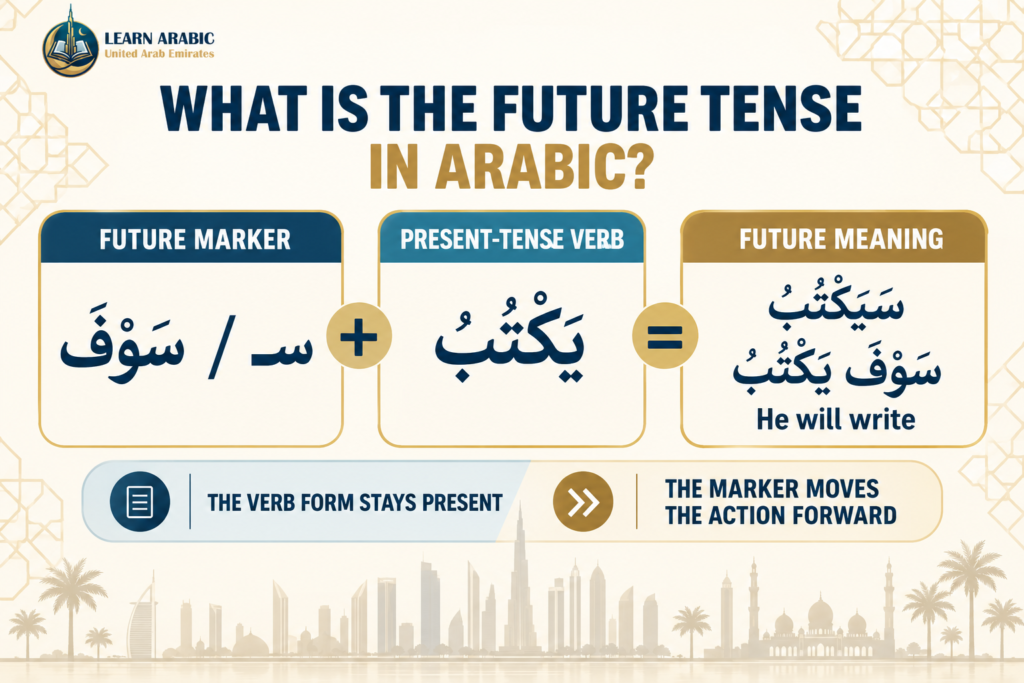
The verb’s root and ending stay exactly the same; only the particle signals that the action is still ahead. This is a structural difference from English, where “will” plus a base verb (will travel, will study) marks the future as its own category.
Arabic instead treats time as secondary to aspect — whether an action is finished or still unfolding — which is also why the same present-tense verb form can describe a habit, an ongoing action, or (with a marker attached) something that hasn’t happened yet.
The Two Markers That Create Future Meaning
Arabic has exactly two standard future markers in Modern Standard Arabic, and a third that belongs to spoken dialect rather than formal grammar.
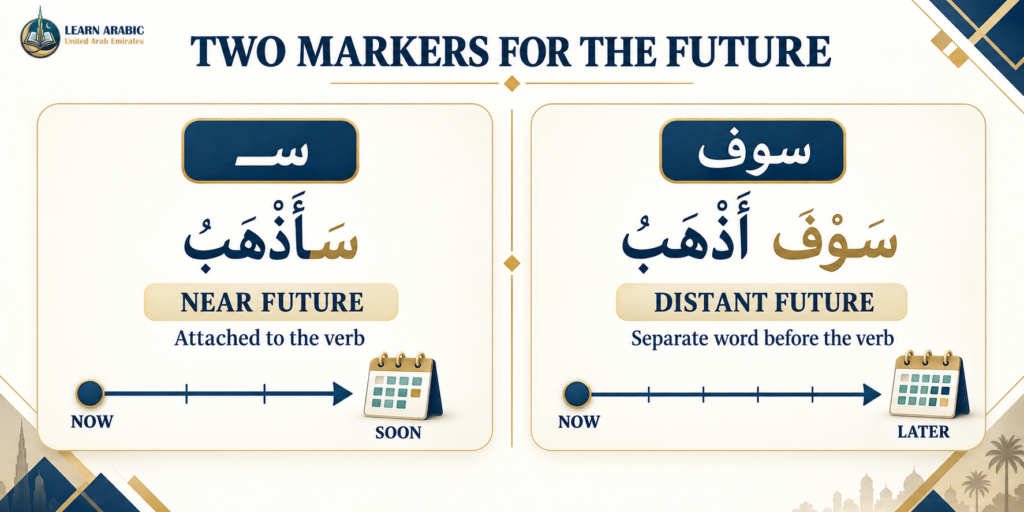
سـ (sa-) attaches directly to the front of a present-tense verb, with no space, and signals something near or fairly certain: سَأَذْهَبُ (sa’adh-habu, I will go).
سوف (sawfa) stands alone as a separate word placed before the verb and signals something further off or more deliberate: سَوْفَ أَذْهَبُ (sawfa adh-habu, I will go).
In Egyptian Arabic specifically, speakers use the prefix حـ (ha-) instead — حَاروح (ha-arūḥ, I’ll go) — which is common in daily conversation and Egyptian media but is not used in formal MSA writing.
The choice between سـ and سوف is not random — it’s a signal to the listener about how soon or how firm the plan is.
Native speakers reach for سـ by default in everyday speech because it’s quick and covers most situations; سوف tends to appear in more formal writing, news broadcasts, and statements about long-term plans, where the extra weight of a standalone word matches the seriousness of the claim.
At Learn Arabic In the UAE Academy, this is one of the first grammar points beginners cover, because it comes up in almost every conversation about plans, appointments, or intentions.
If you’re building this foundation from scratch, our Arabic Classes for Beginners walk through tense formation step by step alongside real conversation practice, so the grammar sticks the first time.
How To Form The Arabic Future Tense Conjugation?
Forming the Arabic future tense conjugation only requires two things: a present-tense verb you already know how to conjugate, and the correct marker attached or placed in front of it.
There is no new set of endings to memorize — the present-tense prefixes and suffixes you use for “he writes” or “we study” stay exactly the same.
1. Attaching سـ (sa-) for the Near Future
سـ (sa-) is the marker learners reach for most, because it covers the vast majority of everyday future statements — plans for later today, tomorrow, or next week.
Two rules keep it correct: سـ is written joined to the verb with no space (سَأَدْرُسُ, not سَ أَدْرُسُ), and it only ever marks the future when attached to a present-tense verb — a verb that already starts with the letter س in its root, such as سَاعَدْتُ (sāʿadtu, I helped), is a past-tense verb and has nothing to do with this marker.
| English | Transliteration | Arabic |
| I will study Arabic tomorrow | Sa-adrusu al-‘arabiyyata ghadan | سَأَدْرُسُ العَرَبِيَّةَ غَدًا |
2. Placing سوف (sawfa) for the Distant Future
سوف (sawfa) is called ḥarf al-taswīf, the particle of postponement, because it points to something further out — a long-term goal rather than an immediate plan.
It always stands as its own word before the verb and shows up more often in formal writing, news reporting, and statements about future commitments than in casual speech.
| English | Transliteration | Arabic |
| I will write a book one day | Sawfa aktubu kitāban yawman mā | سَوْفَ أَكْتُبُ كِتَابًا يَوْمًا مَا |
Read Also: The Arabic Present Tense
Arabic Future Tense Conjugation Chart by Pronoun
Once you know how سـ attaches to a verb, the pattern repeats across every pronoun using the same present-tense prefixes you already use for “he does,” “we do,” and so on. Below is the full pattern using ذهب (dhahaba, to go) as the model verb, since it’s one of the first verbs most students learn.
Each row simply takes the present-tense form of the verb and adds سـ directly to the front — the internal vowels and endings never change because of the future marker.
| Pronoun | Present Tense | Future Tense | Transliteration | Meaning |
| أنا (I) | أَذْهَبُ | سَأَذْهَبُ | Sa’adh-habu | I will go |
| أنتَ (you, m.) | تَذْهَبُ | سَتَذْهَبُ | Sa-tadh-habu | You will go |
| أنتِ (you, f.) | تَذْهَبِينَ | سَتَذْهَبِينَ | Sa-tadh-habīna | You will go |
| هو (he) | يَذْهَبُ | سَيَذْهَبُ | Sa-yadh-habu | He will go |
| هي (she) | تَذْهَبُ | سَتَذْهَبُ | Sa-tadh-habu | She will go |
| نحن (we) | نَذْهَبُ | سَنَذْهَبُ | Sa-nadh-habu | We will go |
| أنتم (you, pl. m.) | تَذْهَبُونَ | سَتَذْهَبُونَ | Sa-tadh-habūna | You will go |
| هم (they, m.) | يَذْهَبُونَ | سَيَذْهَبُونَ | Sa-yadh-habūna | They will go |
The same pattern applies whether you swap in سوف instead of سـ — you would simply write سوف as a separate word before the unchanged present-tense form (سوف أَذْهَبُ, sawfa adh-habu).
A useful shortcut for beginners: once you can conjugate any verb correctly in the present tense across all pronouns, you already know its future tense — you’re just adding one small piece to the front.
Repeated drilling with a real instructor is what makes this pattern automatic rather than something you have to calculate mid-sentence.
That’s the exact focus of the Arabic Intensive Course at Learn Arabic In the UAE Academy, where conjugation practice is built into every session rather than left as homework.
See Our Classroom Environment in Action
Experience a sneak peek into our live sessions. Watch the video below to see our specialized instructors interacting with students, breakdown complex texts, and cultivate an engaging, respectful learning environment.
Master Arabic in the UAE
Experience world-class Arabic language training designed for students and professionals in the Emirates.
Book Your Free TrialWhen to Use the Future Tense in Arabic?
Arabic’s future tense covers more ground than simply stating what happens next — it also carries intention, promises, predictions, and expectation, much the way “will” does in English.
1. Talking About Plans And Intentions
Arabic distinguishes between something you intend to do (which may or may not happen) and something close to certain, but both use the same future-tense structure.
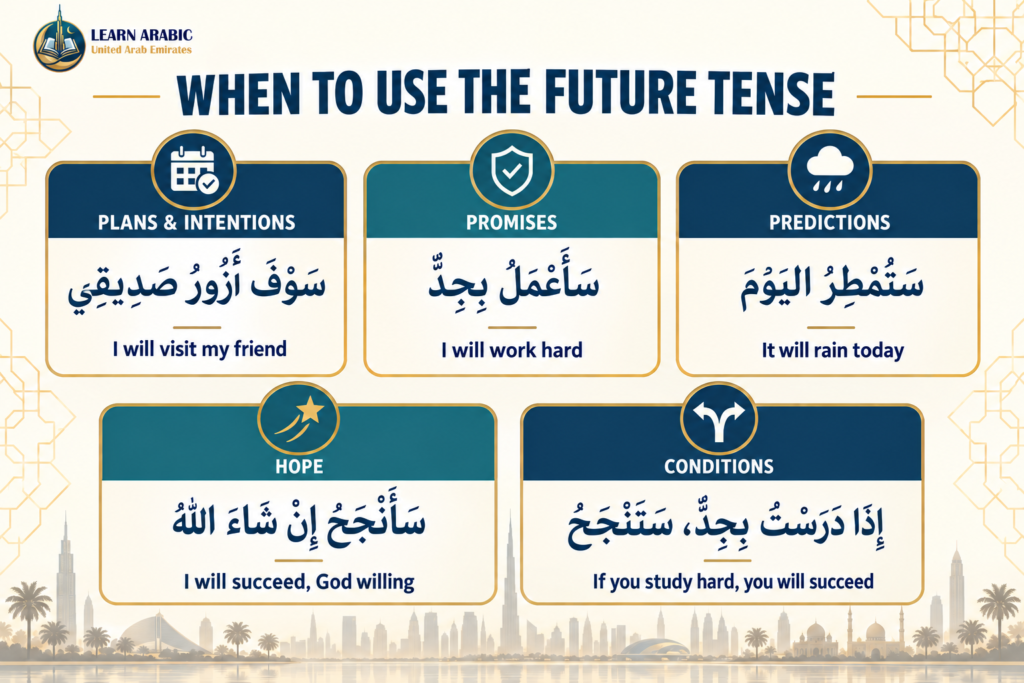
سَوْفَ أَزُورُ صَدِيقِي
الأُسْبُوعَ القَادِمَ (I will visit my friend next week) states an intention; سَتُشْرِقُ الشَّمْسُ غَدًا (the sun will rise tomorrow) states a near-certainty. The grammar doesn’t change — only the context tells the listener which kind of future you mean.
2. Making Promises, Predictions, And Expressing Hope
The future tense is also Arabic’s default form for commitments and forecasts: سَأَعْمَلُ بِجِدٍّ هَذَا العَامَ (I will work hard this year) reads as a promise, while سَتُمْطِرُ اليَوْمَ (it will rain today) reads as a prediction.
In everyday speech, many Arabic speakers add إن شاء الله (in shā’ Allāh, God willing) after a future-tense verb — سَأَنْجَحُ إِنْ شَاءَ اللهُ (I will succeed, God willing) — a common cultural convention that softens certainty about anything not yet in your hands.
Arabic future tense also appears in conditional sentences: إِذَا دَرَسْتَ بِجِدٍّ، سَتَنْجَحُ (if you study hard, you will succeed) ties the future action to a stated condition rather than presenting it as guaranteed.
How to Negate the Future Tense in Arabic?
Negating the future tense in Arabic is not just a matter of adding “not” — it changes both the marker and the verb ending.
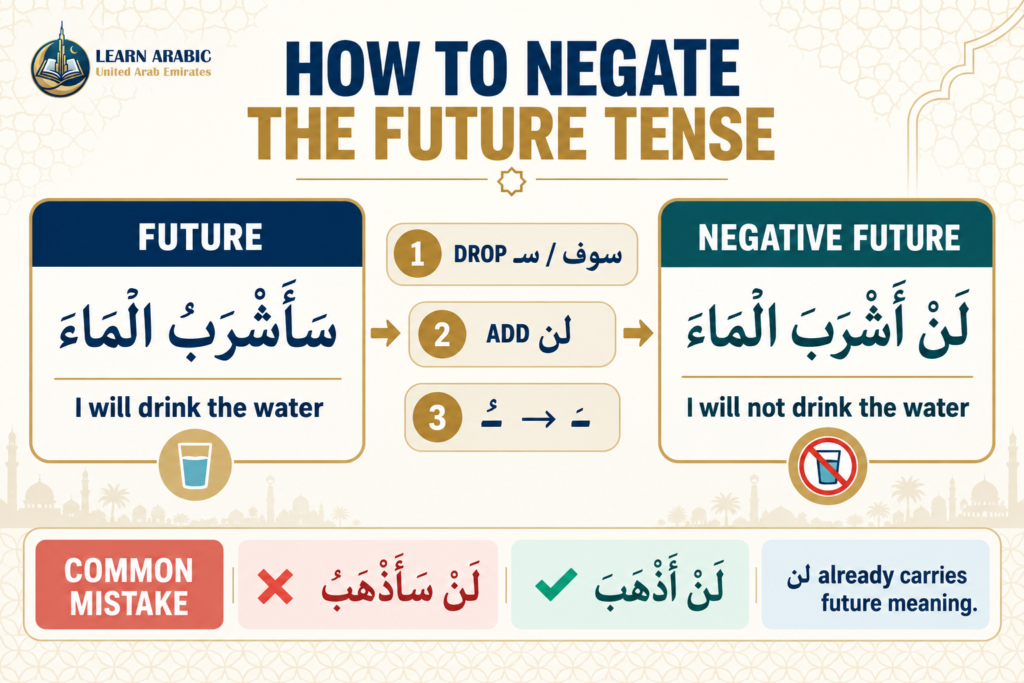
Three steps make future negation correct: drop سـ or سوف entirely, place لن (lan) directly before the present-tense verb, and change the verb’s final vowel from a dammah (ـُ) to a fatha (ـَ).
لن is the clearest, most direct, and most commonly used particle for negating a future action, which is why it’s the one worth mastering first.
| English | Transliteration | Arabic |
| I will drink the water | Sa-ashrabu al-mā’a | سَأَشْرَبُ المَاءَ |
| I will not drink the water | Lan ashraba al-mā’a | لَنْ أَشْرَبَ المَاءَ |
Common Negation Mistakes
The most frequent error is keeping the future marker alongside لن — writing لن سأذهب instead of the correct لن أذهبَ. Since لن already carries future meaning on its own, سـ becomes redundant and grammatically wrong once لن is present. The second common slip is forgetting the vowel change on the verb ending, writing لن أدرسُ instead of the correct لن أدرسَ.
Future Tense Vs. Present, Past, And Imperative In Arabic
Seeing all four forms side by side makes the pattern easier to internalize than studying the future tense in isolation. Using كتب (kataba, to write) as the model verb:
| Tense | Form (he) | Function | Example |
| Past (الماضي) | كَتَبَ | Completed action | كَتَبَ الرِّسَالَةَ أَمْسِ — He wrote the letter yesterday |
| Present (المضارع) | يَكْتُبُ | Ongoing or habitual action | يَكْتُبُ القَصِيدَةَ الآنَ — He is writing the poem now |
| Future (المستقبل) | سَيَكْتُبُ | Action to happen later | سَيَكْتُبُ الرِّوَايَةَ العَامَ المُقْبِلَ — He will write the novel next year |
| Imperative (الأمر) | اُكْتُبْ | Command or request | اُكْتُبِ الوَاجِبَ! — Write the homework! |
Arabic doesn’t have separate grammatical forms matching English’s “future continuous” or “future perfect.”
Instead, it reuses the same سـ / سوف future-simple structure and adds time expressions to carry that meaning — طَوَالَ اليَوْمِ (throughout the day) for an ongoing future action, or قَدْ (qad) combined with a completed-action structure to express something that will already be finished by a certain point.
Recognizing these four forms side by side is exactly the kind of foundation covered in the Arabic Classes for Adults program at Learn Arabic In the UAE Academy, where the goal is speaking fluency built on a clear grammatical base rather than memorized phrases.
Read Also: Daily Routine In Arabic For Kids
Common Mistakes Learners Make with the Arabic Future Tense
Even after learning the rules, three habits keep showing up in early speech and writing. Overusing سوف instead of سـ is the most common one — beginners often prefer سوف because it’s a full, memorable word, while the small prefix سـ is easy to overlook. Using سوف for every future statement, including immediate ones, sounds unnatural to a native ear.
Relying on time words alone is the second mistake. Adding غدًا (tomorrow) to a present-tense sentence does not make it future tense grammatically — غداً أنا أذهب is still structurally present tense; the correct form is غداً سأذهب, with the marker doing the actual grammatical work.
The third is the negation error already covered above: keeping سـ or سوف alongside لن, or forgetting the vowel shift on the verb.
| Mistake | Correct |
| سوف آكل الآن (I will eat now) | سآكل الآن |
| غداً أنا أذهب (Tomorrow I will go) | غداً سأذهب |
| لن سأذهب (I will not go) | لن أذهبَ |
Step Inside Our Classrooms
Don’t just take our word for it—see our community in action. Click below to watch real, live snippets from our recent classes and experience our engaging teaching style firsthand!
Master Arabic in the UAE
Experience world-class Arabic language training designed for students and professionals in the Emirates.
Book Your Free TrialStart Speaking Arabic With Real Confidence, Not Just Grammar Rules
Knowing how سـ, سوف, and لن work on paper is only half the job — real fluency comes from using them in live conversation until they’re automatic. That’s the gap most self-study learners hit, and it’s exactly where a structured course with an instructor changes the outcome.
Learn Arabic In the UAE Academy builds grammar points like the future tense directly into spoken practice from lesson one, so you’re not memorizing a chart — you’re using it to talk about your actual plans, promises, and predictions in Arabic.

Whether you’re starting from zero or want a flexible schedule around work, there’s a course track built for it: the Arabic Intensive Course for fast, immersive progress, the Self-Paced Arabic Course for learning on your own schedule, or the full list of Arabic Course in the UAE options to find the right fit.
Our Arabic courses:
- Arabic Course in the UAE
- Arabic Intensive Course
- Arabic Classes for Beginners (Learn Arabic from Scratch)
- Madinah Arabic Course
- Arabic Classes for Adults
- Self-Paced Arabic Course
- Arabic Speaking Classes
- Learn to Write Arabic Course
- Arabic Grammar Course
- Learn Arabic Alphabet Course

Conclusion
The future tense in Arabic isn’t a separate conjugation to memorize — it’s your existing present-tense verb with سـ attached for something near, or سوف placed in front of it for something further off, and لن replacing both when you need to negate it.
Once that structure is clear, forming future-tense sentences becomes a matter of recognizing which marker fits the timeframe and getting the negation vowel change right, not relearning verb endings from scratch.
Whether you’re making a promise, stating a prediction, or just talking about tomorrow’s plans, the same small set of rules covers it all. With steady practice — the kind built into every level at Learn Arabic In the UAE Academy — this becomes second nature far faster than most learners expect.

FAQs About The Future Tense In Arabic
The questions below come up constantly among learners working through tense formation, and they cover the points this guide’s structure alone doesn’t fully spell out — quick, direct answers you can reference while you practice.
1. Is the Arabic future tense a separate verb conjugation?
No, the arabic future tense is not a separate conjugation — it’s formed by attaching سـ (sa-) or placing سوف (sawfa) before an unchanged present-tense verb. This makes Arabic future tense conjugation simpler in one sense than English, since there’s no new set of verb endings to learn.
2. What’s the real difference between سـ and سوف?
سـ signals a near or fairly certain future action and attaches directly to the verb, while سوف signals a more distant or formal future and stands as a separate word. Both are grammatically correct; the choice depends on how soon or how firm the plan is.
3. Can I just add a time word like “tomorrow” instead of using a future marker?
No — a time word like غدًا (tomorrow) alone does not change a sentence’s grammatical tense. Without سـ, سوف, or another future marker attached to the verb, the sentence remains grammatically present tense even if the meaning implies the future.
4. How do I say “will not” in Arabic?
Use لن (lan) directly before the present-tense verb, and change the verb’s final vowel from a dammah to a fatha. For example, لن أذهبَ means “I will not go” — the future marker سـ or سوف is dropped entirely once لن is used.
5. Does Egyptian Arabic use the same future markers as Modern Standard Arabic?
Egyptian Arabic commonly uses the prefix حـ (ha-) instead of سـ or سوف, as in حَاروح (I’ll go). This dialectal form is widely used in Egyptian speech and media but does not appear in formal Modern Standard Arabic writing.



Leave a Reply