 Learn Arabic
| Key Takeaways |
| Arabic colors are gendered nouns — each color has a masculine and feminine form that must agree with the noun they describe. |
| Colors in Arabic with harakat use short vowel markings that clarify pronunciation, making them essential for beginners and Quran students. |
| Gulf Arabic spoken across the UAE uses some color terms differently from Modern Standard Arabic, particularly in informal daily speech. |
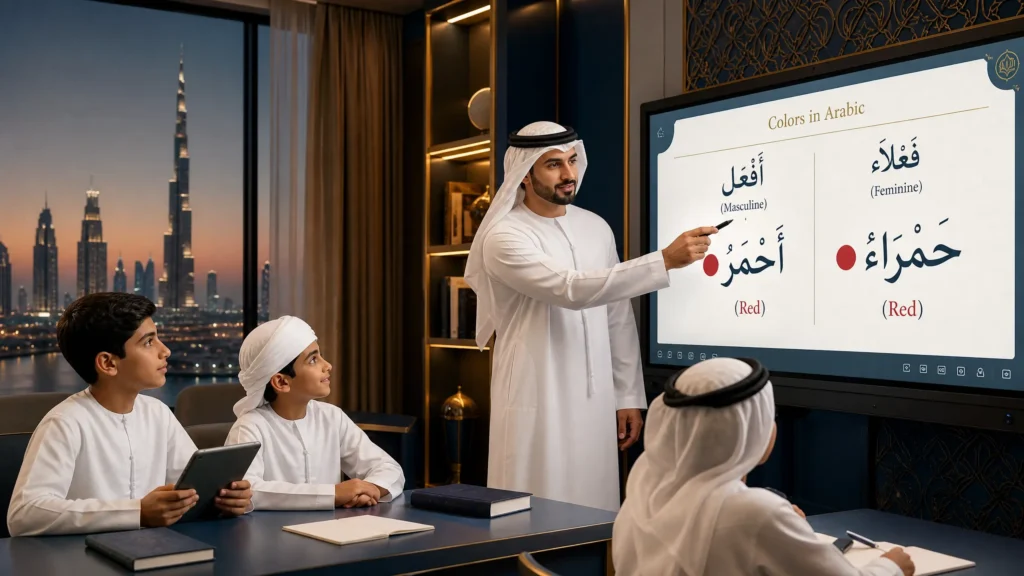
There are 11 primary color words in Arabic, each following the classical af’al morphological pattern for the masculine form and the fu’la pattern for the feminine. Knowing both forms — and their harakat (short vowel markings) — is essential for correct use in Arabic sentences, whether in writing, speech, or Quran recitation study.
This guide covers every core color in Arabic with full harakat, transliteration, English equivalents, and UAE-specific learning notes.
Each color is presented with its masculine and feminine forms, plus the grammatical logic UAE learners need to use colors correctly from day one.Why Colors in Arabic Follow a Special Grammatical Pattern
Why Do Colors in Arabic Follow a Special Grammatical Pattern?
Arabic colors belong to a unique morphological category, and they function as adjectives. This pattern is one of the most distinctive structures in Arabic grammar and differs from how ordinary adjectives are formed.
The masculine form follows the أَفْعَل (af’al) pattern — for example, أَحْمَر (ahmar, red). The feminine form shifts to the فَعلَاء (fa’la’) pattern — giving حَمْرَاء (hamra’, red, feminine). This is non-negotiable in formal Arabic and affects every sentence in which a color describes a noun.
Why Gulf Arabic Learners in the UAE Need Both Forms
At UAE Arabic Learning Academy, we consistently find that students who arrive with conversational Gulf Arabic exposure know color words passively but have never analyzed their grammatical gender agreement. They will say “سيارة أحمر” instead of the correct “سيارة حَمْرَاء” — using the masculine form with a feminine noun (سيارة, sayyara, car, is feminine in Arabic).
This is one of the most common color-grammar errors across all learner backgrounds in the UAE. Our Arabic grammar course addresses this systematically from the earliest levels, building the gender-agreement instinct rather than just drilling vocabulary lists.
Book your FREE trial class in our Arabic grammar course

1. Red in Arabic أَحْمَر
Red in Arabic is أَحْمَر (ahmar) in the masculine form and حَمْرَاء (hamra’) in the feminine. It derives from the root ح-م-ر, associated with redness and rawness. In the UAE, you will encounter this word constantly — from traffic signals to national flag descriptions.
| Form | Arabic | Harakat | Transliteration |
| Masculine | أحمر | أَحْمَرُ | Ahmaru |
| Feminine | حمراء | حَمْرَاءُ | Hamra’u |
Using Red in Arabic Sentences
The adjective follows the noun in Arabic and must agree in gender. الكتاب الأحمر (al-kitab al-ahmar) means “the red book” — and because كتاب (book) is grammatically masculine, the masculine color form applies. الحقيبة الحمراء (al-haqiba al-hamra’) — “the red bag” — uses the feminine form because حقيبة (bag) is feminine.
Shots Videos from Our Courses
Master Arabic in the UAE
Experience world-class Arabic language training designed for students and professionals in the Emirates.
Book Your Free Trial2. Blue in Arabic أَزْرَق
Blue in Arabic is أَزْرَق (azraq) in the masculine and زَرْقَاء (zarqa’) in the feminine. The root ز-ر-ق appears in the famous place name “Zarqa” in Jordan — a city literally named for its blue-tinged water source, which demonstrates how deeply Arabic color roots embed into geography and names.
| Form | Arabic | Harakat | Transliteration |
| Masculine | أزرق | أَزْرَقُ | Azraqu |
| Feminine | زرقاء | زَرْقَاءُ | Zarqa’u |
In the UAE, السماء الزرقاء (al-sama’ al-zarqa’) — “the blue sky” — is a phrase children encounter in early Arabic literacy. Note that سماء (sky) is grammatically feminine, requiring زرقاء rather than أزرق.
3. Green in Arabic أَخْضَر
Green in Arabic is أَخْضَر (akhdar) in the masculine and خَضْرَاء (khadra’) in the feminine. The root خ-ض-ر is foundational in Arabic, making it a high-priority color for students in our Arabic for beginners course.
Begin your Arabic learning path with a FREE trial class
| Form | Arabic | Harakat | Transliteration |
| Masculine | أخضر | أَخْضَرُ | Akhdaru |
| Feminine | خضراء | خَضْرَاءُ | Khadra’u |
Green in the UAE Context
The UAE national flag’s green stripe — representing fertility and the natural environment — is described using this word: الشريط الأخضر (al-sharit al-akhdar).
4. White in Arabic أَبْيَض
White in Arabic is أَبْيَض (abyad) in the masculine and بَيْضَاء (bayda’) in the feminine. This is among the most recognizable color roots — بيضة (bayda), meaning “egg,” shares the same root, connecting whiteness to one of nature’s most universal images.
| Form | Arabic | Harakat | Transliteration |
| Masculine | أبيض | أَبْيَضُ | Abyadу |
| Feminine | بيضاء | بَيْضَاءُ | Bayda’u |
5. Black in Arabic أَسْوَد
Black in Arabic is أَسْوَد (aswad) in the masculine and سَوْدَاء (sawda’) in the feminine. The Black Stone at the Kaaba in Makkah is الحجر الأسود (al-hajar al-aswad) — one of the most recognizable uses of this color term in Islamic vocabulary. UAE students studying Quran and Islamic studies encounter this phrase frequently.
| Form | Arabic | Harakat | Transliteration |
| Masculine | أسود | أَسْوَدُ | Aswadu |
| Feminine | سوداء | سَوْدَاءُ | Sawda’u |
6. Yellow in Arabic أَصْفَر
Yellow in Arabic is أَصْفَر (asfar) in the masculine and صَفْرَاء (safra’) in the feminine. In Quranic Arabic, yellow appears with striking vividness — the Quran describes a yellow cow with a striking, pleasing color in Surah Al-Baqarah. The connection between this color and Quranic text makes it memorable for students in our Quran programs.
| Form | Arabic | Harakat | Transliteration |
| Masculine | أصفر | أَصْفَرُ | Asfaru |
| Feminine | صفراء | صَفْرَاءُ | Safra’u |
Understanding these color terms matters for learners pursuing genuine conversational fluency. Our Arabic speaking course covers this wider vocabulary in the context of real descriptive speech.
Start speaking Arabic with a FREE trial session

7. Purple in Arabic أَرْجُوانِي and بَنَفْسَجِي
Purple in Arabic has two primary terms. أَرْجُوانِي (urjuwani) refers to a deep, royal purple, while بَنَفْسَجِي (banafsaji) describes a lighter violet-purple, derived from بنفسج (banafsaj), the Arabic word for violet flowers.
| Term | Arabic | Harakat | Transliteration | Shade |
| Royal purple | أرجواني | أُرْجُوَانِيّ | Urjuwaniyy | Deep purple |
| Violet/light purple | بنفسجي | بَنَفْسَجِيّ | Banafsajiyy | Light violet |
8. Orange in Arabic بُرْتُقَالِي
Orange in Arabic is بُرْتُقَالِي (burtuqali), derived directly from برتقال (burtuqal) — the Arabic word for orange (the fruit). This is a borrowed descriptive term and, like the purple terms above, does not follow the classical af’al pattern. It remains constant across gender.
At UAE Arabic Learning Academy, our instructors note that students from South Asian backgrounds — a large community across Dubai and Abu Dhabi — find this word immediately recognizable because برتقال sounds close to Portuguese laranja-derived words they may know, reflecting the historical citrus trade routes through the Arab world.
9. Grey in Arabic رَمَادِي
Grey in Arabic is رَمَادِي (ramadi), from رَمَاد (ramad), meaning “ash.” This is a direct reference to the grey colour of ash — one of the most linguistically transparent color etymologies in Arabic.
Like orange and purple, it does not follow the af’al pattern and is used unchanged across genders.
Read Also: Learn Quranic Vocabulary
Our Students Reviews
Master Arabic in the UAE
Experience world-class Arabic language training designed for students and professionals in the Emirates.
Book Your Free Trial10. Pink in Arabic وَرْدِي
Pink in Arabic is وَرْدِي (wardi), from وَرْد (ward), meaning “rose” or “flower.” As with grey and orange, this is a relational adjective (a nisba adjective) rather than a classical af’al color term, and it remains the same form regardless of the noun’s grammatical gender.
Read Also: Arabic Sentences for Kids
Complete Arabic Colors Reference Table
| Color | Masculine | Feminine | Transliteration (M) | Transliteration (F) |
| Red | أَحْمَرُ | حَمْرَاءُ | Ahmar | Hamra’ |
| Blue | أَزْرَقُ | زَرْقَاءُ | Azraq | Zarqa’ |
| Green | أَخْضَرُ | خَضْرَاءُ | Akhdar | Khadra’ |
| White | أَبْيَضُ | بَيْضَاءُ | Abyad | Bayda’ |
| Black | أَسْوَدُ | سَوْدَاءُ | Aswad | Sawda’ |
| Yellow | أَصْفَرُ | صَفْرَاءُ | Asfar | Safra’ |
| Orange | بُرْتُقَالِيّ | بُرْتُقَالِيّة | Burtuqali | Burtuqalia |
| Pink | وَرْدِيّ | وَرْدِيّة | Wardi | Wardia |
| Grey | رَمَادِيّ | رَمَادِيّة | Ramadi | Ramadia |
| Purple | بَنَفْسَجِيّ | بَنَفْسَجِيّة | Banafsaji | Banafsajia |
| Brown | بُنِّيّ | بُنِّيّة | Bunniyy | Bunniyya |
Read Also: Family Members in Arabic
How Do Colors in Arabic Appear in the Arabic Alphabet and Root System?
Colors in the Arabic alphabet are not isolated vocabulary items — they are built from three-letter roots (juzur) that carry meaning across dozens of related words. Understanding the root transforms color learning from memorization into pattern recognition.
The root أ-ح-م-ر (ayn-ha-mim-ra) underpins not just “red” but related words for redness, blushing, and heat-related terms in classical Arabic.
Students who learn colors through their roots — rather than as standalone words — absorb vocabulary three to five times faster, based on the consistent pattern our instructors observe in structured sessions at UAE Arabic Learning Academy.
For children in UAE schools, connecting Arabic color vocabulary to root patterns from early age builds the morphological awareness the UAE Ministry of Education curriculum increasingly emphasizes.
Our Arabic course for kids integrates this root-awareness approach through age-appropriate activities that make color learning structurally meaningful, not just rote.
Begin your kid’s Arabic learning path with a FREE trial class

Read Also: How to Learn Arabic for Kids in the UAE?
Begin Learning Arabic Colors Correctly with UAE Arabic Learning Academy
Arabic color vocabulary is a foundation stone — get the morphological logic right from the start and the rest of Arabic adjective grammar follows naturally.
UAE Arabic Learning Academy offers expert-guided instruction that builds this foundation correctly:
Expert native Arab Azhari tutors — authentic instruction grounded in classical Arabic scholarship
Online 1-on-1 and group modules — flexible scheduling built for UAE families and professionals
UAE-specific curriculum — structured for the multilingual environment UAE students actually live in
All ages and levels welcomed — from absolute beginners to advanced heritage speakers
Free trial session available — start with zero commitment
Check out our top Arabic courses for UAE residents:
- Arabic alphabet course
- Arabic grammar course
- Arabic writing course
- Arabic speaking course
- Arabic course for beginners
- Kids’ Arabic Grammar Course
- Arabic Beginner Course for Kids
- Arabic Conversation for Kids
Book your free trial session today and begin with a structured assessment and your first live lesson.

Conclusion
Mastering Arabic color vocabulary is straightforward when the underlying grammar is taught alongside the words themselves. UAE learners who understand why أَحْمَر becomes حَمْرَاء — rather than just memorizing both — are building the grammatical instinct that carries them through every level of Arabic. Colors are an entry point, not just a vocabulary topic.
For children, adult professionals, and Quran students across Dubai, Abu Dhabi, and the wider UAE, a structured approach to Arabic vocabulary — one that integrates grammar, root awareness, and cultural context — makes the difference between words that fade after a week and knowledge that sticks permanently.
Master Arabic in the UAE
Experience world-class Arabic language training designed for students and professionals in the Emirates.
Book Your Free TrialRead Also: How to Learn Arabic in the UAE?
Frequently Asked Questions About Colors in Arabic
How Quickly Can UAE Learners Master Arabic Color Agreement?
Most adult learners at UAE Arabic Learning Academy internalize the basic masculine/feminine color forms within two to three structured sessions when the forms are taught alongside their grammatical logic — not just as isolated vocabulary. Students who learn colors in isolation without gender-agreement context typically take three to four times as long to use them correctly in sentences.
Are Arabic Colors Used in Quranic Arabic the Same as Modern Arabic?
Yes — the core color terms in the Quran are the same classical forms used in Modern Standard Arabic today. The Quran uses أَخْضَر for green, أَبْيَض for white, أَسْوَد for black, with the same morphological patterns. This makes color vocabulary a particularly transferable learning investment for students studying both modern Arabic and Quranic text.
What Is the Best Way to Practice Colors in Arabic for UAE Children?
Children in UAE schools learn Arabic colors most effectively when they encounter them in context — describing familiar objects, UAE landmarks, and items from their daily environment — rather than through isolated list memorization. At UAE Arabic Learning Academy, our instructors pair color vocabulary with real-object description games in early sessions, accelerating active recall significantly compared to flashcard-only methods.
Related Articles
Learn Arabic

Leave a Reply