 Learn Arabic
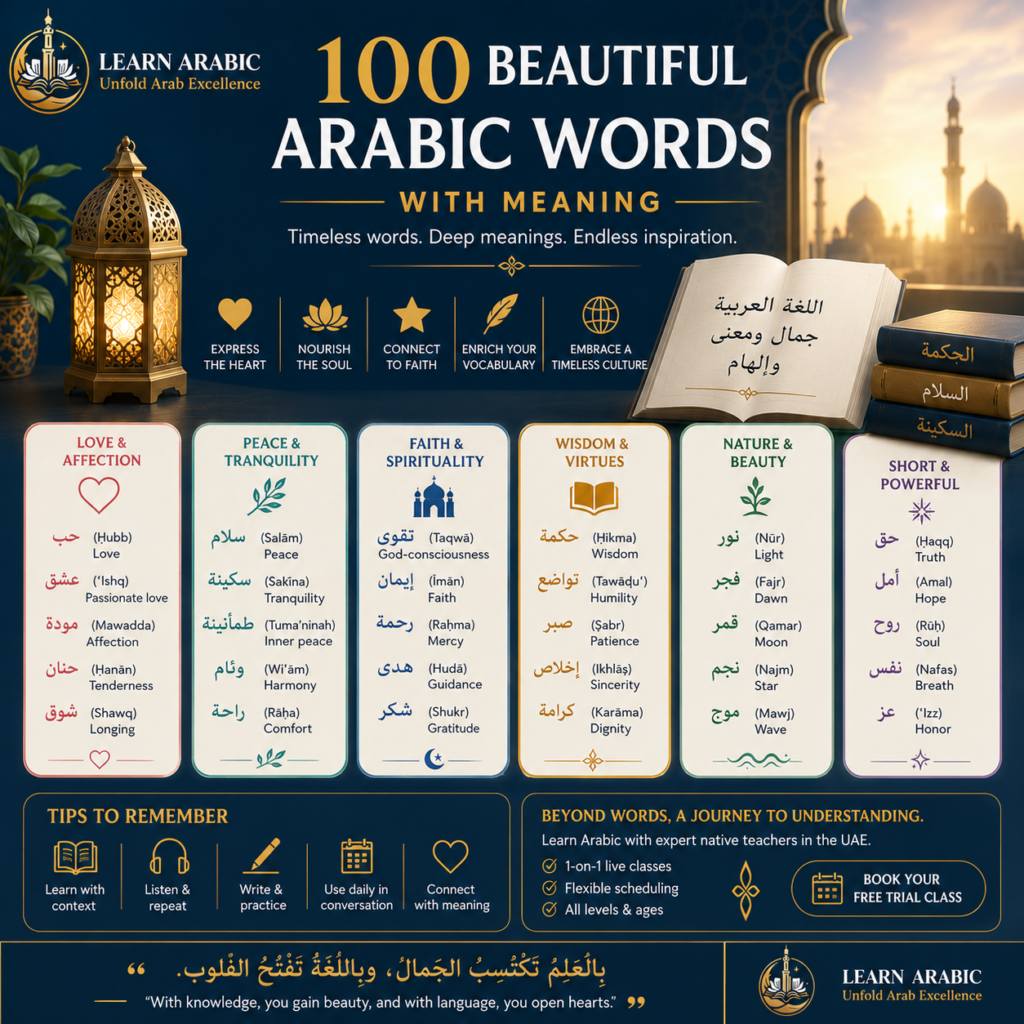
A single Arabic word can express an entire feeling, belief, or life philosophy that may require a full sentence—or even a paragraph—to explain in English. Words like صبر (Ṣabr), سكينة (Sakīna), and مروءة (Murūʾa) carry layers of meaning shaped by centuries of literature, poetry, and the Quran, making Arabic one of the richest languages in the world.
In this guide, you’ll discover 100 beautiful Arabic words with meaning, carefully organized into categories including love, faith, the Quran, deep philosophical concepts, short yet powerful words, and everyday terms of endearment. Each word includes its Arabic spelling, English transliteration, and a clear explanation to help you appreciate not only its translation but also the cultural and emotional depth behind it.
What You’ll Learn in This Article
- The most beautiful Arabic words for love, peace, and faith
- Unique Arabic words with no direct English translation
- Beautiful Arabic words from the Quran with spiritual meaning
- Short, powerful Arabic words and their meanings
- Cute terms of endearment used with family and friends
- Practical tips for learning and remembering Arabic vocabulary
Beautiful Arabic Words With Meaning
Arabic is one of the few languages where a single word can compress an entire emotional or spiritual state into a handful of letters. The root system — where three consonants carry a core idea across dozens of related words — means that beautiful Arabic words carry layers of meaning that resist simple translation.
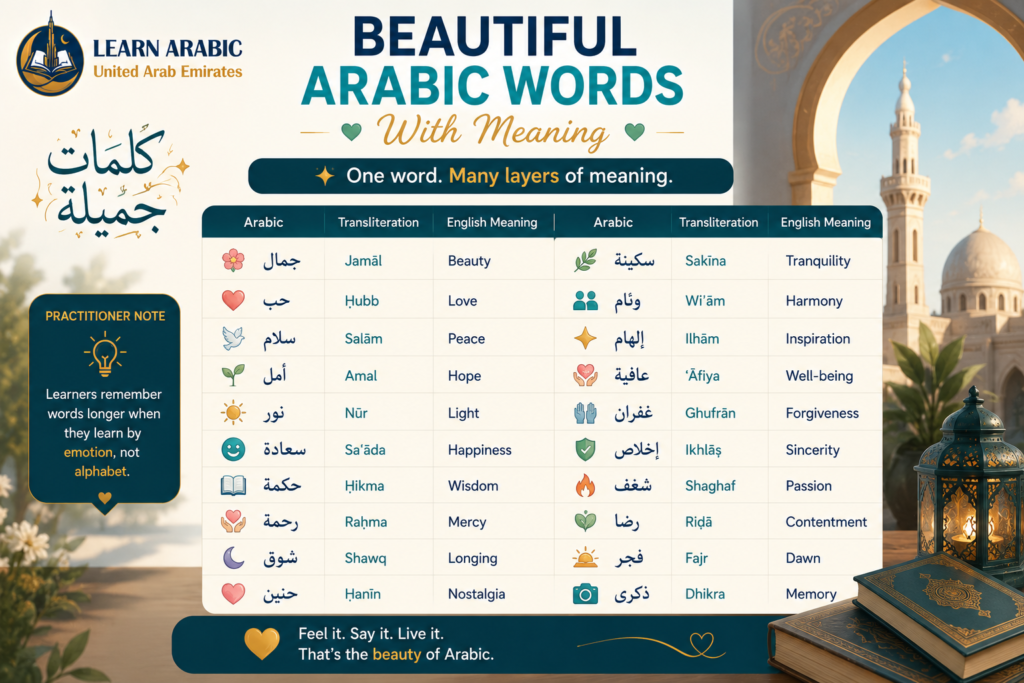
The table below collects some of the most widely admired words in the language, spanning emotion, nature, and virtue.
| Arabic | Transliteration | English Meaning |
| جمال | Jamāl | Beauty |
| حب | Ḥubb | Love |
| سلام | Salām | Peace |
| أمل | Amal | Hope |
| نور | Nūr | Light |
| سعادة | Saʿāda | Happiness |
| حكمة | Ḥikma | Wisdom |
| رحمة | Raḥma | Mercy |
| شوق | Shawq | Longing |
| حنين | Ḥanīn | Nostalgia |
| سكينة | Sakīna | Tranquility |
| وئام | Wiʾām | Harmony |
| إلهام | Ilhām | Inspiration |
| عافية | ʿĀfiya | Well-being |
| غفران | Ghufrān | Forgiveness |
| إخلاص | Ikhlāṣ | Sincerity |
| شغف | Shaghaf | Passion |
| رضا | Riḍā | Contentment |
| فجر | Fajr | Dawn |
| ذكرى | Dhikra | Memory |
One practitioner note worth knowing: language teachers consistently find that learners who group words by emotional theme — rather than alphabetical order or frequency lists — retain Arabic vocabulary significantly longer, because each word anchors itself to a feeling rather than a slot on a list.
Beautiful Arabic Words for Love
Arabic doesn’t have one word for love. It has an entire vocabulary for the different shapes love takes — from the first stirring of attraction to a devotion that outlasts life itself.
Classical Arabic literature identifies at least seven stages of love, each with its own term. Modern speakers use a smaller set, but even that set is richer than what most languages offer.
| Arabic | Transliteration | Meaning / Nuance |
| حب | Ḥubb | Love (the general term) |
| عشق | ʿIshq | Passionate, intense love |
| وِداد | Widād | Affection and devoted attachment |
| مودة | Mawadda | Loving-kindness between close people |
| شوق | Shawq | Burning longing for a beloved |
| غرام | Gharām | Romantic obsession, deep infatuation |
| هيام | Hayām | Bewildered, all-consuming love |
| وله | Walah | Love mixed with grief or yearning |
| حنان | Ḥanān | Tender compassion; a mother’s warmth |
| رحمة | Raḥma | Merciful love; love that protects |
| قمر | Qamar | Moon (a compliment: “you are radiant”) |
| روحي | Rūḥī | My soul (deepest term of endearment) |
| حبيبي / حبيبتي | Ḥabībī / Ḥabībatī | My beloved (masculine / feminine) |
| نور عيني | Nūr ʿAynī | Light of my eyes |
| قلبي | Qalbī | My heart |
| حياتي | Ḥayātī | My life |
| عمري | ʿUmrī | My life/age (deepest endearment) |
| يا بعد قلبي | Yā Baʿd Qalbī | You are beyond my heart |
| غالي / غالية | Ghālī / Ghāliya | My precious (masculine / feminine) |
| أنسي | Unsī | My intimate companion; my comfort |
The distinction between ḥubb (general love) and ʿishq (passionate love) is one Arabic speakers use deliberately. Classical poets and Sufi writers used ʿishq specifically for divine love — the soul’s longing for God — while ḥubb covered the spectrum from friendship to romance. That semantic precision is one reason Arabic poetry translates so poorly: the word choice itself is part of the meaning.
If you want to move from recognizing these words to actually using them, our Arabic writing course helps you connect spoken Arabic to its written form — essential for working with vocabulary at this level.
Begin Your Arabic Writing Journey with a FREE Trial Class
Read more: Hard Arabic Words and Letters to Pronounce
Beautiful Arabic Words From the Quran
The Quran is the highest literary benchmark in Arabic. Classical scholars considered it linguistically inimitable — and even non-religious linguists recognize that Quranic Arabic achieves a density of meaning that few texts in any language approach.
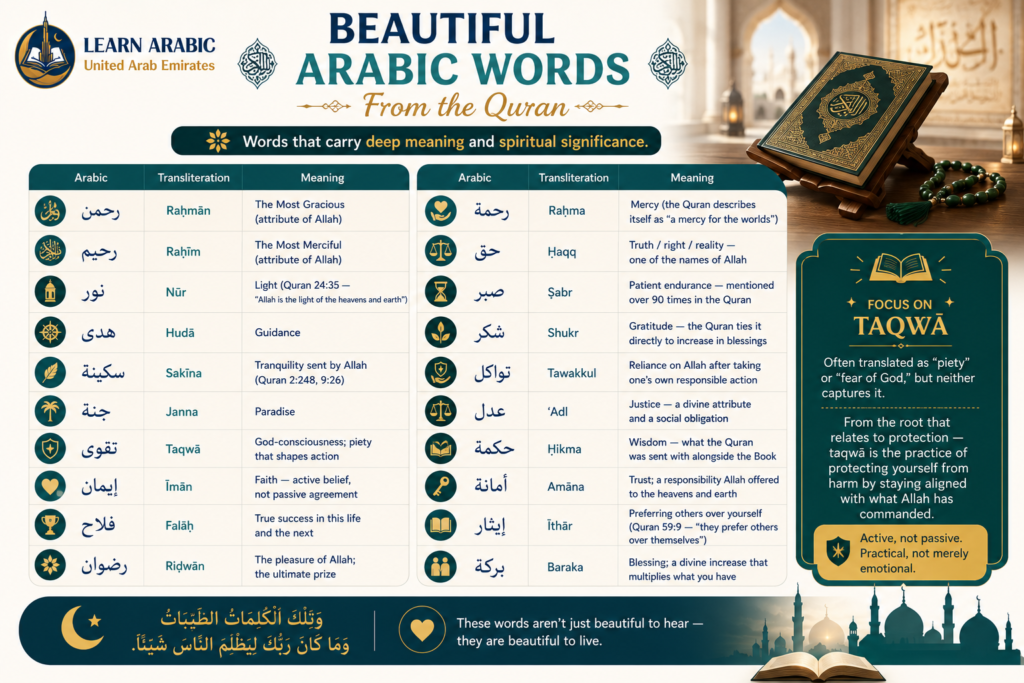
The words below appear in the Quran and carry specific spiritual significance beyond their dictionary definitions.
| Arabic | Transliteration | Meaning |
| رحمن | Raḥmān | The Most Gracious (attribute of Allah) |
| رحيم | Raḥīm | The Most Merciful (attribute of Allah) |
| نور | Nūr | Light (Quran 24:35 — “Allah is the light of the heavens and earth”) |
| هدى | Hudā | Guidance |
| سكينة | Sakīna | Tranquility sent by Allah (Quran 2:248, 9:26) |
| جنة | Janna | Paradise |
| تقوى | Taqwā | God-consciousness; piety that shapes action |
| إيمان | Īmān | Faith — active belief, not passive agreement |
| فلاح | Falāḥ | True success in this life and the next |
| رضوان | Riḍwān | The pleasure of Allah; the ultimate prize |
| رحمة | Raḥma | Mercy (the Quran describes itself as “a mercy for the worlds”) |
| حق | Ḥaqq | Truth / right / reality — one of the names of Allah |
| صبر | Ṣabr | Patient endurance — mentioned over 90 times in the Quran |
| شكر | Shukr | Gratitude — the Quran ties it directly to increase in blessings |
| تواكل | Tawakkul | Reliance on Allah after taking one’s own responsible action |
| عدل | ʿAdl | Justice — a divine attribute and a social obligation |
| حكمة | Ḥikma | Wisdom — what the Quran was sent with alongside the Book |
| أمانة | Amāna | Trust; a responsibility Allah offered to the heavens and earth |
| إيثار | Īthār | Preferring others over yourself (Quran 59:9 — “they prefer others over themselves”) |
| بركة | Baraka | Blessing; a divine increase that multiplies what you have |
Taqwā deserves a closer look. It is routinely translated as “piety” or “fear of God,” but neither captures it. The Arabic root relates to protection — taqwā is the practice of protecting yourself from harm by staying aligned with what Allah has commanded. It is active, not passive; practical, not merely emotional.
Beautiful Arabic Words in English (Transliterated)
Many people encounter beautiful Arabic words in English transliteration first — before they learn the script. This section gives you the phonetic spelling alongside meaning, so you can start using and pronouncing these words right away.
Two pronunciation notes every learner needs early: the letter ح (ḥ) is a breathy H produced deep in the throat — not the light English H. And ع (ʿ) is a voiced constriction with no English equivalent, often described as a “squeezed” sound from the throat. Both letters appear constantly in the most beautiful Arabic words, so training your ear to them early pays off fast.
| Transliteration | Arabic | Meaning |
| Sabr | صبر | Patient endurance |
| Salaam | سلام | Peace / greeting |
| Barakah | بركة | Blessing |
| Habibi / Habibti | حبيبي / حبيبتي | My beloved (m/f) |
| Rahma | رحمة | Mercy, compassion |
| Noor | نور | Light |
| Amal | أمل | Hope |
| Uns | أُنس | Warm, intimate companionship |
| Tuma’ninah | طمأنينة | Deep inner peace, reassurance |
| Wafa | وفاء | Faithfulness, loyalty |
| Hikmah | حكمة | Wisdom |
| Shukran | شكراً | Thank you / gratitude |
| Yaqeen | يقين | Certainty; unwavering conviction |
| Karama | كرامة | Dignity; honor that cannot be taken |
| Rizq | رزق | Provision from Allah; sustenance in all forms |
| Hidayah | هداية | Divine guidance toward the right path |
| Falah | فلاح | True, holistic success |
| Niyyah | نية | Intention (the moral weight behind any action) |
| Haneen | حنين | Bittersweet nostalgia; aching for what was |
| Maktub | مكتوب | It is written; divine destiny |
One word here that consistently surprises non-Arabic speakers is rizq. It doesn’t mean money. It means everything Allah provides — health, children, time, relationships, knowledge, and yes, wealth too. The breadth of that concept is entirely invisible in the English translation “provision.”
Read Also: How to Learn Arabic for Kids in the UAE?
Step Inside Our Classrooms
Don’t just take our word for it—see our community in action. Click below to watch real, live snippets from our recent classes and experience our engaging teaching style firsthand!
Master Arabic in the UAE
Experience world-class Arabic language training designed for students and professionals in the Emirates.
Book Your Free TrialBeautiful Arabic Words With Meaning (Deep & Philosophical)
These are the words that make linguists pause. Arabic has a category of terms — sometimes called untranslatable words — where the English equivalent takes a full sentence to explain what the Arabic says in one.
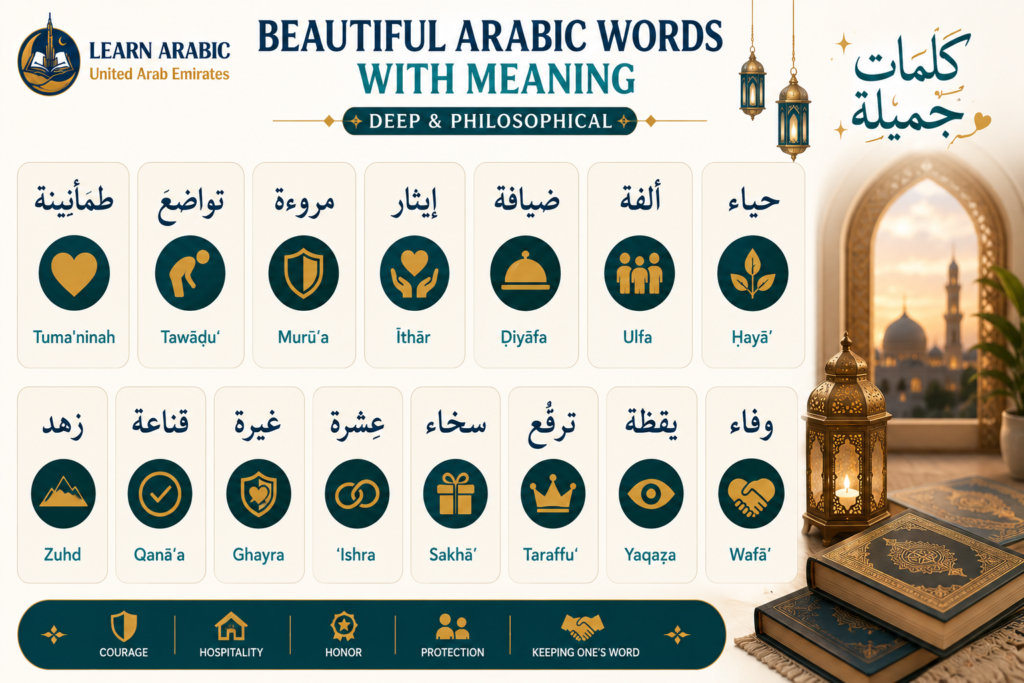
Below are some of the deepest in the language.
| Arabic | Transliteration | What It Actually Means |
| طمأنينة | Tuma’ninah | A deep stillness that settles in the heart — beyond calm, closer to certainty |
| تواضع | Tawāḍuʿ | Humility that comes from knowing your place in a larger order — not self-deprecation |
| مروءة | Murūʾa | Chivalry as an inner code: honor, generosity, and dignity as a way of life |
| إيثار | Īthār | Altruism that costs you something — choosing another’s need over your own comfort |
| ضيافة | Ḍiyāfa | Hospitality as a sacred duty, not social nicety |
| ألفة | Ulfa | The warm familiarity that grows between people who have spent real time together |
| حياء | Ḥayāʾ | Modesty rooted in a sense of dignity — the feeling that stops you before doing something beneath you |
| زهد | Zuhd | Detachment from the world: owning things without being owned by them |
| قناعة | Qanāʿa | Contentment that is a choice — satisfaction with what you have, not resignation |
| غيرة | Ghayra | Protective jealousy; the instinct to guard what you love |
| عِشرة | ʿIshra | The bond that builds through shared time — not love at first sight, but love that accumulates |
| سخاء | Sakhāʾ | Open-handed generosity — giving without calculating what you might get back |
| ترفّع | Taraffuʿ | Carrying yourself with an elevated dignity that rises above pettiness |
| يقظة | Yaqaẓa | Spiritual wakefulness; being fully present and alert in soul, not just body |
| وفاء | Wafāʾ | The faithfulness that keeps promises long after the feeling that made them |
Murūʾa (مروءة) is one of the great words of classical Arabic. Pre-Islamic Arab poetry is built around it. It captures a code of honor that includes courage, hospitality, protection of the weak, and keeping one’s word — a complete moral framework in seven letters.
Read more: Body Parts in Arabic for Kids
100 Beautiful Arabic Words With Meaning (Master List)
The sections above covered themed categories. Here is a consolidated reference of 100 beautiful Arabic words — a single table you can save, share, or return to.
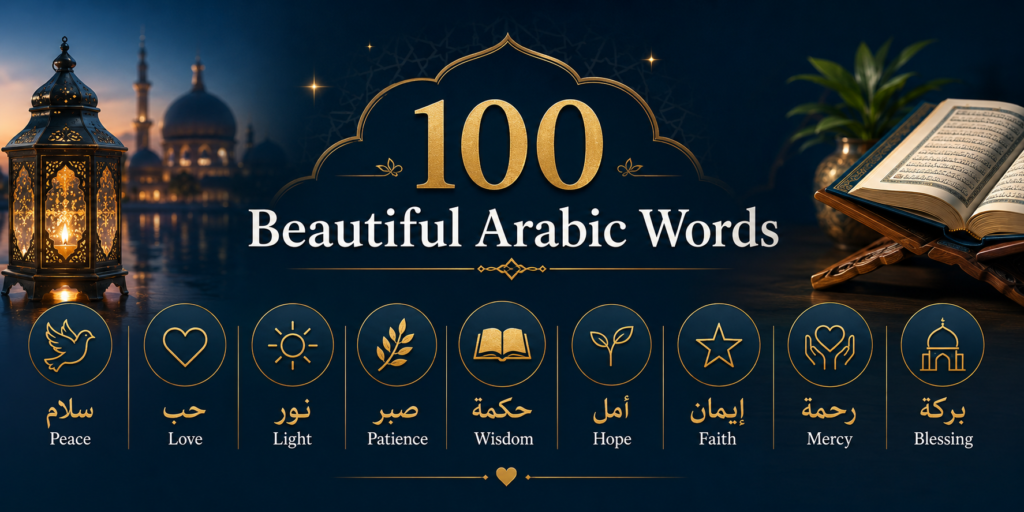
Arabic gives each of these words a sound that matches its meaning in a way linguists call iconicity. Salam (سلام) breathes out softly. ʿAzīma (عزيمة) lands with weight. Read them aloud as you go through this list — the sounds are part of the experience.
| Arabic | Transliteration | Meaning | |
| 1 | سلام | Salām | Peace |
| 2 | حب | Ḥubb | Love |
| 3 | نور | Nūr | Light |
| 4 | صبر | Ṣabr | Patient endurance |
| 5 | أمل | Amal | Hope |
| 6 | جمال | Jamāl | Beauty |
| 7 | حنان | Ḥanān | Tenderness, compassion |
| 8 | شغف | Shaghaf | Passion |
| 9 | سعادة | Saʿāda | Happiness |
| 10 | يقين | Yaqīn | Certainty |
| 11 | وفاء | Wafāʾ | Loyalty |
| 12 | روح | Rūḥ | Soul, spirit |
| 13 | قمر | Qamar | Moon |
| 14 | ذكرى | Dhikra | Memory |
| 15 | أُنس | Uns | Intimate companionship |
| 16 | طمأنينة | Tuma’ninah | Deep inner peace |
| 17 | رحمة | Raḥma | Mercy |
| 18 | حكمة | Ḥikma | Wisdom |
| 19 | بركة | Baraka | Blessing |
| 20 | إيمان | Īmān | Faith |
| 21 | عافية | ʿĀfiya | Well-being, protection from harm |
| 22 | إخلاص | Ikhlāṣ | Sincerity |
| 23 | كرامة | Karāma | Dignity |
| 24 | هناء | Hanāʾ | Happiness, bliss |
| 25 | رضا | Riḍā | Contentment |
| 26 | مودة | Mawadda | Affectionate loving-kindness |
| 27 | حياة | Ḥayāt | Life, vitality |
| 28 | نجاح | Najāḥ | Success |
| 29 | شوق | Shawq | Longing |
| 30 | حنين | Ḥanīn | Nostalgia |
| 31 | سكينة | Sakīna | Tranquility |
| 32 | وئام | Wiʾām | Harmony |
| 33 | إلهام | Ilhām | Inspiration |
| 34 | غفران | Ghufrān | Forgiveness |
| 35 | فجر | Fajr | Dawn |
| 36 | تقوى | Taqwā | God-consciousness |
| 37 | فلاح | Falāḥ | True success |
| 38 | رزق | Rizq | Divine provision |
| 39 | هدى | Hudā | Guidance |
| 40 | أمانة | Amāna | Trust, responsibility |
| 41 | نية | Niyyah | Intention |
| 42 | مكتوب | Maktūb | It is written (destiny) |
| 43 | توكل | Tawakkul | Reliance on God |
| 44 | عدل | ʿAdl | Justice |
| 45 | شكر | Shukr | Gratitude |
| 46 | قدر | Qadar | Divine destiny |
| 47 | تواضع | Tawāḍuʿ | Humility |
| 48 | حياء | Ḥayāʾ | Modesty, dignity |
| 49 | مروءة | Murūʾa | Chivalry, noble honor |
| 50 | إيثار | Īthār | Altruism |
| 51 | ضيافة | Ḍiyāfa | Sacred hospitality |
| 52 | ألفة | Ulfa | Warm familiarity |
| 53 | زهد | Zuhd | Spiritual detachment |
| 54 | قناعة | Qanāʿa | Chosen contentment |
| 55 | سخاء | Sakhāʾ | Open-handed generosity |
| 56 | يقظة | Yaqaẓa | Spiritual wakefulness |
| 57 | عزيمة | ʿAzīma | Determination |
| 58 | ثبات | Thabāt | Steadfastness |
| 59 | صمود | Ṣumūd | Resilience |
| 60 | فخر | Fakhr | Pride (earned) |
| 61 | كرم | Karam | Generosity |
| 62 | شجاعة | Shajāʿa | Courage |
| 63 | نصر | Naṣr | Victory |
| 64 | عظمة | ʿAẓama | Greatness |
| 65 | طموح | Ṭumūḥ | Ambition |
| 66 | ثقة | Thiqa | Confidence |
| 67 | إنجاز | Injāz | Achievement |
| 68 | قيادة | Qiyāda | Leadership |
| 69 | إرادة | Irāda | Willpower |
| 70 | تحمّل | Taḥammul | Endurance |
| 71 | عشق | ʿIshq | Intense passionate love |
| 72 | وِداد | Widād | Devoted affection |
| 73 | غرام | Gharām | Deep romantic infatuation |
| 74 | هيام | Hayām | All-consuming love |
| 75 | وله | Walah | Love mixed with longing |
| 76 | لطيف | Laṭīf | Gentle, kind |
| 77 | مرح | Maraḥ | Cheerfulness, joy |
| 78 | هادئ | Hādiʾ | Calm, serene |
| 79 | مشرق | Mushriq | Radiant, bright |
| 80 | محبوب | Maḥbūb | Beloved, adored |
| 81 | لحظة | Lahẓa | A fleeting moment |
| 82 | حرية | Ḥurriyya | Freedom |
| 83 | صدى | Ṣadā | Echo |
| 84 | شروق | Shurūq | Sunrise |
| 85 | غروب | Ghurūb | Sunset |
| 86 | موج | Mawj | Wave |
| 87 | نفس | Nafas | Breath |
| 88 | خيال | Khayāl | Imagination, fantasy |
| 89 | حلم | Ḥulm | Dream |
| 90 | وقفة | Waqfa | A pause; a moment of stillness |
| 91 | صوت | Ṣawt | Voice |
| 92 | ليل | Layl | Night |
| 93 | نجم | Najm | Star |
| 94 | عِشرة | ʿIshra | Bond built through shared time |
| 95 | غيرة | Ghayra | Protective love/jealousy |
| 96 | ترفّع | Taraffuʿ | Elevated, dignified demeanor |
| 97 | ضمير | Ḍamīr | Conscience |
| 98 | صلاح | Ṣalāḥ | Goodness, moral integrity |
| 99 | هداية | Hidāya | Divine guidance |
| 100 | رحمن | Raḥmān | The Most Gracious |
Read More: How to Learn Arabic in the UAE?
Short Beautiful Arabic Words With Meaning
Some of the most powerful Arabic vocabulary is also the shortest. These one- or two-syllable words carry weight that belies their size — which is part of why they appear so often in poetry, calligraphy, and everyday speech.
The short words below are also among the easiest entry points for beginners.
| Arabic | Transliteration | Meaning |
| نور | Nūr | Light |
| حب | Ḥubb | Love |
| أمل | Amal | Hope |
| روح | Rūḥ | Soul |
| صبر | Ṣabr | Patient endurance |
| بر | Birr | Goodness; kindness to parents |
| حق | Ḥaqq | Truth / reality |
| عز | ʿIzz | Honor, power |
| فجر | Fajr | Dawn |
| ليل | Layl | Night |
| نجم | Najm | Star |
| قمر | Qamar | Moon |
| ذل | Dhull | Humility (the chosen kind) |
| نفس | Nafas | Breath |
| لحظة | Lahẓa | A moment |
| صدى | Ṣadā | Echo |
| موج | Mawj | Wave |
If you’re just starting out, our Arabic course for beginners covers exactly this kind of foundational vocabulary in a structured way.
Join Our Beginner Arabic Classes in the UAE with a FREE Trial
Cute Arabic Words and Terms of Endearment
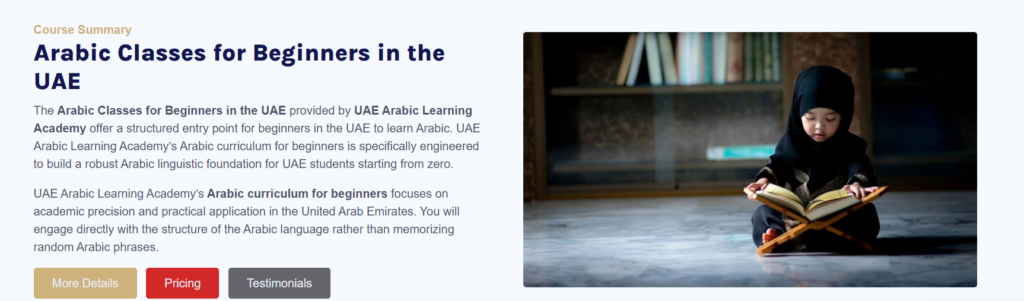
Arabic-speaking cultures use terms of endearment generously — with children, spouses, close friends, and family members. Many of these phrases don’t translate literally; they work because of cultural warmth, not word-for-word logic.
A parent calling their child ya qamar (“oh moon”) is calling them radiant and precious. A spouse saying rūḥī (“my soul”) is saying: without you, I am incomplete.
| Arabic | Transliteration | Who It’s Used For |
| حبيبي / حبيبتي | Ḥabībī / Ḥabībatī | My beloved — anyone you love |
| روحي | Rūḥī | My soul — deepest endearment |
| قلبي | Qalbī | My heart |
| عمري | ʿUmrī | My life/age — very intimate |
| حياتي | Ḥayātī | My life |
| نور عيني | Nūr ʿAynī | Light of my eyes |
| غالي / غالية | Ghālī / Ghāliya | My precious one (m/f) |
These phrases are part of daily Arabic conversation — and learning them is one of the fastest ways to sound natural rather than textbook. Our Arabic conversation course for kids covers this kind of warm, real-world language in a structured way designed for young learners.
Enroll Your Child in Our Arabic Conversation Classes with a FREE Trial
See Our Classroom Environment in Action
Experience a sneak peek into our live sessions. Watch the video below to see our specialized instructors interacting with students, breakdown complex texts, and cultivate an engaging, respectful learning environment.
Master Arabic in the UAE
Experience world-class Arabic language training designed for students and professionals in the Emirates.
Book Your Free TrialBegin Learning Arabic With Expert Instruction in the UAE
Beautiful Arabic words are your entry point into real Arabic communication — and the right instruction from the start prevents the pronunciation and script errors that become harder to correct later.
Learn Arabic UAE connects students across the UAE with expert native Arab tutors for structured, 1-on-1 online sessions:
- Expert native Arab Azhari tutors — authentic MSA and Gulf Arabic instruction
- Flexible online scheduling — fits UAE family and professional schedules
- Age-appropriate programs from young children to adult professionals
- UAE-specific curriculum — vocabulary grounded in Gulf Arabic daily life
- Structured progression from absolute beginner to advanced
- Free trial session available
Book your free trial with Learn Arabic UAE and begin building real Arabic fluency from the foundation up.

Our Arabic courses
- Arabic Course in the UAE
- Arabic Intensive Course
- Arabic Classes for Beginners (Learn Arabic from Scratch)
- Madinah Arabic Course
- Arabic Classes for Adults
- Self-Paced Arabic Course
- Arabic Speaking Classes
- Learn to Write Arabic Course
- Arabic Grammar Course
- Learn Arabic Alphabet Course
- Modern Standard Arabic (MSA) Course
- Quranic Arabic Course
- Fusha Arabic Course
- Classical Arabic Course
- Emirati Arabic Course
- Gulf Arabic Course
- Learn Saudi Arabic
- Business Arabic Course UAE
- Arabic Language Classes for Professionals in UAE
Master Arabic in the UAE
Experience world-class Arabic language training designed for students and professionals in the Emirates.
Book Your Free TrialConclusion
The Arabic language holds a vocabulary that other languages simply don’t have the architecture to replicate. Words like tuma’ninah (طمأنينة) — deep inner peace — or murūʾa (مروءة) — a chivalric code of honor as a way of life — require a full paragraph to explain in English, yet flow naturally in a single Arabic word.
The 100 beautiful Arabic words in this guide are a starting point, not a ceiling. Each word here opens onto a family of related terms built from the same three-letter root — which means learning one word is really learning many. That’s the architecture of the language, and once you understand it, Arabic stops feeling foreign and starts feeling inevitable.
Frequently Asked Questions
The questions below address what most learners search for after encountering Arabic vocabulary for the first time — from the most admired single words to practical advice on building fluency.
What is the most beautiful word in Arabic?
Many speakers and scholars point to سكينة (Sakīna) — tranquility — as among the most beautiful in Arabic. It appears in the Quran to describe a peace sent directly from Allah, and its sound mirrors its meaning: soft, settling, and still.
What are beautiful Arabic words for love?
Arabic has many words for love, not one. Ḥubb (حب) is the general term. ʿIshq (عشق) is passionate, consuming love. Mawadda (مودة) is loving-kindness between people in a close bond. Shawq (شوق) is the aching longing for someone you love. Each describes a different texture of the same emotion.
What are short beautiful Arabic words with meaning?
Among the most beloved short words: nūr (نور) — light; ṣabr (صبر) — patient endurance; amal (أمل) — hope; rūḥ (روح) — soul; and ḥaqq (حق) — truth. Each is one or two syllables and carries a meaning far larger than its size.
What beautiful Arabic words appear in the Quran?
The Quran contains many of the most resonant Arabic words: sakīna (سكينة, tranquility sent by Allah), taqwā (تقوى, God-consciousness), raḥmān (رحمن, The Most Gracious), falāḥ (فلاح, true success), and baraka (بركة, divine blessing) are among the most frequently cited.
What are unique Arabic words with no English translation?
Several Arabic words resist direct translation: murūʾa (مروءة) — a complete code of honor and chivalry; ʿishra (عِشرة) — the bond built through time together; īthār (إيثار) — choosing another’s need over your own; and tuma’ninah (طمأنينة) — a deep, settled certainty of peace in the heart.
How can I learn Arabic vocabulary faster?
The most effective approach is root-based learning: Arabic words are built from three-letter roots, so learning one root unlocks an entire word family. Combining this with themed vocabulary groups (emotions, spiritual terms, nature) and regular exposure to spoken Arabic — through media, conversation, or structured classes — builds retention faster than memorizing isolated words.


Leave a Reply