 Learn Arabic
Meeting someone new is already a little nerve-wracking. Doing it in a language you’re still learning makes it feel even harder. But introducing yourself in Arabic is genuinely one of the most rewarding first steps you can take — and it’s more manageable than you think.
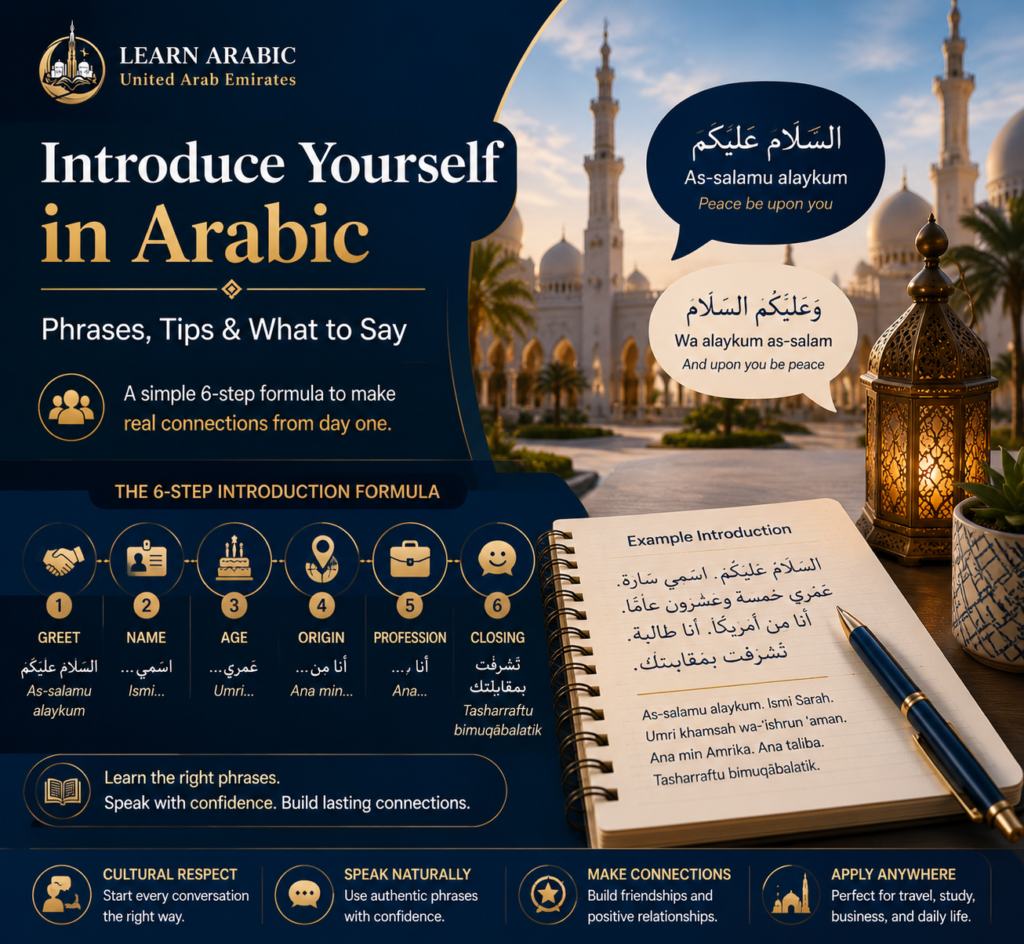
Arabic self-introductions follow a six-step sequence that works across every Arabic-speaking country: greet, share your name, state your age, say where you’re from, mention your profession, and close politely. Master this structure once, and you can hold real conversations from day one — whether you’re at a mosque, a business meeting, or a casual social gathering.
The Six-Step Arabic Introduction at a Glance
Before diving into each step, here is the complete formula so you can see the full picture:
| Step | Arabic Phrase | Transliteration | English |
| 1. Greeting | السلام عليكم | As-salamu alaykum | Peace be upon you |
| 2. Name | اسمي… | Ismi… | My name is… |
| 3. Age | عمري… عامًا | Umri… ʿaman | I am… years old |
| 4. Origin | أنا من… | Ana min… | I am from… |
| 5. Profession | أنا… | Ana… | I am a… |
| 6. Closing | تشرفت بمقابلتك | Tasharraftu bimuqābalatik | Nice to meet you |
Complete example: السلام عليكم.
اسمي سارة.
عمري خمسة وعشرون عامًا.
أنا من أمريكا.
أنا طالبة.
تشرفت بمقابلتك. (As-salamu alaykum. Ismi Sarah. Umri khamsah wa-ʿishrun ʿaman. Ana min Amrika. Ana taliba. Tasharraftu bimuqābalatik.)
1. The Right Greeting — السلام عليكم
How you greet someone sets the tone for the entire conversation. A proper greeting signals respect, warmth, and cultural awareness before you say anything else.
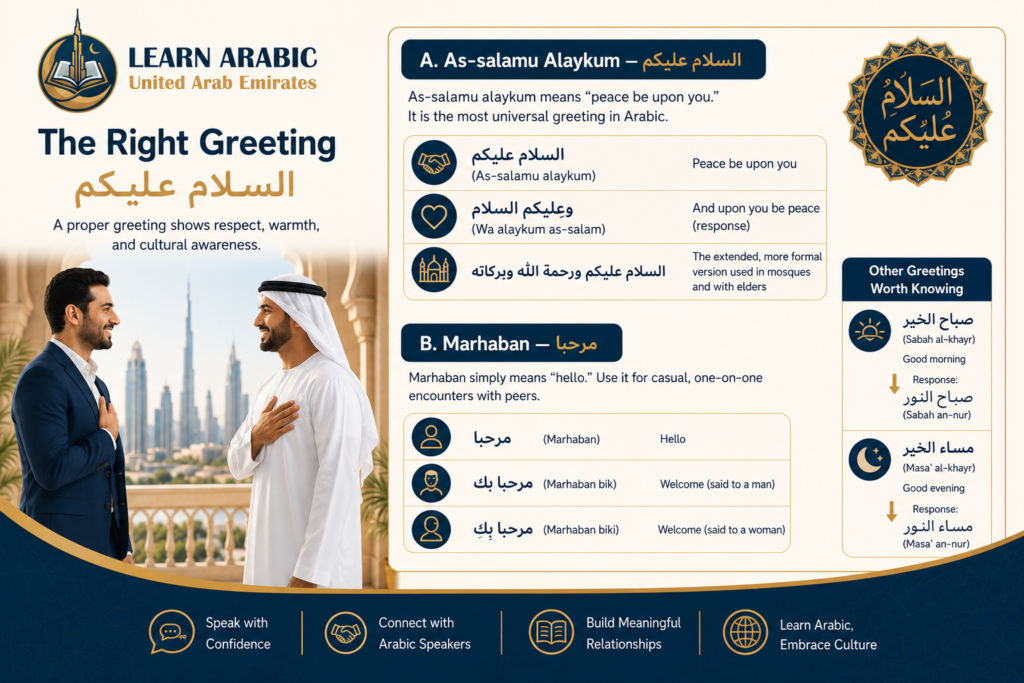
A. As-salamu Alaykum — السلام عليكم
As-salamu alaykum is the most universal Arabic greeting. It means “peace be upon you” and is recognized by Muslims and Arab communities worldwide — used in formal meetings, casual encounters, mosques, offices, and everywhere in between.
When someone greets you with As-salamu alaykum, the correct response is Wa alaykum as-salam (وعليكم السلام). The response is not optional — repeating the same greeting back instead of replying with wa alaykum is one of the most common beginner mistakes, and native speakers notice it immediately.
Examples:
- السلام عليكم (As-salamu alaykum) — Peace be upon you
- وعليكم السلام (Wa alaykum as-salam) — And upon you be peace (response)
- السلام عليكم ورحمة الله وبركاته — The extended, more formal version used in mosques and with elders
B. Marhaban — مرحبا
Marhaban simply means “hello.” It’s the right choice for casual, one-on-one encounters with peers. For groups, formal settings, or any situation where you’re unsure, As-salamu alaykum is always the safer and more respectful option.
Examples:
- مرحبا (Marhaban) — Hello
- مرحبا بك (Marhaban bik) — Welcome (said to a man)
- مرحبا بكِ (Marhaban biki) — Welcome (said to a woman)
Other greetings worth knowing:
- صباح الخير (Sabah al-khayr) — Good morning → Response: صباح النور (Sabah an-nur)
- مساء الخير (Masa’ al-khayr) — Good evening → Response: مساء النور (Masa’ an-nur)
If you want to build on these with proper pronunciation and formal conversation structure, Fusha Arabic Classes takes you from greetings to full dialogue.
Join Our Fusha Arabic Classes in the UAE with a FREE Trial
2. Sharing Your Name in Arabic — اسمي
After your greeting, your name creates the personal connection. Arabic has two clean ways to introduce yourself, each with a slightly different feel.
A. Ismi — اسمي
Ismi means “my name is.” It is the standard, universally appropriate formula — it works in formal presentations, first meetings, and casual conversations alike.
Examples:
- اسمي خالد (Ismi Khalid) — My name is Khalid
- اسمي فاطمة (Ismi Fatima) — My name is Fatima
- اسمي جون (Ismi John) — My name is John
B. Ana — أنا
Ana means “I am.” It’s slightly more casual and natural in fast conversation, similar to saying “I’m Sarah” instead of “My name is Sarah” in English.
Examples:
- أنا خالد (Ana Khalid) — I am Khalid
- أنا فاطمة (Ana Fatima) — I am Fatima
- أنا جون (Ana John) — I am John
One important note: avoid combining the two. أنا اسمي خالد (Ana ismi Khalid) is redundant — it literally says “I my-name Khalid.” Choose one structure and stick with it.
To ask someone else’s name, the question changes based on their gender:
- To a male: ما اسمكَ؟ (Ma ismuka?) — What is your name?
- To a female: ما اسمكِ؟ (Ma ismuki?) — What is your name?
The gender distinction in ismuka vs. ismuki reflects Arabic’s gendered grammatical system, which applies to nouns, adjectives, and verb forms throughout the language. Our Classical Arabic course builds this grammar foundation properly if you want to understand the system from its roots.
Build a Strong Foundation in Classical Arabic with a FREE Trial Class

Read more: The Best Way to Learn Arabic Vocabulary
3. Saying Your Age in Arabic — عمري
The age formula in Arabic is straightforward: Umri + number + ʿaman (عامًا). Never drop the word ʿaman — without it, the sentence is grammatically incomplete, and native speakers will notice.
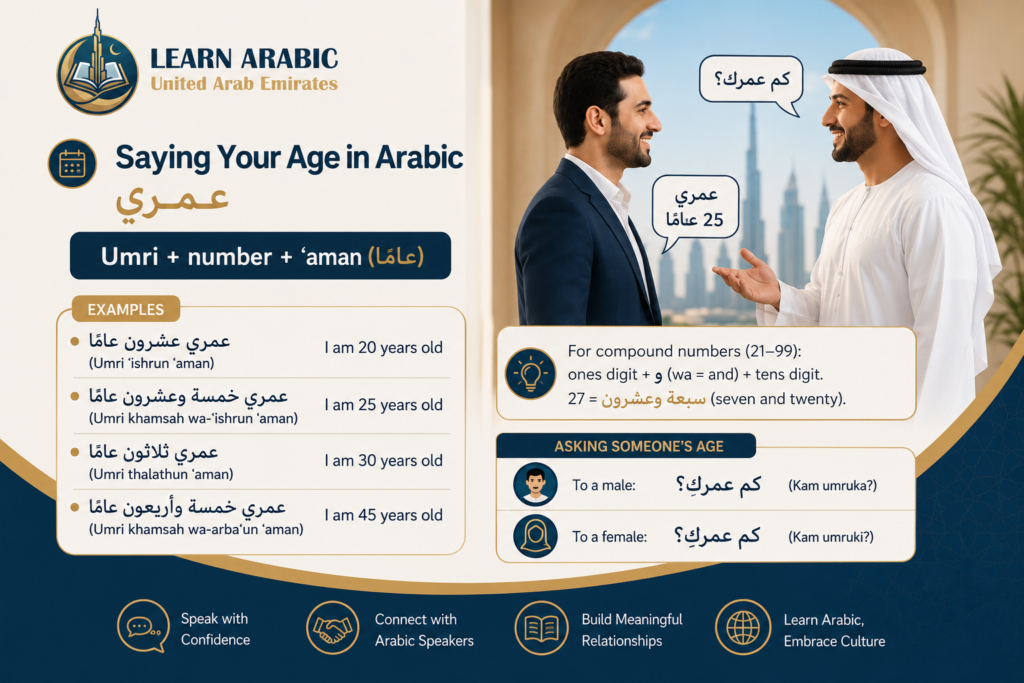
Examples:
- عمري عشرون عامًا (Umri ʿishrun ʿaman) — I am 20 years old
- عمري خمسة وعشرون عامًا (Umri khamsah wa-ʿishrun ʿaman) — I am 25 years old
- عمري ثلاثون عامًا (Umri thalathun ʿaman) — I am 30 years old
- عمري خمسة وأربعون عامًا (Umri khamsah wa-arbaʿun ʿaman) — I am 45 years old
The pattern for compound numbers (21–99) is: ones digit + و (wa = and) + tens digit. So 27 is سبعة وعشرون — “seven and twenty.”
To ask someone’s age, again adjust for gender:
- To a male: كم عمركَ؟ (Kam umruka?)
- To a female: كم عمركِ؟ (Kam umruki?)
Read Also: Learn Quranic Vocabulary
Step Inside Our Classrooms
Don’t just take our word for it—see our community in action. Click below to watch real, live snippets from our recent classes and experience our engaging teaching style firsthand!
Master Arabic in the UAE
Experience world-class Arabic language training designed for students and professionals in the Emirates.
Book Your Free Trial4. Saying Where You’re From — أنا من
The question for origin is Min ayyi baladin ant? (من أي بلد أنت؟) — “Where are you from?” Your answer uses Ana min (أنا من) followed by your country or city.
Examples:
- أنا من أمريكا (Ana min Amrika) — I am from America
- أنا من بريطانيا (Ana min Britanya) — I am from Britain
- أنا من الإمارات (Ana min Al-Imarat) — I am from the UAE
- أنا من مصر (Ana min Misr) — I am from Egypt
One detail that catches many learners off guard: about half of all Arabic country names carry a definite article (al-). Japan is Al-Yaban (اليابان) and Greece is Al-Yunan (اليونان). Native speakers notice when the article is missing, so it’s worth learning which countries require it from the beginning.
5. Talking About Your Profession
To share your profession, say Ana (أنا) followed directly by your job title. Arabic job titles change form based on the speaker’s gender — this is one of the most common errors beginners make and one of the most important to get right.
Male form:
- أنا مهندس (Ana muhandis) — I am an engineer
- أنا معلم (Ana muʿallim) — I am a teacher
- أنا طالب (Ana talib) — I am a student
Female form:
- أنا مهندسة (Ana muhandisa) — I am an engineer
- أنا معلمة (Ana muʿallima) — I am a teacher
- أنا طالبة (Ana taliba) — I am a student
If you prefer to describe your field rather than your title, use Aʿmal fi majal (أعمل في مجال) — “I work in the field of”:
- أعمل في مجال الطب (Aʿmal fi majal al-tibb) — I work in the field of medicine
- أعمل في مجال التعليم (Aʿmal fi majal al-taʿleem) — I work in the field of education
For learners living or working in the UAE, knowing how to discuss professions in the local dialect is just as important as Modern Standard Arabic. Our Emirati Arabic course covers the everyday professional and social Arabic you’ll actually need on the ground.
Begin Your Emirati Arabic Learning Journey with a FREE Trial Class
6. Talking About Your Hobbies — هوايتي
Once name, origin, and profession are covered, conversations naturally shift to personal interests. The question is Ma hi hiwayatika? (ما هي هواياتك؟) — “What are your hobbies?”
The pattern Ana uhibbu (أنا أحب) + activity means “I like/love” something. Once you have that structure, you can plug in almost any hobby.
Examples:
- أنا أحب القراءة (Ana uhibbu al-qiraʾah) — I love reading
- أستمتع بسماع الموسيقى (Astamtiʿu bisamaʿi al-musiqa) — I enjoy listening to music
- هوايتي قراءة الكتب (Hiwayati qiraʾat al-kutub) — My hobby is reading books
- أنا أحب الرسم (Ana uhibbu al-rasm) — I like drawing
You can also share a personal goal to deepen the conversation:
- هدفي أن أتعلم اللغة العربية (Hadafi an ataʿallam al-lugha al-ʿArabiyya) — My goal is to learn the Arabic language
Read More: Learn Arabic Phrases
7. Closing the Conversation Politely
Ending without a closing phrase feels abrupt to Arabic speakers. The closing signals “your turn to speak” and leaves a strong final impression.

Tasharraftu Bimuqābalatik — تشرفت بمقابلتك
This phrase means “nice to meet you” or more literally “I was honored to meet you.” It is the standard formal closing for any introduction.
Examples:
- تشرفت بمقابلتك (Tasharraftu bimuqābalatika) — Nice to meet you (to a man)
- تشرفت بمقابلتكِ (Tasharraftu bimuqābalatiki) — Nice to meet you (to a woman)
- تشرفت بمعرفتك (Tasharraftu bimaʿrifatik) — Honored to know you (slightly warmer alternative)
If this phrase feels too long at first, use the simpler:
- فرصة سعيدة (Fursa saʿida) — Happy opportunity to meet you
- تشرفنا (Tasharrafna) — It was an honor (used by either party)
Complete Self-Introduction Examples
Formal — Female speaker: السلام عليكم.
اسمي سارة جونسون.
عمري خمسة وعشرون عامًا.
أنا من أمريكا.
أنا طالبة في الجامعة.
تشرفت بمقابلتك. (As-salamu alaykum. Ismi Sarah Johnson. Umri khamsah wa-ʿishrun ʿaman. Ana min Amrika. Ana taliba fi al-jamiʿa. Tasharraftu bimuqābalatik.) Peace be upon you. My name is Sarah Johnson. I am 25 years old. I am from America. I am a university student. Nice to meet you.
Formal — Male speaker: السلام عليكم.
اسمي جون سميث.
عمري ثلاثون عامًا.
أنا من بريطانيا.
أنا مهندس.
تشرفت بمقابلتك. (As-salamu alaykum. Ismi John Smith. Umri thalathun ʿaman. Ana min Britanya. Ana muhandis. Tasharraftu bimuqābalatik.) Peace be upon you. My name is John Smith. I am 30 years old. I am from Britain. I am an engineer. Nice to meet you.
See Our Classroom Environment in Action
Experience a sneak peek into our live sessions. Watch the video below to see our specialized instructors interacting with students, breakdown complex texts, and cultivate an engaging, respectful learning environment.
Master Arabic in the UAE
Experience world-class Arabic language training designed for students and professionals in the Emirates.
Book Your Free TrialRead more: Muslim Greeting in Arabic
Start Speaking Arabic with Confidence at Learn Arabic UAE
These six steps give you a complete, memorizable introduction you can use tomorrow. But to use them naturally — with correct pronunciation, proper gender agreement, and real conversational flow — you need structured practice with expert guidance.
At Learn Arabic UAE, we offer specialized courses designed for non-native speakers at every level. Whether you want to master Modern Standard Arabic, connect with Emirati culture through the local dialect, or build a classical Arabic foundation, we have a course built for your goals.
Our Arabic courses
- Arabic Course in the UAE
- Arabic Intensive Course
- Arabic Classes for Beginners (Learn Arabic from Scratch)
- Madinah Arabic Course
- Arabic Classes for Adults
- Self-Paced Arabic Course
- Arabic Speaking Classes
- Learn to Write Arabic Course
- Arabic Grammar Course
- Learn Arabic Alphabet Course
- Modern Standard Arabic (MSA) Course
- Quranic Arabic Course
- Fusha Arabic Course
- Classical Arabic Course
- Emirati Arabic Course
- Gulf Arabic Course
- Learn Saudi Arabic
- Business Arabic Course UAE
- Arabic Language Classes for Professionals in UAE
Master Arabic in the UAE
Experience world-class Arabic language training designed for students and professionals in the Emirates.
Book Your Free TrialConclusion
Introducing yourself in Arabic follows a clear, repeatable six-step sequence: greet with As-salamu alaykum, share your name with ismi, state your age with umri, say where you’re from with ana min, describe your profession, and close warmly with tasharraftu bimuqābalatik.
What separates learners who progress quickly from those who stay stuck is treating this introduction as one complete unit to memorize — not six isolated phrases. Practice the full sequence until it flows without thinking, and you’ll find that real Arabic conversations open up far sooner than you expected.
Frequently Asked Questions
Before you start practicing Arabic introductions, it’s helpful to understand a few common expressions and grammar patterns. These frequently asked questions answer the most common doubts about greetings, self-introductions, and basic conversational Arabic.
What Is the Difference Between Formal and Informal Arabic Introductions?
Formal introductions use As-salamu alaykum and complete sentences like Ismi Khalid. Use them in business meetings, with elders, at mosques, or in any first encounter. Informal introductions use Marhaban or Ahlan and shorter structures like Ana Khalid. When in doubt, start formal — Arabs appreciate the respect and will invite casualness if appropriate.
What Is the Correct Way to Respond to As-salamu Alaykum?
The correct response to As-salamu alaykum is Wa alaykum as-salam (وعليكم السلام), meaning “and upon you be peace.” Never repeat the same greeting back — the wa (“and”) prefix is grammatically required in the response and signals that you understand the exchange, not just the phrase.
How Does Gender Agreement Affect Arabic Introductions?
Arabic changes word endings based on the speaker’s gender and the gender of the person being addressed. Your job title changes based on your own gender: talib (طالب) for a male student, taliba (طالبة) for a female. Questions change based on who you’re asking: Ma ismuka (ما اسمكَ؟) for a male, Ma ismuki (ما اسمكِ؟) for a female. Learning these pairs from the start saves significant correction work later.
Do These Arabic Introduction Phrases Work in All Arabic-Speaking Countries?
Yes. The phrases in this guide use Modern Standard Arabic (MSA), understood across all 22 Arabic-speaking countries. Regional dialects vary — Egyptians may say Izzayak (إزيك) for “how are you,” and Levantine speakers use Kifak (كيفك) — but MSA is always appropriate in formal contexts and respected everywhere. When unsure of someone’s dialect, MSA is the safest choice.
What Should I Do If I Forget Part of My Arabic Introduction?
The greeting and your name are the only two non-negotiable elements. Everything else — age, origin, profession, hobbies — can be added or skipped based on context. A minimal introduction of As-salamu alaykum. Ismi Ahmed. followed by a closing phrase is complete, polite, and perfectly natural for quick encounters.
How Can I Keep the Conversation Going After an Arabic Introduction?
After introducing yourself, ask the other person a follow-up question using the same structures in reverse: Min ayna anta? (من أين أنت؟) — “Where are you from?” or Ma ʿamaluk? (ما عملك؟) — “What do you do?” This shows genuine interest and moves the exchange from a rehearsed introduction into a real conversation.


Leave a Reply