 Learn Arabic
You’re at a hospital in Dubai, Abu Dhabi, or Riyadh. The receptionist is asking you something in Arabic. Your chest tightens — and not from your symptoms. You recognize about three words.
That gap between what you know and what you need is dangerous in a medical setting. Hospital vocabulary in Arabic is not a nice-to-have for learners living or traveling across the Arab world — it is the vocabulary that could determine whether you get the right treatment, communicate your pain clearly, or navigate a system designed primarily for Arabic speakers.
This guide gives you everything you need: the core hospital words and staff roles, how to describe your symptoms and pain, the key medical verbs, phrases that actually work in UAE and Gulf hospitals, and the common mistakes that mark you as unprepared. Every word comes with transliteration so you can use it immediately, even if your Arabic reading is still developing.
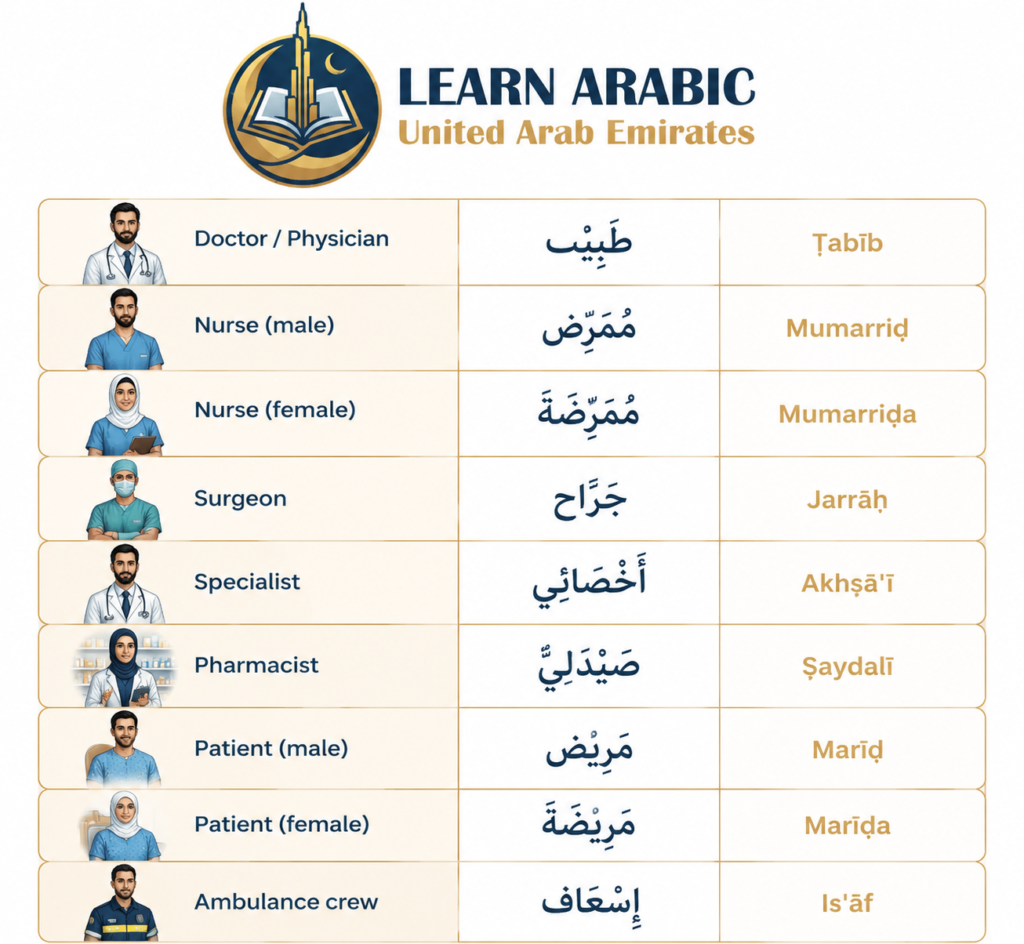
Medical Staff Vocabulary in Arabic
The people you encounter at any hospital follow a consistent vocabulary across the Arab world. A useful distinction to know before you walk in: طبيب (Ṭabīb) is the formal MSA term for doctor — the one you’ll see on signage and written reports — while دكتور (Doktoor) is what staff use in everyday spoken conversation across the Gulf. Both are understood everywhere, but knowing which register you’re hearing helps you follow the conversation.
Hospital Departments and Places in Arabic
Navigating a hospital means reading signage fast — often under stress. The table below covers every department you are likely to encounter, from the moment you enter the building to the pharmacy on your way out. Learn these as a set, not individually, so the full map of the building exists in your head before you need it.
| Place | Arabic | Transliteration |
| Hospital | مُسْتَشْفَى | Mustashfā |
| Emergency Room | طَوَارِئ | Ṭawāri’ |
| Clinic / Outpatient | عِيَادَة | ‘Iyādah |
| Pharmacy | صَيْدَلِيَّة | Ṣaydalīyah |
| Operating Room | غُرْفَة عَمَلِيَّات | Ghurfat ‘amaliyyāt |
| ICU | عِنَايَة مُرَكَّزَة | ‘Ināyah murakkazah |
| X-Ray | أَشِعَّة | Ashi”ah |
| Laboratory | مُخْتَبَر | Mukhtabar |
| Reception / Appointment | مَوْعِد | Maw’id |
Medical Equipment and Documents in Arabic
Beyond rooms and staff, there is a third category that catches learners off guard: the objects and documents that move with you through the visit. A nurse asking for your وَصْفَة طِبِّيَّة or telling you a حُقْنَة is coming should not be a surprise. These are the terms that appear in almost every hospital encounter.
| Item | Arabic | Transliteration |
| Prescription | وَصْفَة طِبِّيَّة | Waṣfa ṭibbīyah |
| Injection / Shot | حُقْنَة | Ḥuqnah |
| Blood test | فَحْص الدَّم | Faḥṣ ad-dam |
| Wheelchair | كُرْسِي مُتَحَرِّك | Kursī mutaḥarrik |
| Insurance | تَأْمِين | Ta’mīn |
| Stethoscope | سَمَّاعَة | Sammā’ah |
| Thermometer | مِقْيَاس الحَرَارَة | Miqyās al-ḥarāra |
| Bandage | ضِمَاد | Ḍimād |
| Ointment | مَرْهَم | Marham |
| Vaccine | لُقَاح | Luqāḥ |
How to Describe Symptoms in Arabic?
Describing what hurts — and where — is the most critical skill in a medical encounter. Arabic gives you two reliable sentence structures to communicate symptoms clearly. The first: عِنْدِي (‘Indī — “I have”) + the symptom name. The second: أَشْعُرُ بـ (Ash’uru bi — “I feel”) + the symptom. Together, these two frames cover the vast majority of what a doctor needs to hear from you.
| Symptom | Arabic Term | Transliteration | Full Phrase |
| Headache | صُدَاع | Ṣudā’ | عِنْدِي صُدَاع شَدِيد — I have a severe headache |
| Fever | حُمَّى | Ḥummā | عِنْدِي حُمَّى — I have a fever |
| Nausea | غَثَيَان | Ghayathān | أَشْعُرُ بِالغَثَيَان — I feel nauseous |
| Dizziness | دُوَار | Duwār | أَشْعُرُ بِدُوَار — I feel dizzy |
| Sore throat | اِلْتِهَاب فِي الحَلْق | Iltihāb fil-ḥalq | عِنْدِي اِلْتِهَاب فِي الحَلْق — I have a sore throat |
| Allergy | حَسَّاسِيَة | Ḥasāsīyah | عِنْدِي حَسَّاسِيَة مِن — I have an allergy to… |
| Bleeding | نَزِيف | Nazīf | هُنَاكَ نَزِيف — There is bleeding |
| Cough | كُحَّة | Kuḥḥah | عِنْدِي كُحَّة — I have a cough |
| Asthma | رَبْو | Rabw | أُعَانِي مِنَ الرَّبْو — I suffer from asthma |
| Indigestion | عُسْر هَضْم | ‘Usr haḍm | عِنْدِي عُسْر هَضْم — I have indigestion |
If you are living in the Gulf and want to communicate naturally with local staff, developing your Gulf Arabic alongside MSA gives you a real practical advantage — something a targeted Gulf Arabic course is built to deliver.
Begin Your Gulf Arabic Learning Journey with a FREE Trial Class

Body Parts in Arabic
The phrase يُؤْلِمُنِي (Yu’limunī — “It hurts me”) is your most direct tool for pointing to pain. Pair it with any body part from the table below and the doctor immediately knows where to focus. This is the structure hospital staff expect — and respond to fastest.
| Body Part | Arabic | Transliteration |
| Head | رَأْس | Ra’s |
| Chest | صَدْر | Ṣadr |
| Stomach | بَطْن / مَعِدَة | Baṭn / Ma’idah |
| Back | ظَهْر | Ẓahr |
| Heart | قَلْب | Qalb |
| Lungs | رِئَة | Ri’ah |
| Kidney | كُلَى | Kulā |
| Shoulder | كَتِف | Katif |
| Knee | رُكْبَة | Rukbah |
| Ankle | كَاحِل | Kāḥil |
| Arm | ذِرَاع | Dhirā’ |
| Bone | عَظْم | ‘Aẓm |
| Skin | جِلْد | Jild |
| Neck | رَقَبَة | Raqabah |
Example in use: يُؤْلِمُنِي ظَهْرِي (Yu’limunī ẓahrī) — My back hurts.
Step Inside Our Classrooms
Don’t just take our word for it—see our community in action. Click below to watch real, live snippets from our recent classes and experience our engaging teaching style firsthand!
Master Arabic in the UAE
Experience world-class Arabic language training designed for students and professionals in the Emirates.
Book Your Free TrialDescribing Pain Intensity in Arabic
Arabic maps cleanly onto the 0–10 pain scale used in UAE and Gulf hospitals, but you can also describe intensity verbally.
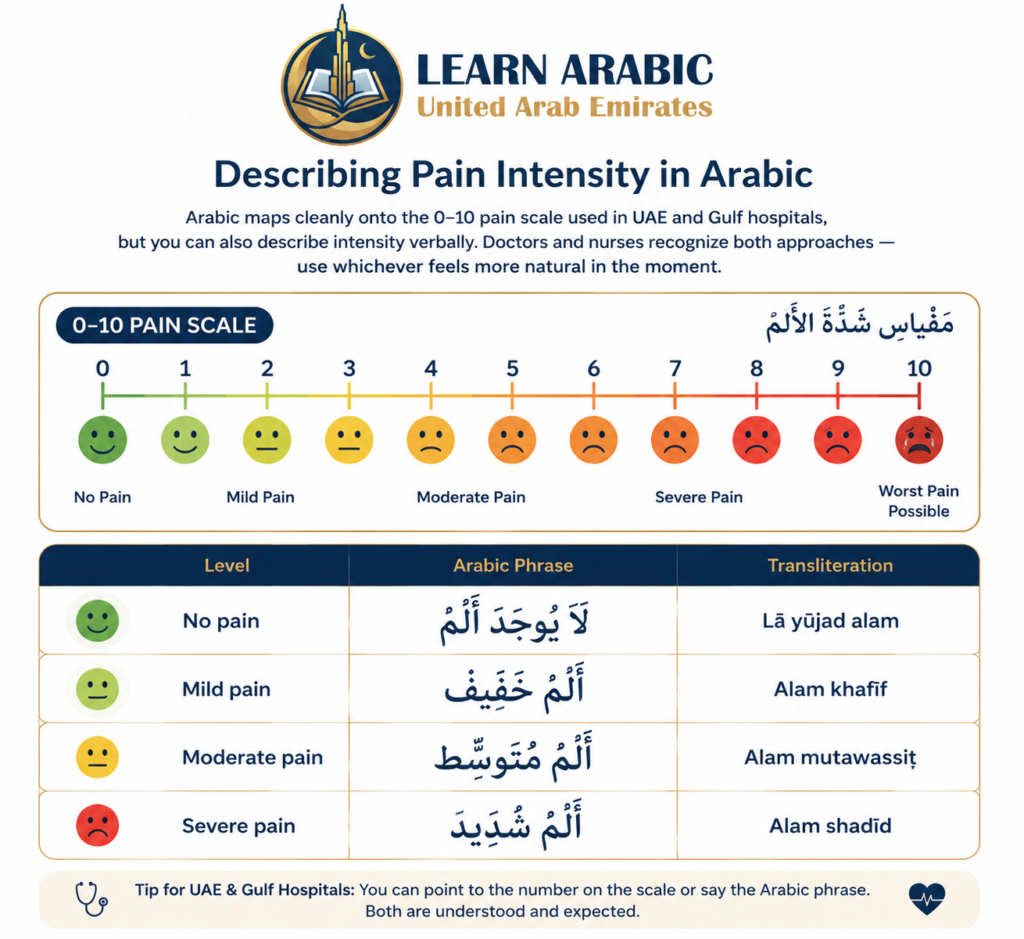
Doctors and nurses recognize both approaches — use whichever feels more natural in the moment.
| Level | Arabic Phrase | Transliteration |
| No pain | لَا يُوجَد أَلَم | Lā yūjad alam |
| Mild pain | أَلَم خَفِيف | Alam khafīf |
| Moderate pain | أَلَم مُتَوَسِّط | Alam mutawassiṭ |
| Severe pain | أَلَم شَدِيد | Alam shadīd |
Emergency Phrases in Arabic
In an emergency, speed and clarity are everything. The four phrases below cover the situations most likely to arise in a sudden medical event — a collapse, an accident, or a crisis in a public space. Know them before you need them, not when you need them.
| Arabic Phrase | Transliteration | Meaning |
| مُسَاعَدَة! | Musā’adah! | Help! |
| اُطْلُبُوا الإِسْعَاف! | Uṭlubū al-is’āf! | Call an ambulance! |
| أَيْنَ أَقْرَب مُسْتَشْفَى؟ | Ayna aqrab mustashfā? | Where is the nearest hospital? |
| إِنَّهَا حَالَةُ طَوَارِئ | Innahā ḥālat ṭawāri’ | It is an emergency. |
In UAE hospitals, emergency department staff are accustomed to multilingual patients and many doctors speak English. However, nurses and administrative staff — particularly in public hospitals in Abu Dhabi and Dubai — often work primarily in Arabic. Having these phrases automatic closes that gap immediately.
For learners preparing specifically for life in Saudi Arabia, where hospital environments are almost entirely Arabic-speaking outside major international facilities, a dedicated Saudi Arabic course for medical situations is worth building early.
Start Learning Saudi Arabic with a FREE Trial Class
Key Medical Verbs in Arabic
Most vocabulary guides give you nouns and stop there. The verbs are what let you follow and participate in an actual conversation with a doctor or nurse. Understanding “the doctor will examine you now” requires knowing يَفْحَصُ (yafḥaṣu — to examine), not just the word for doctor.
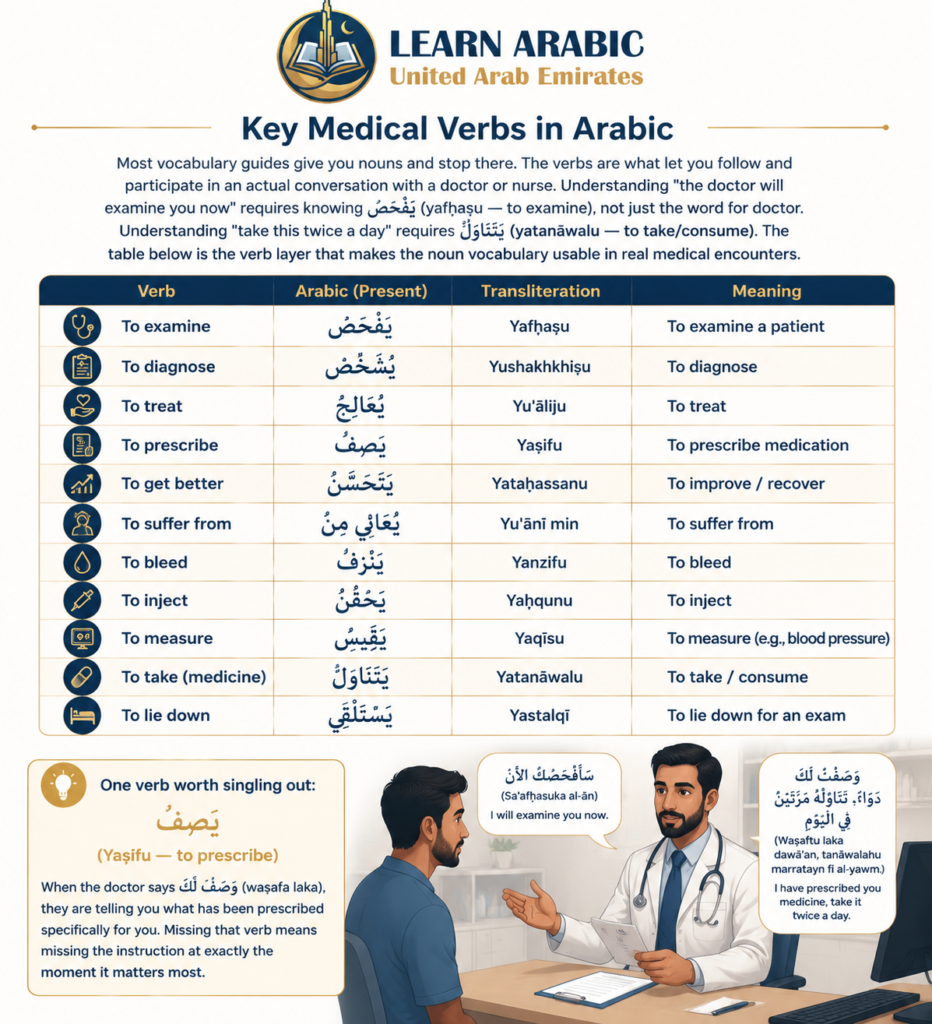
Understanding “take this twice a day” requires يَتَنَاوَلُ (yatanāwalu — to take/consume). The table below is the verb layer that makes the noun vocabulary usable in real medical encounters.
| Verb | Arabic (Present) | Transliteration | Meaning |
| To examine | يَفْحَصُ | Yafḥaṣu | To examine a patient |
| To diagnose | يُشَخِّصُ | Yushakhkhiṣu | To diagnose |
| To treat | يُعَالِجُ | Yu’āliju | To treat |
| To prescribe | يَصِفُ | Yaṣifu | To prescribe medication |
| To get better | يَتَحَسَّنُ | Yataḥassanu | To improve / recover |
| To suffer from | يُعَانِي مِن | Yu’ānī min | To suffer from |
| To bleed | يَنْزِفُ | Yanzifu | To bleed |
| To inject | يَحْقُنُ | Yaḥqunu | To inject |
| To measure | يَقِيسُ | Yaqīsu | To measure (e.g., blood pressure) |
| To take (medicine) | يَتَنَاوَلُ | Yatanāwalu | To take / consume |
| To lie down | يَسْتَلْقِي | Yastalqī | To lie down for an exam |
One verb worth singling out: يَصِفُ (Yaṣifu — to prescribe). When the doctor says وَصَفَ لَكَ (waṣafa laka), they are telling you what has been prescribed specifically for you. Missing that verb means missing the instruction at exactly the moment it matters most.
Common Mistakes Arabic Learners Make with Hospital Vocabulary
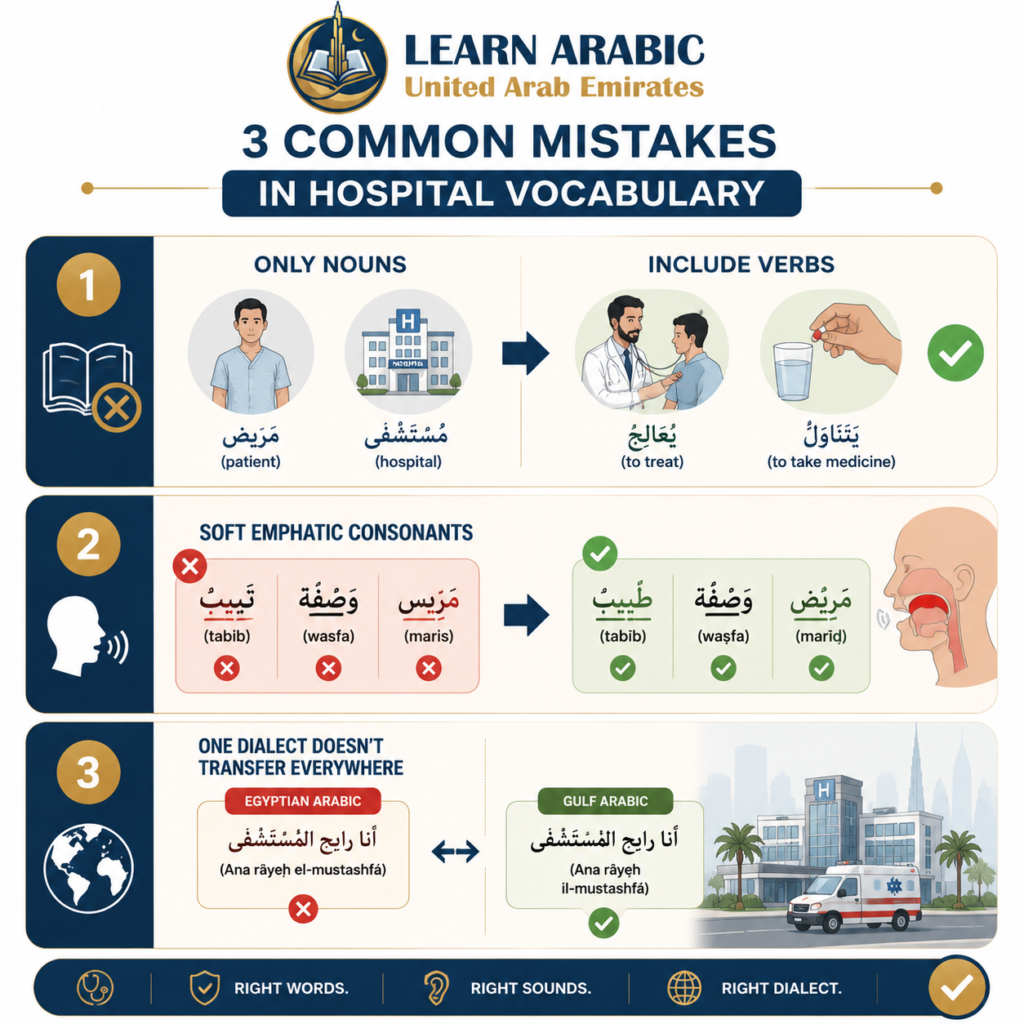
Most vocabulary guides hand you the list and leave you to discover the errors yourself. Here are the three most predictable ones — and how to skip past them entirely.
1. Learning Only Nouns and Skipping Verbs
A learner who knows مَرِيض (patient) and مُسْتَشْفَى (hospital) but not يُعَالِجُ (to treat) or يَتَنَاوَلُ (to take medicine) will understand the actors but miss the action. Hospital conversations are primarily instruction-based — the verb carries the meaning of what you are being told to do. Prioritize verbs from your first study session, not as an afterthought.
2. Pronouncing Emphatic Consonants Softly
Arabic emphatic consonants — ط (Ṭ), ص (Ṣ), ض (Ḍ) — appear in some of the most important medical words: طَبِيب (doctor), وَصْفَة (prescription), مَرِيض (patient). Softening ط to a regular “t” or ص to a regular “s” does not just affect your accent — it changes the phonetic identity of the word entirely. Getting these right early prevents a correction habit that becomes harder to break at intermediate level.
3. Assuming One Dialect Transfers Everywhere
This is a real-world error among learners who study Egyptian Arabic and assume it works in Gulf hospitals. Egyptian dialect is the most widely taught due to its media presence, but it differs meaningfully from Gulf Arabic in both vocabulary and pronunciation.
See Our Classroom Environment in Action
Experience a sneak peek into our live sessions. Watch the video below to see our specialized instructors interacting with students, breakdown complex texts, and cultivate an engaging, respectful learning environment.
Master Arabic in the UAE
Experience world-class Arabic language training designed for students and professionals in the Emirates.
Book Your Free TrialStart Speaking Arabic with Confidence in Medical Situations
Communicating clearly in hospitals, clinics, and pharmacies requires more than memorizing vocabulary. You need practical Arabic that prepares you for real conversations, professional interactions, and emergency situations.
Learn Arabic UAE provides structured Arabic programs that help learners build both Modern Standard Arabic (MSA) and Gulf Arabic through practical, instructor-led lessons designed for everyday medical communication.
- Native Arab Azhari tutors — learn accurate Arabic from experienced instructors who understand both formal and spoken language
- Practical medical communication — build the vocabulary and expressions used in hospitals, clinics, pharmacies, and healthcare settings
- MSA and Gulf Arabic pathways — develop the formal Arabic needed for reading signs and documents alongside the spoken Arabic used across the UAE
- Flexible online classes — study from anywhere with schedules designed for busy professionals, residents, and frequent travelers
- Suitable for all proficiency levels — whether you’re starting from zero or improving your workplace communication
- Free trial lesson available — experience the teaching approach before enrolling
Book your free trial lesson at Learn Arabic UAE and start building the Arabic skills that help you communicate confidently when it matters most.

Our Arabic courses
- Arabic Course in the UAE
- Arabic Intensive Course
- Arabic Classes for Beginners (Learn Arabic from Scratch)
- Madinah Arabic Course
- Arabic Classes for Adults
- Self-Paced Arabic Course
- Arabic Speaking Classes
- Learn to Write Arabic Course
- Arabic Grammar Course
- Learn Arabic Alphabet Course
- Modern Standard Arabic (MSA) Course
- Quranic Arabic Course
- Fusha Arabic Course
- Classical Arabic Course
- Emirati Arabic Course
- Gulf Arabic Course
Master Arabic in the UAE
Experience world-class Arabic language training designed for students and professionals in the Emirates.
Book Your Free TrialConclusion
Hospital vocabulary in Arabic covers three things you need simultaneously: the words to identify people and places, the phrases to describe what you feel, and the verbs to understand what is being done to you. A vocabulary list alone is not enough — you also need to know which register to use, where dialect differs from MSA, and which errors to avoid before they become habits.
The single most important decision for learners in the UAE and Gulf is to build MSA as the foundation first, then layer Gulf dialect on top. MSA gets you through every written instruction, prescription, and diagnostic report. Gulf dialect gets you through every verbal interaction with nursing staff and administrative teams. Both are practical; neither replaces the other.
Start with the words in this guide. Practice the emergency phrases until they are automatic. Then get structured instruction that ties the vocabulary to grammar, so you can produce sentences — not just recognize words.
Frequently Asked Questions About Hospital Vocabulary in Arabic
Whether you’re preparing for a medical appointment, traveling to an Arabic-speaking country, or simply expanding your practical vocabulary, you may still have a few questions about hospital Arabic. Below are answers to the most common questions learners ask about hospital vocabulary in Arabic, medical phrases, and communicating confidently in healthcare settings.
What is the Arabic word for hospital?
The Arabic word for hospital is مُسْتَشْفَى (Mustashfā). It is used identically across all Arab countries in both Modern Standard Arabic and spoken dialects, and it appears on all official hospital signage throughout the UAE, Saudi Arabia, and the wider Arab world.
How do you say “I need a doctor” in Arabic?
“I need a doctor” in Arabic is أَحْتَاجُ إِلَى طَبِيب (Aḥtāju ilā ṭabīb). In spoken Gulf Arabic, you can also say أَبِي دَكْتُور (Abī doktoor), which is the informal and widely understood Gulf equivalent.
What is the Arabic word for emergency room?
The Arabic word for emergency room is طَوَارِئ (Ṭawāri’). In hospitals across the UAE and Saudi Arabia, this word appears prominently on signage in red lettering, often alongside its English translation.
Is hospital Arabic the same in the UAE and Saudi Arabia?
The written Arabic used in hospitals — prescriptions, reports, signage — is identical across both countries, as it is Modern Standard Arabic. Spoken Arabic differs: UAE hospitals reflect Gulf dialect influenced by various nationalities, while Saudi hospitals use primarily Hejazi or Najdi Arabic depending on the region. The core medical vocabulary is shared and understood everywhere.
How do I describe pain in Arabic to a doctor?
To describe pain in Arabic, use the phrase يُؤْلِمُنِي (Yu’limunī — “It hurts me”) followed by the body part. For severity, use أَلَم خَفِيف (mild), أَلَم مُتَوَسِّط (moderate), or أَلَم شَدِيد (severe). These phrases are recognized by medical staff in every Arabic-speaking hospital.
Do I need to speak Arabic in UAE hospitals?
Many UAE hospitals in Dubai and Abu Dhabi have English-speaking doctors, particularly in private facilities. However, nursing staff, pharmacists, and administrative teams often communicate primarily in Arabic — especially in public hospitals. Having hospital vocabulary in Arabic ready dramatically reduces friction and the risk of miscommunication in an already stressful situation.
Related Articles
Learn Arabic



Leave a Reply