 Learn Arabic
Does Arabic have grammatical gender? Many Arabic learners ask this question, especially early in their journey. Every noun you learn in Arabic is either masculine or feminine. If you ignore this concept, your sentence breaks; the wrong pronoun slips in, the verb doesn’t match, and the adjective sounds off. So does Arabic have grammatical gender? Yes, and it runs through nearly every part of the sentence, not just the nouns.
This article shows how gender in Arabic works for nouns, pronouns, verbs, adjectives, and the one word class that skips gender entirely. You’ll see the real patterns used in classical Arabic grammar (نحو), with examples you can start applying today.
By the end of this article, you’ll be able to look at an unfamiliar Arabic word and make a solid guess at its gender, even before you check a dictionary.
What Grammatical Gender Means In Arabic And Why It Exists
Arabic has grammatical gender, meaning every noun is classified as either masculine (مذكر) or feminine (مؤنث), regardless of whether it refers to a living thing.
A “book” (كتاب) is grammatically masculine. A “car” (سيارة) is grammatically feminine. Neither has biological sex; the classification is built into the language itself.
This is important because gender in Arabic isn’t fancy. It’s a load-bearing rule. It decides which demonstrative pronoun you use (هذا vs هذه), which verb ending you attach, and which form the adjective takes. If you get the noun’s gender wrong, the rest of the sentence falls out of agreement.
Arabic treats masculine as the unmarked, default form. Feminine is the form that needs a marker or a rule to justify it. This single idea explains most of this article.
Types Of Gender Rules In Arabic Grammar
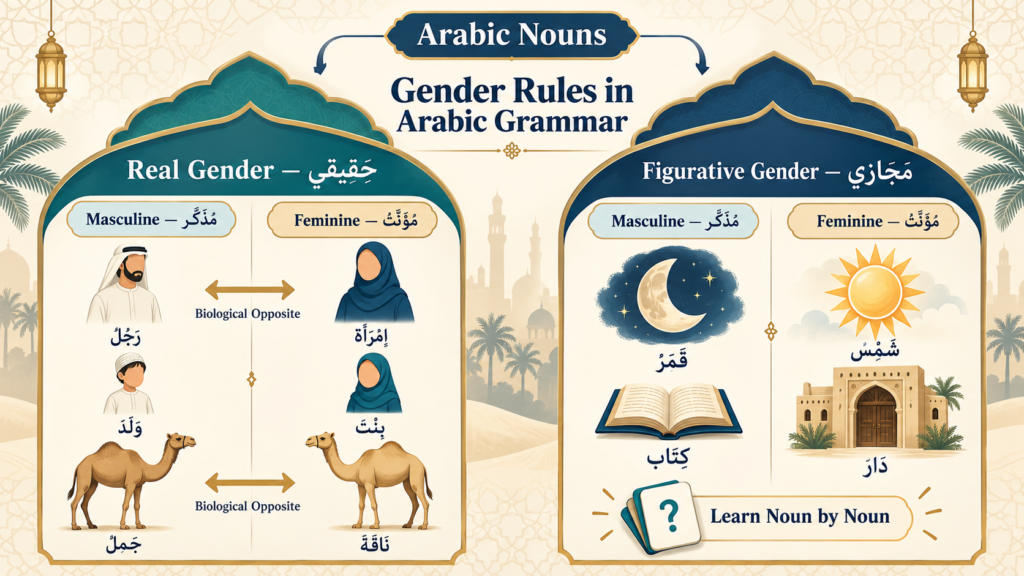
Arabic grammar sorts masculine and feminine nouns into two layers: real (حقيقي) and figurative (مجازي). Real gender applies to living beings that are biologically male or female.
Figurative gender applies to objects, where the classification is a convention of the language, not a biological fact.
1. Real Masculine And Real Feminine (مذكر ومؤنث حقيقي)
Real masculine nouns refer to a male human or animal: رجل (man), جمل (male camel), ولد (boy). Real feminine nouns refer to a female human or animal that gives birth or lays eggs: امرأة (woman), ناقة (female camel), بنت (girl).
A practical test for real gender: can the noun be paired with a biological opposite? رجل has امرأة.
جمل has ناقة. If yes, you’re dealing with real gender, and it’s usually the easiest category to identify.
2. Figurative Masculine And Figurative Feminine (مذكر ومؤنث مجازي)
Figurative gender is assigned to objects, and Arabic speakers simply agreed on the classification over time.
There’s no biological reasoning behind it.
قمر (moon) and كتاب (book) are treated as masculine.
شمس (sun) and دار (house) are treated as feminine, despite having no visible feminine marker.
This is the category that trips up learners, because there’s no shortcut. Figurative gender has to be memorized noun by noun, the same way English speakers memorize that a ship is traditionally “she.”
Read also: The 10 Most Used Sentences In Arabic – Every Arabic Learner Should Know
Word Gender In Arabic – The Three Feminine Markers
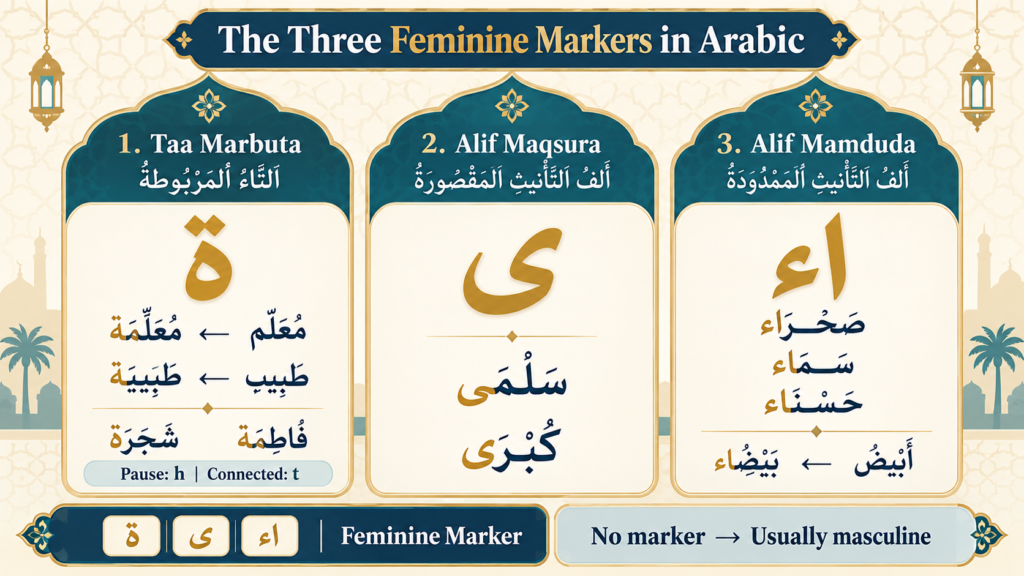
Word gender in Arabic is signaled by three specific endings; a word without any of them defaults to masculine. These are the only visible markers of feminine gender in the language, and recognizing them on sight is the fastest way to identify a noun’s gender.
1. Taa Marbuta (التاء المربوطة)
The taa marbuta (ة) is the most common feminine marker in Arabic, appearing at the end of words like فاطمة (Fatima) and شجرة (tree). It’s also the main tool for converting a masculine noun or adjective into its feminine counterpart: معلم becomes معلمة (teacher, m./f.), and طبيب becomes طبيبة (doctor, m./f.).
A practitioner note worth flagging here: taa marbuta ة is pronounced as a plain “h” sound in a pause but as “t” when the word is followed by another word in construct (إضافة) or has a case ending attached. This detail trips up even intermediate learners reading aloud.
2. Alif Maqsura (ألف التأنيث المقصورة)
The alif maqsura (ى) appears at the end of certain names and adjectives, such as سلمى (Salma) and كُبرى (greater/eldest, feminine). It looks like a regular alif in some fonts but is written and pronounced differently. This distinction is worth confirming with an audio source if you’re self-studying.
3. Alif Mamduda (ألف التأنيث الممدودة)
The alif mamduda (اء) marks feminine nouns and adjectives such as صحراء (desert), سماء (sky), and حسناء (beautiful woman). Many color adjectives in their feminine form also take this ending; أبيض (white, m.) becomes بيضاء (white, f.).
Read also: Masculine And Feminine Nouns In Arabic
Step Inside Our Classrooms
Don’t just take our word for it—see our community in action. Click below to watch real, live snippets from our recent classes and experience our engaging teaching style firsthand!
Master Arabic in the UAE
Experience world-class Arabic language training designed for students and professionals in the Emirates.
Book Your Free TrialArabic Noun Gender – When The Marker And The Meaning Disagree
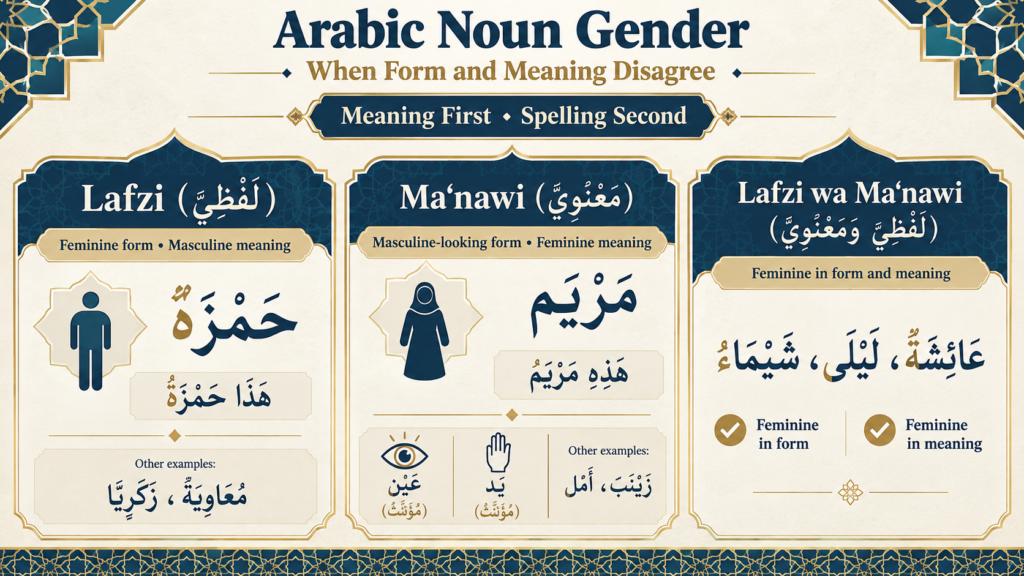
Arabic noun gender is based on meaning first and spelling second, so a word can carry a feminine-looking ending while referring to a male, or carry no feminine marker while referring to a female. This mismatch is common enough that classical grammar gives it its own three-way classification.
1. Lafzi (Verbal) Feminine – Looks Feminine, Acts Masculine
Words like حمزة (Hamza), معاوية (Muawiya), and زكريا (Zachariah) are men’s names that happen to end in a feminine marker.
Grammatically, they’re treated exactly like masculine nouns: هذا حمزة (this is Hamza), جاء حمزة (Hamza came), حمزة قويّ (Hamza is strong). The ending is cosmetic. The meaning decides the agreement.
2. Ma’nawi (Semantic) Feminine – Looks Masculine, Acts Feminine
Words like مريم (Mary), زينب (Zaynab), and أمل (Amal) refer to women but carry no feminine ending. They’re still treated as fully feminine: هذه مريم (this is Mary), جاءت مريم (Mary came). Paired body parts, عين (eye) and يد (hand), fall into this same category, treated as feminine despite the absence of a marker.
3. Lafzi Wa Ma’nawi – Both Feminine In Form And Meaning
Words like عائشة (Aisha), ليلى (Layla), and شيماء (Shaima) refer to women and carry a feminine ending, satisfying both criteria at once. This is the most common and least ambiguous pattern for feminine proper nouns.
To master this rule set, work through graded reading practice where these three categories show up in real sentences rather than isolated lists.
Learn Arabic UAE’s structured Arabic grammar courses walk learners through exactly this kind of pattern recognition, with a tutor correcting agreement mistakes in real time.
Read also: How Many Letters Are In The Arabic Alphabet?
Words That Are Both Masculine And Feminine
A small set of Arabic nouns can be used as either masculine or feminine, with native speakers accepting both forms as correct.
طريق (road), سوق (market), سكّين (knife), لسان (tongue), and عنق (neck) all fall into this group.
Both of the following are grammatically correct:
- طريقٌ طويلٌ (a long road — masculine adjective)
- طريقٌ طويلةٌ (a long road — feminine adjective)
This isn’t a loophole or a regional variation. It’s a recognized dual-gender category in Arabic morphology, and dictionaries typically flag these words explicitly so learners don’t have to guess.
Arabic Pronoun Gender
Arabic pronouns are divided by gender in both the singular and plural, unlike English pronouns, which only distinguish gender in the third-person singular (he/she).
This means the word for “you” itself changes depending on whether you’re speaking to a man or a woman.
| Category | Masculine | Feminine |
| Speaker (1st person singular/plural) | أنا / نحن (shared) | أنا / نحن (shared) |
| Addressee, singular | أنتَ | أنتِ |
| Addressee, dual | أنتما (shared) | أنتما (shared) |
| Addressee, plural | أنتم | أنتنّ |
| Absent, singular | هو | هي |
| Absent, dual | هما (shared) | هما (shared) |
| Absent, plural | هم | هنّ |
Notice that first-person and dual pronouns don’t split by gender; only the second-person and third-person singular and plural forms do. This is a common point of confusion for learners expecting every pronoun slot to have two versions.
Pronouns also divide into بارز (explicit/detached, appearing openly in speech like أنا) and مستتر (hidden/implied, understood from context without appearing in the sentence).
Demonstrative pronouns follow the same gender split: هذا (this, m.) and هذه (this, f.); ذلك (that, m.) and تلك (that, f.); with separate dual forms هذان/هاتان and distinct plural forms هؤلاء (near) and أولئك (far).
Read also: Arabic Broken Plurals – 2 Categories Of Jam’ Al-Taksir
See Our Classroom Environment in Action
Experience a sneak peek into our live sessions. Watch the video below to see our specialized instructors interacting with students, breaking down complex texts, and cultivating an engaging, respectful learning environment.
Do Verbs In Arabic Have Gender?
Verbs in Arabic do have gender, marked by adding or omitting the taa at-ta’nith (تاء التأنيث) depending on whether the subject is masculine or feminine.
A verb with no feminine marker is assumed masculine by default, consistent with the broader rule that masculine is the unmarked form throughout Arabic grammar.
1. Past Tense (الماضي)
The past-tense feminine marker is a silent taa attached to the verb stem: جاءتْ أمّي (my mother came) versus جاء أبي (my father came). The taa ت is what carries the gender information. Without it, the verb defaults to masculine agreement.
2. Present Tense (المضارع)
In the present tense, gender is marked at the start of the verb rather than the end: تأكلُ سلمى (Salma eats) uses the تـ prefix for a feminine subject, while a masculine subject takes a different prefix (يـ), as in يأكلُ خالد (Khalid eats).
3. Imperative (الأمر)
Command forms also shift by gender: اذهبي يا سعاد (go, Suad, feminine command) versus اذهبْ يا خالد (go, Khalid, masculine command). The ي ending is what marks the command as directed at a feminine subject.
A common mistake among learners: applying the masculine imperative form to a feminine subject out of habit, which sounds abrupt and grammatically incorrect to a native speaker even if the meaning is understood.
Arabic Adjective Gender And Predicate Agreement
Arabic adjectives must match the gender of the noun they describe. The predicate (خبر) of a sentence must match the gender of its subject (مبتدأ) in the same way.
This agreement rule is what makes gender identification practically useful. When you master the noun’s gender, every adjective and predicate attached to it follows the same pattern.
1. Examples of noun-adjective agreement
An adjective follows the noun it describes in gender. A masculine noun normally takes a masculine adjective, while a feminine noun takes the corresponding feminine form, which often ends in taa marbuta (ة).
- طالبٌ مجتهدٌ (a hardworking student, masculine).
- طالبةٌ مجتهدةٌ (a hardworking student, feminine).
- طبيبٌ ماهرٌ (a skilled doctor, masculine).
- طبيبةٌ ماهرةٌ (a skilled doctor, feminine).
2. Examples of subject-predicate agreement
When the predicate is an adjective, it agrees with the gender of the subject. This agreement allows the sentence to describe a masculine or feminine subject accurately and naturally.
- هند جميلةٌ (Hind is beautiful)
- الطبيبُ ماهرٌ (the doctor is skilled)
This is where the whole gender system pays off practically. Once you know a noun’s gender, the demonstrative, the pronoun, the verb, the adjective, and the predicate all fall into place around it, a chain of five agreement points, not just one.
Does Arabic Preposition Gender Exist?
Arabic prepositions (حروف الجر) have no gender at all; words like من (from), إلى (to), عن (about), and على (on) are grammatically invariable and never change form for masculine or feminine. This puts prepositions in a separate category from nouns, verbs, and pronouns, all of which carry gender in some form.
This is a useful shortcut for learners: if you’re staring at a preposition trying to work out its gender, you’re solving a problem that doesn’t exist. Prepositions are one of the few genuinely fixed elements in Arabic sentence structure.
For learners working through a full grammar course, this is usually taught alongside the four core parts of speech that do carry classification: noun, verb, letter (particle), and the smaller category of verb-nouns (اسم فعل) like هيهات.
Structured Arabic grammar lessons at Learn Arabic UAE build this sequence deliberately, so gender rules are introduced only after learners can already tell nouns, verbs, and particles apart.
Master Arabic Gender Rules With Guided Practice
Reading the rules is one thing; applying them correctly in a live conversation is another. A tutor who corrects your gender agreement in real time, in full sentences, is what turns this guide into a skill you actually use.
Learn Arabic UAE’s one-on-one Arabic grammar courses walk you through noun, verb, and pronoun gender step by step, with a certified instructor checking your agreement in every sentence you build, not just in isolated drills. Book a session and start applying these rules the way native speakers actually use them.
If you’re ready to build confidence with Arabic gender agreement, explore Learn Arabic UAE’s personalized grammar lessons and practise each rule with supportive, real-time guidance.
Our Arabic courses
- Arabic Grammar Course
- Learn Arabic Alphabet Course
- Modern Standard Arabic (MSA) Course
- Quranic Arabic Course
- Fusha Arabic Course
- Classical Arabic Course
- Emirati Arabic Course
- Gulf Arabic Course
- Learn Saudi Arabic
- Business Arabic Course UAE
- Arabic Language Classes for Professionals in UAE
Master Arabic in the UAE
Experience world-class Arabic language training designed for students and professionals in the Emirates.
Book Your Free Trial
Conclusion
Arabic grammatical gender touches nearly every part of the sentence: the noun itself, the pronoun that replaces it, the verb that acts on it, the adjective that describes it, and the predicate that completes it.
Masculine is the default, unmarked form; feminine needs a marker (taa marbuta, alif maqsura, or alif mamduda) or has to be learned by meaning alone, as with مؤنث معنوي words like مريم and زينب.
The practical payoff is real: once you correctly identify a noun’s gender, every other agreement point in the sentence- demonstrative, pronoun, verb ending, adjective form- follows a predictable pattern. That’s the core skill this guide is meant to build, and it’s the same skill a structured Arabic gender lesson will drill until it becomes automatic.
Frequently Asked Questions
How Do You Know If An Arabic Word Is Male Or Female?
Check for one of the three feminine markers, taa marbuta (ة), alif maqsura (ى), or alif mamduda (اء), at the end of the word. If none appear, the word defaults to masculine, though a handful of feminine words like شمس (sun) carry no visible marker and must be memorized individually.
Are There Gender Pronouns In Arabic?
Yes, Arabic pronouns split by gender in the second person (أنتَ/أنتِ) and third person (هو/هي), in both singular and plural forms. First-person and dual pronouns, however, are shared between genders and don’t change.
Do Verbs In Arabic Have Gender?
Yes, Arabic verbs mark gender by adding or dropping the taa al-ta’nith. Past-tense feminine verbs attach a silent taa (جاءتْ), present-tense feminine verbs take a تـ prefix (تأكلُ), and feminine commands end in ي (اذهبي).
What Are The Gender Forms In Arabic?
Arabic recognizes two grammatical genders, masculine (مذكر) and feminine (مؤنث), each split into real (حقيقي, for living beings) and figurative (مجازي, for objects). Feminine nouns are further divided into lafzi, ma’nawi, and lafzi-wa-ma’nawi based on whether the feminine marker matches the actual meaning.
Can One Arabic Word Be Both Masculine And Feminine?
Yes. A small set of nouns, including طريق (road), سوق (market), and عنق (neck), accept both masculine and feminine agreement, and native speakers use both forms interchangeably without a change in meaning.
Does Every Part Of Speech In Arabic Have Gender?
No. Nouns, verbs, and pronouns all carry gender, but prepositions (حروف الجر) do not. Words like من and إلى are grammatically fixed and never take a masculine or feminine form.



[…] Read also: Does Arabic Have Grammatical Gender? 9 Easy Rules You Need To Know […]
[…] Read also: Does Arabic Have Grammatical Gender? 9 Easy Rules You Need To Know […]