 Learn Arabic
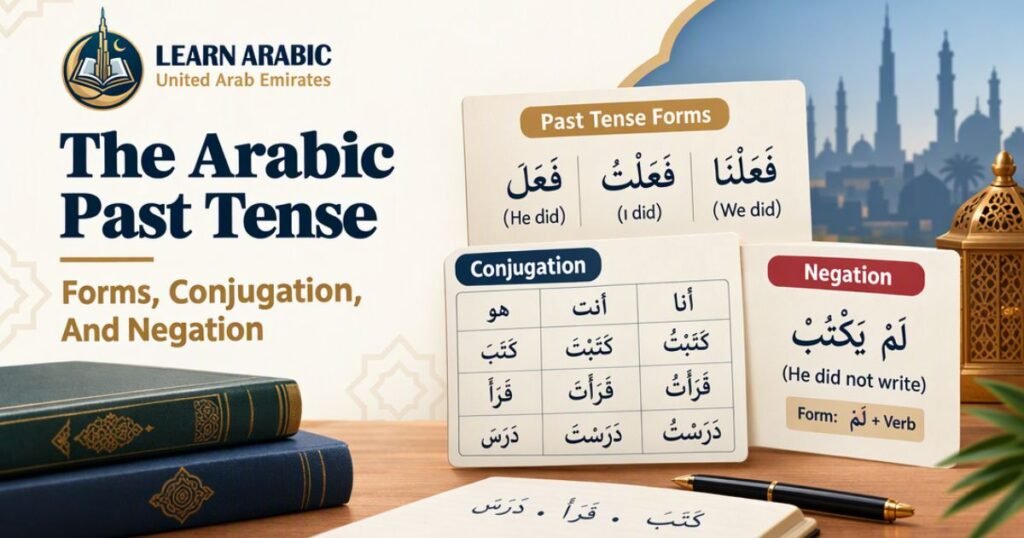
The Arabic past tense is the first grammar point every serious student of Arabic has to master, because almost every sentence about something that already happened runs through it.
Known in Arabic as الماضي (al-māḍī), it’s also the most stable tense in the language — learn the pattern once, and it applies across thousands of verbs.
Unlike English, which builds the past with helper words (“I have gone,” “she had left”), Arabic folds the subject directly into the verb ending.
A single word like كَتَبْتُ (katabtu, “I wrote”) already tells you who did the action, what tense it’s in, and that the action is finished — no separate pronoun required.
This guide covers what actually marks a verb as past tense, the 14 forms of past tense in Arabic laid out in full chart form, an Arabic past tense verbs list you can start using today, past tense in Arabic examples drawn from real usage, and how to negate it correctly — including the one mistake that trips up almost every English-speaking learner.
What You’ll Learn in This Article
- How many tenses in Arabic there are, what marks a verb as Arabic past tense, and how it compares to the other Arabic tenses.
- The complete 14-form conjugation chart for any regular verb.
- An Arabic past tense verbs list with example sentences.
- The main ways the past tense is actually used in real speech and text.
- How to correctly negate the past tense with ما and لم — and the mistake most learners make.
- Where to keep building the skill with structured practice.
What Is The Arabic Past Tense And How Does It Work?
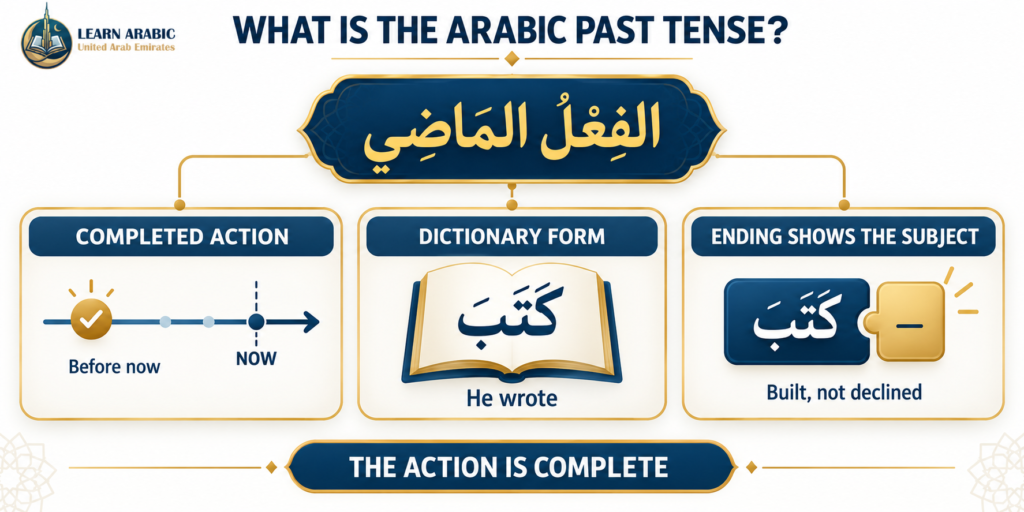
The Arabic past tense, الفعل الماضي (al-fi’l al-māḍī), is the verb form that marks an action as completed before the moment of speaking.
It’s also the form Arabic dictionaries use as the default entry for any verb — which is why a dictionary lists كَتَبَ (kataba, “he wrote”) rather than an infinitive like “to write.” The past-tense form is treated as the root of the verb in action.
In Arabic grammatical tradition — specifically علم الصرف (‘ilm al-ṣarf, “morphology”) — the past tense is built, not declined.
That means its ending doesn’t change according to its role in the sentence (subject, object, and so on) the way a noun’s case ending does. Instead, the ending changes only according to which suffix is attached to show the subject.
How to Recognize a Past Tense Verb in Arabic?
In its bare form — with nothing attached — a past tense verb ends in a فتحة (fatḥa, a short “a” vowel), as in كَتَبَ (kataba) or ذَهَبَ (dhahaba).
That fatḥa is the single clearest signal that you’re looking at a past tense verb rather than a present tense one, which instead takes a prefix (يَ / تَ / أَ / نَ).
The ending does shift once a suffix attaches. A verb takes a sukūn (a “closing,” no-vowel ending) when a moving pronoun suffix attaches, such as the subject تاء in كَتَبْتُ (katabtu, “I wrote”).
It takes a ḍamma (a short “u” vowel) when واو الجماعة (the “they” plural masculine wāw) attaches, as in كَتَبُوا (katabū, “they wrote”). Knowing this mechanism — rather than memorizing each ending as a separate rule — is what lets you predict the ending on a verb you’ve never seen conjugated before.
How the Past Tense Compares with Other Arabic Tenses?
A common question for new learners is how many tenses in Arabic actually exist. The answer is refreshingly small: Arabic has three tenses — the past (الماضي), the present (المضارع), and the imperative (الأمر). Each is built differently, and seeing all three Arabic tenses side by side makes the past tense’s markers easier to spot.
| Tense | Arabic Name | How It’s Formed | Example | Meaning |
| Past | الماضي (al-māḍī) | No prefix; fatḥa ending (shifts to sukūn/ḍamma with certain suffixes) | كَتَبَ (kataba) | He wrote |
| Present | المضارع (al-muḍāri’) | Prefix (يَ/تَ/أَ/نَ) + ḍamma ending | يَكْتُبُ (yaktubu) | He writes / will write |
| Imperative | الأمر (al-amr) | Stem alone, no prefix, command form | اُكْتُبْ (uktub) | Write! |
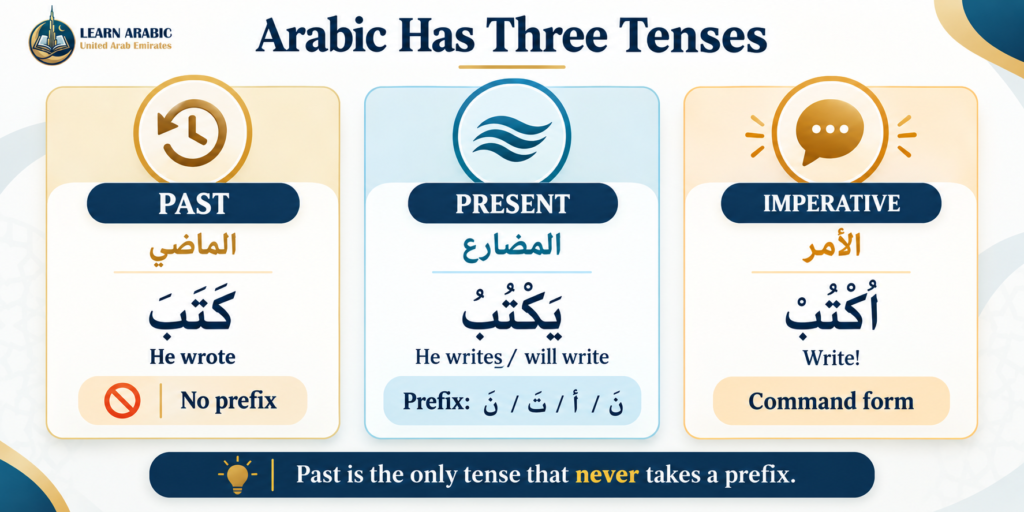
The past tense is the only one of the three that never takes a prefix — which is exactly why it’s usually the tense taught first.
There’s one pattern to learn, and it doesn’t change based on when the action happened; a past-tense verb can describe something a moment ago or centuries ago, since Arabic marks completion, not distance in time.
The 14 Arabic Past Tense Forms and Conjugation Chart
Because Arabic doesn’t use separate pronoun words to show who performed an action, the subject is built into the verb through suffixes called ضمائر (ḍamā’ir). That gives the past tense 14 distinct forms — one for every combination of person, gender, and number.
The table below conjugates كَتَبَ (kataba, “he wrote”), one of the standard teaching verbs for Arabic morphology.
| Pronoun | Transliteration | Verb Form | Transliteration | Meaning |
| هُوَ | Huwa | كَتَبَ | kataba | He wrote |
| هِيَ | Hiya | كَتَبَتْ | katabat | She wrote |
| هُمَا (m) | Humā | كَتَبَا | katabā | They two (m) wrote |
| هُمَا (f) | Humā | كَتَبَتَا | katabatā | They two (f) wrote |
| هُمْ | Hum | كَتَبُوا | katabū | They (m) wrote |
| هُنَّ | Hunna | كَتَبْنَ | katabna | They (f) wrote |
| أَنْتَ | Anta | كَتَبْتَ | katabta | You (m, sing.) wrote |
| أَنْتِ | Anti | كَتَبْتِ | katabti | You (f, sing.) wrote |
| أَنْتُمَا | Antumā | كَتَبْتُمَا | katabtumā | You two wrote |
| أَنْتُمْ | Antum | كَتَبْتُمْ | katabtum | You (m, pl.) wrote |
| أَنْتُنَّ | Antunna | كَتَبْتُنَّ | katabtunna | You (f, pl.) wrote |
| أَنَا | Anā | كَتَبْتُ | katabtu | I wrote |
| نَحْنُ | Naḥnu | كَتَبْنَا | katabnā | We wrote |
Note the pattern: third-person forms simply add a suffix to the root, while first- and second-person forms add one of three “taa” endings — تُ / تَ / تِ (-tu / -ta / -ti). Once that split registers, applying it to a new verb takes seconds, not minutes.
Seeing all 14 forms at once can feel like a lot on a first pass. In Learn Arabic In the UAE Academy’s Arabic Classes for Beginners, instructors drill this exact chart across several different verb roots in the first sessions — not to memorize a table, but to make the ending-swap instinctive before moving on to vocabulary.
Step Inside Our Classrooms
Don’t just take our word for it—see our community in action. Click below to watch real, live snippets from our recent classes and experience our engaging teaching style firsthand!
Master Arabic in the UAE
Experience world-class Arabic language training designed for students and professionals in the Emirates.
Book Your Free TrialHow To Conjugate Any Regular Verb In The Arabic Past Tense?
The 14 forms above aren’t unique to كَتَبَ — the same suffix set attaches to virtually any regular Arabic verb.
That’s what makes past tense conjugation the most learnable part of Arabic grammar: once the pattern is internalized, it transfers directly to thousands of other roots.
A useful shortcut here is what we’ll call the ending-first method: when you see an unfamiliar past-tense verb, look at the ending before you try to translate the whole word. The ending alone tells you the subject before you’ve even worked out the root’s meaning:
- A verb ending in تُ is “I.”
- A verb ending in تَ is “you” (masculine, singular).
- A verb ending in وا is “they” (masculine).
- A verb ending in نَ — attached directly with no vowel before it — is “they” (feminine).
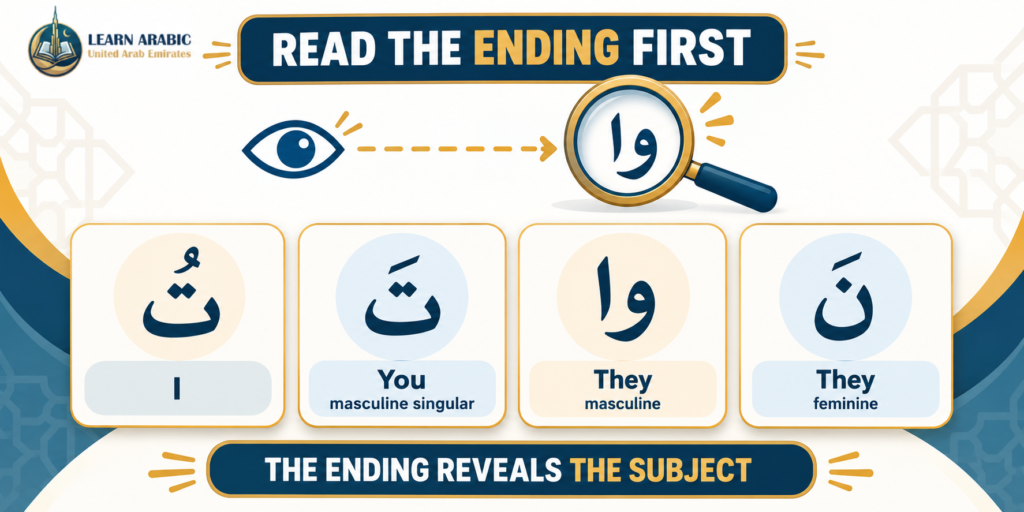
Reading the ending first, rather than trying to sound out the whole word and guess the subject from context, is the single fastest way to build reading speed with Arabic past tense verbs.
Read Also: Tenses In Arabic
Common Arabic Past Tense Verbs with Examples
Past tense verbs in Arabic all follow the conjugation logic above regardless of meaning — the real work for a learner is building vocabulary through exposure to high-frequency roots.
The Arabic past tense verbs list below covers twelve common Arabic past tense words, several of which also appear frequently in Quranic Arabic.
| Verb (Māḍī) | Transliteration | Meaning | Example Sentence | Translation |
| ذَهَبَ | dhahaba | He went | ذَهَبَ الوَلَدُ إِلَى المَدْرَسَةِ | The boy went to school |
| أَكَلَ | akala | He ate | أَكَلَ الطِّفْلُ التُّفَّاحَةَ | The child ate the apple |
| شَرِبَ | shariba | He drank | شَرِبَتِ الفَتَاةُ المَاءَ | The girl drank water |
| قَرَأَ | qara’a | He read | قَرَأَ الطَّالِبُ الكِتَابَ | The student read the book |
| كَتَبَ | kataba | He wrote | كَتَبَ الوَلَدُ رِسَالَةً | The boy wrote a letter |
| سَمِعَ | sami’a | He heard | سَمِعَ المُعَلِّمُ الجَوَابَ | The teacher heard the answer |
| رَأَى | ra’ā | He saw | رَأَى السَّيَّارَةَ الجَدِيدَةَ | He saw the new car |
| عَلِمَ | ‘alima | He knew | عَلِمَ الرَّجُلُ الحَقِيقَةَ | The man knew the truth |
| رَجَعَ | raja’a | He returned | رَجَعَ المُسَافِرُ إِلَى بَيْتِهِ | The traveler returned home |
| وَصَلَ | waṣala | He arrived | وَصَلَ القِطَارُ فِي الوَقْتِ المُحَدَّدِ | The train arrived on time |
| جَلَسَ | jalasa | He sat | جَلَسَ فِي الكُرْسِيِّ | He sat in the chair |
| سَافَرَ | sāfara | He traveled | سَافَرَ إِلَى الخَارِجِ | He traveled abroad |
A well-known Quranic example puts the past tense to work with added emphasis:
قَدْ أَفْلَحَ الْمُؤْمِنُونَ
Qad aflaḥa l-mu’minūn
“Certainly the believers have succeeded.” (Al-Mu’minūn 23:1)
أَفْلَحَ (aflaḥa) is the past tense form of the root ف-ل-ح, third-person masculine singular — and the particle قَدْ (qad) placed before it is what adds the certainty, a point covered in the next section.
If building this vocabulary one root at a time feels slow on your own, Learn Arabic In the UAE Academy’s Arabic Intensive Course is structured to move through common verb roots faster, with speaking practice built around each one rather than isolated memorization.
How the Arabic Past Tense Is Used in Real Sentences?
Past tense in Arabic covers more ground than “something happened yesterday.” The past tense in Arabic examples below show it at work in formal declarations, prayers, and storytelling — not just simple narration.
Each usage answers a distinct question about when and why the past tense form gets used.
1. Using the Past Tense for Completed Actions
This is the direct use: an action that happened and is finished, with no further nuance attached.
ذَهَبَتْ فَاطِمَةُ إِلَى المَسْجِدِ
Dhahabat Fāṭimatu ilā l-masjid — “Fatima went to the mosque.”
There’s no marker here beyond the verb form itself — the fatḥa on ذَهَبَتْ signals a plain, completed event.
2. Using قَدْ (Qad) to Emphasize a Past Action
Adding قَدْ (qad) directly before a past-tense verb intensifies its certainty — it’s the difference between simply stating something happened and stressing that it definitely did. This construction is extremely common in Quranic Arabic and formal registers.
قَدْ سَمِعَ اللهُ
Qad sami’a Allāhu
“Certainly, Allah has heard.” (Al-Mujādila 58:1)
3. Using Past-Tense Forms for Formal Present-Meaning Statements
In formal or official speech, a past-tense verb can describe an action that’s happening in that very moment — a use that surprises most learners the first time they encounter it. Sale contracts and formal declarations rely on this constantly.
بِعْتُكَ هٰذَا البَيْتَ
Bi’tuka hādhā al-bayt — “I hereby sell you this house.”
بِعْتُ (bi’tu) is grammatically past tense, but functionally present — the sale is being finalized as the words are spoken, not recounting a sale from earlier.
4. Using the Past Tense for Wishes, Prayers, and Conditions
Arabic also uses the past tense form to express a hope or wish about the future — treating the wish as if it were already granted, which adds confidence to the request.
رَزَقَكَ اللهُ
Razaqaka Allāh — “May Allah grant you provision.”
The same past tense form also appears in both halves of a conditional sentence, even when the overall meaning points to the future: إِنْ جَاءَ مُحَمَّدٌ أَكْرَمْتُهُ (“If Muhammad comes, I will honor him”) uses جَاءَ and أَكْرَمْتُ — both past tense in form, future in meaning.
Read Also: Learn Arabic for Kids Online For Free in the UAE
How to Negate the Arabic Past Tense Correctly
Negating a past tense verb in Arabic isn’t as simple as adding “not” the way English does. Arabic uses two distinct negation particles, and choosing between them changes more than tone — one of them changes the verb’s form entirely.
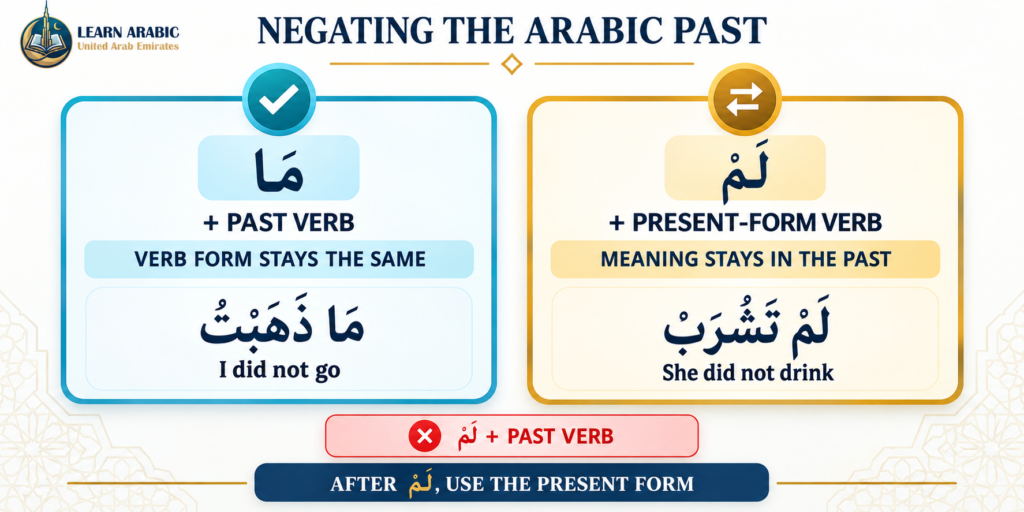
A. Negating Past-Tense Verbs with ما (Maa)
ما (maa) placed directly before a past tense verb turns it negative without changing the verb’s form at all. This is the simpler of the two options, and it works across every subject:
ما ذَهَبْتُ إِلَى المَدْرَسَةِ أَمْسِ
Maa dhahabtu ilā al-madrasah ams — “I did not go to school yesterday.”
ما زَارَنَا الضَّيْفُ
Maa zaaranā ad-daif — “The guest did not visit us.”
B. Negating Past Actions with لم (Lam)
لم (lam) also negates a past action, but with one requirement that catches nearly every English-speaking learner off guard: the verb after لم has to switch into its present-tense form, even though the sentence still means past tense.
شَرِبَتِ العَصِيرَ (“She drank the juice”) becomes لَمْ تَشْرَبِ العَصِيرَ (“She did not drink the juice”) — تَشْرَبِ is grammatically present tense, but لم flips the whole meaning to past.
The common mistake is attaching لم to the past-tense form itself (writing something like لم شربت, which isn’t valid Arabic) instead of converting the verb to its present-tense shape first.
As a working rule: if you’re using لم, check the verb after it — it should look like a present-tense verb, not a past-tense one.
لَمْ يُصَلِّ الفَجْرَ هٰذَا الصَّبَاحَ
Lam yuṣalli al-fajr hādhā aṣ-ṣabāḥ — “He didn’t pray Fajr this morning.”
لَمْ تَزُرْ جَدَّتَهَا الأُسْبُوعَ المَاضِيَ
Lam tazur jaddatahā al-usbū’ al-māḍī — “She didn’t visit her grandmother last week.”
Getting comfortable with this switch takes real spoken practice, not just reading the rules. Learn Arabic In the UAE Academy’s Arabic Speaking Classes are built around exactly this kind of live correction, catching the لم/ما mix-up in conversation before it turns into a habit.
See Our Classroom Environment in Action
Experience a sneak peek into our live sessions. Watch the video below to see our specialized instructors interacting with students, breakdown complex texts, and cultivate an engaging, respectful learning environment.
Master Arabic in the UAE
Experience world-class Arabic language training designed for students and professionals in the Emirates.
Book Your Free TrialStart Speaking Arabic With Confidence Today
Reading the rules is one thing — using the Arabic past tense correctly in a live conversation is another.
Learn Arabic In the UAE Academy pairs every grammar point in this guide with real speaking practice, guided by instructors who catch and correct mistakes like the لم/ما mix-up as soon as they happen, not weeks later.

Whether you’re starting from zero with Arabic Classes for Beginners or want a faster track through core grammar with the Arabic Intensive Course, the next class is one trial lesson away.
Our Arabic courses:
- Arabic Course in the UAE
- Arabic Intensive Course
- Arabic Classes for Beginners (Learn Arabic from Scratch)
- Madinah Arabic Course
- Arabic Classes for Adults
- Self-Paced Arabic Course
- Arabic Speaking Classes
- Learn to Write Arabic Course
- Arabic Grammar Course
- Learn Arabic Alphabet Course

Conclusion
The Arabic past tense follows one consistent pattern: no prefix, a fatḥa ending by default, and a set of 14 suffixes that build the subject directly into the verb. Once that pattern is internalized across a handful of common roots, it applies to virtually every regular verb in the language.
What separates a confident speaker from someone who can only recite the rules is practice with the exceptions — the لم/present-tense switch, the formal present-meaning use, the qad-emphasis construction — in real conversation, where mistakes get corrected on the spot rather than repeated silently.
If you’re working through the Arabic past tense on your own, treat the 14-form chart and the ending-first method above as your reference point, and look for chances to hear and produce these forms out loud.
That’s the step most self-study skips, and it’s the one that actually builds fluency.

Frequently Asked Questions About the Arabic Past Tense
Here are direct answers to the questions learners most often ask about the Arabic past tense, its forms, and how it compares to Arabic’s other tenses.
1. How many tenses does Arabic have?
Arabic has three tenses: the past (الماضي), the present (المضارع), and the imperative (الأمر). The past tense is the only one that never takes a prefix, which is why it’s usually taught first.
2. What are the 14 forms of the Arabic past tense?
The 14 forms cover every combination of person, gender, and number — third person (he, she, they-two-masculine, they-two-feminine, they-masculine, they-feminine), second person (you-masculine, you-feminine, you-two, you-plural-masculine, you-plural-feminine), and first person (I, we). Each form is built by adding a specific suffix to the verb root.
3. How do you conjugate a verb in the Arabic past tense?
Start from the bare root ending in a fatḥa, such as كَتَبَ (kataba). Then attach the suffix matching your subject — تُ for “I,” تَ for “you” (masculine), وا for “they” (masculine), and so on through the full 14-form chart above.
4. What’s the fastest way to actually retain Arabic past tense conjugation?
Pattern drilling across multiple verb roots, paired with speaking practice, works faster than memorizing one verb’s chart in isolation. Structured classes such as Learn Arabic In the UAE Academy‘s Arabic Classes for Beginners apply this exact approach from the first lesson.
5. How do you negate the past tense in Arabic?
Use ما before the verb without changing its form, or use لم — which requires switching the verb into its present-tense form even though the meaning stays past tense. Confusing these two is the most common negation mistake among learners.
6. Is the Arabic past tense harder to learn than the present tense?
Not usually — it’s often considered the easier of the two, since it never takes a prefix and its ending changes only with specific suffixes. The present tense (المضارع) requires learning four different prefixes depending on the subject, which adds a layer the past tense doesn’t have.
One response to “The Arabic Past Tense – Forms, Conjugation, And Negation”
Leave a Reply
Related Articles
Learn Arabic




[…] Read Also: The Arabic Past Tense […]