 Learn Arabic
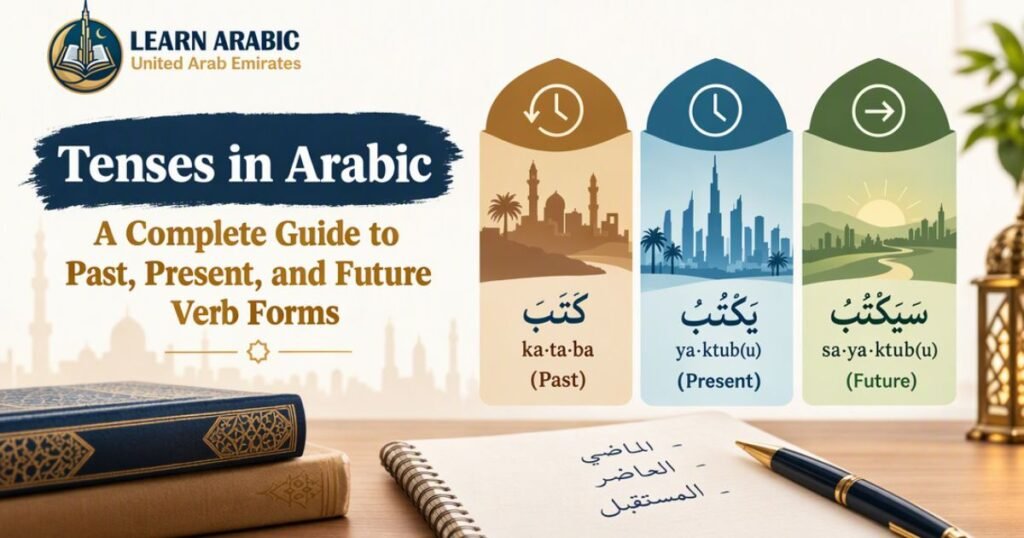
Tenses in Arabic work differently from what most English speakers expect, and that difference is what trips up more beginners than any other part of the grammar.
Once you see how Arabic actually organizes time, the system turns out to be more logical, not less, than English.
At Learn Arabic In the UAE Academy, tense confusion is one of the most common issues new students bring to their first lesson.
This guide walks through every verb tense in Arabic — past, present, future, and the imperative — with the conjugation patterns, time markers, and common mistakes you need to use them correctly.
By the end, you’ll be able to look at an unfamiliar Arabic verb and identify its tense on sight, then build your own sentences in any of them.
What You’ll Learn in This Article
- How many tenses in Arabic actually exist, and why grammar books disagree on the count.
- How to conjugate the past tense (الماضي) using suffixes.
- How to conjugate the present tense (المضارع) using prefixes, and how it doubles as the future.
- How to form commands with the imperative (الأمر).
- The most common mistakes students make with Arabic tenses, and how to avoid them.
How Tenses Work in Arabic Grammar?
Arabic verbs are built around three grammatical forms: الماضي (al-māḍī, the past), المضارع (al-muḍāriʿ, the present), and الأمر (al-amr, the command or imperative).
Classical Arabic grammarians settled on these three because they needed a way to separate verbs from nouns and particles, not because they set out to map time itself.
This is why the system feels compact compared to English. Arabic verbs care first about whether an action is finished or unfinished — grammarians call this aspect — and only secondarily about the clock.
The same past-tense form, for instance, can describe something that happened yesterday or something completed only a second ago; the form doesn’t change, because the completion is what matters.
Future meaning isn’t a separate conjugation at all. It’s built by adding a particle — سَـ (sa) or سَوْفَ (sawfa) — to the present tense. That single design choice is the reason Arabic tenses in Arabic can look simpler on paper than they are in practice: three visible forms carry four functional time meanings.
How the Past Tense Works in Arabic (الماضي)?
الماضي marks any action that reached its endpoint, regardless of when it happened. It’s the form you’ll see first in most textbooks, because it’s also the dictionary form used to look up a verb.
The past tense is built by adding suffixes to a fixed verb stem, so once you learn the pattern for one verb, you can apply it to thousands of others.
We’ll use كَتَبَ (kataba, “he wrote”) as the model verb throughout this guide, the same way most Arabic grammar references do.
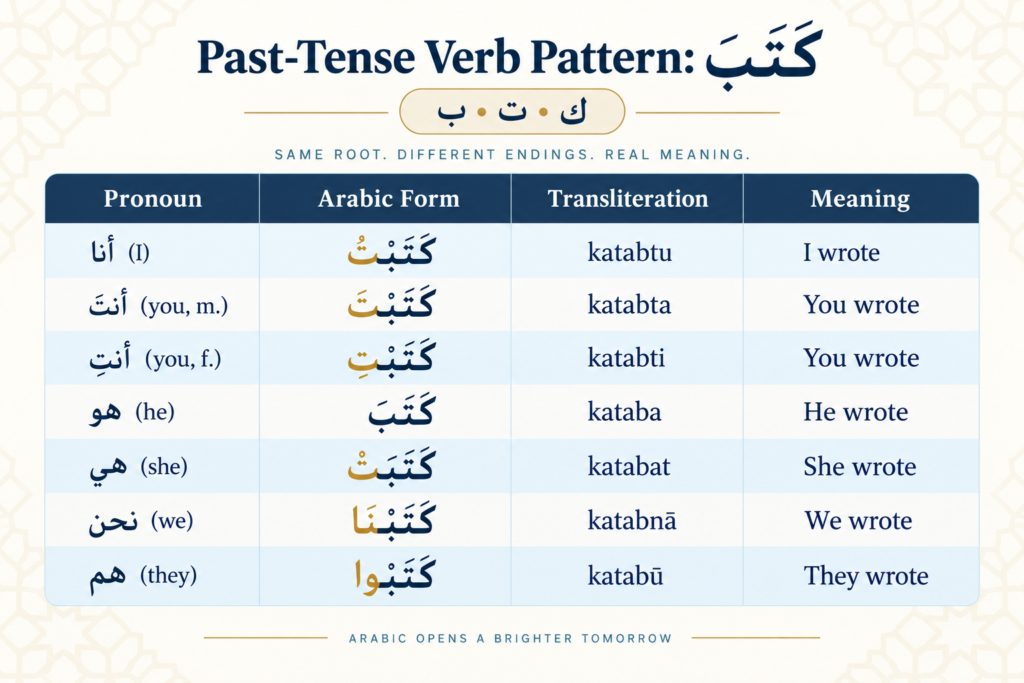
Conjugating الماضي means attaching the right suffix to the verb stem for each subject — the stem itself never changes, only the ending does. The table below shows the full pattern using كَتَبَ (kataba, “he wrote”) as the model verb, so you can see exactly which suffix goes with which pronoun.
| Pronoun | Arabic Form | Transliteration | Meaning |
| أنا (I) | كَتَبْتُ | katabtu | I wrote |
| أنتَ (you, m.) | كَتَبْتَ | katabta | You wrote |
| أنتِ (you, f.) | كَتَبْتِ | katabti | You wrote |
| هو (he) | كَتَبَ | kataba | He wrote |
| هي (she) | كَتَبَتْ | katabat | She wrote |
| نحن (we) | كَتَبْنَا | katabnā | We wrote |
| هم (they) | كَتَبُوا | katabū | They wrote |
Each pronoun has its own distinctive suffix attached to the same three-letter root. Memorize this pattern once with كتب and you can transfer it directly onto most other regular verbs.
Words That Signal the Past Tense
Context words make the past tense unmistakable even before you look at the verb form. The most common ones are أمس (ams, “yesterday”), قبل (qabla, “before”), منذ (mundhu, “since/ago”), and في الماضي (fī al-māḍī, “in the past”). Pairing a past-tense verb with one of these removes any ambiguity about timing.
How to Negate the Arabic Past Tense?
There are two accepted ways to negate الماضي, and knowing both saves you from a common beginner mix-up. In everyday speech, placing ما (mā, “not”) directly before the past-tense verb works fine — ما كَتَبْتُ (mā katabtu, “I did not write”).
In formal Modern Standard Arabic, the construction you’ll see in books, news, and official writing is different: لم (lam, “not”) followed by the present-tense verb in its jussive form, as in لَمْ أَكْتُبْ (lam aktub, “I did not write”). Use ما for casual speech and لم when you’re writing or reading formal Arabic.
How the Present Tense Works in Arabic (المضارع)?
المضارع covers everything الماضي doesn’t: actions happening right now, habits, and general truths. Unlike the past tense’s suffix system, the present tense is marked by prefixes attached to the front of the verb stem.
Present Tense Prefixes and Conjugation Patterns
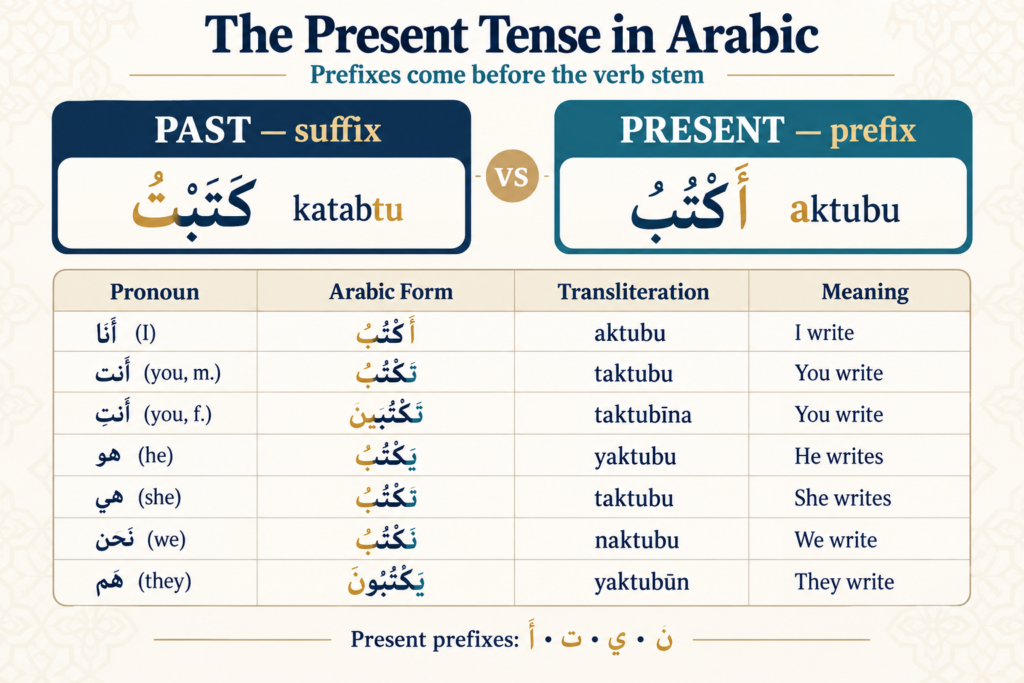
Conjugating المضارع works the opposite way from the past tense: instead of adding a suffix to a fixed stem, you attach a prefix to the front of the verb, and in a few forms a suffix as well.
The table below uses the same model verb, كَتَبَ (kataba, “to write”), so you can compare the two patterns directly.
| Pronoun | Arabic Form | Transliteration | Meaning |
| أنا (I) | أَكْتُبُ | aktubu | I write |
| أنتَ (you, m.) | تَكْتُبُ | taktubu | You write |
| أنتِ (you, f.) | تَكْتُبِينَ | taktubīna | You write |
| هو (he) | يَكْتُبُ | yaktubu | He writes |
| هي (she) | تَكْتُبُ | taktubu | She writes |
| نحن (we) | نَكْتُبُ | naktubu | We write |
| هم (they) | يَكْتُبُونَ | yaktubūn | They write |
The prefixes أ / ت / ي / ن map onto specific pronouns in a pattern that repeats across nearly every verb, which is what makes المضارع feel more predictable once the prefixes click.
Time words such as الآن (al-ān, “now”) and كُلَّ يَوْم (kulla yawm, “every day”) tell you whether a given sentence means an ongoing action or a habitual one, since the verb form alone doesn’t distinguish the two.
How to Negate the Arabic Present Tense?
Negating المضارع is the simplest of the three: place لا (lā, “not”) directly before the conjugated verb.
لا أَكْتُبُ (lā aktubu) means “I do not write” or “I am not writing,” depending on context.
Getting comfortable with prefix patterns takes repetition more than memorization, and that’s exactly where guided practice makes the difference between recognizing a rule and actually using it in conversation.
Learn Arabic In the UAE Academy structures its lessons around live conjugation drills for this reason, so the prefixes stop feeling like a lookup table and start feeling automatic.
Step Inside Our Classrooms
Don’t just take our word for it—see our community in action. Click below to watch real, live snippets from our recent classes and experience our engaging teaching style firsthand!
Master Arabic in the UAE
Experience world-class Arabic language training designed for students and professionals in the Emirates.
Book Your Free TrialRead also: Connecting Arabic Letters Practice
How the Future Tense Works in Arabic?
Arabic doesn’t have a standalone future conjugation. Instead, it attaches a particle to the present tense, which is a more economical system than languages that require a fully separate set of endings.
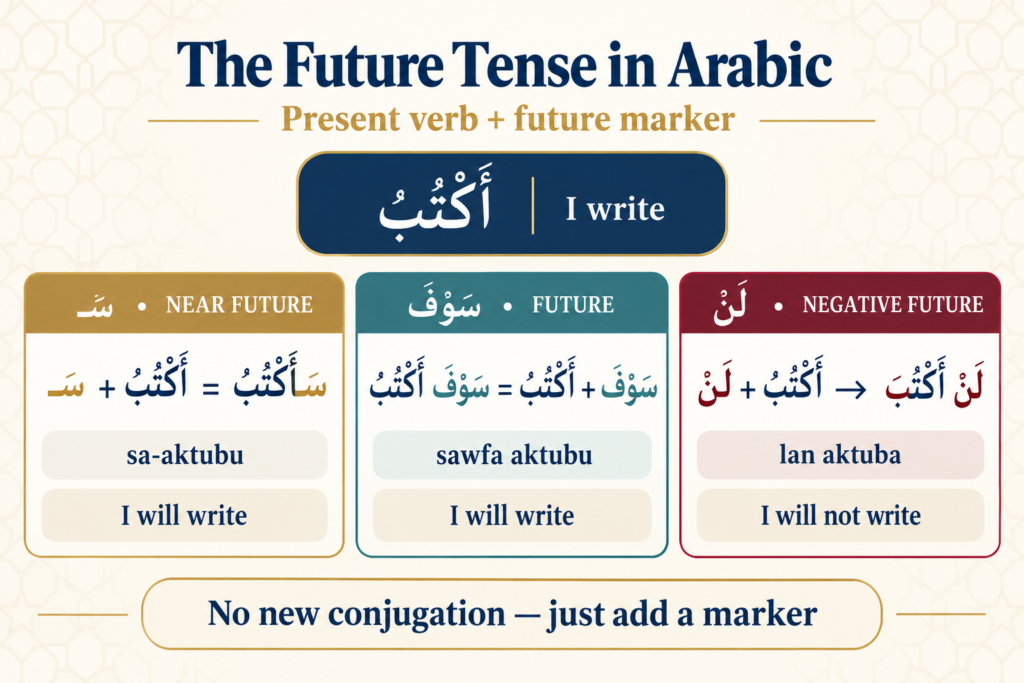
1. Using سَـ and سَوْفَ to Express the Future
سَـ (sa) attaches directly to the front of the present-tense verb: سَأَكْتُبُ (sa-aktubu, “I will write”).
سَوْفَ (sawfa) stands as its own word before the verb: سَوْفَ أَكْتُبُ (sawfa aktubu, “I will write”), and tends to sound slightly more formal.
Both are built from the same present-tense forms shown above — you’re not learning a new conjugation, just adding a marker.
How to Negate the Arabic Future Tense?
لن (lan, “will not”) negates future meaning by combining with the present tense: لَنْ أَكْتُبَ (lan aktuba, “I will not write”). Note that the verb after لن takes the subjunctive ending, which is a small but noticeable shift from the present tense’s usual form.
How the Imperative Form Works in Arabic (الأمر)?
الأمر is the command form: it tells someone to do something, and Arabic grammar traditionally counts it as the third core verb form alongside past and present.
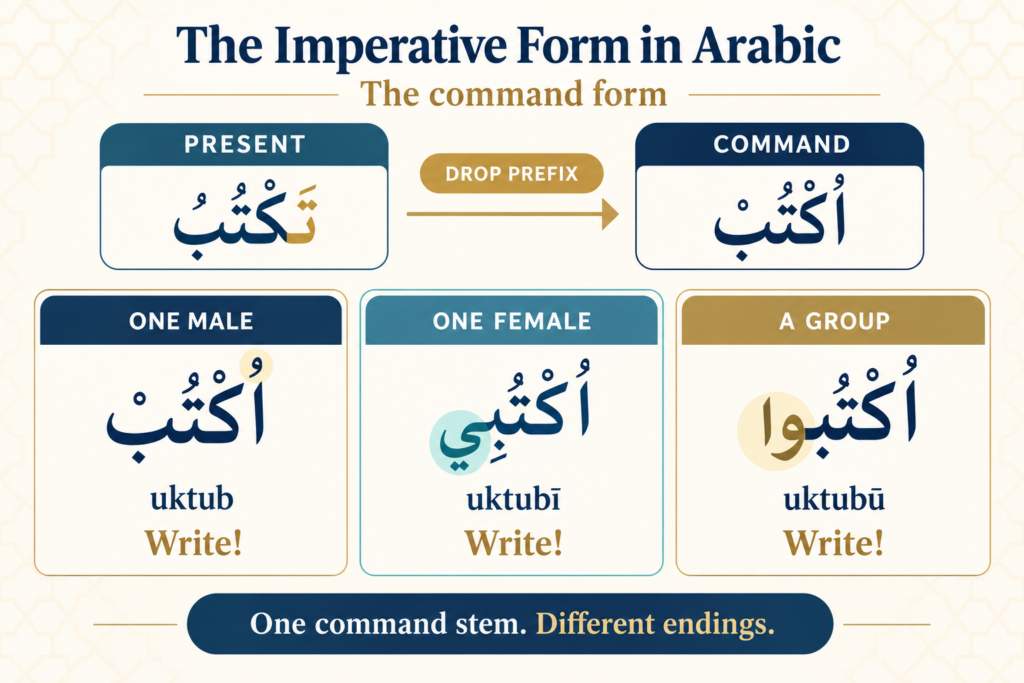
Commands are built from the present-tense stem with the prefix dropped and a short vowel added at the start.
For كتب, the forms are اُكْتُبْ (uktub, “write!” — to one male), اُكْتُبِي (uktubī, “write!” — to one female), and اُكْتُبُوا (uktubū, “write!” — to a group). Each ending mirrors the gender and number patterns you already saw in the present tense.
How to Identify Arabic Verb Tenses Quickly?
When you’re reading a sentence and need to work out a verb’s tense quickly, a three-point check handles the vast majority of cases.
- Check the ending first: A suffix like ـتُ, ـتَ, ـتِ, or ـنَا attached to a bare stem almost always signals الماضي.
- Check the front of the verb: A prefix — أ, تَ, يَ, or نَ — with no suffix marks المضارع.
- Check for a particle: سَـ or سَوْفَ before a present-tense verb pushes it into the future; لن also marks future, but in the negative.
This three-point check is worth memorizing on its own, since it works even on verbs you’ve never seen before — the prefix and suffix patterns hold across almost the entire language.
How Arabic Verb Roots Affect Tense Conjugation?
Every Arabic verb is built from a three-letter root that carries the core meaning, and tenses are formed by adding prefixes, suffixes, and internal vowel patterns around that root rather than by using separate helper words the way English uses “did,” “is,” or “will.”
This is why كتب alone can generate كَتَبَ, يَكْتُبُ, سَيَكْتُبُ, and اُكْتُبْ — four tense forms from one three-letter core.
Not every root behaves the same way, though. Sound verbs — roots made entirely of strong consonants, like ك-ت-ب — follow the regular patterns shown above without exception. Weak verbs, which contain و, ي, or ا in the root, and doubled verbs, where the second and third root letters are identical, shift or drop letters during conjugation.
قَالَ (qāla, “he said”) becomes قُلْتُ (qultu, “I said”) in the past tense rather than the pattern you’d expect from a sound verb — a detail that trips up students who’ve only practiced with regular roots.
Recognizing which category a verb falls into before you try to conjugate it saves a lot of guesswork, and it’s exactly the kind of pattern-spotting that’s easier to build with a tutor correcting you in real time than with a textbook alone.
This matters just as much for professional Arabic as for everyday conversation — a workplace email with the wrong tense reads as sloppy, which is one reason the Business Arabic Course UAE and the Arabic Language Classes for Professionals in UAE both dedicate early lessons to exactly this kind of conjugation accuracy.
Common Arabic Tense Mistakes and How to Avoid Them
Three mistakes account for most of the tense errors we see in new students.
The first is assuming Arabic has a full future conjugation the way French or Spanish does, and hunting for a fourth set of endings that doesn’t exist — the future is always just المضارع plus a particle.
The second is applying sound-verb patterns to weak or doubled roots without checking, which produces forms native speakers won’t recognize.
The third is mixing negation particles — using لا on a past-tense verb instead of ما or لم — which is grammatically wrong even though the meaning is usually still understood.
None of these are difficult to fix once you know to watch for them; they’re just easy to miss without correction, which is the main advantage of learning tenses with a tutor rather than from a book alone.
How Tenses Work in Gulf and Emirati Arabic?
Everything covered so far describes Modern Standard Arabic, the grammatical system taught in books and used in formal writing across the Arab world.
Daily conversation in the UAE runs on Gulf and Emirati Arabic, which keep the same three-way logic — completed, ongoing, and command — but simplify some of the endings and swap in different future markers in casual speech.
If your goal is reading and writing formal Arabic, the rules in this guide apply directly. If your goal is speaking with people day to day in the UAE, it’s worth pairing this grammar foundation with dialect-specific practice — which is exactly what the Emirati Arabic Course and Gulf Arabic Course are built around.
Students working across the wider region sometimes also study alongside Learn Saudi Arabic, since Gulf dialects share a lot of common ground.
Read also: Arabic Short Vowels
How to Teach Arabic Tenses to Children?
Children generally learn the same three-tense structure faster than adults do, because simplified examples land better than grammatical explanations.
A sentence like أكلَ الولدُ (the boy ate) taught alongside its present and command forms is usually enough to build the pattern recognition kids need before introducing exceptions like weak verbs.
If you’re introducing tenses at home or in a classroom, our related guides on Arabic vocabulary for kids and how to teach kids Arabic in the UAE walk through age-appropriate ways to introduce verbs before layering in tense rules.
See Our Classroom Environment in Action
Experience a sneak peek into our live sessions. Watch the video below to see our specialized instructors interacting with students, breakdown complex texts, and cultivate an engaging, respectful learning environment.
Master Arabic in the UAE
Experience world-class Arabic language training designed for students and professionals in the Emirates.
Book Your Free TrialMaster Arabic Tenses with Learn Arabic in the UAE Academy
Reading about tense rules only gets you partway there — the patterns stick once you’ve used them in real conversation, with someone correcting the small mistakes before they become habits.
Learn Arabic In the UAE Academy pairs every student with a tutor who drills conjugation directly into speaking practice, so tenses in Arabic stop being a grammar chart and start being something you use without thinking.
Our Arabic courses:
- Arabic Course in the UAE
- Arabic Intensive Course
- Arabic Classes for Beginners (Learn Arabic from Scratch)
- Madinah Arabic Course
- Arabic Classes for Adults
- Self-Paced Arabic Course
- Arabic Speaking Classes
- Learn to Write Arabic Course
- Arabic Grammar Course
- Learn Arabic Alphabet Course
- Modern Standard Arabic (MSA) Course

Conclusion
Tenses in Arabic come down to three core forms — الماضي, المضارع, and الأمر — with future meaning layered onto the present tense through سَـ and سَوْفَ rather than a conjugation of its own.
Past-tense suffixes, present-tense prefixes, and imperative endings all build from the same three-letter root system, which is what makes the pattern transferable across thousands of verbs once you’ve learned it in one.
The details that trip students up — weak verbs, negation particles, and the gap between formal grammar and everyday Gulf speech — are all fixable with focused practice rather than more memorization.
Understanding how tenses in Arabic actually work is the foundation Learn Arabic In the UAE Academy builds every course on, from absolute beginners through professional and dialect-specific tracks.

Frequently Asked Questions
Here are direct answers to the questions students ask most often about tenses in Arabic, along with a few points this guide didn’t cover in full above.
1. How many tenses does Arabic have?
Arabic has two fully conjugated tenses — past (الماضي) and present (المضارع) — plus a separate imperative form (الأمر) for commands. Future meaning is created by adding سَـ or سَوْفَ to the present tense rather than through a fourth conjugation.
2. How do you negate a verb in each Arabic tense?
Past-tense verbs are negated with ما in casual speech or لم plus the present-tense jussive form in formal writing. Present-tense verbs take لا before the verb, and future meaning is negated with لن plus the subjunctive form.
3. Do spoken Arabic dialects use the same tenses as Modern Standard Arabic?
Gulf and Emirati Arabic keep the same three-part logic of completed, ongoing, and command actions, but simplify some endings and use different everyday future markers than formal MSA. Learning MSA grammar first still gives you the pattern recognition dialect speech builds on.
4. What’s the easiest way to start practicing Arabic tenses?
Start with one model verb — most learners use كتب (kataba, “to write”) — and drill its past, present, future, and command forms until the prefix and suffix patterns feel automatic. From there, applying the same patterns to new verbs becomes far faster than learning each one from scratch.
5. Is Arabic future tense a separate conjugation?
No. Arabic future meaning comes from attaching the particle سَـ (sa) or the word سَوْفَ (sawfa) to a present-tense verb, not from a distinct set of endings. This makes the future the easiest tense to learn once you already know the present.
6. What’s the difference between المضارع and the future?
المضارع on its own describes ongoing, habitual, or general-truth actions happening now. Adding سَـ or سَوْفَ to that same form shifts the meaning forward in time — the verb conjugation itself doesn’t change, only the particle attached to it.
Related Articles
Learn Arabic




Leave a Reply