 Learn Arabic
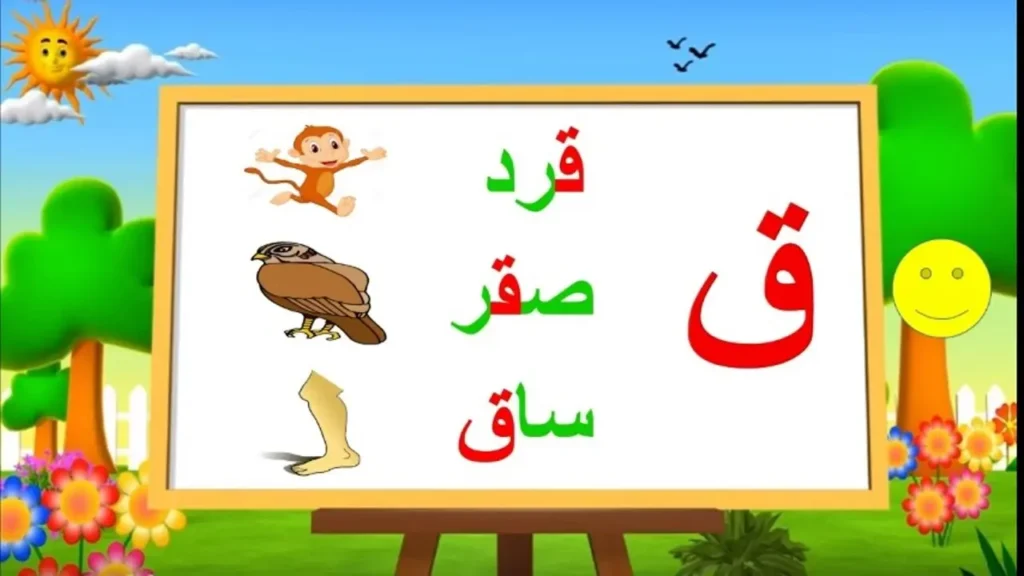
Learning the letter Qaf in Arabic (ق) is a milestone moment for any Arabic student. It is one of the letters that immediately signals whether a speaker has genuinely studied the language or simply approximated it — because ق has no equivalent in English, and guessing it never sounds right.
This guide covers everything you need: where the sound comes from in your mouth, how to pronounce it with every vowel marking, how to write it in all four positional forms, how to practice it inside real Arabic words, and how to stop confusing it with the letter ك (Kaf). By the end, you will have a complete, actionable understanding of ق — not just a surface-level introduction.
What Is the Letter Qaf in Arabic (ق)?
The letter Qaf (ق) is the twenty-first letter of the Arabic alphabet. It belongs to a category of Arabic sounds called guttural consonants — letters produced deep in the throat or at the very back of the mouth, far further back than any English consonant is produced.
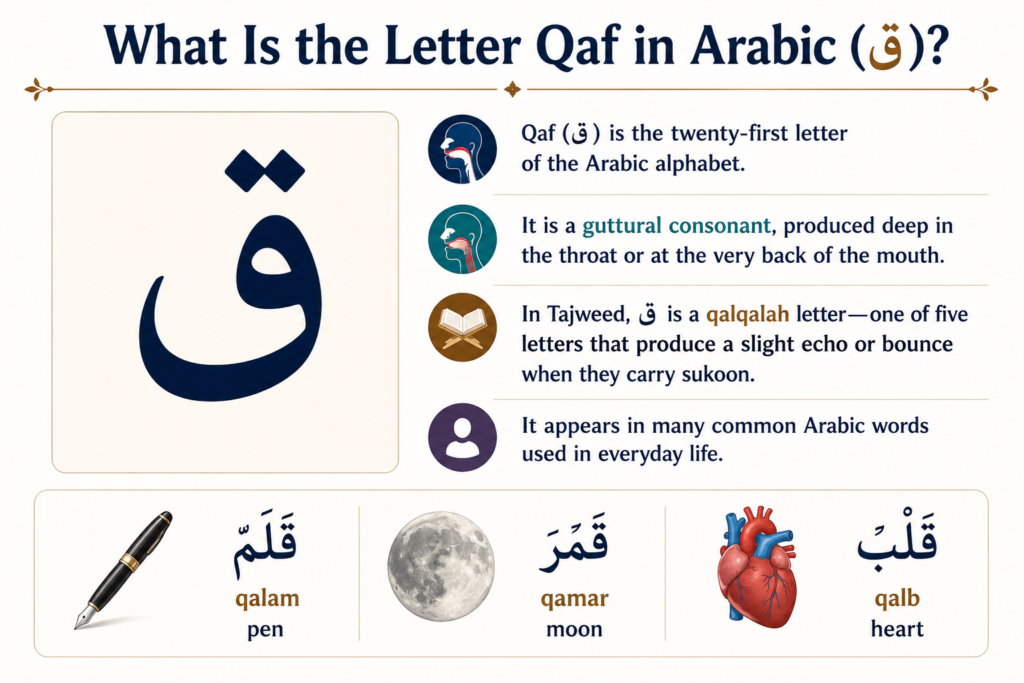
In Arabic phonology, ق is classified as a qalqalah letter in Tajweed (one of five letters that produce a slight echo or bounce when they carry sukoon in Quranic recitation), which is a detail that becomes important when reading the Quran. Outside of Tajweed, it functions as a standard consonant — but its articulation point remains unique.
The letter appears in some of the most common Arabic words in daily life: qalam (قَلَم, pen), qamar (قَمَر, moon), and qalb (قَلْب, heart). Getting ق right is not an advanced skill — it is foundational vocabulary.
How to Produce the Arabic ق (Qāf) Sound Correctly?
Pronouncing ق (Qāf) correctly begins with understanding where the sound is produced. Unlike many Arabic consonants that use the front or middle of the tongue, ق is articulated at the back of the mouth, where the back of the tongue approaches the soft palate.
1. Position the Back of Your Tongue
The main part of the tongue involved in producing ق is its back portion. Raise the back of your tongue toward the soft area at the back of the roof of your mouth.
Avoid trying to pronounce ق with the tip of your tongue. The articulation should occur much farther back in the mouth.
2. Find the Soft Palate
The other important area is the soft palate, located toward the back of the roof of the mouth.
When pronouncing ق, the back of the tongue makes firm contact with this area, temporarily blocking the airflow.
3. Block and Release the Airflow
To produce ق, raise the back of your tongue until it makes complete contact with the soft palate. Hold the airflow for a brief moment, then release the contact cleanly.
This makes ق a stop consonant: airflow is temporarily blocked and then released. The result should be a distinct sound produced at the back of the mouth.
4. Practice ق Without a Vowel
Before adding vowel markings, practice the basic articulation on its own. Focus on three movements:
Raise the back of the tongue → block the airflow → release
Once this movement feels comfortable, practice ق with the three main short vowels:
قَ — قِ — قُ
Repeating these combinations slowly will help you maintain the correct articulation while moving naturally between ق and different vowel sounds.
How to Pronounce the Letter Qaf in Arabic (ق) with Harakat?
Arabic vowel markings — called harakat (حركات) — are written above or below a letter and change the vowel sound attached to that consonant. The letter Qaf (ق) can carry five different harakat, each producing a different syllable.
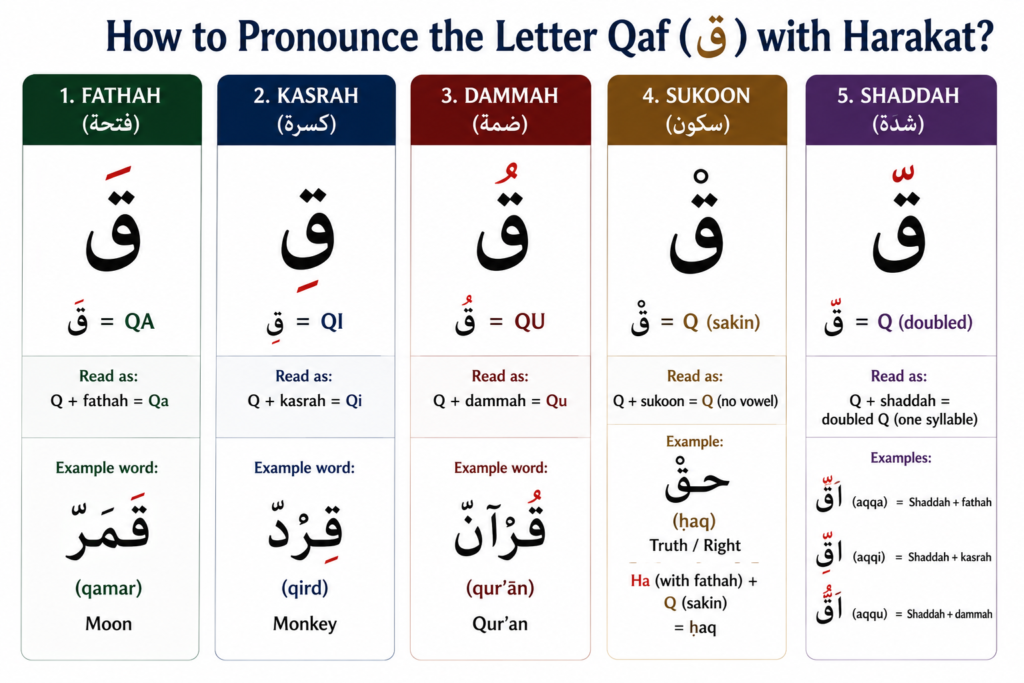
Fathah (فتحة)
The fathah is a small diagonal line written above the letter. It produces an “AA” sound, similar to the “a” in “cat.”
قَ = QA
Read as: Q + fathah = Qa
Example word: قَمَرٌ (qamar) — Moon. The first syllable is a clean “qa” sound — deep Q from the throat followed immediately by the “a” vowel.
Kasrah (كسرة)
The kasrah is a small diagonal line written below the letter. It produces an “EE” sound, similar to the “ee” in “feet” but shorter.
قِ = QI
Read as: Q + kasrah = Qi
Example word: قِرْدٌ (qird) — Monkey. The ق here carries a kasrah, so the first sound is a deep “qi” from the back of the throat.
Dammah (ضمة)
The dammah is a small comma-like symbol written above the letter. It produces a “UU” sound, similar to the “oo” in “book.”
قُ = QU
Read as: Q + dammah = Qu
The dammah gives ق a rounder, fuller sound. Practice it by rounding your lips slightly as you release the back-of-throat contact.
Jazm / Sukoon (جزم / سكون)
The sukoon is a small circle written above the letter. It means the letter carries no vowel — it is silent in terms of a vowel sound, and it connects to what comes before it.
قْ = Q sakin
A letter with sukoon is called sakin (still). It cannot stand alone as a syllable — it always follows a vowelled letter.
Example: حَقْ = ح with fathah (ha) + قْ with sukoon (q sakin) = ḥaq
This pattern — a vowelled letter followed by a sakin — is extremely common in Arabic, especially at the end of words. Getting comfortable with ق sakin prepares you for a large portion of everyday Arabic vocabulary.
Shaddah (شدة)
The shaddah is a small “w”-shaped symbol written above the letter. It means the letter is doubled — the sound is held and released as one emphatic movement, not two separate sounds.
A letter with shaddah is called mushadad. Phonetically, the shaddah means you approach the articulation point twice but release once — think of the doubled “tt” in the Italian word tutto.
Shaddah is always combined with one of the other harakat:
- اَقَّ (aqqa) — shaddah + fathah
- اَقِّ (aqqi) — shaddah + kasrah
- اَقُّ (aqqu) — shaddah + dammah
One common learner mistake with shaddah: separating it into two syllables (“a-qa-qa” instead of “aq-qa”). The shaddah produces one syllable with extra weight on the consonant, not two separate syllables.
If you want to practice harakat with a native Arabic speaker who can correct your pronunciation in real time, the Arabic courses for kids at Learn Arabic UAE offer structured sessions that cover exactly this foundation.
Give Your Kids a Great Start in Arabic with a FREE Trial Class in the UAE

Words with the Letter Qaf (ق)
Reading about pronunciation is useful. Actually saying words aloud with ق in different positions is what builds the muscle memory. Practice each of the following words by identifying where ق appears, which harakat it carries, and producing the correct sound:
| Arabic | Transliteration | Meaning | Position of ق |
| قَائِمْ | qāyim | Standing / Upright | Initial |
| مَقَامْ | maqām | Location / Station | Medial |
| قَمَرٌ | qamar | Moon | Initial |
| قِرْدٌ | qird | Monkey | Initial |
| قَائِدْ | qāyid | Leader | Initial |
| قَلْبٌ | qalb | Heart | Initial |
| قَلَمْ | qalam | Pen | Initial |
| حَقْ | ḥaq | Truth / Right | Final (sakin) |
A note on the word مَقَامْ (maqām): this is a particularly useful practice word because ق appears in the middle of the word carrying a fathah. Many learners produce ق correctly at the start of a word but weaken it in medial position. Use this word to train consistency — the back-of-throat contact must be equally firm whether ق leads the word or sits in the middle of it.
For listening practice, look up recordings of native Arabic speakers reciting Quranic verses containing ق — the letter is extremely common in Quranic text, and recitations by certified reciters provide clean, precise articulation models.
Read also: The Arabic Letter ر (Rāʾ) – Pronunciation, Writing, and Practice Guide
How to Write the Arabic Letter ق (Qāf)?
Arabic is written from right to left, and ق (Qāf) is a connecting letter. It can connect to letters on both sides when the surrounding letters allow connection. As a result, its written form changes slightly depending on its position within a word.
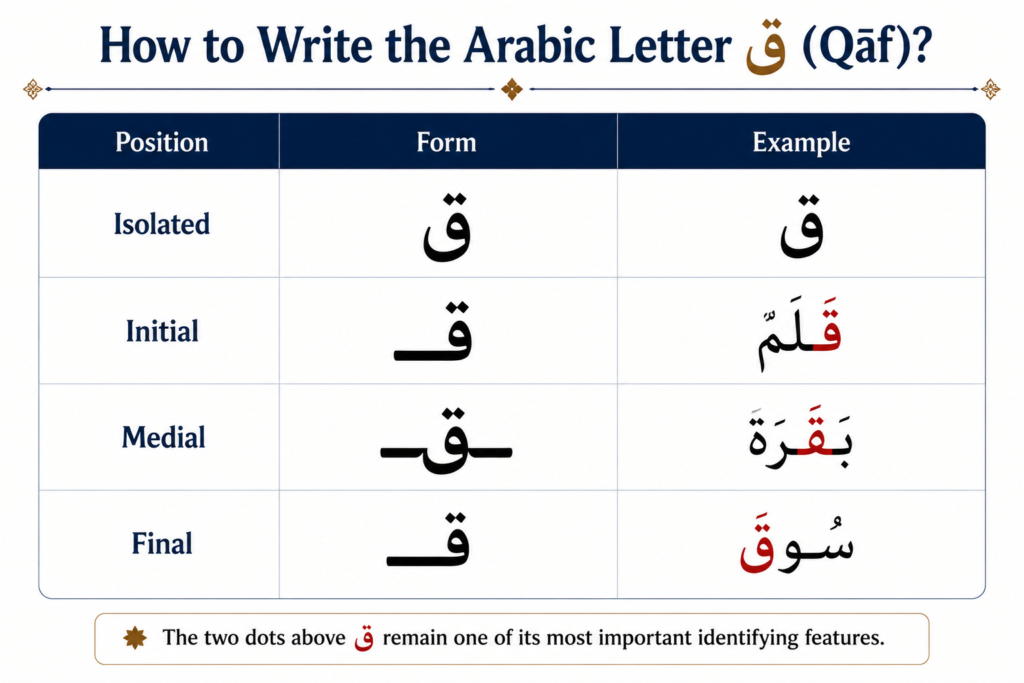
The Four Written Forms of ق
The table below shows how ق appears when it is isolated or positioned at the beginning, middle, or end of an Arabic word.
| Position | Form | Example |
| Isolated | ق | ق |
| Initial | قـ | قَلَم |
| Medial | ـقـ | بَقَرَة |
| Final | ـق | سُوق |
Although the connecting strokes change, the two dots above ق remain one of its most important identifying features.
Step Inside Our Classrooms
Don’t just take our word for it—see our community in action. Click below to watch real, live snippets from our recent classes and experience our engaging teaching style firsthand!
Master Arabic in the UAE
Experience world-class Arabic language training designed for students and professionals in the Emirates.
Book Your Free TrialCommon Mistakes When Writing ق
Beginners may make a few common mistakes when learning to write ق. Paying attention to its dots and overall shape makes the letter much easier to distinguish from similar Arabic letters.
1. Confusing ق with ف
The letters ق and ف (Fāʾ) can look similar, especially in their connected forms. The easiest way to distinguish them in standard Arabic writing is by counting the dots:
- ق — two dots above
- ف — one dot above
Practice writing them side by side:
ق — ف — ق — ف
Remembering the number of dots will help you identify each letter quickly when reading and writing.
2. Making ق Look Like و
Another mistake is drawing the body of ق incorrectly, particularly in its isolated or final form. This can sometimes make it resemble و (Wāw).
How to fix it: Pay attention to the distinctive body of ق and always include its two dots above. Practice its four forms repeatedly:
ق — قـ — ـقـ — ـق
Regular handwriting practice will help you recognize and produce ق naturally in different word positions.
Read also: The Letter Dha in Arabic ظ – Pronunciation, Writing, and Full Practice Guide
The Difference Between ق (Qaf) and ك (Kaf)
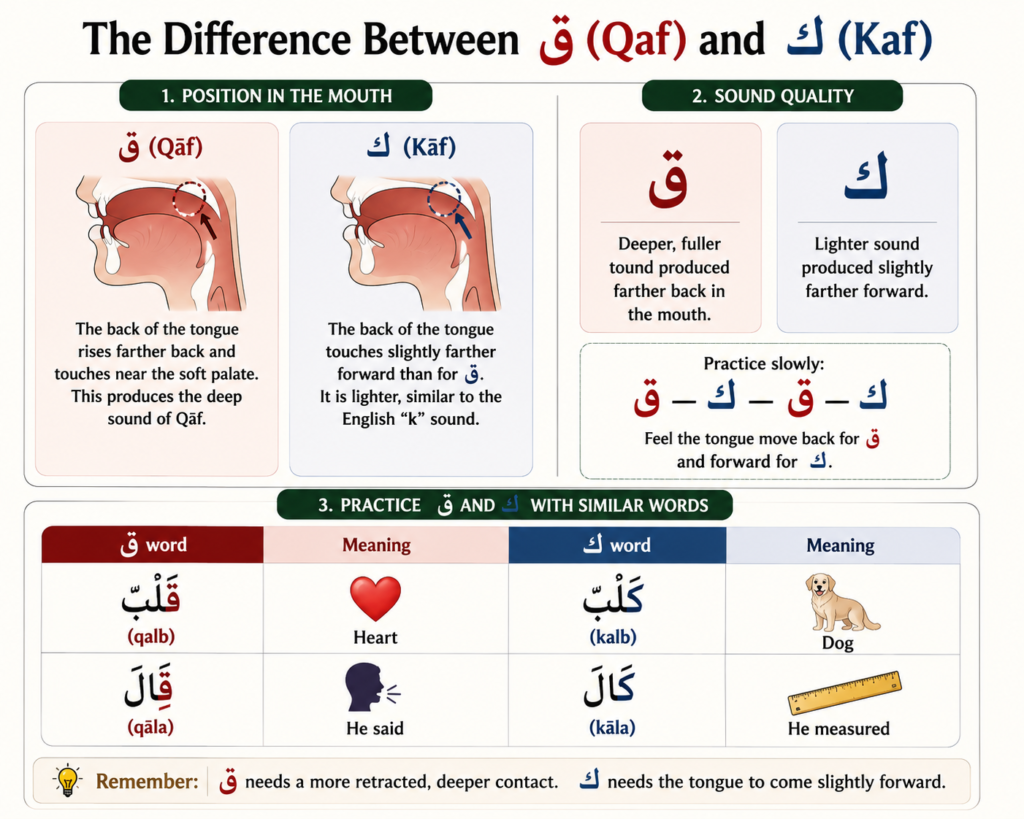
This is the most important phonetic distinction for any learner of Arabic pronunciation. Both ق and ك are produced at the back of the mouth — but they are not the same sound, and mixing them up changes word meanings completely.
Position in the Mouth
The main difference between ق and ك is where the back of the tongue makes contact.
ق (Qāf): The back of the tongue rises farther back in the mouth and makes contact near the soft palate. This produces the characteristic deep sound of Qāf.
ك (Kāf): The tongue makes contact slightly farther forward than it does for ق. Its pronunciation is lighter and is relatively close to the English “k” sound in words such as king and cat.
A useful exercise is to alternate slowly between:
ق — ك — ق — ك
Pay attention to how the tongue moves slightly forward for ك and farther back for ق.
Sound Quality
The two letters also have noticeably different sound qualities:
- ق has a deeper, fuller sound produced farther back in the mouth.
- ك has a lighter sound produced slightly farther forward.
Rather than thinking of ق simply as a “heavy K,” focus on learning its distinct articulation point. This will help you produce a clearer difference between the two Arabic letters.
3. Practice ق and ك with Similar Words
The fastest way to train this distinction is to alternate between words that differ only by ق versus ك:
| ق word | Meaning | ك word | Meaning |
| قَلْبٌ (qalb) | Heart | كَلْبٌ (kalb) | Dog |
| قَالَ (qāla) | He said | كَالَ (kāla) | He measured |
Say each pair aloud, slowly, focusing on changing your tongue position between the two sounds. The ق requires a more retracted, deeper contact — reaching further back each time. The ك needs the tongue to come slightly forward.
If you have never had a teacher explicitly correct this distinction, there is a reasonable chance you are blending the two sounds. This is one of the highest-value things a native Arabic instructor can fix in a single session. Check out the full range of Arabic programs at Learn Arabic UAE to find structured pronunciation coaching that addresses exactly this.
Find the Right Arabic Program for You in the UAE with a FREE Trial Class

Common Pronunciation and Writing Mistakes with ق
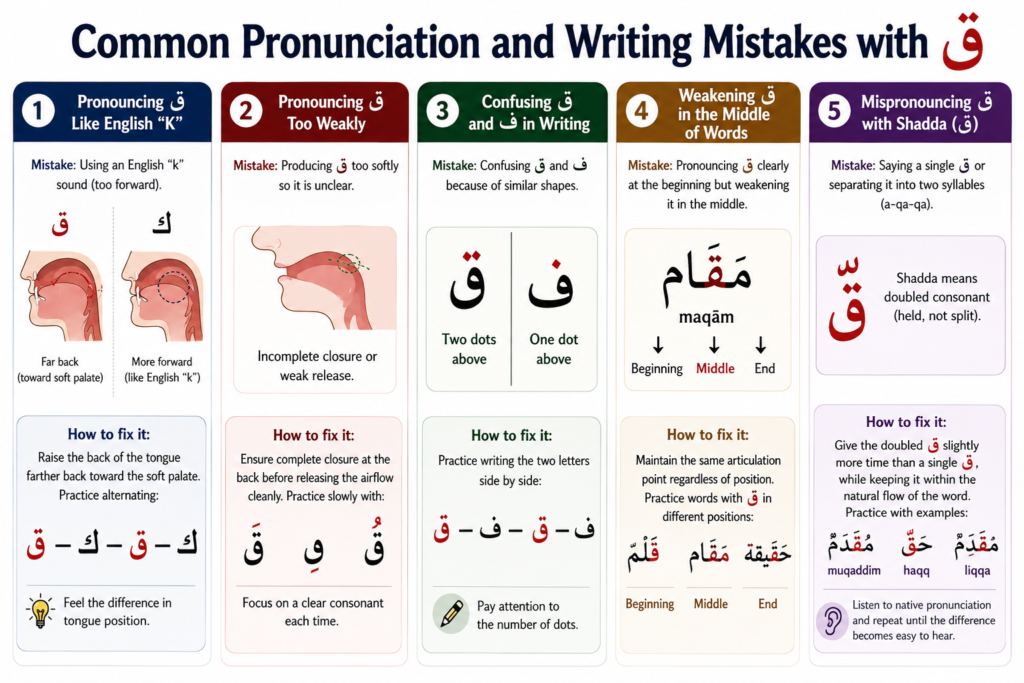
Learning ق (Qāf) can be challenging because its pronunciation requires an articulation point that may be unfamiliar to beginners. Recognizing the following common mistakes can help learners improve both their pronunciation and writing.
1. Pronouncing ق Like English “K”
A common mistake is replacing ق with an English “k” sound. Although the sounds may seem similar to beginners, ق is articulated farther back in the mouth than ك or the English “k.”
How to fix it: Focus on raising the back of the tongue farther back toward the soft palate. Practice alternating between:
ق — ك — ق — ك
This helps you feel the difference in tongue position.
2. Pronouncing ق Too Weakly
Some learners produce ق too softly because its articulation feels unfamiliar. This can make the sound unclear.
How to fix it: Make sure the back of the tongue creates complete closure before releasing the airflow cleanly. Practice slowly with:
قَ — قِ — قُ
Focus on producing a clear consonant each time rather than forcing or exaggerating the sound.
3. Confusing ق and ف in Writing
Because ق and ف have similar shapes in standard Arabic script, beginners may confuse them when reading or writing.
Remember:
- ق — two dots above
- ف — one dot above
How to fix it: Practice writing the two letters side by side:
ق — ف — ق — ف
Pay particular attention to the number of dots.
4. Weakening ق in the Middle of Words
Some learners pronounce ق clearly at the beginning of a word but weaken it when it appears in the middle.
For example:
مَقَام — maqām
How to fix it: Maintain the same articulation point regardless of where ق appears. Practice words containing Qāf at the beginning, middle, and end.
5. Mispronouncing ق with Shadda
When ق carries a Shadda (قّ), the consonant is doubled. A common mistake is either pronouncing it as a single ق or separating it unnaturally into two syllables.
How to fix it: Give the doubled قّ slightly more time than a single ق, while keeping it within the natural flow of the word. Practice listening to native pronunciation and repeating examples containing قّ until the difference becomes easier to hear and produce.
Read also: The Arabic Letter ط (Ṭāʾ) – Pronunciation, Writing, and Practice Guide
See Our Classroom Environment in Action
Experience a sneak peek into our live sessions. Watch the video below to see our specialized instructors interacting with students, breakdown complex texts, and cultivate an engaging, respectful learning environment.
Build Strong Arabic Pronunciation with Learn Arabic UAE
Most pronunciation habits — including how learners produce ق — are formed in the first few months of study. Fixing a deeply ingrained wrong articulation later takes significantly more effort than learning it correctly from the start.
At Learn Arabic UAE, native Arabic teachers guide students through the alphabet with precision, correcting articulation at the letter level before bad habits set in. Programs are available for children and adults, with flexible scheduling and live sessions via Zoom and Skype.
[Book a Free Trial Lesson Today]

Our Arabic courses
- Arabic Course in the UAE
- Arabic Intensive Course
- Arabic Classes for Beginners (Learn Arabic from Scratch)
- Quranic Arabic Course
- Fusha Arabic Course
- Classical Arabic Course
- Emirati Arabic Course
- Gulf Arabic Course
- Learn Saudi Arabic
- Business Arabic Course UAE
- Arabic Language Classes for Professionals in UAE
Master Arabic in the UAE
Experience world-class Arabic language training designed for students and professionals in the Emirates.
Book Your Free TrialConclusion
The letter Qaf in Arabic (ق) is produced at the furthest-back articulation point of any Arabic letter — where the root of the tongue meets the soft palate near the throat. It carries all five harakat (fathah, kasrah, dammah, sukoon, and shaddah), each producing a distinct syllable. It appears in four written forms depending on its position in a word, and its two dots above the bowl distinguish it visually from ف (Fa).
The single most important skill to develop alongside ق pronunciation is the ability to distinguish it clearly from ك (Kaf) — a lighter, more forward sound that shares the back-of-mouth region but is produced at a different point on the palate. Training this distinction through minimal pairs like qalb (heart) and kalb (dog) is one of the most practical pronunciation exercises available.
Master ق and you will have conquered one of Arabic’s most challenging sounds — the one that most clearly separates learners who have studied the language carefully from those who haven’t.
FAQs
What is the letter Qaf in Arabic (ق)?
The letter Qaf (ق) is the twenty-first letter of the Arabic alphabet. It is a guttural stop consonant produced where the root of the tongue meets the soft palate near the throat. It has no direct equivalent in English and must be learned through explicit articulation training.
How do you pronounce ق correctly?
Press the root of your tongue firmly against the soft palate at the back of your mouth — the area near the uvula, called lahāẗu al-ḥalqi in Arabic. Block the airflow, then release it suddenly. That release produces the sound ق. Practice the release motion first without any vowel, then add fathah, kasrah, or dammah.
What is the difference between ق (Qaf) and ك (Kaf)?
Both are produced at the back of the mouth, but at different points. Qaf (ق) is produced at the soft palate near the throat — the furthest-back position — giving it a thick, heavy sound. Kaf (ك) is produced slightly further forward on the palate, giving it a lighter sound similar to the English “K.” Mixing them up changes word meanings — for example, qalb (قَلْبٌ, heart) versus kalb (كَلْبٌ, dog).
How many forms does the letter ق have in Arabic writing?
The letter Qaf (ق) has four written forms: isolated, initial (start of word), medial (middle of word), and final (end of word). All four forms share the distinctive deep bowl shape and two dots above. The connecting lines change depending on position, but the dots always identify it as ق rather than ف.
What does shaddah do to the letter ق?
Shaddah (ّ) doubles the consonant — the articulation point is approached twice but released once, producing a heavier, more emphatic sound. The common mistake is treating it as two separate syllables. With shaddah, ق produces one emphatic release, not “qa-qa.”
How can children learn the letter Qaf more easily?
Children learn guttural sounds fastest through audio repetition and live correction from a native speaker. Structured Arabic courses that teach letters with consistent vowel-marking practice — hearing ق with fathah, kasrah, and dammah in real words — build accurate pronunciation before incorrect habits form. Starting early, before English phonetic habits are fully fixed, gives children a significant advantage.
Related Articles
Learn Arabic




Leave a Reply