 Learn Arabic
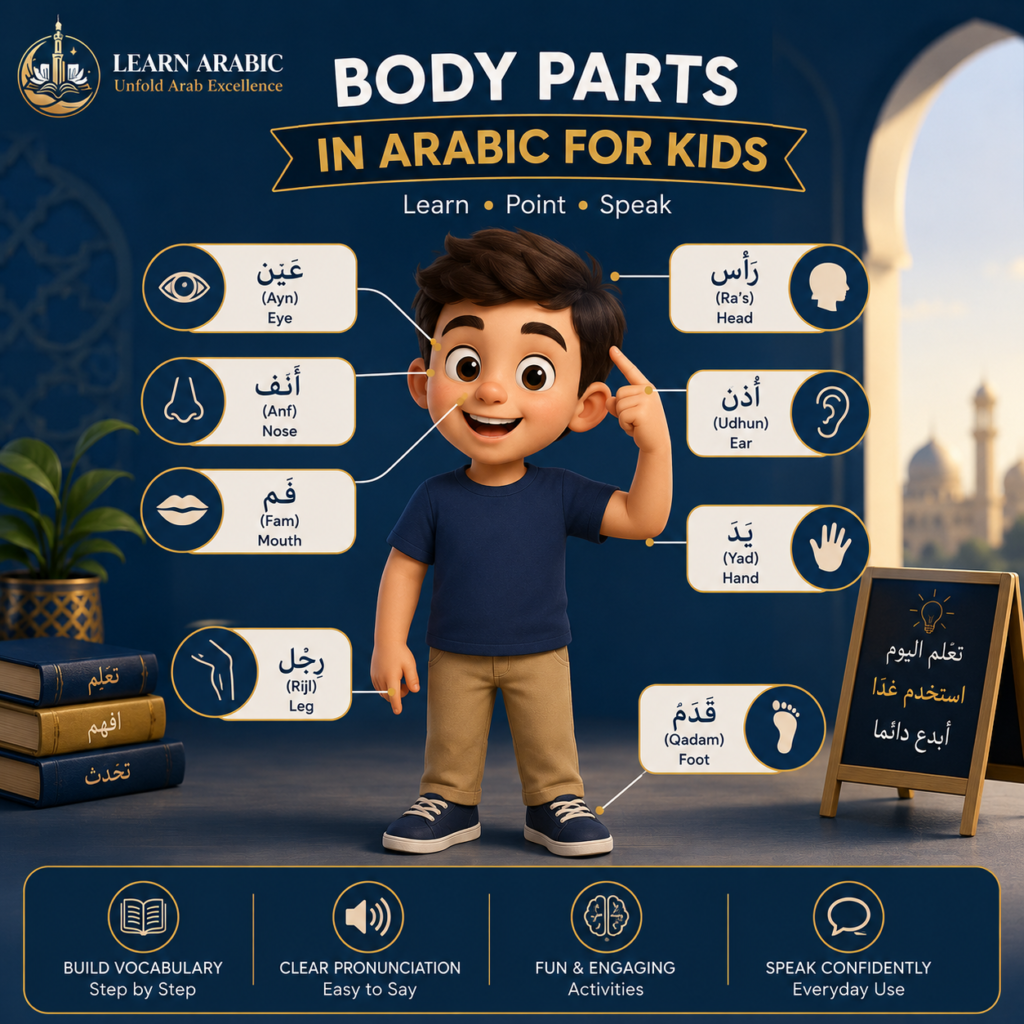
Teaching a child their first words in a new language usually starts with something they can point to on their own body. That’s why body parts in Arabic are one of the most useful vocabulary sets for young learners — every word has an immediate, physical meaning, and kids can practice it anywhere, without flashcards or a screen.
This guide walks through the core body parts in Arabic for kids, with clear meanings, simple pronunciation, and practical ways to teach them at home. Whether your child is just starting out or already knows a few Arabic words, you’ll find a structured path here.
By the end, you’ll have a full vocabulary reference plus real teaching methods you can use today — no prior Arabic knowledge required on your part.
What you’ll learn in this article
- The Arabic names for the main head, arm, and leg parts, with meanings
- How to say “my head,” “my hand,” and other possessive forms kids use daily
- The difference between singular and “two” (dual) forms, explained simply
- Practical games and routines that help body-part vocabulary stick
- Answers to the most common questions parents ask about teaching this topic
Basic Body Parts in Arabic for Kids
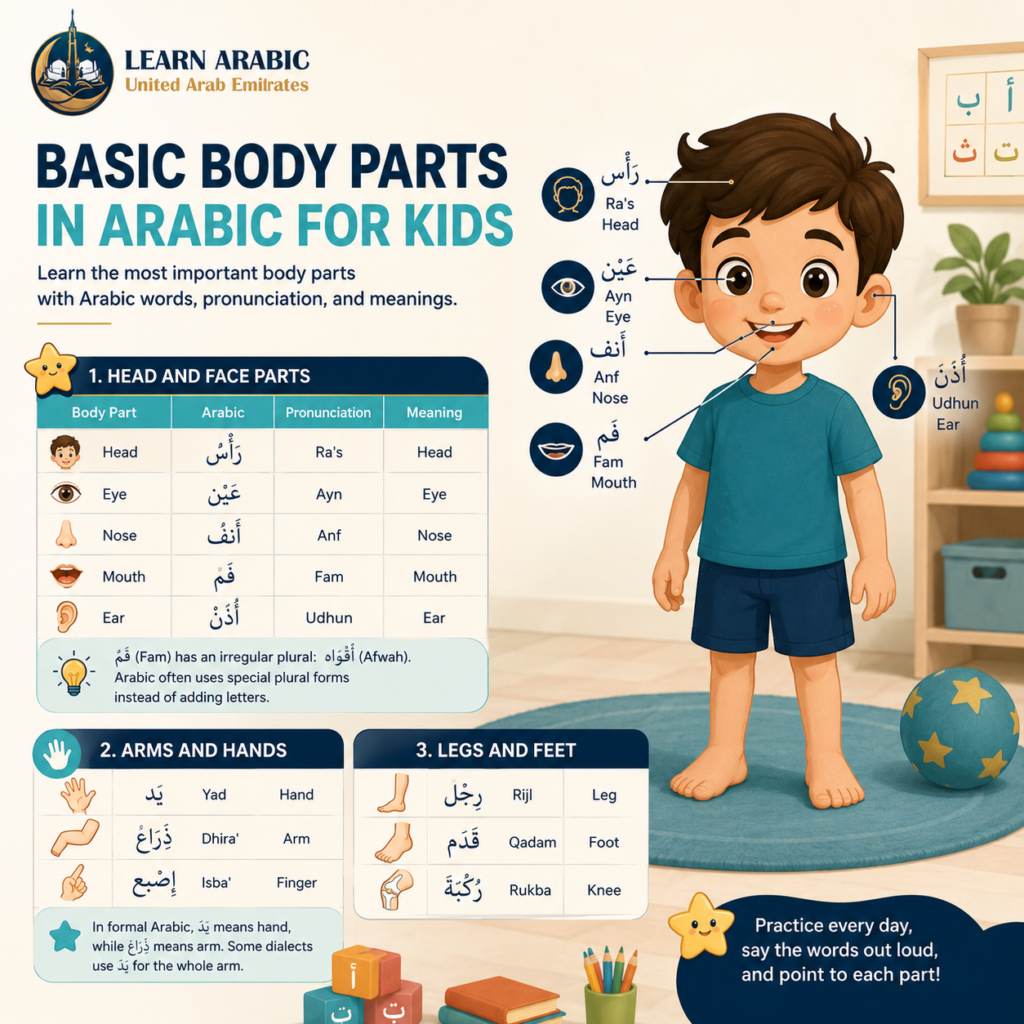
Arabic groups body vocabulary the same way English does — head and face, then arms and hands, then legs and feet. Starting with these three groups gives a child a complete, usable vocabulary before moving to smaller details like fingers or joints.
1. Head and Face Parts
The head (رَأْس — Ra’s) is usually the first word taught, since it’s the easiest to point to and the most repeated in songs and games.
| Body Part | Arabic | Pronunciation | Meaning |
| Head | رَأْس | Ra’s | Head |
| Eye | عَيْن | Ayn | Eye |
| Nose | أَنْف | Anf | Nose |
| Mouth | فَم | Fam | Mouth |
| Ear | أُذُن | Udhun | Ear |
A useful detail for parents: فَم (Fam) has an irregular plural, أَفْوَاه (Afwah), rather than a word built by simply adding letters to the end. Arabic does this with a number of everyday nouns, and body parts are a gentle, low-pressure way to introduce that pattern before a child hits it in reading later on.
2. Arms and Hands
Once a child knows the face words, the arm and hand words follow the same repeat-and-point method.
- يَد (Yad) — hand
- ذِرَاع (Dhira’) — arm
- إِصْبَع (Isba’) — finger
One distinction worth explaining early: in formal Arabic, يَد refers specifically to the hand, while ذِرَاع refers to the arm. Some spoken dialects blur this and use يَد for the whole arm — it’s worth mentioning to a child once they’re a little older, so they’re not confused when they hear both usages.
3. Legs and Feet
The lower body follows the same short list format, which keeps early lessons from becoming overwhelming.
| Body Part | Arabic | Pronunciation |
| Leg | رِجْل | Rijl |
| Foot | قَدَم | Qadam |
| Knee | رُكْبَة | Rukba |
A common teaching mistake here is introducing all twelve or more body parts in one sitting. Young learners retain vocabulary better in groups of four or five, reviewed over several short sessions rather than one long one. If your child is working through this kind of structured list, a live tutor can pace it appropriately — this is exactly the kind of sequencing our Arabic tutors for kids build into every lesson, adjusting the number of new words per session to the child’s age and attention span.
Begin Your Child’s Arabic Learning Journey with a FREE Trial Class

Step Inside Our Classrooms
Don’t just take our word for it—see our community in action. Click below to watch real, live snippets from our recent classes and experience our engaging teaching style firsthand!
Master Arabic in the UAE
Experience world-class Arabic language training designed for students and professionals in the Emirates.
Book Your Free TrialRead more: Famous Arabic Quotes About Life and Success
Complete Body Parts in Arabic for Kids Vocabulary
Now that you’ve learned the main body-part groups, here’s a complete reference table with some of the most common body parts in Arabic for kids. Keep this list handy for daily practice, flashcards, and simple speaking activities.
| English | Arabic | Transliteration |
| Head | رَأْس | Ra’s |
| Hair | شَعْر | Sha’r |
| Eye | عَيْن | Ayn |
| Ear | أُذُن | Udhun |
| Nose | أَنْف | Anf |
| Mouth | فَم | Fam |
| Teeth | أَسْنَان | Asnan |
| Neck | رَقَبَة | Raqabah |
| Shoulder | كَتِف | Katif |
| Arm | ذِرَاع | Dhira’ |
| Hand | يَد | Yad |
| Finger | إِصْبَع | Isba’ |
| Chest | صَدْر | Sadr |
| Stomach | بَطْن | Batn |
| Leg | رِجْل | Rijl |
| Knee | رُكْبَة | Rukbah |
| Foot | قَدَم | Qadam |
| Toe | إِصْبَع القَدَم | Isba’ al-Qadam |
This vocabulary list covers many of the body parts children hear and use most often in everyday Arabic. Rather than trying to memorize every word at once, focus on learning four or five new words at a time and review them regularly through songs, games, and simple conversations. Once these core words become familiar, children will find it much easier to understand classroom instructions, follow Arabic stories, and describe themselves confidently.
Read Also: Learn Quranic Vocabulary
Our Students Reviews
body parts in arabic for kids with meaning
In Arabic, possession is shown by adding the suffix -ي (-i) directly onto the noun — no separate word for “my” is needed. This single rule unlocks dozens of useful phrases at once.
| Body Part | Arabic | “My [Body Part]” | Meaning |
| Head | رَأْس | رَأْسِي (Ra’si) | My head |
| Eye | عَيْن | عَيْنِي (Ayni) | My eye |
| Hand | يَد | يَدِي (Yadi) | My hand |
| Foot | قَدَم | قَدَمِي (Qadami) | My foot |
| Stomach | بَطْن | بَطْنِي (Batni) | My stomach |
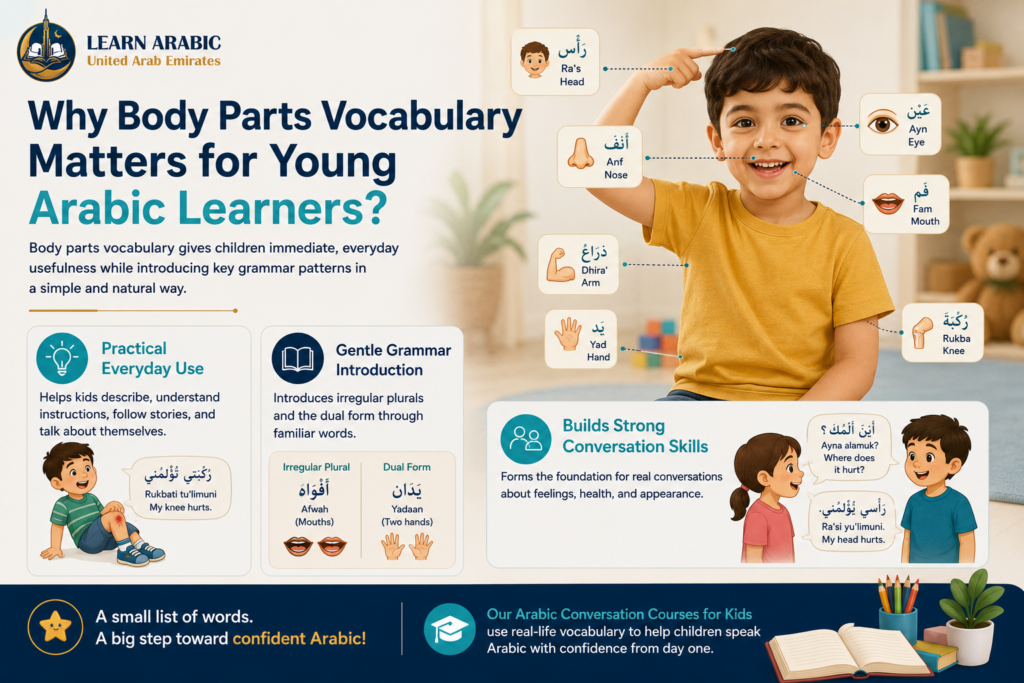
This possessive form matters practically, too — it’s how a child tells a parent or doctor exactly what hurts. “رَأْسِي يُؤْلِمُنِي” (Ra’si yu’limunii) simply means “my head hurts,” and it’s one of the most functional phrases a young Arabic learner can carry into daily life.
Two Eyes, Two Hands: Understanding the Dual Form
Arabic has a grammatical feature English doesn’t: a separate “dual” form used specifically for exactly two of something. For body parts, this comes up constantly, since eyes, hands, legs, and feet naturally come in pairs.
- Two eyes → عَيْنَان (Aynaan)
- Two hands → يَدَان (Yadaan)
- Two feet → قَدَمَان (Qadamaan)
For kids, it’s easiest to teach the dual form as its own small set rather than a grammar rule — most children pick up “yadaan” as simply “the word for two hands,” the same way they’d learn any new vocabulary word, without needing the underlying grammatical explanation.
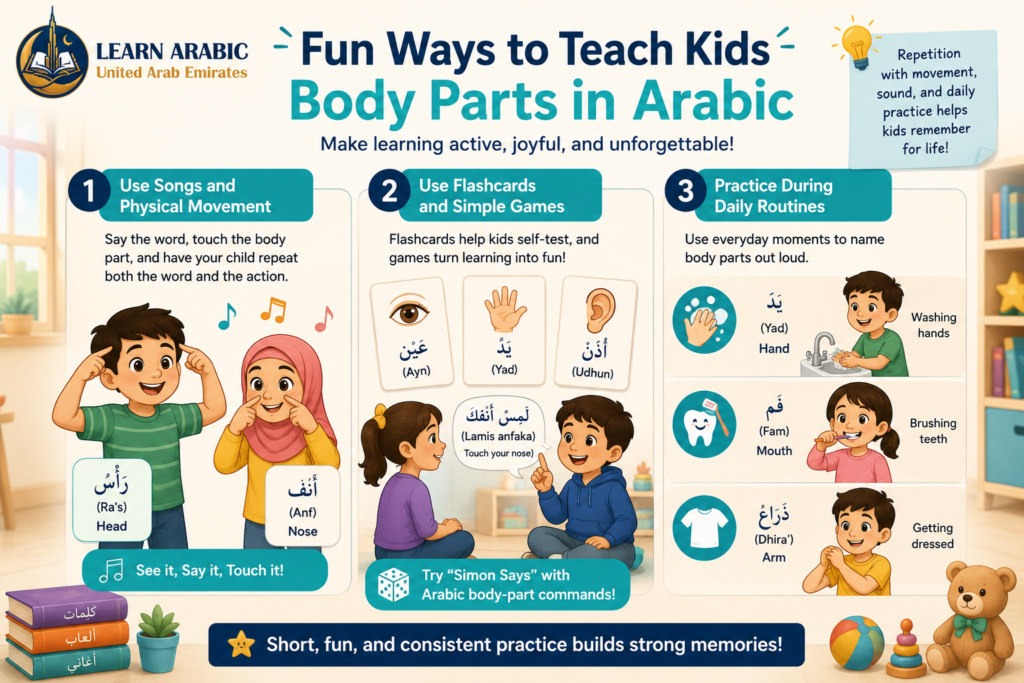
Fun Ways to Teach Kids Body Parts in Arabic
Repetition works, but repetition alone gets boring fast for a young child. Pairing the words with movement, sound, and daily routine is what turns a vocabulary list into something a child actually remembers.
1. Use Songs and Physical Movement
A simple method that works across ages: say the word, touch the body part, and have the child repeat both the word and the action together. This “See it, Say it, Touch it” approach links the sound of the Arabic word to a physical sensation, which is a stronger memory anchor than sound alone. Songs that repeat body-part names in a fixed sequence (head, shoulders, knees) work the same way in Arabic as they do in English, whether children learn through classroom activities or body parts in Arabic for kids YouTube videos, because the rhythm carries the vocabulary and makes each word easier to remember.
2. Use Flashcards and Simple Games
Flashcards with the Arabic word on one side and a picture on the other let a child self-test without needing a parent to quiz them constantly. A basic “Simon Says” game using Arabic body-part commands (لَمِسْ أَنْفَكَ — touch your nose) turns passive vocabulary into active listening comprehension, which is a different and important skill.
3. Practice During Daily Routines
Washing hands before a meal, brushing teeth, or getting dressed are all natural moments to name the body part involved out loud. This kind of built-in repetition, spread across a normal day, tends to outperform a single dedicated study session — the words get reinforced in context rather than in isolation.
If you want this kind of structured, playful repetition without having to design it yourself, our Arabic summer courses for kids are built specifically around short, high-frequency sessions during the break, when kids have more time to absorb new vocabulary without school competing for their attention.
Give Your Teen a Head Start in Arabic with a FREE Trial Class

Read more: Food in Arabic Language
Why Body Parts Vocabulary Matters for Young Arabic Learners?
Body parts vocabulary gives a child immediate, everyday usefulness — describing a scrape, following an instruction, or understanding a story. It also introduces two grammar patterns (irregular plurals and the dual form) gently, through words a child already understands the meaning of, rather than through abstract grammar drills. That combination — practical use plus low-pressure grammar exposure — is why this topic is often taught in the first weeks of a children’s Arabic curriculum rather than saved for later.
Vocabulary like this also transfers directly into conversation practice once a child has the basic list down — describing how they feel, what hurts, or what someone looks like all build on these same words. Our Arabic conversation courses for kids use exactly this kind of everyday vocabulary as a starting point, so children move from naming words to using them in real sentences.
Begin Your Child’s Arabic Conversation Journey with a FREE Trial Class
See Our Classroom Environment in Action
Experience a sneak peek into our live sessions. Watch the video below to see our specialized instructors interacting with students, breakdown complex texts, and cultivate an engaging, respectful learning environment.
Master Arabic in the UAE
Experience world-class Arabic language training designed for students and professionals in the Emirates.
Book Your Free TrialHelp Your Child Learn Body Parts in Arabic with Expert Teachers in the UAE
Building a strong Arabic vocabulary starts with the words children use every day. At UAE Arabic Learning Academy, young learners discover body parts in Arabic through fun, interactive online lessons led by native Azhari-trained tutors. Our practical teaching approach encourages children to speak, listen, and use new vocabulary naturally, making every lesson both enjoyable and effective.
- Native Arab Azhari-trained tutors specializing in children’s Arabic education
- Practical lessons that teach body parts through real-life conversations
- Interactive games and activities that keep children engaged
- Continuous guidance to improve pronunciation and vocabulary retention
- Flexible online classes for families across all UAE emirates
- Free trial lesson available
Book your child’s free trial lesson today and help them build a strong Arabic vocabulary from the very beginning.

Our Arabic Courses for Kids
- Arabic for Kids
- Arabic Conversation for Kids
- Arabic Qaida for Kids
- Beginner Arabic for Kids
- Arabic Grammar for Kids
- Teen Arabic Summer Course
- UAE Kindergarten Arabic Classes
Master Arabic in the UAE
Experience world-class Arabic language training designed for students and professionals in the Emirates.
Book Your Free TrialConclusion
Body parts in Arabic are one of the most practical vocabulary sets a young learner can start with — words like رَأْس (head), يَد (hand), and قَدَم (foot) are used every day, easy to demonstrate physically, and open the door to possessive forms and the dual number without a single grammar lecture. Teaching this vocabulary through movement, routine, and short repeated sessions, rather than one long list, is what makes it stick. Once a child has this foundation, body parts in Arabic naturally lead into fuller conversation and everyday description skills.
The key is consistency rather than speed. A few minutes of interactive practice each day—using songs, games, picture cards, or simple conversations—helps children remember new words more effectively than occasional long study sessions. As their vocabulary grows, they’ll be able to understand simple instructions, describe themselves with confidence, and build a strong foundation for learning Arabic naturally.
FAQs about Body Parts in Arabic for Kids
Whether you’re teaching Arabic at home or supporting your child’s language learning, these frequently asked questions cover the essentials of learning body parts in Arabic for kids.
What are the easiest body parts in Arabic for kids to learn first?
The easiest starting words are رَأْس (Ra’s — head), عَيْن (Ayn — eye), يَد (Yad — hand), and قَدَم (Qadam — foot). These four are short, easy to point to, and appear constantly in songs, games, and daily routines, making them ideal first words for a child’s Arabic vocabulary.
How do you say “my body parts” in Arabic?
To say “my [body part]” in Arabic, add the suffix -ي (-i) to the end of the word — for example, رَأْسِي (Ra’si, “my head”) or يَدِي (Yadi, “my hand”). For paired body parts like eyes or hands, the dual possessive form changes slightly, as in عَيْنَايَ (Aynaaya, “my two eyes”).
What is the meaning of common Arabic body part words used with kids?
Body parts in Arabic with meaning include رَأْس (Ra’s) meaning head, عَيْن (Ayn) meaning eye, يَد (Yad) meaning hand, and قَلْب (Qalb) meaning heart. Teaching the meaning alongside the word — rather than the word alone — helps children connect sound and concept from the first lesson.
Are there good videos to teach kids body parts in Arabic?
Video and song-based resources can reinforce body-part vocabulary well, since they combine sound, repetition, and visual pointing in one format. That said, videos work best as a supplement to guided practice — a live tutor can correct pronunciation and check a child’s understanding in ways a video alone cannot.
At what age should a child start learning body parts in Arabic?
Most children can begin learning basic body-part vocabulary in Arabic from around age three or four, once they can already point to and name body parts in their first language. Starting with a short list of four to five words and building up gradually works better than introducing the full vocabulary set at once.
Related Articles
Learn Arabic



Leave a Reply