 Learn Arabic
Your child can start learning Arabic for kids online free in the UAE today — no subscription, no classroom commute, and no complicated setup.
Whether you are an expat family in Dubai trying to connect your child to their heritage, or a local parent looking to supplement school lessons, the UAE context makes free Arabic learning more accessible than almost anywhere else in the world.
Between dedicated apps, YouTube channels, interactive platforms, and government-supported initiatives, the resources are already there.
The resources below are genuinely free, accessible from the UAE, and appropriate for children. Each one is described with enough detail to help you decide whether it fits your child right now.
Read Also: Education Vocabulary in Arabic: The Complete Word List with Pronunciation
1. 3asafeer (عصافير) — Best Free Platform for Arabic Reading
3asafeer is the most comprehensive free Arabic reading platform available for children. It combines graded storybooks, cartoon lessons, interactive exercises, and educational games — all within one platform and all free at the basic access level.
What makes it genuinely valuable rather than just another website is its use of the عربي 21 classification system — the only certified Arabic grading framework for children’s literature. Books are sorted by reading difficulty, which means a child progresses through authentic Arabic texts at exactly the right level: not so easy they stop engaging, not so hard they give up.
The platform reports over 2.2 million active learners and more than 1.7 million books read in a single month. Those are engagement numbers, not just download counts.
3asafeer also offers cartoon episodes and learning units that tie stories to games and worksheets. It is available on iOS, Android, and web — and works from any UAE device without restriction.
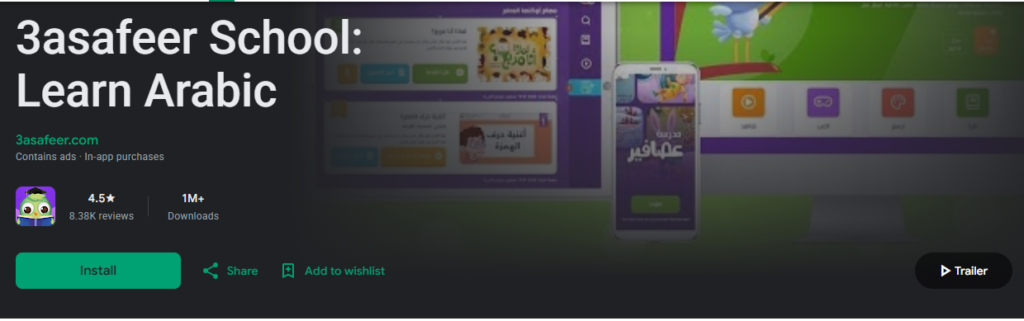
This app is best for children aged 3–18 developing Arabic reading fluency; works for both native speakers and non-native learners.
Read also: Arabic Sentences for Kids
2. Alefbata (أ ب ت) — Best Free App for Learning the Arabic Alphabet
Alef Ba ta is a focused app for children aged 4 to 10 who need to learn the Arabic alphabet course and basic vocabulary. It uses play-based activities — matching letters to images, building simple words, and memory games — to build the foundation every Arabic learner needs before they can read or write.
The app does not try to teach grammar or full sentences. It does one thing: builds letter recognition and early vocabulary association through repetitive play. That narrow focus is its strength.
A child who completes Alefbata consistently knows all 28 Arabic letters and a meaningful set of everyday vocabulary — which is exactly what they need before moving to a reading platform like 3asafeer.
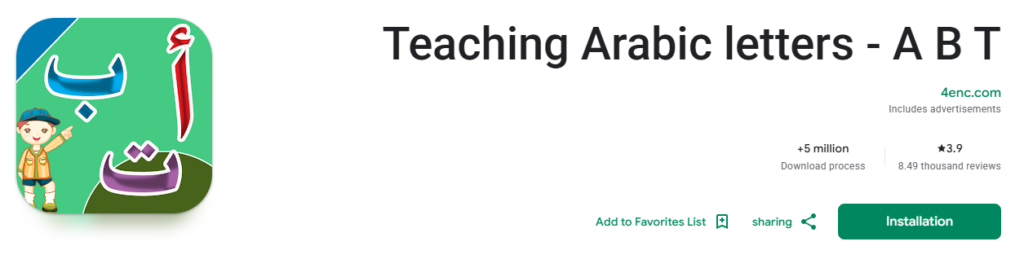
It is suitable for complete beginners aged 4–10; ideal as the first Arabic app for a child starting from zero.
3. Duolingo Arabic — Best Free App for Building a Daily Learning Habit
Duolingo needs no introduction as a language learning platform, and its Arabic course is one of the most accessible free options available to UAE families — particularly for children aged 8 and up who are capable of reading English instructions. The app uses short, gamified daily lessons built around streaks, points, and rewards to make consistent practice feel like a game rather than a chore.
Each lesson runs between five and ten minutes and covers vocabulary, basic phrases, letter recognition, and simple sentence construction. The interface is colourful and deliberately low-pressure: children respond to picture prompts, match words to translations, and tap letters to build words — all without needing a parent to sit beside them and guide the session.
One honest limitation worth knowing: Duolingo teaches Modern Standard Arabic, and its Arabic course is currently less developed than its Spanish or French offerings. It covers the Arabic script and foundational vocabulary well, but does not go deep into grammar or conversation.
Think of it as a habit-builder and vocabulary tool rather than a complete Arabic curriculum. Used daily for ten minutes, it is an excellent supplement to reading platforms like 3asafeer — but it works best as one layer of a broader learning routine, not the whole strategy.
This app is best for children aged 8 and up; families who want a no-effort daily habit that children will actually maintain on their own.
4. Dinolingo Arabic for Kids
Dinolingo is a dedicated children’s language learning platform with a full Arabic course built specifically for ages 2 to 14. Unlike general language apps, Dinolingo was designed from the ground up for young learners: the interface is simple enough for a three-year-old to navigate, the characters are child-friendly, and every lesson is short enough to hold a young child’s attention without losing it.
The Arabic course covers over 1,000 words through animated videos, songs, mini-games, worksheets, and storybooks — all organised by topic (colours, numbers, animals, family, food) and delivered in Modern Standard Arabic with clear audio. Children progress through themed units at their own pace, with parents able to monitor progress through a simple dashboard.
Dinolingo is not free indefinitely — it operates on a subscription model — but it offers a free trial period that gives families a genuine sense of how the platform works before committing.
For UAE families who have tried free apps and want something more structured and age-appropriate for young children, Dinolingo is worth the trial. The combination of video, audio, games, and printable worksheets means it reaches children across different learning styles in a way that single-format apps cannot.
It is ideal for children aged 2–14, particularly younger learners aged 2–7 who need a fully visual, child-designed experience; families who want more structure than YouTube channels but are not yet ready for live instruction.
Read also: Learn Arabic Phrases
Step Inside Our Classrooms
Don’t just take our word for it—see our community in action. Click below to watch real, live snippets from our recent classes and experience our engaging teaching style firsthand!
Master Arabic in the UAE
Experience world-class Arabic language training designed for students and professionals in the Emirates.
Book Your Free Trial5. Karazah Channel (قناة كرزة) — Best Free YouTube Resource for Young Learners
Karazah is a YouTube channel that teaches Arabic fundamentals through high-quality, research-informed educational songs. Its stated goal is to produce reliable, well-produced content that builds a child’s love of Arabic while teaching real language skills — not just entertainment dressed up as education.
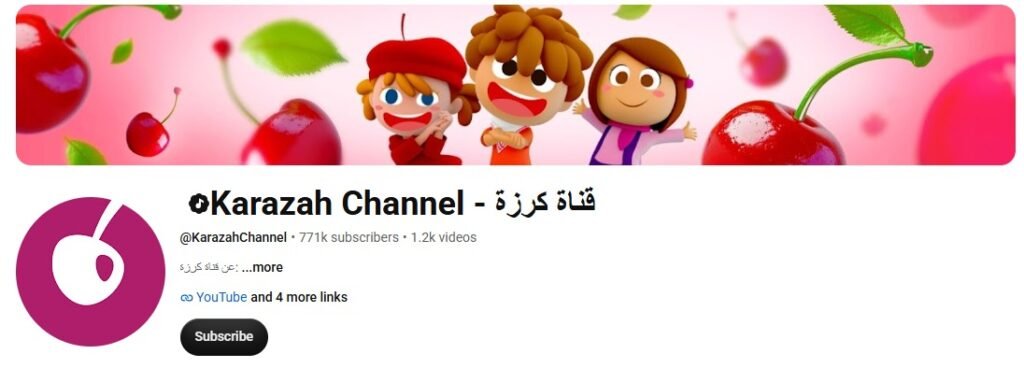
The channel is especially practical for parents of young children who will happily rewatch a favourite song but resist anything that feels like a lesson. Repeated exposure to well-produced Arabic audio builds phonological awareness — the ability to recognise and reproduce Arabic sounds — before a child can formally read. This is a critical but often neglected foundation.
Children who sing Arabic songs regularly before starting formal lessons almost always reach correct pronunciation faster than those who begin with textbooks alone.
This channel is best for children aged 3–7; excellent as a daily habit to build listening exposure and love of the language.
Read also: Best 10 Arabic Cartoons for Kids
6. Learn with Zakaria (تعلم مع زكريا) — Best Free Resource for Multilingual Families
Learn with Zakaria presents Arabic vocabulary, letters, animals, colours, and everyday objects through videos in Arabic, English, and French simultaneously. The format is deliberately funny and warm — the goal is to make children smile and laugh while absorbing language.
For UAE families where Arabic is not spoken at home, this channel fills a specific gap: it meets children in the language they are comfortable with while learning Arabic vocabulary alongside it. Children who feel that Arabic is foreign and difficult often respond well to this kind of low-pressure bilingual exposure before any formal instruction begins.
It is an amazing choice for multilingual families; heritage learners; children for whom Arabic feels unfamiliar or stressful.
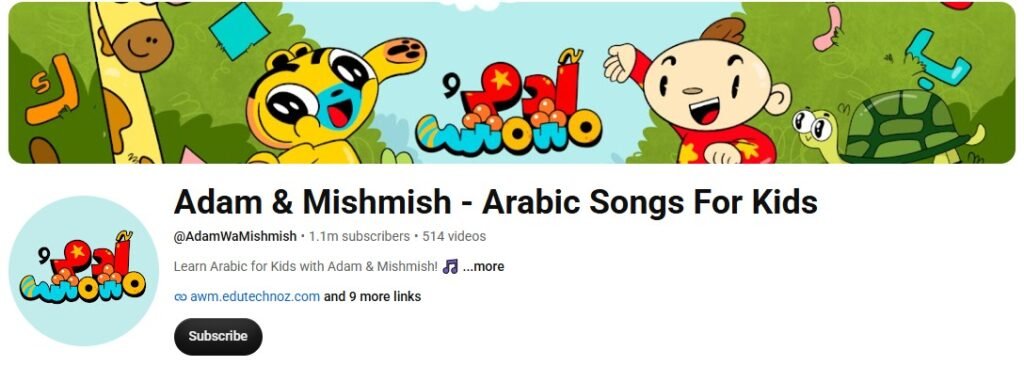
7. Adam wa Mishmish (آدم ومشمش) — Best Free Resource for Toddlers
Adam wa Mishmish is an animated project that uses music as its core teaching mechanism. Episodes are deliberately short — one to three minutes each — and cover a single topic per episode: the alphabet, numbers, shapes, or everyday concepts. The project is designed for children from birth to age five.
The musical approach is grounded in how early language acquisition actually works. Young children absorb language most naturally through rhythm and repetition, and Adam wa Mishmish builds its content entirely around this. Even a parent with no Arabic at all can use it confidently: just press play, sit beside the child, and watch together.
It is suitable for children aged 0–5; the strongest free resource for the very youngest learners.
8. Twinkl — Best Free Source for Arabic Worksheets and Teaching Materials
Twinkl is a global educational platform with a dedicated Arabic-language section covering letters, reading, writing, grammar, and vocabulary across different school levels. Unlike the platforms above, Twinkl is primarily a resource library used by parents and teachers — you download materials, print or display them, and use them in structured activities with your child.
It is particularly useful for UAE parents who are actively involved in their child’s Arabic education and want printable worksheets, illustrated stories, and activity packs to use alongside digital tools. Materials are available for both native speakers and non-native learners.
This app is designed for parents and teachers wanting structured Arabic worksheets and activity resources to use at home or in class.
Enroll your kids in our conversation course in the UAE
Read Also: Learn Quranic Vocabulary
Using Learning Arabic For Kids Online Free Resources Effectively
Downloading five apps and hoping one works is a frustrating approach that most parents eventually abandon. A more effective strategy matches the tool to the child’s specific stage, then uses them consistently and in combination.
Three elements narrow the choice down quickly.
A. The Child’s Arabic Language Level Right Now
A child who cannot yet identify Arabic letters needs Alefbata and audio exposure through Karazah — not 3asafeer. A child who knows all the letters and can read basic words is ready for 3asafeer’s graded stories. Matching the tool to the actual level matters more than matching it to the child’s age.
B. Your Child’s Primary Arabic Learning Goal
Vocabulary building, reading development, listening exposure, and heritage connection are different goals that require different tools. A child in a UAE school who needs to keep up with Arabic lessons needs reading practice above everything else. A child in an expat family who hears no Arabic at home needs listening exposure first.
C. Daily Time Available for Arabic Learning
Ten to fifteen minutes of focused daily use outperforms an hour of scattered, distracted screen time every single time. Set a consistent short session — same time each day — rather than relying on motivation to create the habit.
A practical starting combination for most UAE families: Karazah or Adam wa Mishmish for daily listening exposure (10 minutes), Alefbata for alphabet work if needed (10 minutes), and 3asafeer for reading once letters are established (15–20 minutes). That is a 30–40 minute Arabic day, entirely free.
Read also: How to Learn Arabic in the UAE?
The Limits of Free Arabic Resources — And What to Do Next
Free tools are genuinely effective for building exposure, vocabulary, and early literacy. For many children, particularly young ones in homes where Arabic is spoken regularly, they may be sufficient for the early stages.
Where free platforms consistently fall short is in producing children who can speak, write, and understand Arabic at a functional level — especially when Arabic is not the home language. Apps cannot respond to a child’s mistake. They cannot adjust to frustration or shyness in real time.
They cannot explain why a rule applies in one sentence but not another, or encourage a hesitant child to try again.
The pattern observed consistently in Arabic language education is that children who combine daily use of free tools with structured instruction from a qualified teacher progress significantly faster and with more confidence than those relying on digital resources alone. Free platforms build the soil; a good teacher plants and tends what grows in it.
See Our Classroom Environment in Action
Experience a sneak peek into our live sessions. Watch the video below to see our specialized instructors interacting with students, breakdown complex texts, and cultivate an engaging, respectful learning environment.
Master Arabic in the UAE
Experience world-class Arabic language training designed for students and professionals in the Emirates.
Book Your Free TrialTake Your Child’s Arabic Further with Learn Arabic UAE
For families in the UAE ready to go beyond what free apps can offer, Learn Arabic UAE provides expert-led Arabic instruction designed for real-world results — not just passing a test.
Courses cover every stage and goal: from the Arabic alphabet and beginner foundations through to Quranic Arabic, Gulf dialect, and advanced reading and writing.
Classes are structured for the UAE context, with qualified instructors who understand the specific challenges facing expat children, heritage learners, and adult beginners living in an English-dominant environment.
Our beginner Arabic course for kids at UAE Arabic Learning Academy practises asking for help, responding to the teacher, and expressing comprehension — all in structured, age-appropriate Arabic.
Our Arabic Courses
- Arabic Intensive Course
- Arabic Classes for Adults
- Self-Paced Arabic Course
- Arabic Speaking Classes
- Learn to Write Arabic Course
- Arabic Grammar Course
- Modern Standard Arabic (MSA) Course
- Quranic Arabic Course
- Fusha Arabic Course
- Classical Arabic Course
- Emirati Arabic Course
- Gulf Arabic Course
- Learn Saudi Arabic
- Arabic Language Classes for Professionals in UAE
Explore all Arabic courses at Learn Arabic UAE →
Master Arabic in the UAE
Experience world-class Arabic language training designed for students and professionals in the Emirates.
Book Your Free TrialConclusion
Learning Arabic for kids online and for free in the UAE is genuinely possible — the resources are strong, varied, and well-suited to different ages and goals. For toddlers and pre-schoolers, Adam wa Mishmish and Karazah build early listening skills and love of the language through music and repetition. For children learning the alphabet from scratch, Alefbata provides focused, play-based foundations.
For developing readers, 3asafeer is the standout free platform — its graded stories, certified difficulty classification, and combination of cartoons and games make it effective and engaging across a wide age range.
Twinkl rounds out the picture for parents who want structured worksheets and teaching materials to use at home. The key insight that separates children who progress from those who plateau: free tools work best as a daily habit, not a one-time download. Ten consistent minutes every day with Karazah and 3asafeer produces results that an occasional hour-long session never will.
Frequently Asked Questions
What is the best free way for kids to learn Arabic online in the UAE?
The most effective free approach combines daily listening exposure through Karazah or Adam wa Mishmish with structured reading practice on 3asafeer. Start with Alefbata for alphabet foundations if the child is a complete beginner. All three are free, accessible in the UAE, and work on any smartphone or tablet.
At what age should a child start learning Arabic online?
Children can begin exposure to Arabic from birth through songs and audio. Structured app-based learning — including letter recognition — is appropriate from age 3 to 4. The earlier a child begins building listening familiarity, the more naturally they absorb correct pronunciation and vocabulary.
Can a child learn Arabic entirely for free without a teacher?
Free tools are effective for building vocabulary, listening skills, and early reading foundations. However, children who need to reach functional speaking, writing, or reading ability — particularly those in expat households where Arabic is not spoken at home — progress significantly faster with structured instruction alongside free digital resources.
Are free Arabic apps suitable for non-native speaking children in the UAE?
Yes. Platforms like 3asafeer and Alefbata, and channels like Learn with Zakaria, are designed to work for children who have little or no Arabic background. They use visual cues, repetition, and bilingual support to build familiarity without requiring prior knowledge.
How long should a child use free Arabic apps each day?
Ten to fifteen minutes of focused daily use is more effective than longer occasional sessions. Consistency builds the habit and the vocabulary retention that Arabic acquisition depends on. A simple routine — same time each day, same platform — produces the most durable results.
What free Arabic resources does the UAE government support?
The UAE supports Arabic language learning through cultural centres such as the Sheikh Mohammed Centre for Cultural Understanding, which offers Arabic language programmes. The Sharjah government has also launched free digital programmes for Arabic learners. For the most current offerings, checking the relevant emirate’s cultural and education authority websites is recommended.



Leave a Reply