 Learn Arabic
If you’ve ever marveled at the sweeping inscriptions on a mosque wall, the ornate headings inside a Quran, or the Shahada written on the flag of Saudi Arabia — you were looking at thuluth arabic calligraphy. Of all the scripts that emerged from the Arabic writing tradition, thuluth arabic calligraphy stands alone as the foundation from which every other cursive Arabic script descends.
This article explains what thuluth is, where it came from, how its six related scripts evolved from it, and why classical calligraphers considered it the only true test of a master. Whether you are drawn to it as an art form, as a path to understanding Arabic script, or as part of a deeper connection to Islamic tradition, what follows gives you the knowledge to approach it with real understanding.
What Is Thuluth Arabic Calligraphy?
Thuluth arabic calligraphy is the primary decorative script of the Islamic world — an elegant, flowing style in which one-third of each letter slopes obliquely, giving the script both its name and its defining visual quality. The word thuluth (ثُلُث) means “one third” in Arabic.
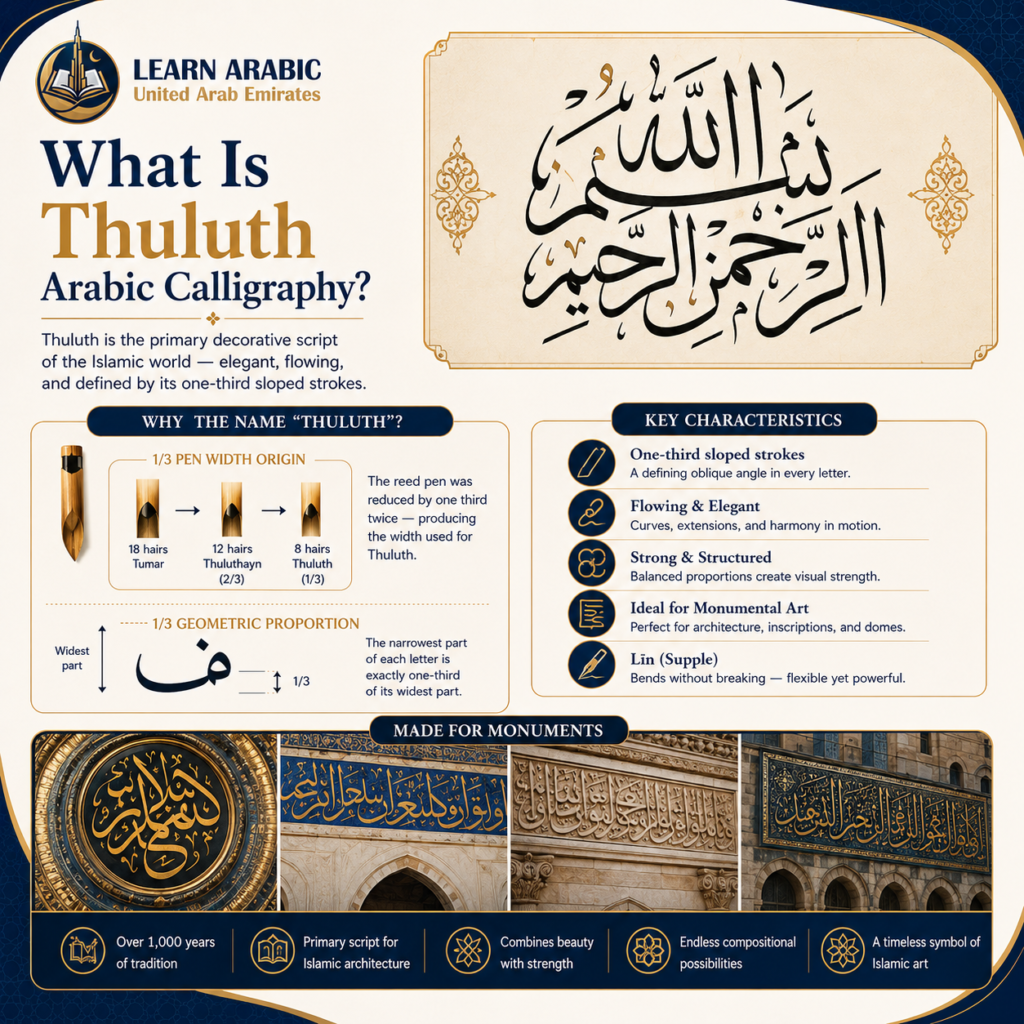
The name has two connected explanations. The first traces back to the calamus — the reed pen used by Arab scribes. Classical scribes originally wrote with a pen cut to the width of 18 hairs of a Turkmen horse for the large Tumar format script. When they reduced that width by a third to 12 hairs, they called it Thuluthayn (two-thirds). Reducing it by another third to 8 hairs produced the script now known as thuluth. The second explanation, favored by later technical writers, is that the narrowest part of each letter is exactly one-third of its widest part — a built-in geometric proportion governing every stroke.
What sets arabic calligraphy thuluth apart from all other Arabic scripts is its combination of flexibility, structural strength, and compositional power. Letters curve, interlock, and stack with a rhythmic, muscular elegance that no other Arabic script fully replicates. Classical masters described it as لين (supple) — the script that bends without breaking — and this suppleness is precisely what made it the primary tool for monumental inscription across over a thousand years of Islamic architecture.

Read More: 9 Arabic Poems For Kids
The Origins of Arabic Thuluth: From Kufic to Cursive
The history of arabic thuluth begins in the Umayyad era. The geometric Kufic script dominated Islamic writing from the earliest period, and within Kufic tradition there were two recognized modes: yaabis (dry/angular) and layyin (soft/curved). Angular Kufic was used for formal architectural inscriptions and early Quran manuscripts. Soft Kufic appeared on papyrus documents written quickly by hand.
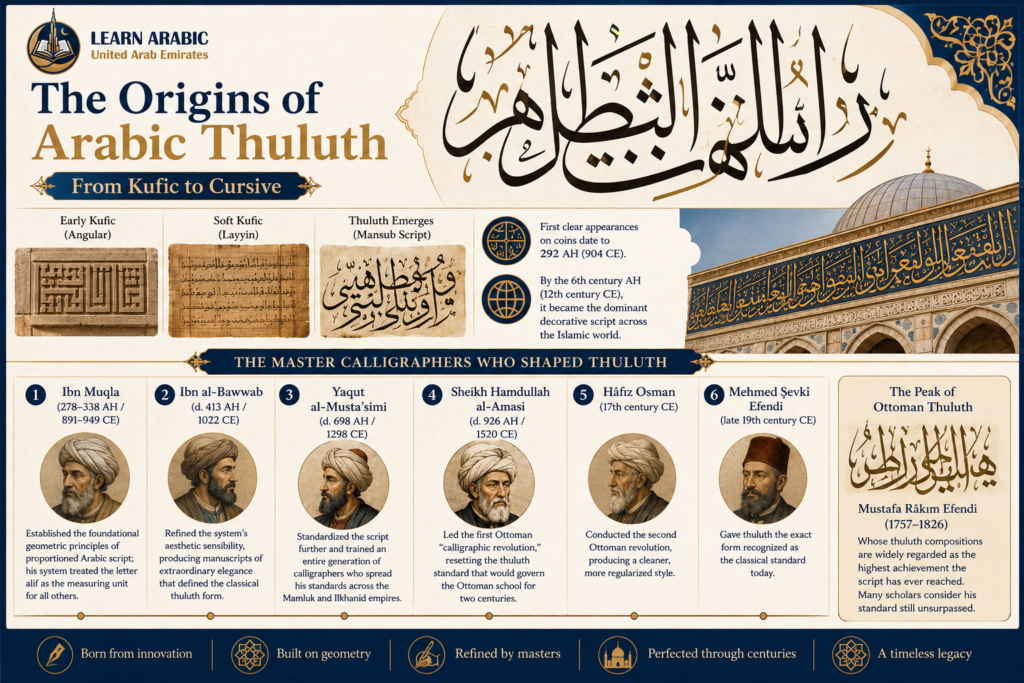
Thuluth emerged from a fundamentally different creative effort — not a simplification of Kufic, but a deliberate reinvention. It belongs to what Arabic paleographers call the mansub (proportioned) scripts: writing systems built on calculated geometric relationships between letter parts, rather than inherited angular templates. Its first clear appearances on coins date to 292 AH (904 CE), and by the 6th century AH (12th century CE) it had become the dominant decorative script across the Islamic world.
The Master Calligraphers Who Shaped It
The proportioned scripts, with thuluth at their head, were systematized through the work of a succession of master calligraphers:
- Ibn Muqla (278–338 AH / 891–949 CE) — established the foundational geometric principles of proportioned Arabic script; his system treated the letter alif as the measuring unit for all others
- Ibn al-Bawwab (d. 413 AH / 1022 CE) — refined the system’s aesthetic sensibility, producing manuscripts of extraordinary elegance that defined the classical thuluth form
- Yaqut al-Musta’simi (d. 698 AH / 1298 CE) — standardized the script further and trained an entire generation of calligraphers who spread his standards across the Mamluk and Ilkhanid empires
- Sheikh Hamdullah al-Amasi (d. 926 AH / 1520 CE) — led the first Ottoman “calligraphic revolution,” resetting the thuluth standard that would govern the Ottoman school for two centuries
- Hâfız Osman (17th century CE) — conducted the second Ottoman revolution, producing a cleaner, more regularized style
- Mehmed Şevkî Efendi (late 19th century CE) — gave thuluth the exact form recognized as the classical standard today
The peak of the Ottoman tradition is most associated with Mustafa Râkım Efendi (1757–1826), whose thuluth compositions are widely regarded as the highest achievement the script has ever reached. Many scholars consider his standard still unsurpassed.
Step Inside Our Classrooms
Don’t just take our word for it—see our community in action. Click below to watch real, live snippets from our recent classes and experience our engaging teaching style firsthand!
Master Arabic in the UAE
Experience world-class Arabic language training designed for students and professionals in the Emirates.
Book Your Free TrialRead More: Arabic Cursive Writing
The Six Scripts That Descended from Thuluth Arabic Calligraphy
One of the most important — and most frequently misunderstood — facts about arabic thuluth font and the broader Arabic script tradition is this: thuluth is not one script among many equals. It is the root from which all other classical cursive Arabic scripts grew.
The classical source Minhaj al-Isabah states this directly: “All fourteen script methods, with their heavy and light variants and derivatives that extend to forty-two types and beyond, ultimately return to one path — the method of the qalam al-thuluth and what was innovated from it.”
The six classical scripts known as the Aqlam al-Sitta (Six Pens) all derive from thuluth through specific modifications:
| Script | Relationship to Thuluth | Primary Use |
| Thuluth (ثلث) | The root script | Monumental inscriptions, Quran headings |
| Naskh (نسخ) | Thuluth reduced in size with added firmness | Quran body text (from 7th AH century onward) |
| Muhaqqaq (محقق) | Thuluth with elongated horizontals and increased angularity | Large Quran manuscripts |
| Rayhan (ريحان) | Muhaqqaq at reduced scale | Smaller format manuscripts |
| Tawqi’ (توقيع) | Thuluth reduced with added fluency | Official chancery documents |
| Riqa’ (رقاع) | Tawqi’ at reduced scale | Correspondence and administrative use |
Muhaqqaq eventually merged back into thuluth by approximately the 12th–13th century AH (17th–18th century CE), surviving only in its distinctive Basmala form, which calligraphers still reproduce today. The principle that a slight increase in length and angularity produces Muhaqqaq — while a reduction in size with added softness produces Tawqi’ — demonstrates that thuluth functions as a structural axis, not merely one decorative choice among many.
The Varieties of Thuluth Arabic Font and Script
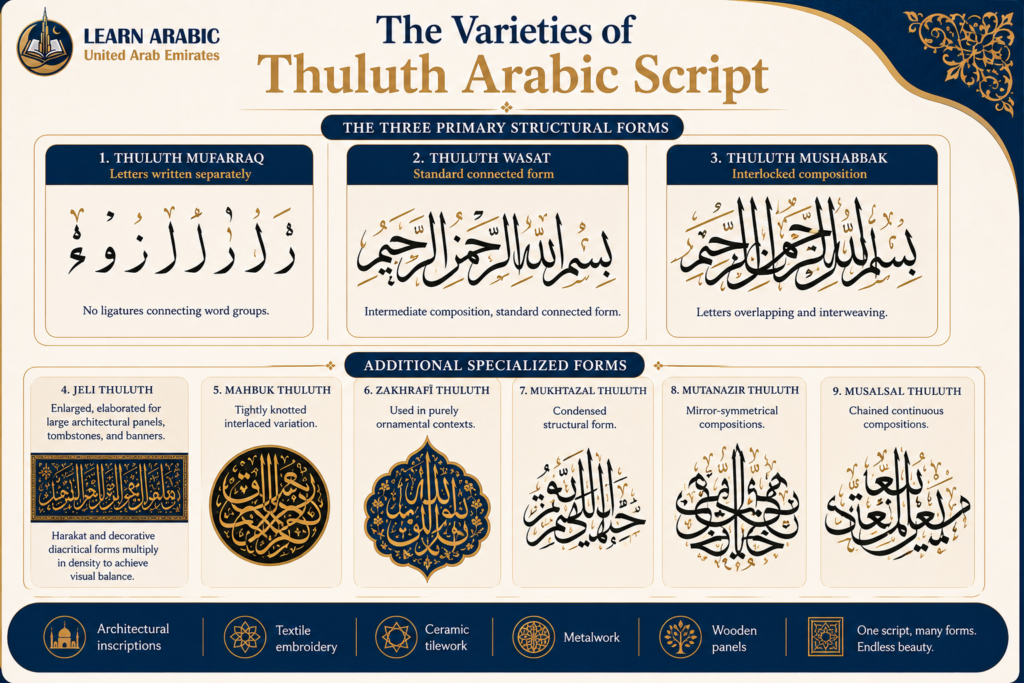
Arabic thuluth font in classical calligraphy scholarship recognizes three primary structural forms:
- Thuluth Mufarraq — letters written separately, without ligatures connecting word groups
- Thuluth Wasat — intermediate composition, standard connected form
- Thuluth Mushabbak — interlocked composition, letters overlapping and interweaving
Additional Specialized Forms
Beyond the three core types, thuluth generated several specialized forms in practice:
- Jeli Thuluth — an enlarged, elaborated version developed for large architectural panels, tombstones, and banner-scale compositions; harakat (vowel marks) and decorative diacritical forms multiply in density, filling the composition to achieve visual balance
- Mahbuk Thuluth — a tightly knotted interlaced variation
- Zakhrafī Thuluth — used in purely ornamental contexts
- Mukhtazal Thuluth — a condensed structural form
- Mutanazir Thuluth — mirror-symmetrical compositions
- Musalsal Thuluth — chained continuous compositions where letters flow from one to the next in an unbroken thread
The variety of structural forms within thuluth itself explains why it remained dominant as the monumental decorative script for over a millennium — its inherent flexibility allowed it to adapt to architectural surfaces, textile embroidery, ceramic tilework, metalwork, and wooden panels, in each case producing a visually complete composition rather than a mere inscription.
Read also: How to Introduce Yourself in Arabic? Phrases, Tips & What to Say
Why Thuluth Arabic Is Considered the Most Demanding Script?
Classical calligraphy masters drew a clear line: a calligrapher who could not write thuluth was not considered a complete master, regardless of proficiency in other scripts. This standard persisted across the Abbasid, Ilkhanid, Mamluk, and Ottoman traditions without exception.
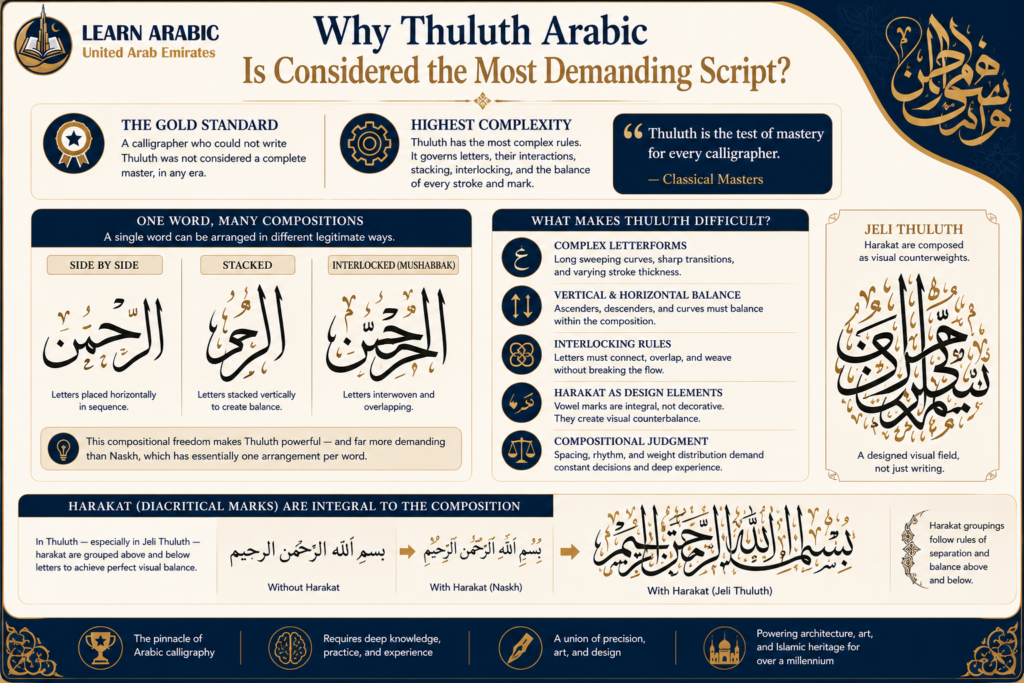
The reason is technical. Thuluth has the highest compositional complexity of all Arabic scripts. Its rules govern not only individual letter forms but their interactions: how letters stack vertically, how they interlock in the mushabbak style, how harakat are grouped above and below in Jeli compositions, how the weight of curved strokes must balance against the vertical thrust of ascenders.
A practitioner note that explains the difficulty concretely: in thuluth, a single word can be written in multiple legitimate compositional arrangements — letters placed side by side, stacked, or interlocked — with each version requiring different spacing and weight decisions. This compositional freedom is also the source of thuluth’s aesthetic power. Naskh, by contrast, has essentially one compositional arrangement per word; its rules are stricter and its forms more uniform.
The harakat (diacritical marks indicating vowels) in thuluth and especially in Jeli Thuluth are not secondary details — they are integral compositional elements. In Jeli compositions, the calligrapher designs harakat groupings as visual counterweights to the letter bodies, with rules governing whether marks written below letters are separated from those written above. A finished Jeli Thuluth panel is as much a designed visual field as it is a piece of writing.
How Thuluth Arabic Calligraphy Has Been Used Across Islamic History?
The clearest evidence of thuluth’s dominance is its presence in every medium of Islamic art across every region and era. Inscriptional bands in thuluth circle the interior walls of mosques from Mosul to Istanbul to Cairo. Quran surah headings are written in thuluth in manuscripts spanning from the 4th AH century to the present. Coins minted in the 3rd AH century bear early thuluth forms on their faces.
The Shahada — There is no god but Allah, and Muhammad is His Messenger — is rendered in thuluth on the flags of Saudi Arabia, Afghanistan, and Somaliland, bringing thuluth arabic font before billions of eyes in the most prominent possible context.
A significant misunderstanding in much Western art-historical literature has been to describe the two major traditions of Arabic writing simply as “Kufic” (angular) and “Naskh” (rounded), treating them as parallel equivalents. This classification collapses the entire mansub tradition — with thuluth at its head — into a single generic category and erases the specific identity of the script that actually dominated Islamic monumental art for a thousand years. The specialist literature in Arabic has consistently named this correctly; learners approaching the subject in English should be aware of this terminological gap.

See Our Classroom Environment in Action
Experience a sneak peek into our live sessions. Watch the video below to see our specialized instructors interacting with students, breakdown complex texts, and cultivate an engaging, respectful learning environment.
Master Arabic in the UAE
Experience world-class Arabic language training designed for students and professionals in the Emirates.
Book Your Free TrialStart Learning Thuluth Arabic Calligraphy with Expert Guidance
The path into Arabic thuluth calligraphy begins with the Arabic script itself — letter recognition, correct pen hold, understanding of proportional relationships. The same Al-Azhar-trained instructors at Learn Arabic UAE who guide students through Quranic Arabic, Tajweed, and Arabic grammar bring the same structured, expert approach to Arabic script and calligraphy foundations.
Whether your goal is to read thuluth inscriptions with understanding, study the script’s history as part of Islamic art, or develop your own calligraphic practice, starting with a qualified teacher shortens the path dramatically.
[Book your free trial lesson today]
Our Arabic courses
- Learn to Write Arabic Course
- Arabic Grammar Course
- Learn Arabic Alphabet Course
- Modern Standard Arabic (MSA) Course
- Quranic Arabic Course
- Fusha Arabic Course
- Classical Arabic Course
- Emirati Arabic Course
- Gulf Arabic Course
- Learn Saudi Arabic
- Business Arabic Course UAE
- Arabic Language Classes for Professionals in UAE

Master Arabic in the UAE
Experience world-class Arabic language training designed for students and professionals in the Emirates.
Book Your Free TrialConclusion
Thuluth arabic calligraphy is not a decorative curiosity — it is the structural foundation of the entire Arabic cursive script tradition. From it descended Naskh, Muhaqqaq, Rayhan, Tawqi’, and Riqa’: the six classical scripts that defined Islamic manuscript culture. It remained the primary monumental inscription script across the Umayyad, Abbasid, Ilkhanid, Mamluk, and Ottoman eras without being displaced, because no other Arabic script offered the same combination of compositional flexibility, visual weight, and structural rigor.
Understanding arabic thuluth font and its place in the script family changes how you read Islamic architecture, Quran manuscripts, and Arabic calligraphic art. The calligrapher who masters it, classical sources unanimously agree, has mastered the root of the entire tradition.
Frequently Asked Questions About Thuluth Arabic Calligraphy
Whether you’re exploring the history of Thuluth or planning to learn this classical script, these frequently asked questions cover the fundamentals—from its origins and characteristics to its uses and level of difficulty.
What does thuluth mean in Arabic?
Thuluth (ثُلُث) means “one third” in Arabic. The name refers either to the fact that the pen used to write it had a width one-third that of the original Tumar script calamus, or to the structural rule that the narrowest part of each thuluth letter is one-third of its widest part.
Who invented thuluth arabic calligraphy?
The proportional rules governing thuluth were first systematized by the polymath calligrapher Ibn Muqla (878–940 CE) during the Islamic Golden Age. His framework was later refined by Ibn al-Bawwab, Yaqut al-Musta’simi, and ultimately given its modern classical form by Mehmed Şevkî Efendi in the 19th century.
What is the difference between thuluth and naskh?
Thuluth is the root script; Naskh is a derivative. Naskh was developed by reducing the size of thuluth and increasing its regularity for use in Quran manuscripts from the 7th AH century onward. Thuluth has greater compositional flexibility — letters can be stacked, interlocked, or arranged in multiple configurations — while Naskh has more uniform letter placement and is easier to read at smaller sizes.
What is thuluth arabic font used for today?
Thuluth arabic font is used for Quran surah headings, mosque inscriptions, Islamic flags (including Saudi Arabia and Afghanistan), architectural panels, and formal calligraphic art. It remains the most prestigious decorative Arabic script and the primary style used in large-format Islamic calligraphic compositions.
Is thuluth arabic calligraphy difficult to learn?
Thuluth is the most technically demanding of all classical Arabic scripts. Its rules govern individual letter proportions, compositional arrangements, and the placement of diacritical marks in multi-layered compositions. Classical masters held that no calligrapher could be considered complete without mastering it — which is why structured instruction from a qualified teacher is the most effective path into the script.
How many types of thuluth arabic script are there?
There are three primary structural forms — Mufarraq (separated), Wasat (standard connected), and Mushabbak (interlocked) — plus five specialized varieties: Jeli Thuluth (large architectural form), Mahbuk (knotted), Zakhrafī (ornamental), Mukhtazal (condensed), Mutanazir (mirror-symmetrical), and Musalsal (chained continuous). Each variety applies the same underlying proportional system to a different compositional purpose.



Leave a Reply