 Learn Arabic
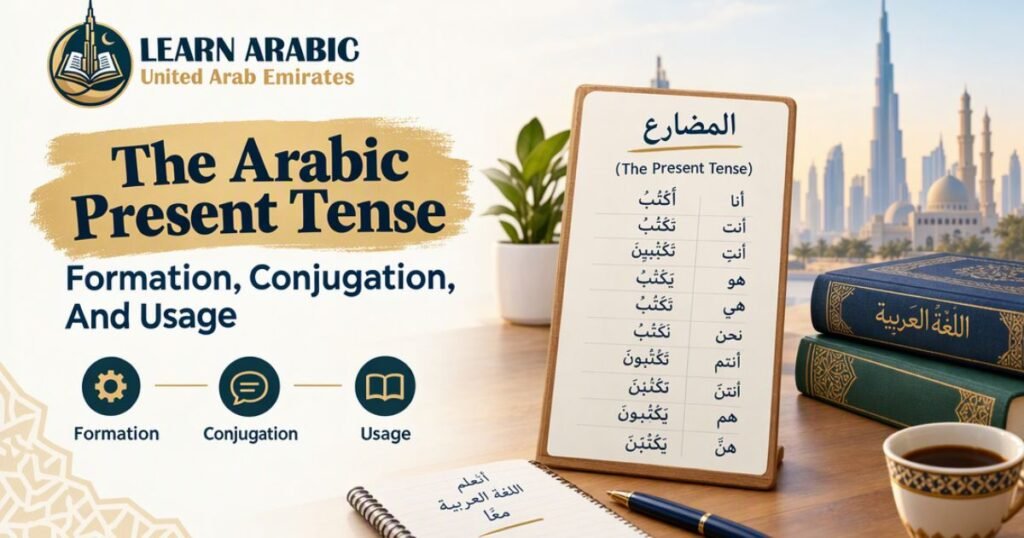
Anyone starting to read or speak Arabic runs into the same wall early on: verbs change shape depending on who is doing the action, and there’s no single fixed word for “is” or “am” the way English uses helper verbs.
The Arabic present tense, called al-mudāri‘ (المضارع), carries all of that information inside the verb itself. Once you understand its logic, present tense arabic conjugation stops looking like a memorization exercise and starts looking like a pattern you can predict.
This guide walks through how the arabic present tense is built, how it’s fully conjugated across every subject pronoun, when to use it, how it’s negated, and where most learners go wrong.
Everything here is organized the way Learn Arabic in the UAE Academy teaches it in live classes — starting from the verb root, then the markers, then the context.
What Is the Arabic Present Tense and How Does It Work?
The Arabic present tense (al-mudāri‘) is the verb form used to describe an action happening now, a habitual action, a general truth, or — with the right context words — the near future.
Unlike English, Arabic doesn’t need a separate helper verb like “am” or “is” to mark the present; the tense is built entirely into the verb’s shape.
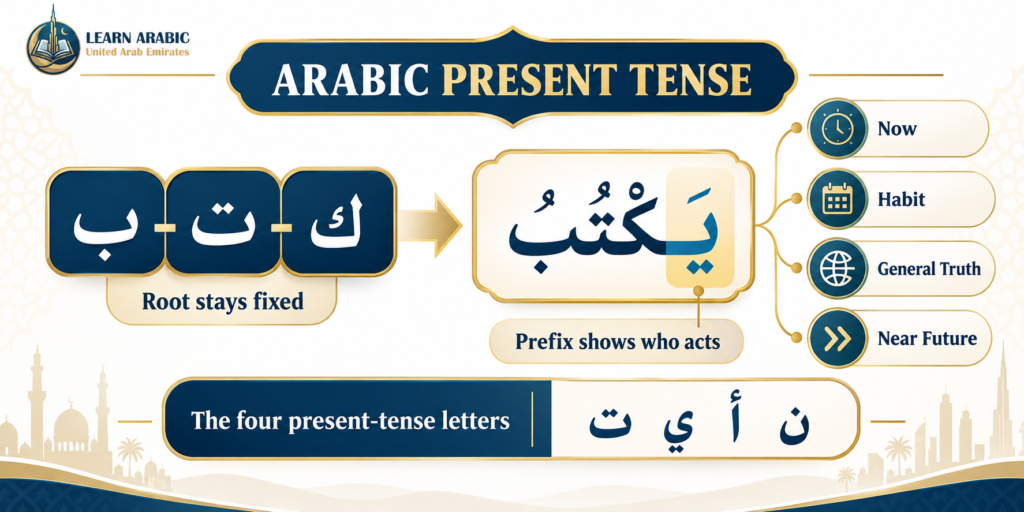
Every Arabic present tense verb is derived from a three-consonant root that carries the core meaning. The root ك-ت-ب, for example, is the idea of “writing.” That root doesn’t change. What changes is the prefix (and sometimes the suffix) attached to it, and that’s what tells you who is performing the action.
Before looking at full conjugation tables, it helps to isolate the piece that actually signals “this is a present tense verb” — the four present tense letters.
The Four Letters That Mark the Arabic Present Tense
Every present tense arabic verb begins with one of four letters: أ (hamza), ن (nūn), ي (yā), or ت (tā). Grammarians group these under the term hurūf al-mudāra‘ah (حروف المضارعة), and they’re often memorized using the mnemonic word نأتي (“we come”), which strings the four letters together.
Each letter marks a specific subject:
- أ (hamza) marks the first person singular — أنا أكتب (ana aktubu) — “I write.”
- ن (nūn) marks the first person plural — نحن نكتب (nahnu naktubu) — “we write.”
- ت (tā) marks the second person (you, in every gender and number) and also the third person feminine — أنتَ تكتب (anta taktubu) — “you write.”
- ي (yā) marks the third person masculine (he, they-masculine) — هو يكتب (huwa yaktubu) — “he writes.”
This is the fastest way to identify a present tense verb on sight in any text: check the first letter of the verb, not the ending.
How Arabic Verb Roots and Patterns Form the Present Tense
Once you can spot the marker letter, the rest of the verb is the root plus whatever vowel pattern the specific verb follows.
Most present tense verbs in Arabic keep a fairly stable internal vowel between the marker and the final root letter, though a smaller group of “weak” verbs — those with و or ي as one of their root letters — change shape more noticeably (يسعى, ينمو, يبكي).
These are covered in more depth under common mistakes below, since they’re where most learners lose points on written work.
How to Conjugate Arabic Verbs in the Present Tense
Arabic present tense conjugation follows a fixed slot system: subject marker + root + ending. Every present tense conjugation arabic verb follows is built from the same fixed slot system: subject marker + root + ending.
Once you know the 14 subject-pronoun slots, you can conjugate almost any regular verb in the present tense without memorizing each one from scratch — you’re really just running the same formula with a different root.
The table below is the arabic present tense conjugation chart most students at Learn Arabic in the UAE Academy use as their first reference sheet, built on the verb كَتَبَ (kataba) — “to write.”
The 14-Form Arabic Present Tense Conjugation Chart
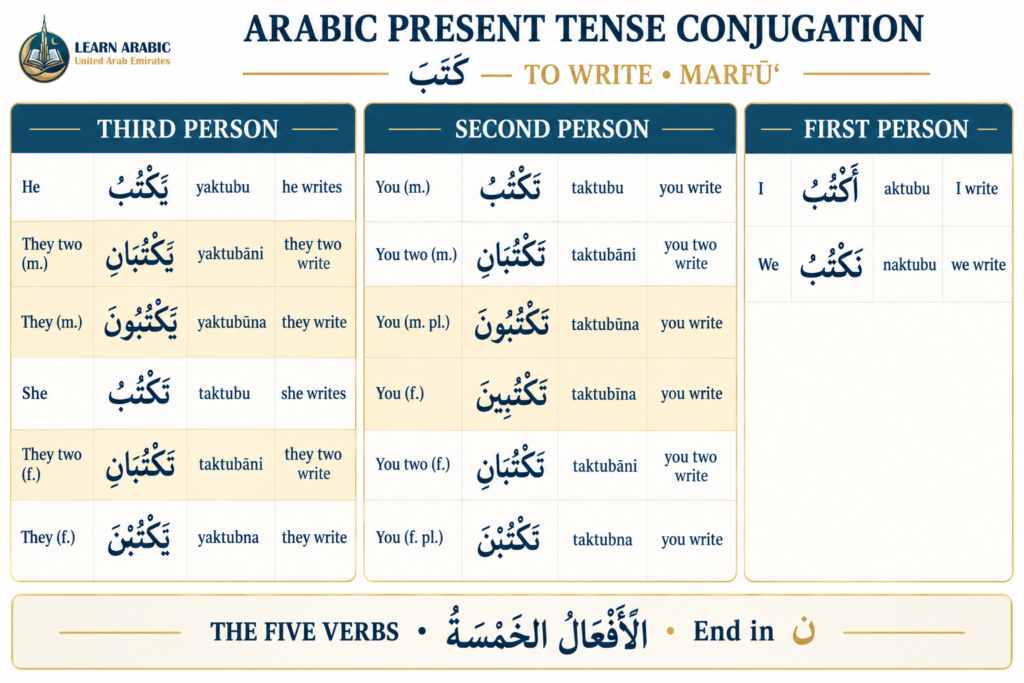
The chart below breaks down every subject-pronoun form of the verb كتب (kataba – to write) in its default present tense state (marfū‘), so you can see all 14 conjugations side by side before moving on to how those endings shift.
This full arabic present tense verb conjugation table covers all 14 subject-pronoun forms using the root ك-ت-ب. Save this arabic present tense verb conjugation chart as your first reference sheet for every regular verb you learn afterward.
| Person | Gender | Number | Verb | Transliteration | Meaning |
| 3rd | Masculine | Singular | يَكْتُبُ | yaktubu | he writes |
| 3rd | Masculine | Dual | يَكْتُبَانِ | yaktubāni | they two (m.) write |
| 3rd | Masculine | Plural | يَكْتُبُونَ | yaktubūna | they (m.) write |
| 3rd | Feminine | Singular | تَكْتُبُ | taktubu | she writes |
| 3rd | Feminine | Dual | تَكْتُبَانِ | taktubāni | they two (f.) write |
| 3rd | Feminine | Plural | يَكْتُبْنَ | yaktubna | they (f.) write |
| 2nd | Masculine | Singular | تَكْتُبُ | taktubu | you (m.) write |
| 2nd | Masculine | Dual | تَكْتُبَانِ | taktubāni | you two write |
| 2nd | Masculine | Plural | تَكْتُبُونَ | taktubūna | you (m. pl.) write |
| 2nd | Feminine | Singular | تَكْتُبِينَ | taktubīna | you (f.) write |
| 2nd | Feminine | Dual | تَكْتُبَانِ | taktubāni | you two (f.) write |
| 2nd | Feminine | Plural | تَكْتُبْنَ | taktubna | you (f. pl.) write |
| 1st | — | Singular | أَكْتُبُ | aktubu | I write |
| 1st | — | Plural | نَكْتُبُ | naktubu | we write |
Notice that five forms — يكتبان، يكتبون، تكتبان، تكتبون، تكتبين — end in ن (nūn) rather than a short vowel. Grammarians call this set al-af‘āl al-khamsah (الأفعال الخمسة), “the five verbs,” and they behave differently when the verb’s grammatical state changes — which is the next thing to understand.
If you want to see the same present tense verb conjugation pattern applied to a different root, the verb شرب (shariba) — “to drink” — follows an identical slot structure: يشرب (yashrabu, he drinks), تشربين (tashrabīna, you f. drink), نشرب (nashrabu, we drink), and so on.
Once this present tense verb conjugation arabic formula feels automatic, swapping in a different root verb is mechanical.
This is exactly the kind of pattern recognition our instructors build class drills around at Learn Arabic in the UAE Academy — rather than memorizing verbs one at a time, students learn to conjugate any regular root on demand.
If verb patterns like this are the part that’s been slowing you down, our Arabic Grammar Course is built specifically to drill this until it’s automatic.
See Our Classroom Environment in Action
Experience a sneak peek into our live sessions. Watch the video below to see our specialized instructors interacting with students, breakdown complex texts, and cultivate an engaging, respectful learning environment.
Master Arabic in the UAE
Experience world-class Arabic language training designed for students and professionals in the Emirates.
Book Your Free TrialHow Arabic Present Tense Endings Change Grammatically
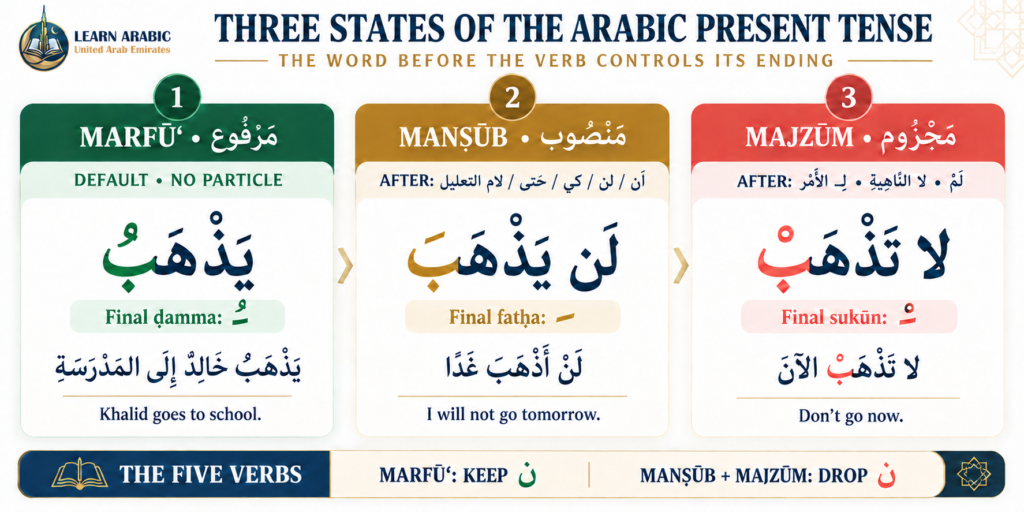
Unlike English, where “write,” “writes,” and “wrote” are the only real present-tense shapes, Arabic present tense verbs are mu‘rab (إعراب) — their final vowel or ending shifts based on grammatical context. There are three states.
Each state is triggered by a specific type of word appearing directly before the verb, so recognizing the trigger word tells you which ending to expect.
1. Marfū‘ (Indicative) — The Default Present Tense
When no particle precedes it, the present tense verb is marfū‘ (مرفوع), marked by a final damma (ـُ) — or, for the five verbs, by keeping the ن.
This is the default, “neutral” present tense state: يذهبُ خالد إلى المدرسة (yadhhabu Khālid ilā al-madrasah) — “Khalid goes to school.”
2. Manṣūb (Subjunctive) — After Certain Particles
Five particles push the verb into the manṣūb (منصوب) state, marked by a final fatha (ـَ) or, for the five verbs, by dropping the ن: أنْ (to), لنْ (will not), كي (in order to), حتى (until/so that), and lām al-ta‘līl (لام التعليل, “in order to”). Example: لن أذهبَ غدًا (lan adhhaba ghadan) — “I will not go tomorrow.”
3. Majzūm (Jussive) — Negation and Commands
Three particles push the verb into the majzūm (مجزوم) state, marked by sukūn (ـْ), by dropping the final weak letter in weak verbs, or by dropping the ن in the five verbs:
لم (did not — negates the past using a present-tense verb, which is a common point of confusion), لا الناهية (the negative command “don’t”), and lām al-amr (لام الأمر, the command lām). Example: لا تذهبْ الآن (lā tadhhab al-ān) — “Don’t go now.”
This is the part of arabic verb conjugation present tense that trips up intermediate learners specifically because the verb’s core shape barely changes — only the last letter or the ن ending shifts — so it’s easy to miss in reading and easy to mis-produce in writing.
Read Also: The Arabic Past Tense
How the Arabic Present Tense Is Used in Real Sentences
The present tense verbs arabic speakers use most often cover four distinct situations that English usually splits across separate tenses.
1. Using the Present Tense for Actions Happening Now
Used the way English uses the present continuous.
أذاكرُ الآن (udhākiru al-ān) — “I am studying now.” The word الآن (“now”) supplies the immediacy; the verb form itself doesn’t change.
2. Using the Present Tense for Habits and General Truths
This is the equivalent of the present simple tense explanation in Arabic that most textbooks lead with: repeated actions and permanent facts use the same mudāri‘ form, clarified by context words like كل يوم (every day) or دائمًا (always).
أقرأ القرآن كل يوم (aqra’u al-Qur’āna kulla yawm) — “I read the Quran every day.” الشمس تشرق من الشرق (ash-shamsu tushriqu min ash-sharq) — “The sun rises from the east” is a general truth, not a one-time event, and still uses the plain present tense.
3. Using the Present Tense for Near-Future Actions
With a future time word attached (غدًا “tomorrow,” الأسبوع المقبل “next week”), the same present tense form can point forward: أسافر إلى مصر الأسبوع المقبل (usāfiru ilā Miṣr al-usbū‘ al-muqbil) — “I’m traveling to Egypt next week.”
In practice, spoken and written Arabic more often marks the future explicitly by attaching سـ or سوف before the verb (سأذهب / sa’adh-hab, “I will go”) rather than relying on context alone — worth knowing so you’re not caught guessing which the sentence means.
Where does “present perfect” fit in?
This is the point where present perfect tense explanations in Arabic usually go wrong: Arabic has no separate present perfect verb form the way English has “have written.” Any accurate present perfect tense explanation arabic grammar guides give will point you back to the plain past tense plus qad, not to a separate present perfect verb form.
The completed-with-present-relevance meaning that English handles with “have + past participle” is instead carried by the plain past tense (الماضي) plus context, or by the particle قد before a past-tense verb to add a sense of completion (“قد كتبتُ الرسالة” — “I have [already] written the letter”).
Learners searching for a present tense equivalent of “have done” should look at قد + past tense, not at the mudāri‘ itself — a distinction most grammar guides skip entirely.
How to Negate the Arabic Present Tense Correctly
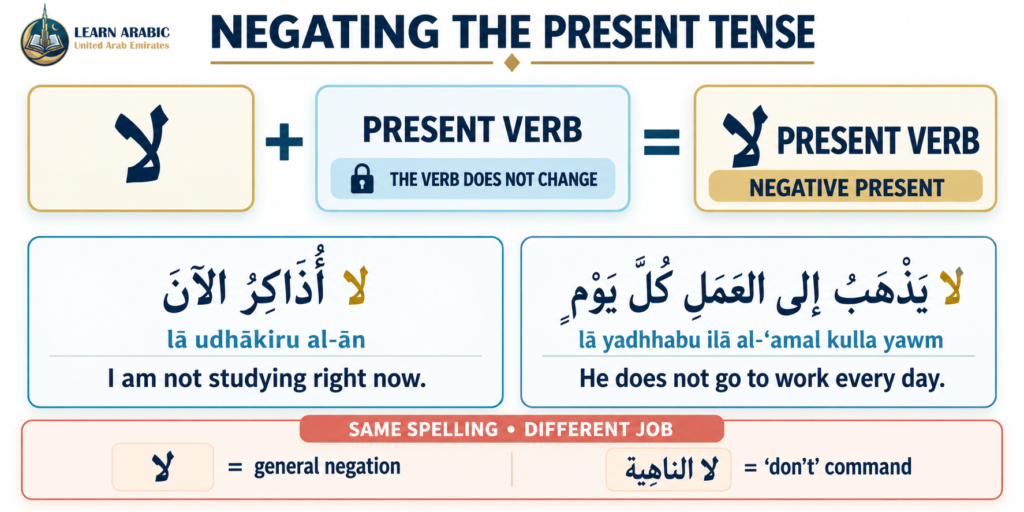
Negation is simpler than it looks: place لا (lā) directly before the verb, and the verb’s own shape doesn’t change.
لا أذاكر الآن (lā udhākiru al-ān) — “I am not studying right now.”
لا يذهب إلى العمل كل يوم (lā yadhhabu ilā al-‘amal kulla yawm) — “He does not go to work every day.” Note that لا here (general negation) is grammatically distinct from لا الناهية (the “don’t” command form covered above under majzūm) — same spelling, different job.
Common Arabic Present Tense Mistakes and How to Avoid Them
These are the errors our instructors at Learn Arabic in the UAE Academy see most often in placement tests, and each one has a specific fix:
Mixing up تَ prefixes for “she” and “you (m.).” Both تكتبُ and تكتبُ look identical out of context — she writes and you (masculine) write share the exact same conjugated form. Context (a stated subject or surrounding pronoun) is what disambiguates it, not the verb itself.
Forgetting the ن drop in the five verbs. After a subjunctive or jussive particle, forms like يكتبون must lose the ن (لن يكتبوا, not لن يكتبون). Leaving it in is one of the most common written errors even among intermediate students.
Treating weak verbs like regular ones. Verbs with و، ي، or ا as a root letter (يسعى “he strives,” يدعو “he calls,” يبكي “he cries”) don’t take a visible damma or fatha in the marfū‘ or manṣūb states — the vowel is “estimated” (مقدّرة) rather than written, because pronouncing it on that letter would be awkward.
Students who expect every verb to show a visible ending on the page get confused when weak verbs simply don’t.
Confusing لم (negates the past, followed by a jussive-form present verb) with لن (negates the future, followed by a subjunctive-form present verb). They look and sound similar but point in opposite time directions.
Read Also: Hard Arabic Words and Letters to Pronounce
Arabic Present Tense Vs. Past, Future, And Command Forms
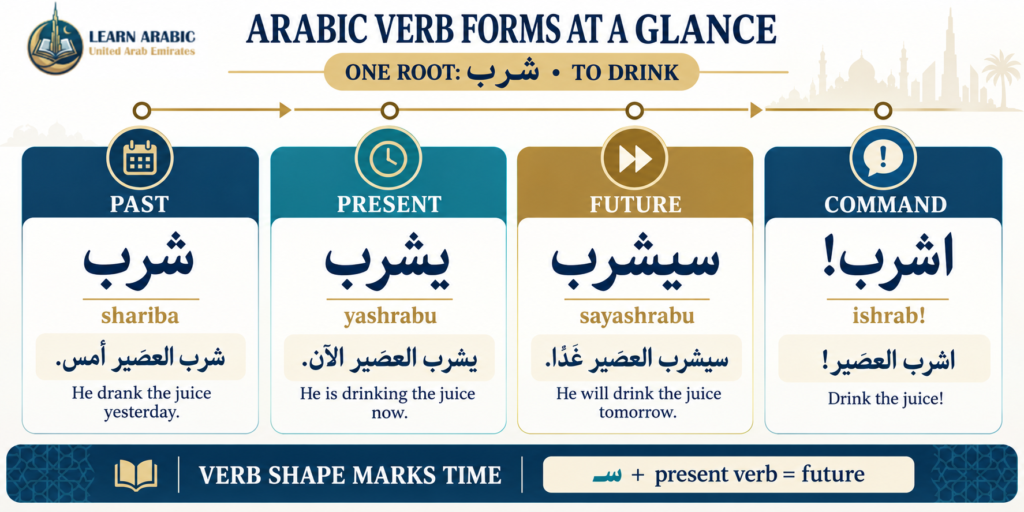
The table below places the mudāri‘ next to Arabic’s three other verb forms — past, future, and imperative — using the single root شرب (to drink), so the contrast between them is easy to see at a glance. Keep an Arabic conjugation chart present tense reference like the one below handy whenever you’re unsure which ending a particle triggers.
| Tense | Form (he) | Example | Meaning |
| Past (الماضي) | شرب (shariba) | شرب العصير أمس. | He drank the juice yesterday. |
| Present (المضارع) | يشرب (yashrabu) | يشرب العصير الآن. | He is drinking the juice now. |
| Future | سيشرب (sayashrabu) | سيشرب العصير غدًا. | He will drink the juice tomorrow. |
| Imperative (الأمر) | اشرب! (ishrab!) | اشرب العصير! | Drink the juice! |
The pattern to take from this table: Arabic marks time primarily through the verb’s internal shape (past vs. present root pattern), then fine-tunes it with a small set of attached particles (سـ for future, لم/لن/لا for various negations) rather than through separate auxiliary words the way English uses “will,” “have,” or “did.”
Getting comfortable with this comparison is usually the moment students stop translating word-for-word from English and start thinking in Arabic’s own logic — which is the real goal of any grammar unit, not just passing a quiz on it.
It’s also exactly where a structured course helps more than self-study, since seeing the four forms drilled together, out loud, with a native instructor correcting your ear in real time, moves faster than reading tables alone. Our Arabic Speaking Classes are built around exactly this kind of active practice.
Step Inside Our Classrooms
Don’t just take our word for it—see our community in action. Click below to watch real, live snippets from our recent classes and experience our engaging teaching style firsthand!
Master Arabic in the UAE
Experience world-class Arabic language training designed for students and professionals in the Emirates.
Book Your Free TrialStart Speaking Arabic With Confidence Today
Grammar rules only become useful once you can produce them without stopping to think. Learn Arabic in the UAE Academy runs live, instructor-led classes that take you from recognizing the present tense letters on a page to using them fluently in real conversation — with structured drills, native-speaker correction, and a clear path from your current level to the next one.
Whether you’re starting from zero or refining conjugation you already half-know, our Arabic Course in the UAE and our Arabic Classes for Beginners are designed to get you speaking, not just memorizing tables.
Our Arabic courses:
- Arabic Course in the UAE
- Arabic Intensive Course
- Madinah Arabic Course
- Arabic Classes for Adults
- Self-Paced Arabic Course
- Arabic Speaking Classes
- Learn to Write Arabic Course
- Arabic Grammar Course
- Learn Arabic Alphabet Course
- Quranic Arabic Course
- Fusha Arabic Course
- Classical Arabic Course

Conclusion
The Arabic present tense (al-mudāri‘) is built on a simple, repeatable formula: a three-letter root, one of four present tense letters marking the subject, and an ending that shifts depending on what precedes the verb in the sentence.
Once you can identify the marker letters, run the standard conjugation chart across the 14 subject forms, and recognize the three grammatical states — marfū‘, manṣūb, and majzūm — arabic present tense conjugation stops being memorization and becomes pattern recognition you can apply to almost any regular verb.
The details that trip learners up most — the ن drop in the five verbs, weak-verb endings, and the absence of a true present perfect form — are exactly the points worth reviewing again once the basic chart feels comfortable.
Keep practicing the present tense in Arabic out loud with real sentences, not isolated tables, and the forms will start to feel automatic well before you’d expect.

Frequently Asked Questions
Here are direct answers to the questions learners ask most often about the arabic present tense, based on what comes up repeatedly in our placement tests and beginner classes.
1. What are the four present tense letters in Arabic?
The four present tense letters are أ (hamza), ن (nūn), ي (yā), and ت (tā), often remembered through the word نأتي. Each one marks a specific subject: أ for “I,” ن for “we,” ي for third-person masculine, and ت for second person and third-person feminine.
2. How do you conjugate a present tense verb in Arabic?
You attach the correct present tense letter (and, for some subjects, a suffix like ـين، ـون، or ـان) to the verb’s three-letter root. For example, the root ك-ت-ب becomes أكتب (“I write”), تكتب (“you write”), or يكتبون (“they write”), depending on the subject.
3. Does Arabic have a present perfect tense?
No, Arabic doesn’t have a separate present perfect verb form. The meaning English expresses with “have written” is instead conveyed using the past tense (الماضي), often paired with the particle قد to add a sense of completion, such as قد كتبتُ (“I have [already] written”).
4. How is the present tense different from the past tense in Arabic?
The past tense (الماضي) uses a different internal verb pattern and doesn’t change based on surrounding particles, while the present tense (المضارع) uses the four present tense letters and shifts its ending depending on what comes before it in the sentence.
5. What is the difference between marfū‘, manṣūb, and majzūm present tense verbs?
Marfū‘ is the default present tense ending (a final damma), used when no special particle precedes the verb. Manṣūb appears after particles like أنْ or لنْ and changes the ending to a fatha. Majzūm appears after particles like لم or لا الناهية and changes the ending to a sukūn or drops the final letter.
6. Why do some present tense verbs drop the ن at the end?
Verbs known as “the five verbs” (الأفعال الخمسة) — forms ending in ـون، ـان، or ـين — normally keep their ن when marfū‘, but drop it when the sentence pushes the verb into the manṣūb or majzūm state, such as after لن or لم.
One response to “The Arabic Present Tense – Formation, Conjugation, And Usage ”
Leave a Reply
Related Articles
Learn Arabic




[…] Read Also: The Arabic Present Tense […]