 Learn Arabic
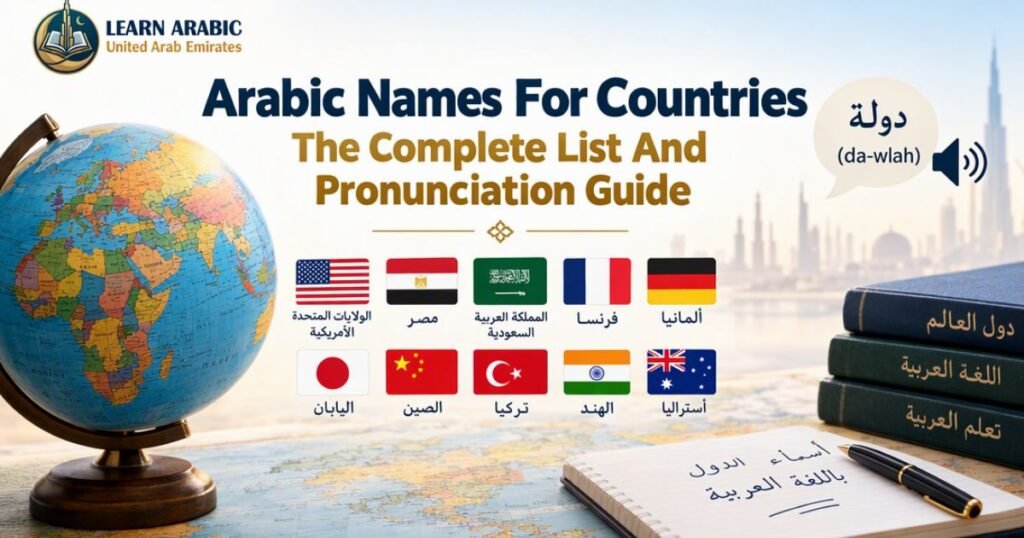
If you’ve started studying Arabic, one of the first vocabulary sets you’ll need is arabic names for countries. Every country has an official Arabic name, and unlike English, many of these names carry a story in their spelling — a definite article, a long vowel, a borrowed sound from French or Spanish.
Learning Arabic names for countries early gives you a foothold into how Arabic grammar actually works, because the same patterns that shape “Egypt” or “France” in Arabic repeat across hundreds of other words.
This guide breaks down every Arab League country’s Arabic name, gives you a working list of Arabic names for countries around the world, and explains the grammar patterns behind them so you’re not just memorizing — you’re recognizing.
What you’ll learn in this article
- The grammar rules behind arabic names for countries, including when to use “Al-” and how nationality words are formed.
- A full list of the 22 Arab League countries with their Arabic names.
- A reference list of Arabic names for countries outside the Arab world.
- Common pronunciation and spelling mistakes learners make.
- How to practice and retain these names long-term.
How Arabic Names for Countries Are Formed?
Arabic country names are not random strings of letters — they follow a small set of predictable rules. Once you know these rules, a new country name stops looking foreign and starts looking familiar, because you already recognize the pattern underneath it.
Three things shape almost every country name in Arabic: whether it carries the definite article, how its vowels are stressed, and how it converts into a nationality word.
The Definite Article “Al-” in Country Names
The Arabic definite article الـ (al-, “the”) appears in many country names, but not all of them. Countries with names rooted in Arabic — or names the Arabic language treats as descriptive — usually keep the article: العراق (al-ʿIrāq, Iraq) and السعودية (as-Suʿūdiyyah, Saudi Arabia) are two clear examples.
Countries whose names were borrowed directly from another language typically drop the article.
فرنسا (Faransā, France) and ألمانيا (Almāniyā, Germany) both stay bare, with no الـ attached.
This is a reliable shortcut: if a country’s name sounds transliterated from a European language, expect no article; if it sounds like a descriptive or native Arabic term, expect one.
Long Vowels, Stress, and Pronunciation Patterns
Arabic uses long vowels — ا (ā), و (ū), and ي (ī) — to stretch a syllable, and that stretch usually tells you where the stress falls. In السودان (as-Sūdān, Sudan), the long ā in the final syllable pulls the stress to the end of the word. In الصين (aṣ-Ṣīn, China), the same rule applies.
A doubled consonant, marked with a shadda, adds a similar emphasis. In السعودية (as-Suʿūdiyyah), the doubled ي gets held slightly longer than a single ي would.
Getting these lengths right is what separates a learner who reads Arabic from one who sounds natural saying it out loud — it’s a detail worth drilling early rather than picking up by accident later.
Turning a Country Name into a Nationality (Nisba)
Once you know a country’s Arabic name, you can usually build the nationality word from it using the nisba suffix ـي (-iyy) for masculine, and ـية (-iyyah) for feminine.
مصر (Miṣr, Egypt) becomes مصري (Miṣrī, Egyptian).
لبنان (Lubnān, Lebanon) becomes لبناني (Lubnānī, Lebanese). This one suffix effectively doubles your vocabulary for every country name you learn, since you get the place and the person from the same root.
This is exactly the kind of pattern-based teaching that structured lessons build around, rather than leaving learners to absorb it by trial and error.
Arabic Classes for Beginners (Learn Arabic from Scratch) at Learn Arabic In the UAE Academy walk through these formation rules in the first few sessions, so grammar patterns like this become second nature instead of a list to memorize under pressure.

Arabic Names for the 22 Arab League Countries
The Arab League currently recognizes 22 member states, spread across Africa and Asia. These are the Arabic names for countries most learners need first, since they come up constantly in news, travel, and everyday conversation with native speakers.
1. Arab Countries in Africa
North and East Africa are home to ten Arab League members, each with its own Arabic name and regional dialect:
- Algeria — الجزائر (Al-Jazāʾir).
- Comoros — جزر القمر (Juzur al-Qamar).
- Djibouti — جيبوتي (Jībūtī).
- Egypt — مصر (Miṣr).
- Libya — ليبيا (Lībiyā).
- Mauritania — موريتانيا (Mūrītānyā).
- Morocco — المغرب (Al-Maghrib).
- Somalia — الصومال (Aṣ-Ṣūmāl).
- Sudan — السودان (As-Sūdān).
- Tunisia — تونس (Tūnis).
2. Arab Countries in Asia
The Asian Arab League members are often grouped together as the Middle East, and their Arabic names are the ones you’ll hear most often in Gulf and Levantine media:
- Bahrain — البحرين (Al-Baḥrayn).
- Iraq — العراق (Al-ʿIrāq).
- Jordan — الأردن (Al-Urdunn).
- Kuwait — الكويت (Al-Kuwayt).
- Lebanon — لبنان (Lubnān).
- Oman — عمان (ʿUmān).
- Palestine — فلسطين (Filasṭīn).
- Qatar — قطر (Qaṭar).
- Saudi Arabia — السعودية (As-Suʿūdiyyah).
- Syria — سوريا (Sūriyā).
- United Arab Emirates — الإمارات العربية المتحدة (Al-Imārāt al-ʿArabiyyah al-Muttaḥidah).
- Yemen — اليمن (Al-Yaman).
A practical note for anyone learning Arabic in the Gulf specifically: الإمارات العربية المتحدة is the country name you’ll see on official UAE documents, but everyday speech shortens it to just الإمارات (Al-Imārāt).
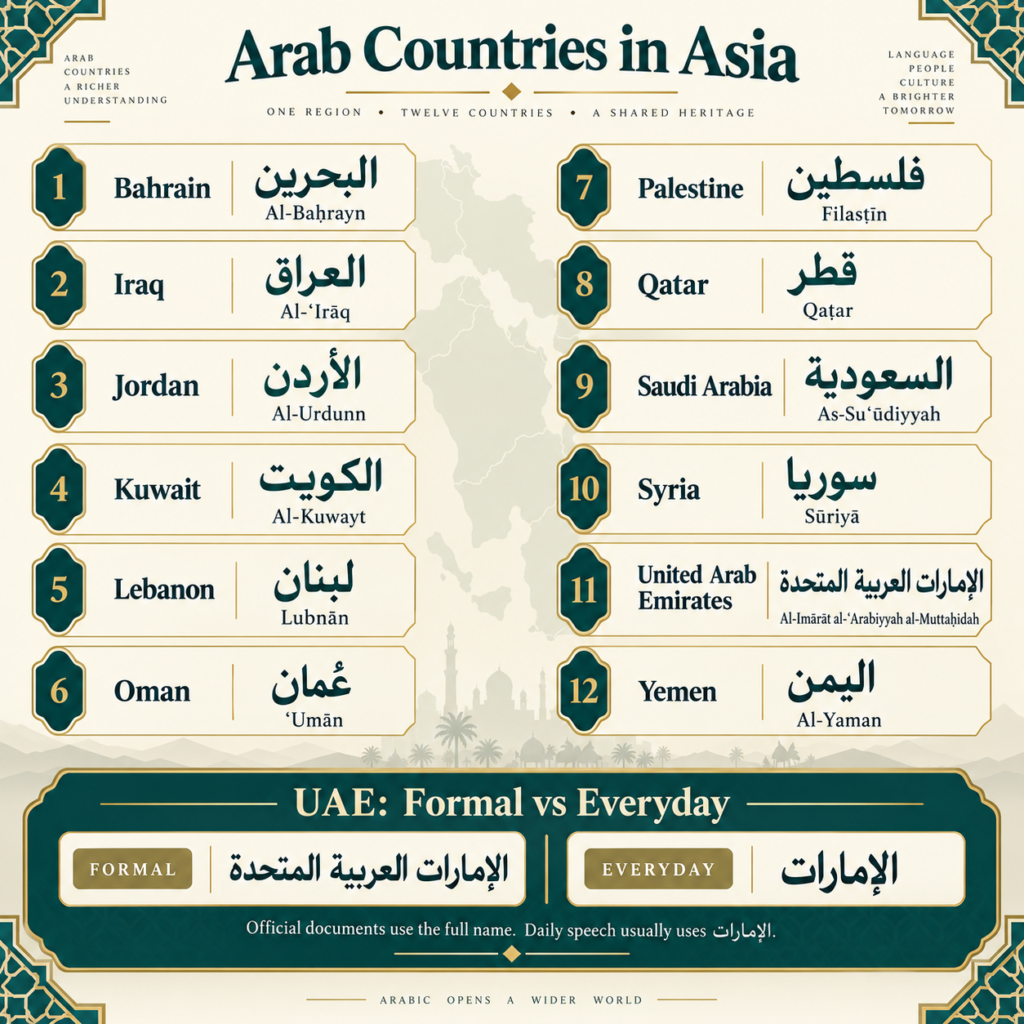
Formal Arabic keeps the full name; spoken Arabic drops to the short form almost every time.
Step Inside Our Classrooms
Don’t just take our word for it—see our community in action. Click below to watch real, live snippets from our recent classes and experience our engaging teaching style firsthand!
Master Arabic in the UAE
Experience world-class Arabic language training designed for students and professionals in the Emirates.
Book Your Free TrialRead Also: Essential Arabic Vocabulary for Kids
Arabic Names For Countries Around The World
Arabic names for countries don’t stop in the Arab world. If you’re reading Arabic news, watching Arabic-language television, or handling paperwork with Arabic labels, you’ll run into the Arabic names of countries on every continent — and these follow the same borrowing patterns described above.
Country Names in Arabic by Continent
Most non-Arab country names in Arabic are transliterations, adapted to fit Arabic sounds and syllable rhythm rather than translated for meaning.
| English | Arabic | Transliteration |
| United States | الولايات المتحدة | Al-Wilāyāt al-Muttaḥidah |
| United Kingdom | المملكة المتحدة | Al-Mamlakah al-Muttaḥidah |
| France | فرنسا | Faransā |
| Germany | ألمانيا | Almāniyā |
| Spain | إسبانيا | Isbāniyā |
| Italy | إيطاليا | Īṭāliyā |
| Russia | روسيا | Rūsiyā |
| China | الصين | Aṣ-Ṣīn |
| Japan | اليابان | Al-Yābān |
| India | الهند | Al-Hind |
| Canada | كندا | Kanadā |
| Brazil | البرازيل | Al-Barāzīl |
| Turkey | تركيا | Turkiyā |
| Pakistan | باكستان | Bākistān |
A pattern worth noticing here: the same الـ rule from earlier still applies.
الصين and اليابان carry the article because Arabic treats them as descriptive names embedded early in the language, while فرنسا and ألمانيا, as newer transliterations, stay bare.
Common Mistakes When Writing Country Names in Arabic
Learners consistently trip on the same handful of errors with arabic names for countries. The most frequent one is dropping or adding الـ inconsistently — writing سعودية instead of السعودية, for example, which is grammatically incomplete in formal writing.
The second common mistake is skipping the shadda on doubled letters, which changes both the spelling and the pronunciation of names like السعودية.
A third mistake, and one that trips up even intermediate learners, is using an abbreviated country name where formal Arabic expects the full form.
News broadcasts and official documents almost always use الولايات المتحدة الأمريكية in full rather than any shortened version — Arabic has much less tolerance for acronyms and clipped names than English does.

How to Practice and Memorize Arabic Country Names?
Grouping vocabulary by region, the way this guide has, gives your memory a hook to hang each new word on. Countries in the same region often share sounds, root letters, or historical naming conventions, so once one name sticks, nearby ones come easier.
The second habit that works well is using each country name inside a full sentence rather than reviewing it in isolation — for example, أنا من مصر (I am from Egypt) or سافرت إلى الأردن (I traveled to Jordan).
This forces you to also practice the nisba form and basic sentence structure at the same time, instead of treating vocabulary and grammar as separate tasks.
If you’d rather build this vocabulary with structured feedback on your pronunciation than work through word lists alone, an Arabic Intensive Course with Learn Arabic In the UAE Academy pairs vocabulary drills like this with live correction, so mistakes with the definite article or the shadda get caught early rather than becoming habits.
See Our Classroom Environment in Action
Experience a sneak peek into our live sessions. Watch the video below to see our specialized instructors interacting with students, breakdown complex texts, and cultivate an engaging, respectful learning environment.
Master Arabic in the UAE
Experience world-class Arabic language training designed for students and professionals in the Emirates.
Book Your Free TrialRead Also: What Are the Arabic Names of Each of the Five Pillars of Islam?
Start Speaking Arabic with Real Confidence Today
Knowing the Arabic names for countries is a useful start, but reading a list is not the same as speaking naturally with a native speaker.
Learn Arabic In the UAE Academy builds full courses around exactly this kind of practical, pattern-based learning, so you go from recognizing words to using them in real conversation.
Whether you’re starting from zero or want to sharpen existing skills with a structured, classical foundation, the Arabic Course in the UAE gives you a clear path forward with live instructors and a curriculum built for real retention.
Our Arabic courses:
- Madinah Arabic Course
- Arabic Classes for Adults
- Self-Paced Arabic Course
- Arabic Speaking Classes
- Learn to Write Arabic Course
- Arabic Grammar Course
- Learn Arabic Alphabet Course
- Modern Standard Arabic (MSA) Course
- Quranic Arabic Course
- Fusha Arabic Course
- Classical Arabic Course
- Emirati Arabic Course
- Gulf Arabic Course
- Learn Saudi Arabic

Conclusion
Arabic names for countries follow rules you can learn once and reuse everywhere: the definite article marks native or naturalized names, long vowels and doubled letters guide pronunciation, and the nisba suffix turns any country name into a nationality word.
Whether you’re memorizing the 22 Arab League countries or the Arabic names of countries worldwide, the fastest path is pattern recognition, not rote repetition.
With consistent practice and the right guidance, Arabic names for countries move from a list you look up to vocabulary you use without thinking.

Frequently Asked Questions
Here are answers to some of the most common questions learners ask about arabic names for countries, covering spelling, pronunciation, and everyday usage.
1. How many Arab countries are there?
The Arab League currently recognizes 22 member states across Africa and Asia. This list includes countries like Egypt, Morocco, Saudi Arabia, and the United Arab Emirates, each with an official Arabic name used in government and media.
2. Why do some Arabic country names include “Al-” and others don’t?
Country names rooted in Arabic, like العراق (Iraq) and السعودية (Saudi Arabia), typically keep the definite article الـ. Names borrowed from other languages, like فرنسا (France), usually drop it, since they were transliterated rather than formed from Arabic roots.
3. What’s the best way to learn Arabic country names quickly?
Group country names by region, practice them inside full sentences rather than as isolated words, and pay close attention to the definite article and vowel length for each one. Structured practice with a native-speaking instructor, such as through a beginner Arabic course, speeds this up by correcting mistakes as they happen rather than letting them become habits.
4. What is the Arabic word for a country’s nationality?
Arabic builds nationality words using the nisba suffix ـي for masculine and ـية for feminine, added to the country name.
مصر (Egypt) becomes مصري (Egyptian), and لبنان (Lebanon) becomes لبناني (Lebanese).
5. Is the Arabic name for a country always the same in every Arabic-speaking country?
The formal, written Arabic name for a country stays consistent across the Arab world, since it follows Modern Standard Arabic. Everyday spoken use can shorten names, such as saying الإمارات instead of the full الإمارات العربية المتحدة, but the formal version remains standard in writing.


[…] Read Also: Arabic Names For Countries […]