 Learn Arabic
Every parent trying to teach their child Arabic knows the moment of frustration — the alphabet looks unfamiliar, the child loses focus, and the lesson quietly falls apart. The problem is rarely the child. It’s the absence of the right materials at the right level.
Arabic worksheets for kids solve that problem by giving children a structured, hands-on path through letters, words, and basic grammar — one focused activity at a time.
This guide covers every type of Arabic worksheet available, how to use them effectively at home, what to avoid, and when to pair worksheet practice with live instruction to get real results.
What You’ll Learn in This Article
- The main types of Arabic worksheets for kids and what each one teaches
- How to choose the right worksheet for your child’s age and level
- A practical home routine that avoids overwhelm and builds daily momentum
- The most common mistakes parents make with Arabic worksheets — and how to fix them
- When worksheets alone are not enough, and what to add
Read Also: The Best Way to Learn Arabic Vocabulary
Arabic Worksheets for Kids
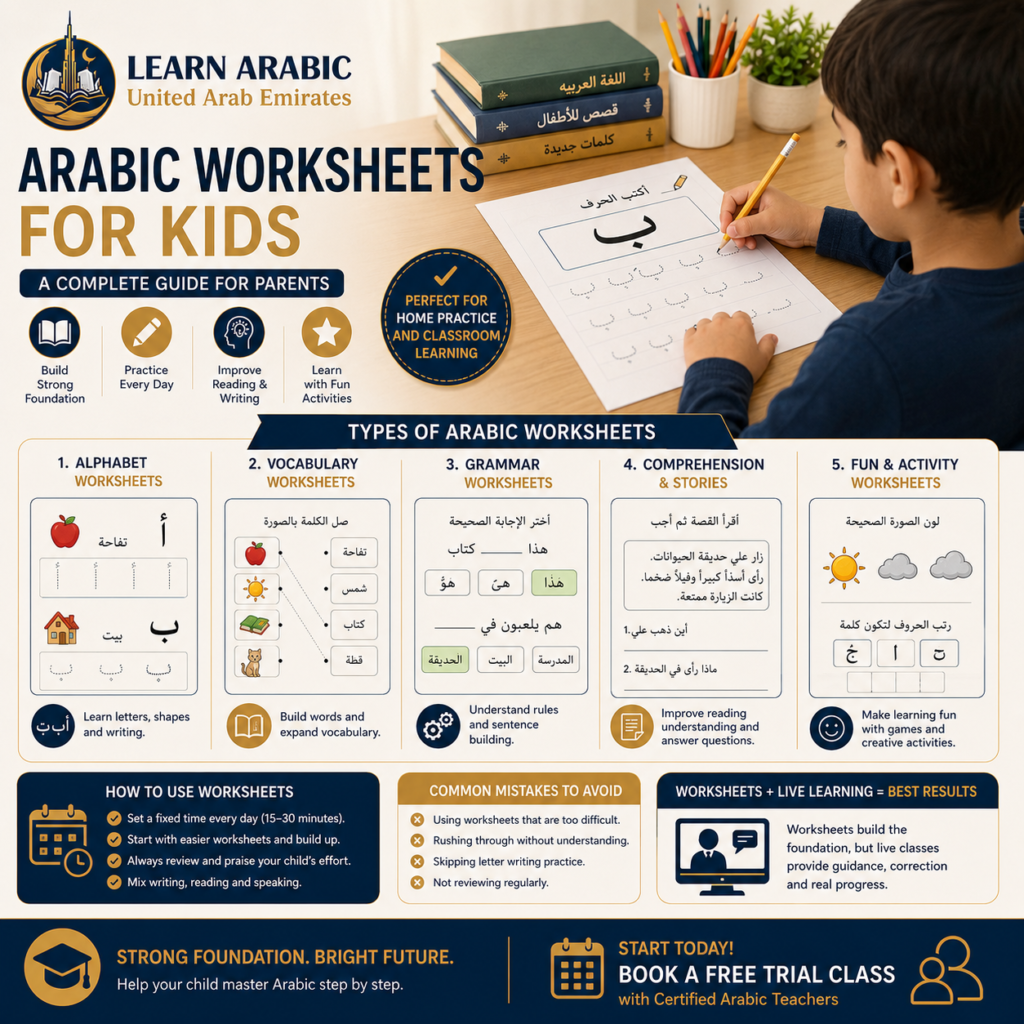
Arabic worksheets for kids are structured printable or digital activities designed to build foundational Arabic skills through repetition, recognition, and writing practice.
Unlike passive screen time, worksheets require a child to produce something — trace a letter, circle the correct word, complete a sentence — and that active production is what drives retention.
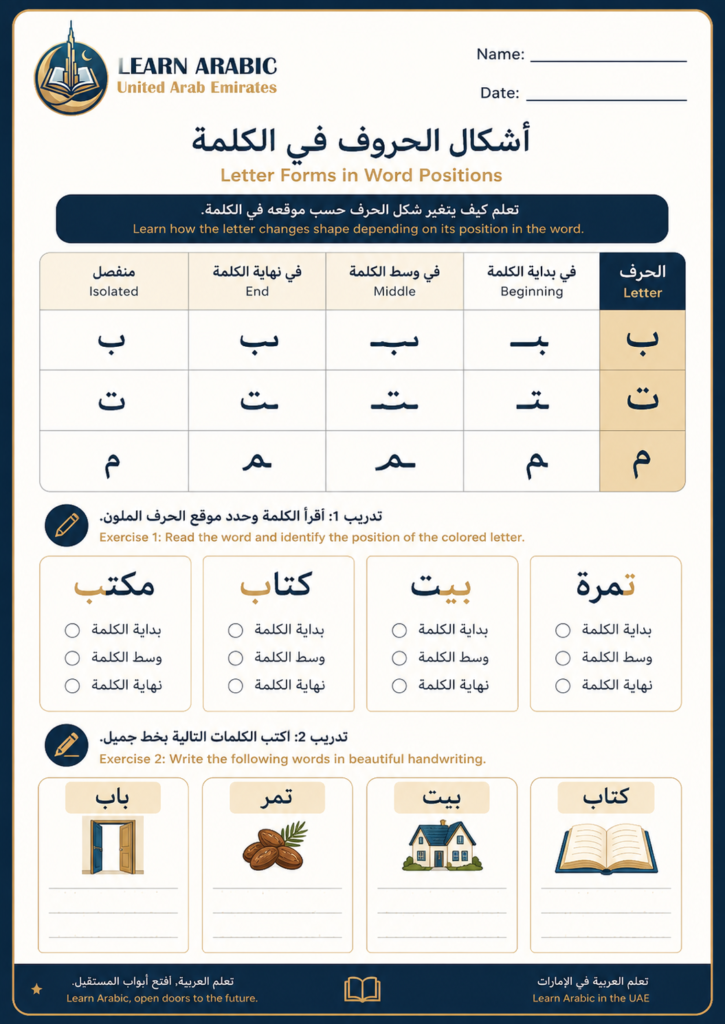
The Arabic language presents specific challenges that make structured worksheets especially useful. Each of the 28 letters changes shape depending on where it appears in a word (initial, medial, or final position).
Short vowels are written as diacritical marks above and below letters rather than as full letters. Sounds like ع, غ, and خ do not exist in English, which means children cannot rely on sound-spelling intuitions they already have.
Well-designed Arabic worksheets introduce these features progressively — first the isolated letter shape, then its forms in words, then full words with meaning — matching the way children’s brains build new skills layer by layer.
Join Our Arabic Course in the UAE with a FREE Trial

Read also: How to Write Arabic Letters in Calligraphy? – A Beginner’s Complete Guide
Types of Arabic Worksheets for Kids
Before selecting worksheets, it helps to understand what each category trains. The right choice depends on where your child is now, not simply their age.
A. Arabic Alphabet Worksheets
Arabic alphabet worksheets are the foundation. A child who cannot reliably recognize and write all 28 letters in their isolated and connected forms is not ready for vocabulary or grammar worksheets — and pushing ahead produces confusion, not progress.
Effective alphabet worksheets move through three stages in sequence:
The first stage is recognition: the child sees the letter paired with a familiar image (أ for أسد — lion) and identifies it in a set of similar-looking letters.
The second stage is tracing: dotted letter guides develop the specific motor movements Arabic script requires, particularly the right-to-left direction and curves that differ from Latin script.
The third stage is independent writing: the child reproduces the letter without a template, in its isolated form first, then connected within a simple word.
One detail most free worksheets skip: they teach the isolated letter shape but ignore the initial, medial, and final forms. A child who only knows the isolated ب will not recognize بيت (house) in running text. Look for worksheets — or worksheet series like the أ ب ت platform — that explicitly practice all four positions for each letter.
B. Arabic Vocabulary Worksheets
Once a child can write all 28 letters reliably, vocabulary worksheets expand reading and spelling across familiar topics. The most effective formats are cut-and-paste matching exercises (connect the Arabic word to its picture), word completion exercises (fill in the missing letter), and scrambled-letter activities that require children to arrange letters in the correct order.
Thematic organization matters here. Worksheets built around connected vocabulary clusters — family members in Arabic ,animals, colors, classroom objects — outperform random word lists because children build mental categories, not isolated memories. A child who learns dog, cat, bird, and fish together will retrieve those words faster than a child who learned each one in a separate session weeks apart.
A specific technique worth building into vocabulary practice of food in Arabic language for example: after completing a worksheet about vocabulary, have your child say each word aloud while pointing to the picture. The combination of writing, reading, and speaking a word within the same short session accelerates retention significantly — especially for children aged 5–8.
Explore The Capabilities of Our Teachers

C. Arabic Grammar Worksheets for Kids
Grammar worksheets are appropriate once a child can read simple Arabic sentences with tashkeel (vowel markers) confidently. Introducing grammar before this point produces children who can fill blanks mechanically without understanding what they are doing.
The correct sequence for grammar worksheets follows the same logic as the curriculum at platforms like أ ب ت: dual and plural forms before verb conjugation, demonstrative pronouns before prepositions, sentence-type identification before transformation exercises. Each concept needs to feel natural before the next one is introduced.
One area where worksheet-only learning consistently falls short is verb conjugation with pronouns. Children can correctly complete a conjugation table on paper but cannot produce the correct verb form in a spoken sentence. This gap is where live instruction becomes essential — a tutor can catch the real-time error that a completed worksheet never reveals.
D. Arabic Comprehension and Story Worksheets
Reading comprehension worksheets — short passages followed by questions — are the final stage of printed worksheet practice. They integrate all prior skills: letter recognition, vocabulary, grammar, and sentence understanding in a single exercise.
The most valuable comprehension worksheets use texts that are slightly below a child’s reading ceiling — familiar enough that the child is not decoding every word, challenging enough that the questions require genuine thinking.
Texts at this level, sometimes called “instructional level” in literacy pedagogy, produce faster reading development than texts that are either too easy or frustratingly hard.
Begin your kid’s Arabic learning path with a FREE trial class

Step Inside Our Classrooms
Don’t just take our word for it—see our community in action. Click below to watch real, live snippets from our recent classes and experience our engaging teaching style firsthand!
Master Arabic in the UAE
Experience world-class Arabic language training designed for students and professionals in the Emirates.
Book Your Free TrialRead More: Types of Arabic Calligraphy
Using Arabic Worksheets for Kids Effectively at Home
Having the right worksheets is only half the equation. How a parent structures the practice session determines whether the material actually transfers into the child’s long-term memory.
Read also: Vegetables in Arabic — The Complete Vocabulary Guide with Pronunciation
A. Build a Daily Micro-Routine of Arabic Worksheets Practice
Short daily sessions outperform long weekend sessions by a measurable margin. Fifteen minutes of focused Arabic worksheet practice every day produces stronger skill retention than 90 minutes on Saturday morning — because sleep consolidates what was practiced that day, and daily practice means daily consolidation.
A practical home micro-routine that works for ages 4–10: review yesterday’s worksheet for two minutes by asking your child to read or identify what they practiced. Introducing today’s new worksheet. Complete it together or independently depending on level. Close with one spoken activity — say five words from the worksheet aloud, or use one new word in a sentence.
This three-part structure (review → new → produce) matches the learning cycle that Arabic teachers use in structured classrooms.
Read also: Body Parts in Arabic for Kids: A Complete Guide with Meanings
B. Match the Arabic Worksheet to the Child’s Actual Level
The single most common mistake in home Arabic worksheet practice is choosing worksheets by age rather than by skill level. A seven-year-old who has never studied Arabic needs alphabet tracing worksheets, not vocabulary matching exercises. An eight-year-old who has been studying since age five may be ready for simple grammar work.
Before downloading or printing anything, answer two questions: Can my child read a simple Arabic word with tashkeel correctly? Can my child write all 28 letters in their isolated form without tracing? If the answer to either question is no, start with alphabet worksheets — regardless of the child’s age.
Enroll your kids in our conversation course in the UAE

C. Avoid The Following Common Worksheet Mistakes
Many parents unknowingly undermine their child’s Arabic progress through well-intentioned habits.
The first mistake is moving too fast — introducing new letter worksheets before the previous letters are secure. Solid recognition of ا, ب, and ت builds the scaffolding everything else depends on; rushing past it creates gaps that cost double the time to fix later.
The second mistake is treating every worksheet as homework rather than as a game. Children aged 4–8 learn best in low-pressure, playful contexts. Let your child choose the color of pen they use. Count completed letters together. Celebrate finishing an activity — the emotional association with success matters as much as the practice itself.
The third mistake is skipping the speaking component entirely. Worksheets train reading and writing, but Arabic has sounds that require active practice to produce correctly — especially ع, ح, and خ. Including even one minute of saying words aloud during each session prevents the silent-reader problem, where a child can complete every worksheet perfectly but cannot speak a single Arabic sentence.
See Our Classroom Environment in Action
Experience a sneak peek into our live sessions. Watch the video below to see our specialized instructors interacting with students, breakdown complex texts, and cultivate an engaging, respectful learning environment.
Master Arabic in the UAE
Experience world-class Arabic language training designed for students and professionals in the Emirates.
Book Your Free TrialStart Your Child’s Arabic Journey with Learn Arabic UAE
Worksheets build solid foundations — but consistent progress requires a structured curriculum and an experienced teacher who can spot what the paper cannot.
Learn Arabic UAE connects families across the UAE and beyond with expert Arabic instructors who have helped hundreds of children reach real Arabic fluency — not just completed worksheets.
What parents and children get with Learn Arabic UAE:
- Al-Azhar graduate instructors with 12+ years teaching Arabic to non-native-speaking children
- Age-appropriate curriculum designed for children aged 4–15, covering alphabet through grammar
- Short 20–30 minute sessions that match children’s natural attention spans — no fatigue, no frustration
- Gamification, songs, and storytelling woven into every lesson so children look forward to class
- Real-time pronunciation correction on every session — something no worksheet can provide
- Flexible scheduling built around your family’s routine
Children who study with Learn Arabic UAE typically move from zero Arabic to reading simple Quranic text within six months. That outcome is the result of combining structured worksheet practice at home with expert-guided live instruction — not either one alone.
Explore Learn Arabic UAE’s courses for children:
- Arabic alphabet course
- Arabic grammar course
- Arabic writing course
- Arabic speaking course
- Arabic course for beginners
- Kids’ Arabic Grammar Course
- Arabic Beginner Course for Kids
- Arabic Conversation for Kids
Book your free trial session today and begin with a structured assessment and your first live lesson.

Master Arabic in the UAE
Experience world-class Arabic language training designed for students and professionals in the Emirates.
Book Your Free TrialConclusion
Arabic worksheets for kids are most effective when they follow a clear progression — alphabet first, vocabulary second, grammar third, comprehension last — and when each stage is practiced consistently in short daily sessions rather than occasional long ones.
The three worksheet types that produce the strongest foundation are alphabet tracing with all letter positions, thematic vocabulary with picture matching, and grammar exercises introduced only after confident reading is established.
The parents who see the best results combine high-quality printable worksheets with one critical addition: a qualified teacher who can hear what the worksheet cannot see, correct in real time, and adapt the material to how that specific child learns. Worksheets build the foundation. Expert instruction builds fluency.
Frequently Asked Questions
What age should a child start using Arabic worksheets?
Children can begin with simple alphabet tracing worksheets from age 4, provided they have basic pencil control. At this age, worksheets should feel like coloring activities — tracing large dotted letters with crayons, matching pictures to their first letter.
How many Arabic worksheets should a child complete per day?
One to two worksheets per day is sufficient for ages 4–8. The goal is focused practice, not volume. Completing one worksheet with full attention and a brief spoken follow-up produces more learning than rushing through five pages without consolidation.
Are free Arabic worksheets for kids good enough, or do I need to pay for materials?
Free worksheets from platforms like أ ب ت and Arabic Worksheets cover the core content adequately. The real gap in free materials is sequence — many free sheets mix levels randomly.
For best results, choose a free source that organizes worksheets by skill level and follow that sequence consistently rather than downloading random sheets.
How do I know if my child is ready to move from alphabet to vocabulary worksheets?
Your child is ready when they can write all 28 Arabic letters from memory in their isolated form without tracing, and when they can identify each letter in a running word — not just in isolation.
Testing this takes two minutes: write a simple word like بيت or كتاب and ask them to name each letter. If they hesitate on more than one, stay with alphabet practice a little longer.
Can Arabic worksheets replace a teacher for young children?
No. Worksheets build visual recognition and writing motor skills effectively. They cannot teach pronunciation, catch real-time errors, provide the motivating relationship between a teacher and child, or adapt to how a particular child is struggling. For children aged 4–10 especially, a qualified Arabic teacher — even for one session per week — makes worksheet practice significantly more effective by directing what to practice and confirming what has been learned correctly.
What is the best free source for printable Arabic worksheets for kids?
أ ب ت offers over 1,000 structured exercises organized by level, from alphabet coloring through full verb conjugation. It is the most comprehensive free Arabic worksheet resource available online, with a clear progression from basic letters to advanced grammar across 133 numbered activity sets.



Leave a Reply