 Learn Arabic

Living or working in the Gulf and want to connect with locals beyond a polite nod? Learning Khaleeji Arabic phrases is the fastest way to break the ice, earn genuine respect, and feel at home in the UAE, Saudi Arabia, Kuwait, Qatar, Bahrain, or Oman. This guide gives you over 100 real Gulf dialect phrases — organized by situation, with pronunciation, Arabic script, and usage tips so you actually remember them.
Whether you are brand new to the region or have been here for years without cracking the dialect, this is your practical starting point.
What Are Khaleeji Arabic Phrases?
Khaleeji Arabic is the spoken dialect used across the six GCC nations — Bahrain, Kuwait, Oman, Qatar, Saudi Arabia, and the UAE. It differs from Modern Standard Arabic (MSA) in vocabulary, rhythm, and everyday expressions, and it is what you will actually hear in homes, markets, and offices across the Gulf.
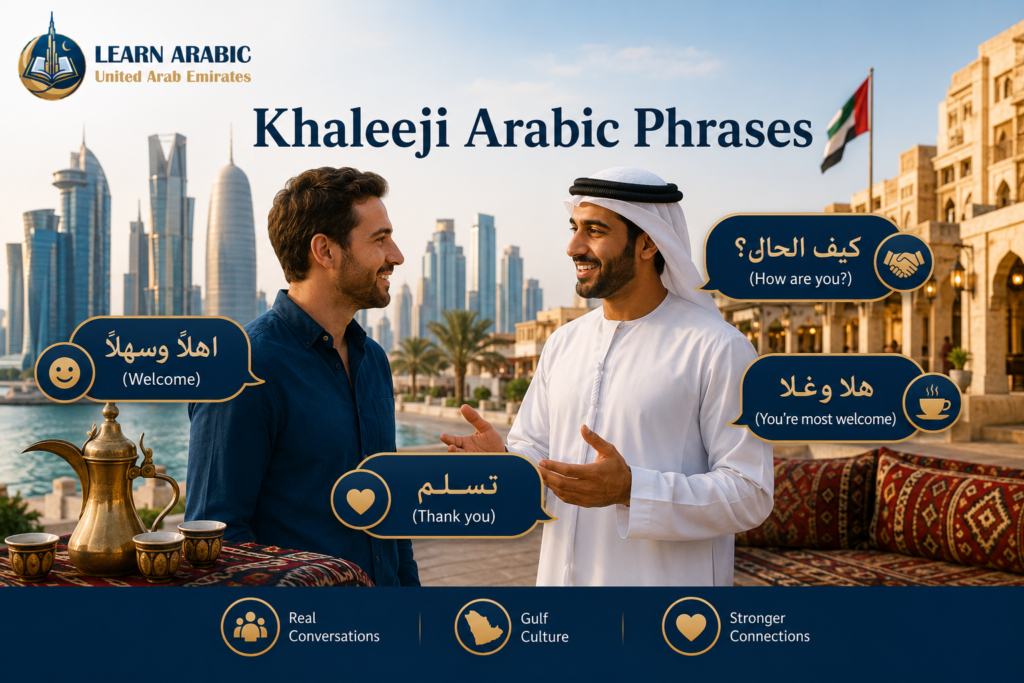
Khaleeji phrases are the building blocks of real local communication. They carry warmth, culture, and social intelligence that formal Arabic simply cannot replicate. When an expat uses even a handful of them correctly, locals notice — and the relationship changes.
If you want to go beyond this list and develop conversational fluency, exploring structured Arabic courses designed for Gulf learners is a natural next step.
Learn Arabic in the UAE with a FREE Trial Class
Khaleeji Arabic Greetings and Responses
Greetings are at the heart of Gulf culture, where a simple exchange can reflect respect, hospitality, and cultural awareness. Unlike Modern Standard Arabic (MSA), many Khaleeji greetings come with a customary response, so learning both parts of the conversation helps you sound more natural.
The Core Greeting Exchange
The expressions below are the greetings you’ll hear most often in everyday life across the Gulf. Learning both the greeting and its reply is just as important as memorizing the phrase itself.
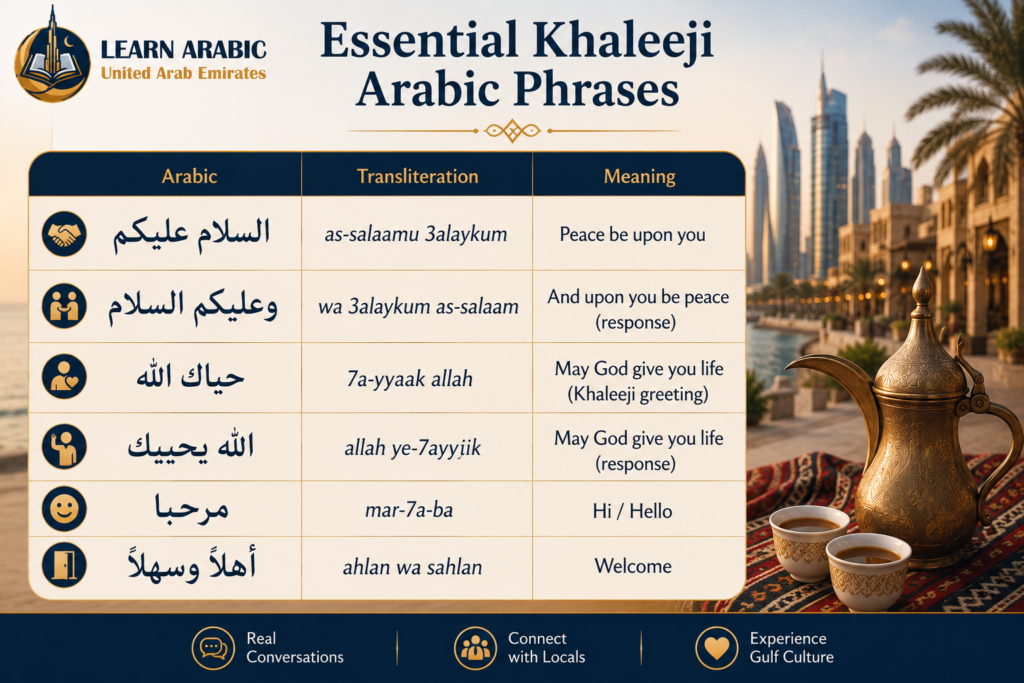
In Gulf culture, greetings are often exchanged in pairs. Responding with the expected phrase shows familiarity with local customs and creates a warmer first impression.
Read also: The Best 8 Arabic Learning Apps for Kids
Morning and Evening Greetings
Greeting someone at the right time of day is a simple way to sound more natural in Khaleeji Arabic. Unlike English, these greetings are usually followed by a fixed response rather than repeating the same phrase.
Good Morning
Start your day with this polite greeting, commonly used in both formal and casual conversations.
- Greeting: صباح الخير (ṣabaḥ al-khair)
- Response: صباح النور (ṣabaḥ an-nūr)
- Meaning: Good morning / Morning of light
Good Evening
This greeting is widely used after sunset and follows the same response pattern.
- Greeting: مساء الخير (masā’ al-khair)
- Response: مساء النور (masā’ an-nūr)
- Meaning: Good evening / Evening of light
Good Night
Use this expression to wish someone a restful night before parting or going to bed.
- Greeting: تِصْبَح على خير (teṣbaḥ ʿalā khair)
- Response: وإنت من أهله (wa inta min ahloo)
- Meaning: Good night / And to you as well
Don’t repeat صباح الخير after someone greets you. The natural response is صباح النور. The same pattern applies to مساء الخير, which is answered with مساء النور.
Step Inside Our Classrooms
Don’t just take our word for it—see our community in action. Click below to watch real, live snippets from our recent classes and experience our engaging teaching style firsthand!
Master Arabic in the UAE
Experience world-class Arabic language training designed for students and professionals in the Emirates.
Book Your Free TrialWelcoming Expressions in Khaleeji Arabic
Gulf culture is deeply hospitable, and the dialect reflects it. These welcoming phrases go beyond a simple hello — they communicate genuine warmth and social status.
When a Gulf local opens a door for you, seats you at their table, or receives you at their office, these are the expressions you will hear. Knowing how to respond correctly is just as important as knowing the phrase itself.
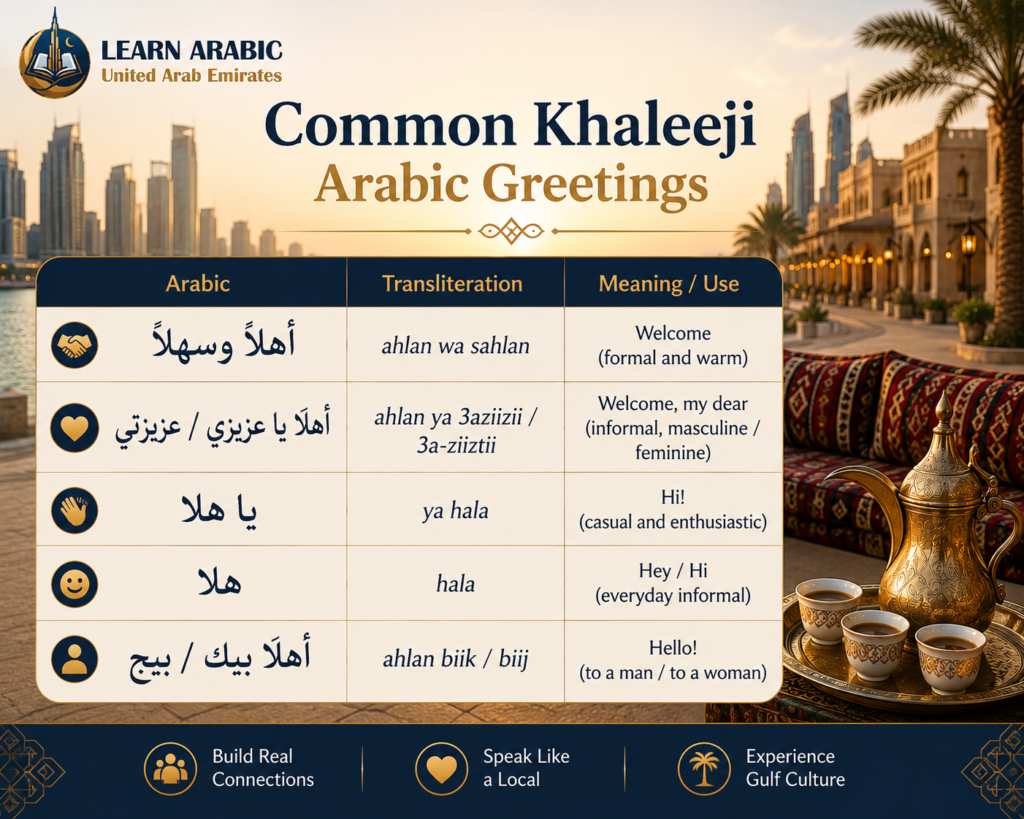
The phrase يا هلا carries a particular Gulf warmth that direct translation cannot capture. It is the kind of thing a local says when genuinely pleased to see you — not just a polite formality.
How to Ask “How Are You?” in Khaleeji Arabic
Asking someone how they are is one of the most common interactions you’ll have in the Gulf. While كيف حالك؟ is understood everywhere, Gulf speakers often use regional expressions like شلونك؟ or إشحالك؟, with the wording changing depending on the person’s gender and, sometimes, the country.
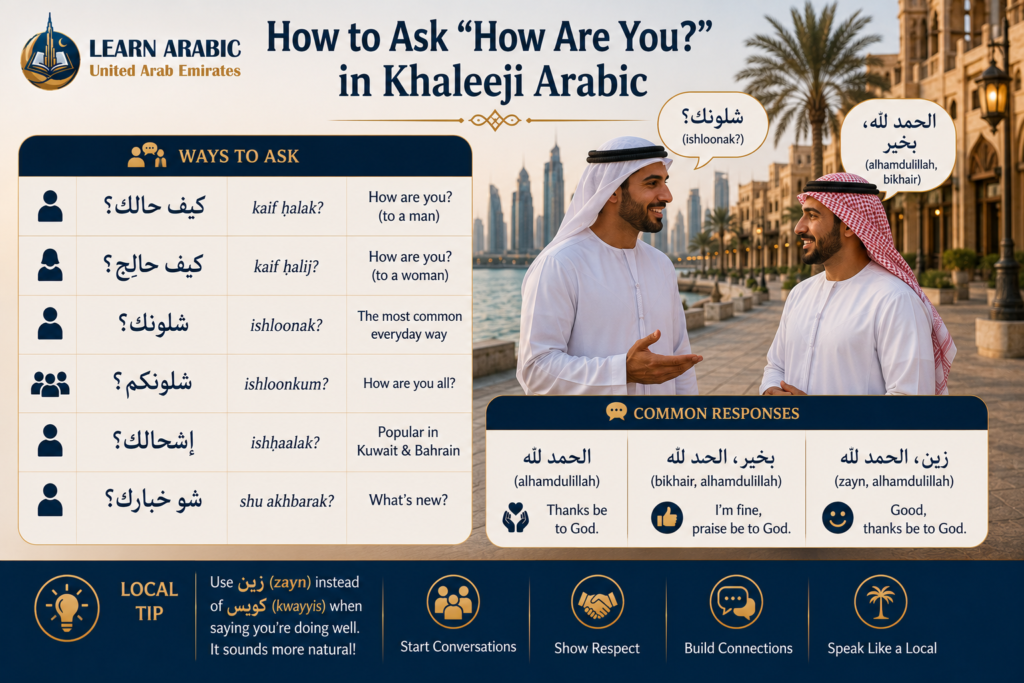
The most common ways to ask include:
- كيف حالك؟ (kaif ḥalak?) — How are you? (to a man)
- كيف حالِج؟ (kaif ḥalij?) — How are you? (to a woman)
- شلونك؟ (ishloonak?) — The most common everyday way to say “How are you?” in Gulf Arabic.
- شلونكم؟ (ishloonkum?) — How are you all?
- إشحالك؟ (ishḥaalak?) — A popular variation in Kuwait and Bahrain.
- شو خبارك؟ (shu akhbarak?) — What’s new?
Once someone asks how you’re doing, your answer is usually short and polite. The most common responses are:
- الحمد لله — Thanks be to God.
- بخير، الحمد لله — I’m fine, praise be to God.
- زين، الحمد لله — Good, thanks be to God.
If you want to sound more like a Gulf local, use زين (zayn) instead of كويس (kwayyis) when saying you’re doing well. It’s one of the easiest ways to make your Arabic sound more natural.
If you want to move beyond memorizing phrases, the Gulf Arabic Course at Learn Arabic UAE gives you the opportunity to practice with experienced instructors, improve your pronunciation, and build the confidence to use Khaleeji Arabic naturally in everyday conversations.
Start Our Gulf Arabic Classes in the UAE with a FREE Trial
Polite Expressions and Thank-You Phrases
Politeness is an important part of everyday communication in the Gulf. While شكرًا (shukran) is the standard way to say “thank you,” native speakers often use different expressions depending on the situation and the person they are speaking to.
Saying “Thank You”
The most common expressions include شكرًا (shukran), شكرًا لك (shukran lak), and شكرًا جزيلاً (shukran jazeelan) when you want to express deeper appreciation. If someone thanks you, the natural reply is العفو (al-‘afw), meaning “You’re welcome.”
Thanking Someone Personally
When speaking directly to a person, Gulf speakers often use مشكور (mashkuur) for a man, مشكورة (mashkuurah) for a woman, and مشكورين (mashkuureen) when thanking a group. These expressions sound more personal than a simple شكرًا.
Appreciating Someone’s Effort
If someone has done something for you, such as preparing a meal or helping with a task, you’ll often hear تسلم (tislam) or تسلمي (tislami). An even warmer expression is تسلم إيدك (tislam iidak) or تسلم إيدج (tislam iidej), literally meaning “Bless your hands,” and is commonly used after someone cooks or creates something well.
A Distinctly Gulf Expression
One of the most recognizable Khaleeji phrases is يعطيك العافية (yaʿṭiik al-ʿaafiyah), literally “May God give you wellness.” It’s commonly said to taxi drivers, waiters, shop assistants, or colleagues after they’ve helped you. The customary response is الله يعافيك (Allah yaʿaafiik), which returns the same good wish.
Survival Essentials — Daily Life Khaleeji Phrases
Whether you’re shopping, asking for directions, or ordering food, these are the Khaleeji Arabic phrases you’ll use most often. Start with the expressions that match your daily routine, then gradually expand your vocabulary as your confidence grows.
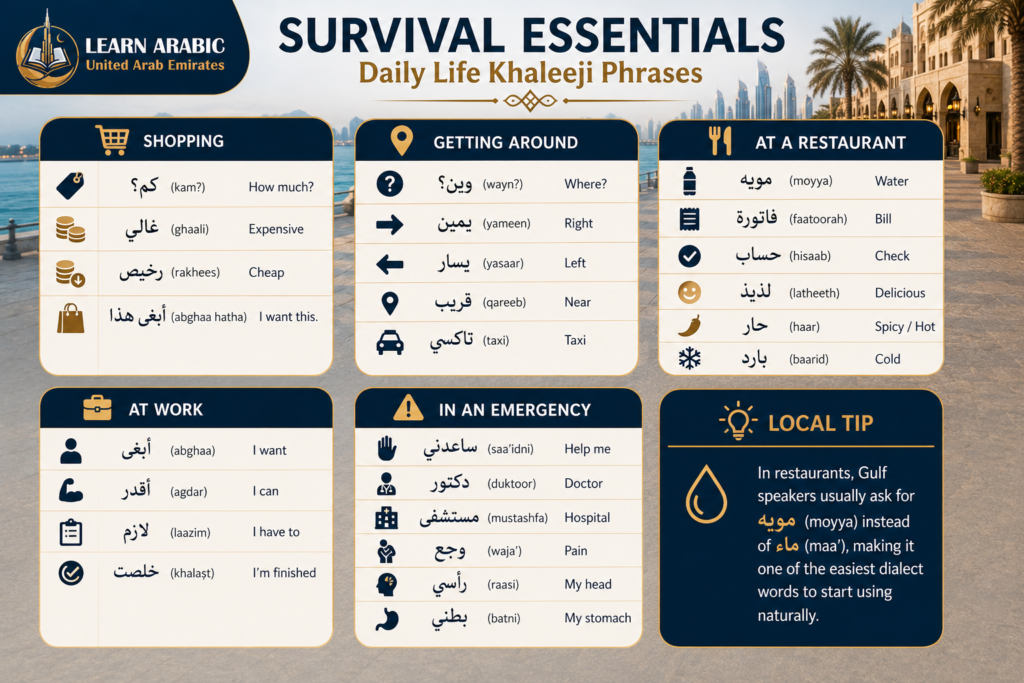
Shopping
Shopping in the Gulf becomes much easier when you know a few everyday Khaleeji Arabic phrases. These expressions will help you ask about prices, pay for your purchases, and communicate confidently with shopkeepers.
- كم؟ (kam?) — How much?
- غالي (ghaali) — Expensive
- رخيص (rakhees) — Cheap
- أبغى هذا (abghaa hatha) — I want this.
Getting Around
Whether you’re asking for directions or taking a taxi, these phrases will help you navigate cities across the Gulf with greater confidence.
- وين؟ (wayn?) — Where?
- يمين (yameen) — Right
- يسار (yasaar) — Left
- قريب (qareeb) — Near
- تاكسي (taxi) — Taxi
At a Restaurant
- مويه (moyya) — Water
- فاتورة (faatoorah) — Bill
- حساب (hisaab) — Check
- لذيذ (latheeth) — Delicious
- فاتورة (faatoorah) — Bill
- حساب (hisaab) — Check
- حار (haar) — Spicy / Hot
- بارد (baarid) — Cold
- لذيذ (latheeth) — Delicious
At Work
These useful workplace phrases will help you communicate with colleagues, ask for assistance, and handle everyday conversations in professional settings.
- أبغى (abghaa) — I want
- أقدر (agdar) — I can
- لازم (laazim) — I have to
- خلصت (khalaṣt) — I’m finished
In an Emergency
Although you may rarely need them, these emergency phrases are important to know. They can help you ask for assistance or explain a medical situation quickly.
- ساعدني (saa’idni) — Help me
- دكتور (duktoor) — Doctor
- مستشفى (mustashfa) — Hospital
- وجع (waja’) — Pain
- رأسي (raasi) — My head
- بطني (batni) — My stomach
Local Tip: In restaurants, Gulf speakers usually ask for مويه (moyya) instead of ماء (maa’), making it one of the easiest dialect words to start using naturally.
Common Khaleeji Expressions You Will Hear Every Day
These phrases are the cultural glue of Gulf conversation. They appear in almost every interaction and signal that you understand more than vocabulary.
| Arabic | Transliteration | Meaning |
| يلا، بسم الله | Yalla, bismillah | Let’s go — in the name of God |
| مبروك | Mab-ruuk | Congratulations |
| إن شاء الله | Inshaa-al-llaah | God willing — used for any future plan or hope |
| يعطيك العافية | ya3-Tiik al-3a-fya | May God bless you (to a worker or helper) |
| ما في مشكلة | maa fee mush-ki-la | No problem |
| تشرفت فيك | ta-shar-raft feek | Nice to meet you (formal) |
| هلا والله | ha-la wal-lah | A very warm welcome (literally: “Welcome, by God”) |
إن شاء الله deserves its own note. In Gulf culture it is not evasiveness — it is a genuine acknowledgment that plans exist under God’s will. Expecting a firm yes when someone says إن شاء الله is a common expat misreading.
Gulf Arabic vs Modern Standard Arabic: Which Should You Learn?
This is one of the most practical questions for anyone new to the GCC, and the honest answer is: it depends on your goal.
Modern Standard Arabic (MSA) is the formal, written, and institutional form of Arabic. It is used in government communication, universities, news media, and official correspondence. It is understood across all Arab countries and carries prestige in formal settings. If you want to study at a Gulf university, write professional documents, or follow Arabic news, MSA is the foundation you need.
Khaleeji Arabic is what people actually speak at home, in markets, in social settings, and increasingly in professional ones. It carries warmth and local identity that MSA cannot. When a local switches from formal Arabic to Khaleeji in a conversation with you, it is a signal of acceptance — they are treating you as an insider.
A practical decision framework:
- Working in a formal institution, legal context, or government office → prioritize MSA
- Building relationships with local colleagues, neighbors, and community → prioritize Khaleeji
- Staying in the Gulf long-term → learn both, starting with whichever matches your immediate need
For those specifically living or working in Saudi Arabia, Arabic courses tailored to the Saudi context go deeper into regional vocabulary and register differences that a general Gulf Arabic course may not cover.
Join Our Saudi Arabic Classes in the UAE with a FREE Trial
Common Mistakes Expats Make With Khaleeji Arabic Phrases
Many learners memorize useful Khaleeji Arabic phrases quickly but still struggle to sound natural. Avoiding the following mistakes will help you communicate more confidently and develop authentic Gulf Arabic skills.
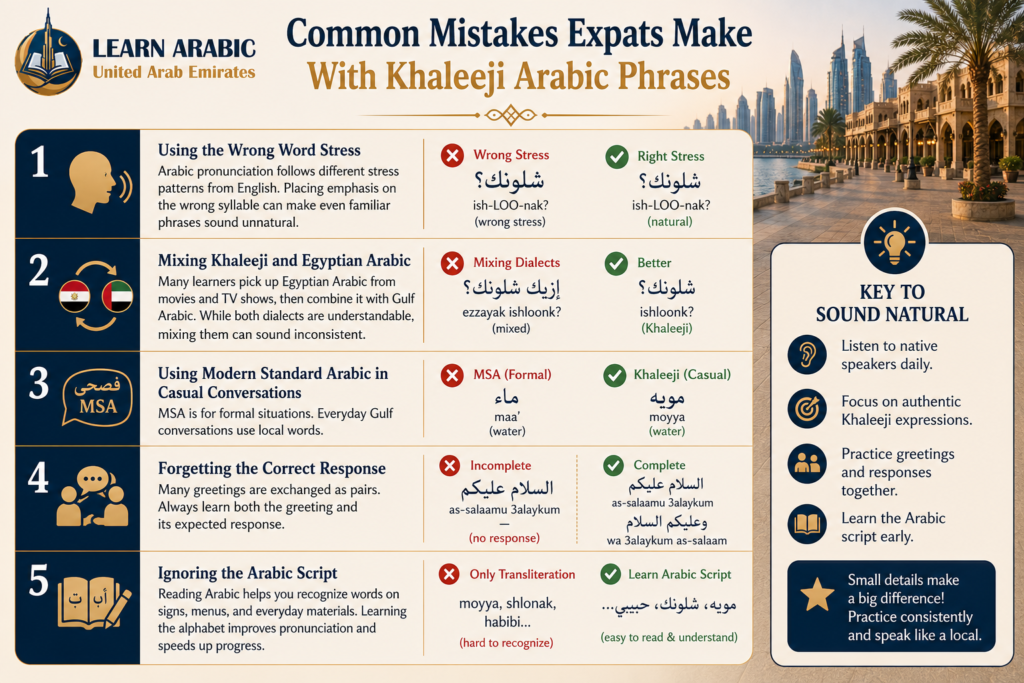
1. Using the Wrong Word Stress
Arabic pronunciation follows different stress patterns from English. Placing emphasis on the wrong syllable can make even familiar phrases sound unnatural. Listening to native speakers and imitating their pronunciation is the best way to develop a natural accent.
2. Mixing Khaleeji and Egyptian Arabic
Many learners pick up Egyptian Arabic from movies and TV shows, then combine it with Gulf Arabic. While both dialects are understandable, mixing them can sound inconsistent. If your goal is to communicate in the Gulf, focus on Khaleeji-specific vocabulary and expressions.
3. Using Modern Standard Arabic in Casual Conversations
Modern Standard Arabic (MSA) is appropriate for formal situations, but everyday conversations in the Gulf rely on local vocabulary. For example, Gulf speakers usually say مويه (moyya) instead of ماء (maa’) for “water.” Using local expressions makes your speech sound more natural.
Read Also: 10 Steps to Learning Arabic Numbers for Kids in the UAE
4. Forgetting the Correct Response
Many Khaleeji greetings are exchanged as pairs. Learning السلام عليكم without knowing وعليكم السلام, or صباح الخير without صباح النور, leaves the conversation incomplete. Always memorize both the greeting and its expected response.
5. Ignoring the Arabic Script
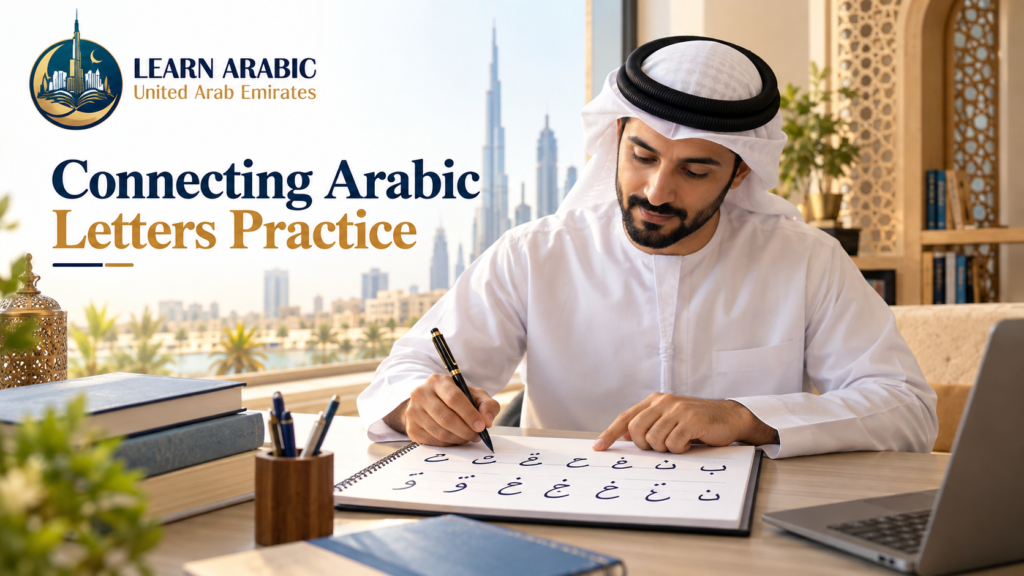
Although you can learn basic phrases through transliteration, reading Arabic script helps you recognize words on signs, menus, and everyday materials. Learning the alphabet early also improves your pronunciation and speeds up your overall progress.
Read Also: How to Learn Khaleeji Arabic in the UAE?
How to Learn These Phrases Fast? — A Practical Method
Learning Khaleeji Arabic phrases is more effective when you focus on a few expressions at a time instead of trying to memorize long vocabulary lists. Start with 5–10 phrases that match your daily routine, practice their pronunciation, and use them in real conversations whenever possible.
To remember new phrases faster, learn them as complete exchanges rather than individual words. For example, memorize السلام عليكم together with وعليكم السلام, or يعطيك العافية with الله يعافيك. Practicing phrases in context improves both your confidence and long-term retention.
Working through these phrases with a native-speaking teacher who can correct your pronunciation in real time compresses the timeline considerably. Qualified Arabic tutors who specialize in Gulf Arabic can identify specific mistakes that self-study simply cannot catch.
Read Also: Arabic Alphabet for Kids
See Our Classroom Environment in Action
Experience a sneak peek into our live sessions. Watch the video below to see our specialized instructors interacting with students, breakdown complex texts, and cultivate an engaging, respectful learning environment.
Master Arabic in the UAE
Experience world-class Arabic language training designed for students and professionals in the Emirates.
Book Your Free TrialLearn with the Best Online Arabic Tutors in the UAE with a FREE Trial
Build Real Khaleeji Arabic Skills with Learn Arabic UAE
Learning a list of phrases is a great first step, but true confidence comes from using them in real conversations. With regular speaking practice, accurate pronunciation, and guidance from experienced instructors, you’ll learn when and how to use Khaleeji Arabic naturally in everyday situations.
At Learn Arabic UAE, our online Arabic courses combine practical conversation, cultural insights, and personalized instruction to help you communicate confidently across the Gulf. Whether you’re living in the UAE or preparing to work in the GCC, our expert teachers will help you build lasting Arabic skills at your own pace.
Explore Arabic courses designed for Gulf learners →
Our Arabic courses
- Quranic Arabic Course
- Fusha Arabic Course
- Classical Arabic Course
- Emirati Arabic Course
- Gulf Arabic Course
- Learn Saudi Arabic
- Business Arabic Course UAE
- Arabic Language Classes for Professionals in UAE
Conclusion
Khaleeji Arabic phrases are the fastest route to genuine connection in the Gulf. The 100+ phrases in this guide cover greetings, daily survival, shopping, food, directions, family, and emergencies — organized for real expat life rather than classroom exercises. The key distinctions to carry forward: learn Gulf-specific vocabulary rather than MSA equivalents, always learn the response phrase alongside the greeting, and train your ear to Gulf stress patterns before worrying about grammar. The Gulf dialect represents the cultural identity of six nations and millions of people — a few well-placed phrases signal far more than linguistic effort. They signal respect.
Frequently Asked Questions
What are the most important Khaleeji Arabic phrases for a new expat?
Start with survival greetings and responses: السلام عليكم / وعليكم السلام, the morning and evening pair صباح الخير / صباح النور, and the universal thank-you يعطيك العافية. Add the question-response pairs for “how are you” — شلونك / الحمد لله — and the essential survival words: نعم، لا، ممكن، خلاص، وين. These 15–20 items cover the majority of real daily interactions.
How is Khaleeji Arabic different from Egyptian Arabic?
Khaleeji Arabic is the spoken dialect of the six GCC nations; Egyptian Arabic is the dialect of Egypt, widely spread through Arab media. Key differences include distinct vocabulary (مويه for water in Khaleeji vs مية in Egyptian), different question words (وين for “where” in Gulf vs فين in Egyptian), and different intonation patterns. Using Egyptian phrases in the Gulf sounds like arriving in London and speaking Australian slang — understandable, but noticeably foreign.
Do I need to learn the Arabic script to speak Khaleeji Arabic?
You can start speaking without reading Arabic script, but skipping it creates a ceiling on your progress. Script knowledge helps you recognize words on signs, in learning materials, and in written messages from locals. Most learners who avoid script hit a plateau around beginner-intermediate level. Learning the alphabet early, even before mastering Khaleeji phrases, accelerates every other stage of acquisition.
How long does it take to hold a basic conversation in Khaleeji Arabic?
With consistent daily practice of 15–20 minutes, most expats can hold simple social conversations — greetings, how-are-yous, basic requests, and shopping exchanges — within 6 to 8 weeks. Reaching comfortable conversation on a wider range of topics typically takes 3 to 6 months of structured study with regular practice.
Is Khaleeji Arabic understood across all GCC countries?
Yes, with minor variation. The core dialect is mutually intelligible across Bahrain, Kuwait, Qatar, Saudi Arabia, Oman, and the UAE. Regional differences exist — some words used in Kuwait differ from those in the UAE, and Saudi Khaleeji has its own expressions — but the shared vocabulary and grammar structure mean a speaker from one Gulf country is easily understood in another.
What is the difference between شلونك and كيف حالك?
Both mean “how are you?” شلونك is the distinctly Khaleeji form — used in casual, warm, everyday exchanges across the Gulf.
كيف حالك is the MSA form, grammatically correct but more formal and less natural in casual Gulf conversation. Locals use both, but شلونك signals dialect awareness and social ease; كيف حالك tends to signal that someone has learned formal Arabic rather than the spoken dialect.


Leave a Reply