 Quran
Quran
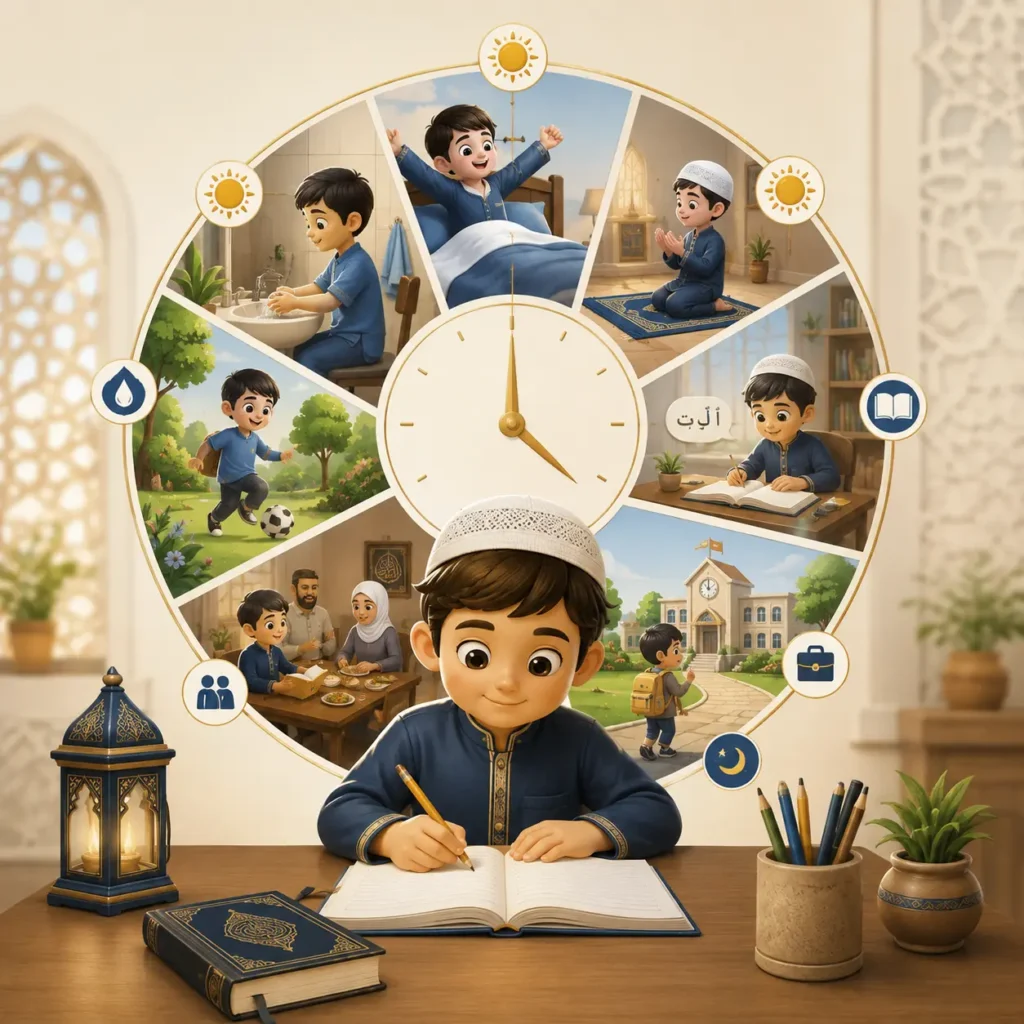
Teaching children a daily routine is one of the most powerful things you can do as a parent or educator. When kids know what comes next in their day, they feel secure, focused, and far less likely to resist transitions.
And when that routine is taught alongside Arabic, something remarkable happens — language learning becomes woven into life itself, not confined to a classroom.
Research in child psychology also shows that predictable structures of each daily routine in Arabic for kids reduce anxiety, improve behaviour, and help children develop self-regulation. Combining routine with Arabic language instruction gives children two benefits at once — emotional security and linguistic growth.
This guide walks through 10 key daily routine activities in Arabic for kids, complete with vocabulary, simple sentences, meanings in English, and practical tips for making each step stick.
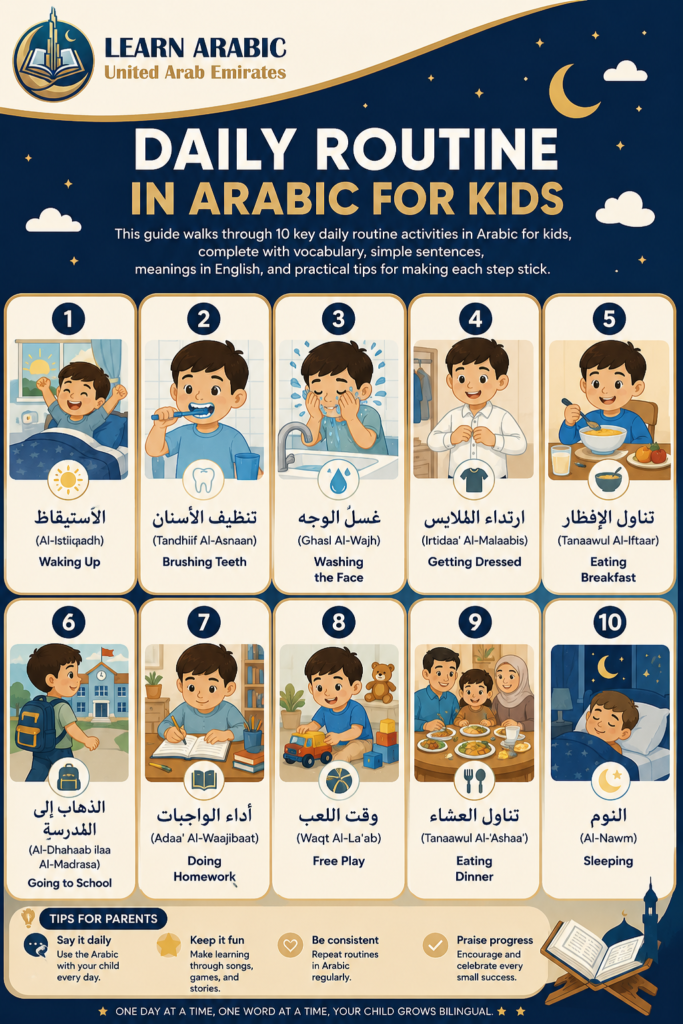
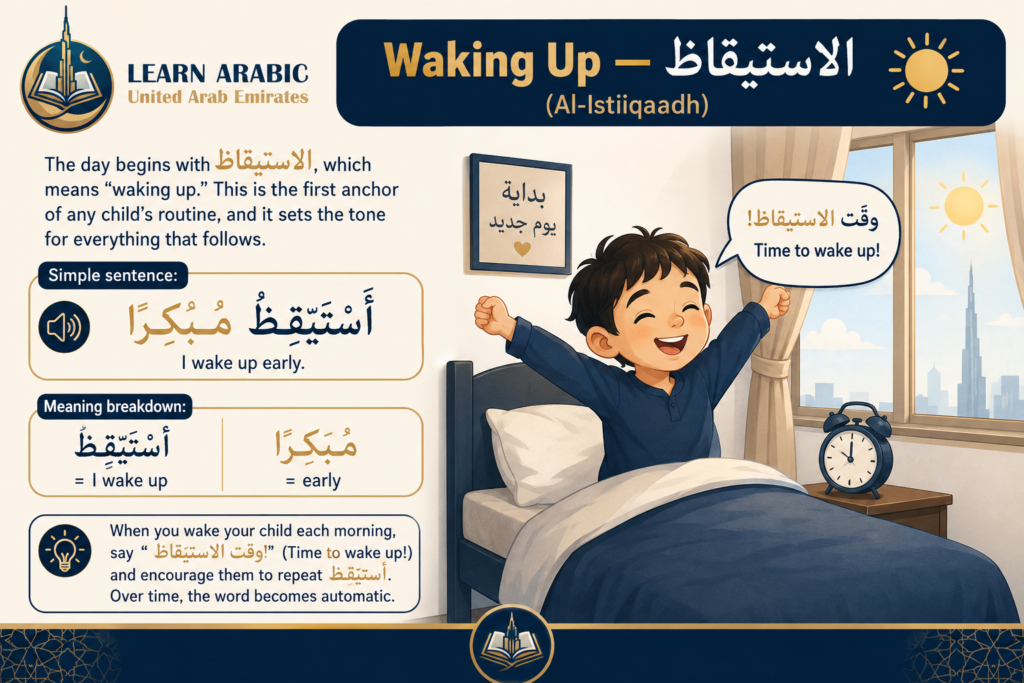
1. Waking Up — الاستيقاظ (Al-Istiiqaadh)
The day begins with الاستيقاظ, which means “waking up.” This is the first anchor of any child’s routine, and it sets the tone for everything that follows.
Simple sentence: أستيقظ مبكرًا — I wake up early.
Meaning breakdown: أستيقظ = I wake up | مبكرًا = early
When you wake your child each morning, say “وقت الاستيقاظ!” (Time to wake up!) and encourage them to repeat أستيقظ. Over time, the word becomes automatic.
Islamic tradition places great value on rising early. The Prophet Muhammad (ﷺ) said, “O Allah, bless my nation in their early mornings.” Building the habit of early rising in childhood tends to persist into adulthood — which is one reason Arabic-Islamic homeschool programmes place it at the top of every daily schedule.
2. Brushing Teeth — تنظيف الأسنان (Tandhiif Al-Asnaan)
After waking, children move to تنظيف الأسنان — tooth brushing — which is both a health habit and a rich Arabic vocabulary moment.
Simple sentence: أُنظِّف أسناني — I brush my teeth.
Meaning breakdown: أُنظِّف = I clean | أسناني = my teeth
On a visual routine chart, pair this phrase with a toothbrush icon. Children from age three can match the picture to the word and say the Arabic aloud before brushing.
This is also a natural moment to introduce body parts in Arabic — lips (الشفاه), teeth (الأسنان), tongue (اللسان) — turning a two-minute hygiene habit into a mini vocabulary session. Exploring body parts in Arabic alongside the brushing routine helps children connect language to their own physical experience.
3. Washing the Face — غسل الوجه (Ghasl Al-Wajh)
غسل الوجه, or face washing, follows immediately after brushing teeth in most children’s morning routines. The word غسل (washing) appears repeatedly throughout Islamic practice, making it highly useful for children learning Quranic or everyday Arabic.
Simple sentence: أغسل وجهي — I wash my face.
Meaning breakdown: أغسل = I wash | وجهي = my face
Children who attend Islamic schools will recognise غسل from the context of wudhu (ritual purification). Linking the morning face wash to the broader concept of طهارة (cleanliness and purity) gives the word deeper meaning and memorability.
Build a Strong Foundation in Fusha Arabic with a FREE Trial Lesson

4. Getting Dressed — ارتداء الملابس (Irtidaa’ Al-Malaabis)
Getting dressed — ارتداء الملابس — is a daily activity that opens the door to some of the most practical Arabic vocabulary for children.
Simple sentence: أرتدي ملابسي — I put on my clothes.
Meaning breakdown: أرتدي = I wear/put on | ملابسي = my clothes
This activity pairs naturally with learning clothes in Arabic — shirt (قميص), trousers (بنطلون), shoes (حذاء), school uniform (الزي المدرسي). When a child reaches for their socks and you name the item in Arabic, you are doing vocabulary instruction with zero effort and maximum retention.
A simple matching sheet — pictures of clothing items on one side, Arabic words on the other — can be completed in under five minutes as part of the morning routine.
Step Inside Our Classrooms
Don’t just take our word for it—see our community in action. Click below to watch real, live snippets from our recent classes and experience our engaging teaching style firsthand!
Master Arabic in the UAE
Experience world-class Arabic language training designed for students and professionals in the Emirates.
Book Your Free Trial5. Eating Breakfast — تناول الإفطار (Tanaawul Al-Iftaar)
تناول الإفطار is breakfast, and it is one of the most valuable vocabulary moments of the entire day because of how many sub-words it contains.
Simple sentence: أتناول وجبة الإفطار — I eat my breakfast.
Meaning breakdown: أتناول = I have/eat | وجبة = meal | الإفطار = breakfast
Breakfast is the ideal time to name foods aloud in Arabic. Many families find that introducing food in Arabic language during mealtimes is the most effective vocabulary strategy available — children hear the word, see the food, smell it, and taste it, all at once.
That kind of multi-sensory input creates memory that lasts. You can extend this by pointing out Vegetables in Arabic when they appear on the plate — cucumber (خيار), tomato (طماطم), carrot (جزر) — turning every meal into an informal Arabic lesson.
The word إفطار is also used for breaking the Ramadan fast, so children learning Arabic in a Muslim household will encounter it with double significance — a real-world connection that deepens understanding.
Read also: How to Talk About the Weather in Arabic? Words, Phrases, and Real Conversations
6. Going to School — الذهاب إلى المدرسة (Al-Dhahaab ilaa Al-Madrasa)
الذهاب إلى المدرسة — going to school — is a transition moment that happens every morning and carries emotional weight for young children. Naming it in Arabic makes the transition feel more purposeful.
Simple sentence: أذهب إلى المدرسة — I go to school.
Meaning breakdown: أذهب = I go | إلى = to | المدرسة = the school
Once children are comfortable with the base sentence, parents can ask questions in Arabic: “مع من تذهب؟” (Who do you go with?) and “متى تعود؟” (When do you come back?). Simple question-and-answer patterns like these are among the most effective language drills available, and they happen naturally during the school commute.
Book a Free Trial Lesson in Our Self-Paced Arabic Classes

7. Doing Homework — أداء الواجبات (Adaa’ Al-Waajibaat)
After school, the routine shifts to أداء الواجبات — completing homework and assignments. This is an important phase for teaching children the concept of الالتزام (commitment) alongside Arabic vocabulary.
Simple sentence: أؤدي واجباتي المنزلية — I do my homework.
Meaning breakdown: أؤدي = I perform/do | واجباتي = my homework/assignments | المنزلية = home-related
Many Arabic educators recommend a fixed homework time rather than a flexible one. When children know that homework begins at 4:00 PM every day without negotiation, resistance drops significantly. Using a bilingual Arabic-English daily schedule chart — which you can print and display in the child’s room — helps reinforce this structure visually.
8. Free Play — وقت اللعب (Waqt Al-La’ab)
وقت اللعب — playtime — is not a reward for completing tasks; it is a developmental necessity. Research consistently shows that unstructured play supports cognitive development, emotional regulation, and social skills in young children.
Simple sentence: ألعب بحرية — I play freely.
Meaning breakdown: ألعب = I play | بحرية = freely
Outdoor play, especially with siblings or peers, is one of the richest environments for spontaneous Arabic use. Children narrate, negotiate, argue, describe, and imagine in the language they are comfortable in. Encouraging Arabic during play — even just naming what they are doing — accelerates fluency faster than most formal lessons.
A common phrase used by Arabic-speaking families with young children is “العب وتعلم” — play and learn — reflecting a long-standing educational philosophy that childhood learning should be embedded in joy, not extracted from it.
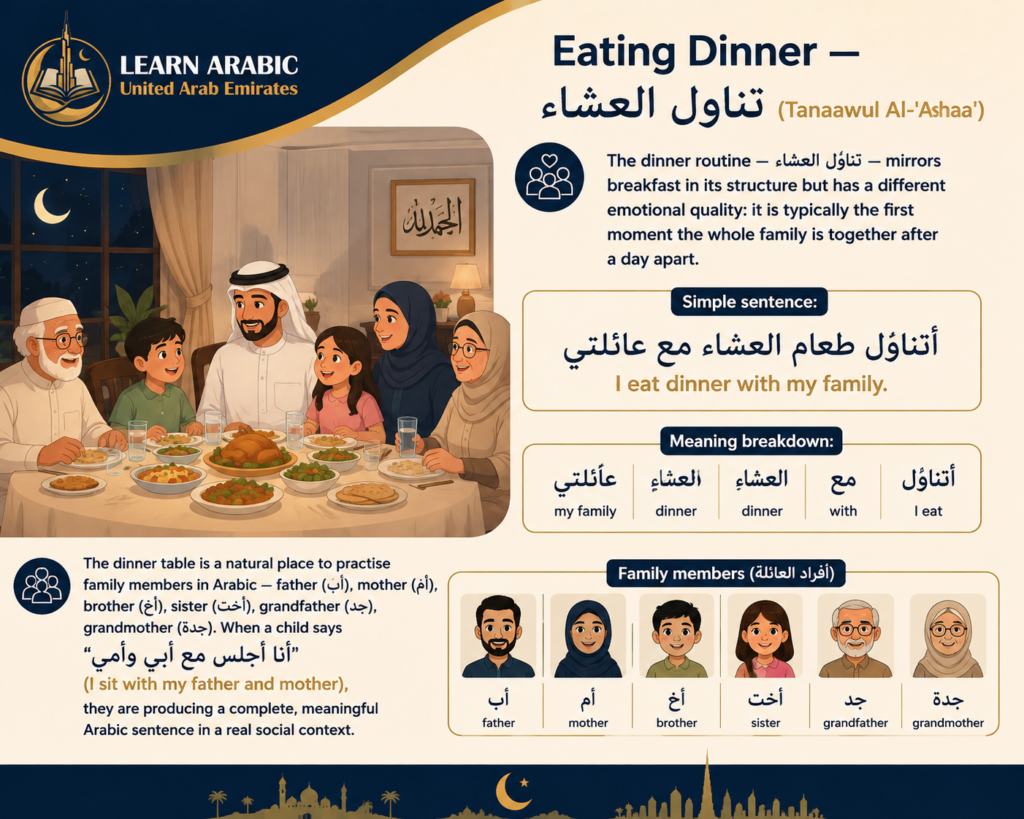
9. Eating Dinner — تناول العشاء (Tanaawul Al-‘Ashaa’)
The dinner routine — تناول العشاء — mirrors breakfast in its structure but has a different emotional quality: it is typically the first moment the whole family is together after a day apart.
Simple sentence: أتناول طعام العشاء مع عائلتي — I eat dinner with my family.
Meaning breakdown: أتناول = I eat | طعام = food | العشاء = dinner | مع = with | عائلتي = my family
The dinner table is a natural place to practise family members in Arabic — father (أب), mother (أم), brother (أخ), sister (أخت), grandfather (جد), grandmother (جدة). When a child says “أنا أجلس مع أبي وأمي” (I sit with my father and mother), they are producing a complete, meaningful Arabic sentence in a real social context.
A simple rule — one Arabic word per meal — is surprisingly effective over time. By the end of a school term, a child who has been doing this will have acquired dozens of food and family vocabulary words through pure habit.
10. Sleeping — النوم (Al-Nawm)
النوم — sleep — closes the loop of the daily routine. It is also one of the most emotionally significant transitions in a child’s day, which is why bedtime rituals across cultures tend to be the most consistent and the most loved.
Simple sentence: أذهب إلى النوم باكرًا — I go to sleep early.
Meaning breakdown: أذهب = I go | إلى = to | النوم = sleep | باكرًا = early
Reading a short story in Arabic before sleep, or reciting a bedtime du’aa’, creates a powerful daily Arabic exposure moment that children associate with comfort and safety. Over weeks and months, this single habit contributes enormously to listening comprehension and vocabulary acquisition.
Turning off screens an hour before sleep, completing a light نشاط هادئ (calm activity), and making dhikr or du’aa’ are consistent recommendations across Islamic parenting resources — all of which can be named and performed in Arabic to reinforce language alongside values.
Printable Daily Routine Chart in Arabic for Kids
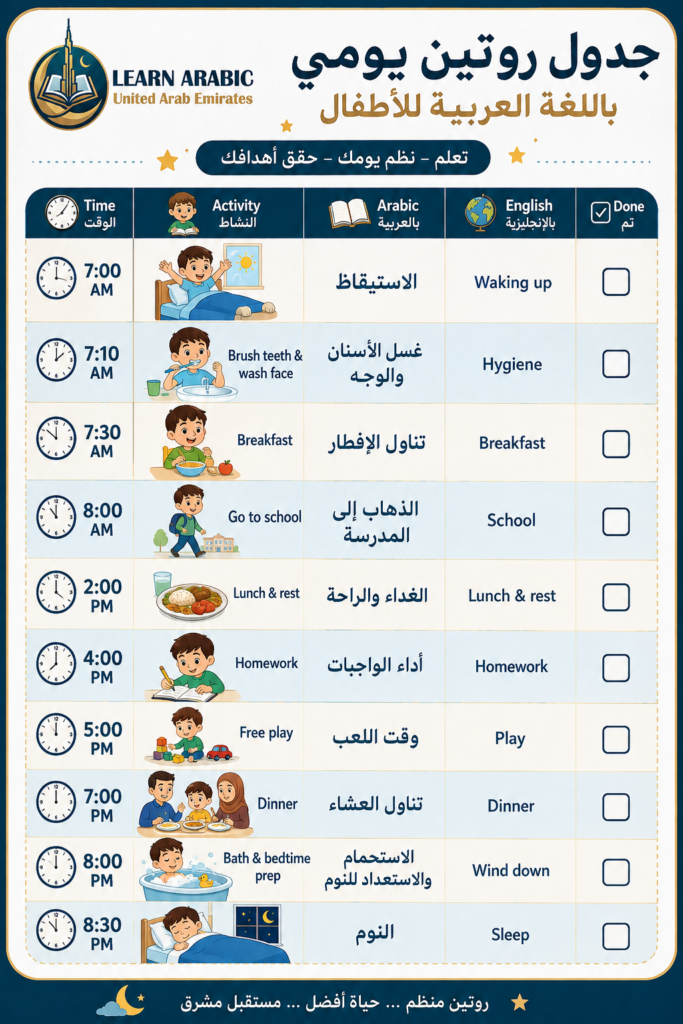
One of the most requested resources for parents and teachers is a daily routine in Arabic printable charts — something children can see, follow, and tick off throughout the day.
A. Essential Features Of An Effective Arabic Daily Routine Chart
- Visual icons next to each activity so pre-readers can follow along
- Arabic text with the activity name written clearly in Modern Standard Arabic
- English translation beneath each Arabic word for families still learning
- A time column showing when each activity happens
- A checkbox or sticker space for children to mark completed tasks
B. Sample Arabic Daily Routine Chart For Kids
| Time | Activity | Arabic | English |
| 7:00 AM | Wake up | الاستيقاظ | Waking up |
| 7:10 AM | Brush teeth & wash face | غسل الأسنان والوجه | Hygiene |
| 7:30 AM | Breakfast | تناول الإفطار | Breakfast |
| 8:00 AM | Go to school | الذهاب إلى المدرسة | School |
| 2:00 PM | Lunch & rest | الغداء والراحة | Lunch & rest |
| 4:00 PM | Homework | أداء الواجبات | Homework |
| 5:00 PM | Free play | وقت اللعب | Play |
| 7:00 PM | Dinner | تناول العشاء | Dinner |
| 8:00 PM | Bath & bedtime prep | الاستحمام والاستعداد للنوم | Wind down |
| 8:30 PM | Sleep | النوم | Sleep |
Print one chart per child, laminate it, and provide dry-erase markers so children can tick activities off and reset the chart daily. This also teaches أولاً، ثم، بعد ذلك، أخيراً (first, then, after that, finally) — sequencing vocabulary that is foundational for both Arabic language development and early literacy.
Read Also: 10 Interesting Easy Arabic Stories For Kids
Exercise On Daily Routine in Arabic For Kids With Answers
One of the most practical formats for children learning daily routine vocabulary in Arabic is the question-and-answer structure. It mirrors natural conversation, builds listening comprehension, and can be used at home or in group lessons.
Here are the most useful Q&A pairs, formatted so they can be used directly with children:
س: متى تستيقظ؟ (When do you wake up?) ج: أستيقظ في الساعة السابعة صباحاً. (I wake up at 7 AM.)
س: ماذا تفعل في الصباح؟ (What do you do in the morning?) ج: أغسل وجهي وأتناول الإفطار. (I wash my face and eat breakfast.)
س: متى تذهب إلى المدرسة؟ (When do you go to school?) ج: أذهب إلى المدرسة في الساعة الثامنة. (I go to school at 8 AM.)
س: ماذا تفعل بعد المدرسة؟ (What do you do after school?) ج: ألعب وأؤدي واجباتي. (I play and do my homework.)
س: متى تنام؟ (When do you sleep?) ج: أنام في الساعة الثامنة والنصف مساءً. (I sleep at 8:30 PM.)
These exchanges can be practised during the actual activity — asking a child “ماذا تفعل الآن؟” (What are you doing now?) while they brush their teeth produces far more retention than asking the same question in a separate lesson context.
See Our Classroom Environment in Action
Experience a sneak peek into our live sessions. Watch the video below to see our specialized instructors interacting with students, breakdown complex texts, and cultivate an engaging, respectful learning environment.
Master Arabic in the UAE
Experience world-class Arabic language training designed for students and professionals in the Emirates.
Book Your Free TrialLearn Arabic UAE Helps Kids Master Arabic Through Structured, Engaging Lessons
If you are looking for professional Arabic instruction for children in the UAE, Learn Arabic UAE offers dedicated programmes designed specifically for young learners.
Children thrive when Arabic instruction meets them where they are — at their level, in their language, with content that feels meaningful rather than mechanical. At Learn Arabic UAE, lessons are structured around real vocabulary children actually use, including everyday topics like the daily routine, family life, school, and their environment in the UAE.
Whether your child is a complete beginner, a heritage speaker who needs to formalise their grammar, or a confident reader looking to deepen comprehension, there is a course pathway built for them.
Explore programmes built for children and families in the UAE:
- Arabic Course in the UAE
- Arabic Classes for Beginners — Learn Arabic from Scratch
- Learn Arabic for Kids in the UAE
- Emirati Arabic Course
- Quranic Arabic Course
- Learn Arabic Alphabet Course
- Arabic Grammar Course
Book your free trial class today and discover how structured Arabic instruction can help you write with confidence from your very first lessons.

Conclusion
Teaching a daily routine in Arabic for kids with meaning is not just a language exercise — it is one of the most practical investments you can make in a child’s development. When children learn the Arabic words for waking up, eating, going to school, playing, and sleeping, they are not memorising a vocabulary list.
They are building a structured internal world where Arabic belongs naturally, alongside the rhythms of real life. The ten activities covered in this guide — from الاستيقاظ to النوم — form the backbone of any child’s day. Each one is an opportunity to speak Arabic, hear Arabic, and gradually internalise it.
A printable daily routine chart in Arabic, used consistently alongside the Q&A practice sentences, gives children both the structure and the language to navigate their days with confidence.
The key insight worth carrying forward: a routine only becomes second nature through repetition, and Arabic only becomes second nature the same way. When you combine the two, each reinforces the other. The child who says أتناول الإفطار every morning at the breakfast table will remember that phrase long after any classroom lesson has faded.
Start with one or two activities from this list. Add the Arabic label. Say it aloud together. Repeat it daily. The rest follows.
Frequently Asked Questions
What is “daily routine” in Arabic?
الروتين اليومي (Al-Rooteen Al-Yawmi) is the Arabic term for daily routine. It refers to the set of activities a person carries out every day in a consistent order — such as waking up, eating, going to school, and sleeping.
What are the most important daily routine words in Arabic for kids?
The most useful starting vocabulary includes: الاستيقاظ (waking up), تناول الإفطار (eating breakfast), الذهاب إلى المدرسة (going to school), وقت اللعب (playtime), أداء الواجبات (doing homework), تناول العشاء (eating dinner), and النوم (sleeping).
At what age should children start learning Arabic daily routine vocabulary?
Children can begin learning simple Arabic routine words from age two to three, starting with visual charts and single words. By age five or six, most children can produce short Arabic sentences describing their daily activities when given consistent exposure at home or in school.
How do I use a printable daily routine chart in Arabic with my child?
Print the chart, place it somewhere the child can see it at eye level, and review it together each morning. Point to each Arabic word as the activity happens in real time. Laminating the chart and using stickers or dry-erase markers for daily tracking keeps children engaged over weeks and months.
What does “أستيقظ مبكرًا” mean?
أستيقظ مبكرًا means “I wake up early.” It is one of the most common first sentences taught in Arabic daily routine vocabulary for young learners.
أستيقظ = I wake up, مبكرًا = early.
How can I help my child practise Arabic daily routine phrases at home?
The most effective method is to use the Arabic phrase during the actual activity. Say “وقت الإفطار!” when breakfast is ready, ask “ماذا تفعل الآن؟” while your child is playing, and use “وقت النوم” consistently at bedtime. Language attached to real experience is language that sticks.



[…] also: How Many Letters Are In The Arabic […]