 Learn Arabic

Most people searching for how to learn Arabic in 6 months in the UAE have already tried something — an app, a YouTube playlist, a phrasebook — and stalled within weeks. Not because Arabic is impossible, but because generic advice ignores the specific environment you are learning in.
The UAE is one of the most Arabic-saturated environments on earth. Every commute, every supermarket visit, every Friday khutbah is a free lesson — if you know how to use it. Most learners never activate that advantage, and they progress slower than they should as a result.
This guide gives you a month-by-month plan built specifically for two groups of UAE residents: expat professionals who need functional Arabic for daily life, and Muslim learners who want to understand the Quran and Islamic texts without relying on a translation. Both goals are achievable in six months. The plan is largely the same — and this article tells you exactly where the paths diverge.
Month 1 — The Arabic Alphabet and the Sounds the UAE Keeps Throwing at You
How to learn Arabic in 6 months in the UAE begins with a foundation most learners rush past — and pay for later. Month 1 has one job: getting you to read and produce Arabic sounds correctly before anything else is attempted. Everything that follows — vocabulary, grammar, conversation — collapses without this foundation being solid.
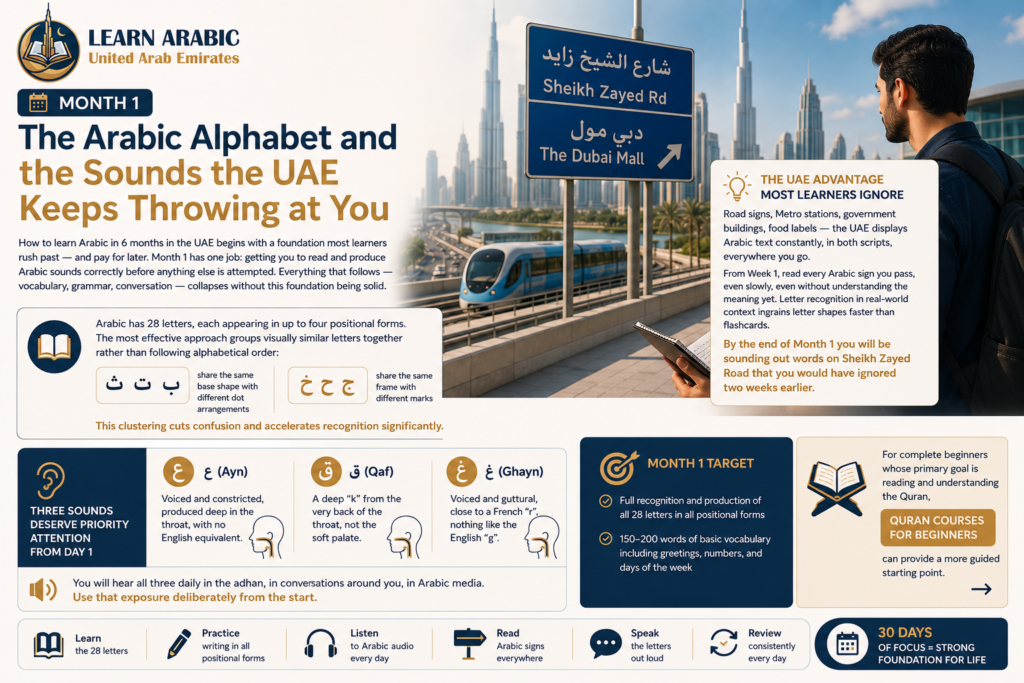
Arabic has 28 letters, each appearing in up to four positional forms. The most effective approach groups visually similar letters together rather than following alphabetical order: ب، ت، ث share the same base shape with different dot arrangements; ج، ح، خ share the same frame with different marks. This clustering cuts confusion and accelerates recognition significantly.
The UAE Advantage Most Learners Ignore
Road signs, Metro stations, government buildings, food labels — the UAE displays Arabic text constantly, in both scripts, everywhere you go. Most residents scan past it without reading. From Week 1, read every Arabic sign you pass, even slowly, even without understanding the meaning yet. Letter recognition in real-world context ingrains letter shapes faster than flashcards. By the end of Month 1 you will be sounding out words on Sheikh Zayed Road that you would have ignored two weeks earlier.
Three sounds deserve priority attention from Day 1: ع (Ayn) — voiced and constricted, produced deep in the throat, with no English equivalent; ق (Qaf) — a deep “k” from the very back of the throat, not the soft palate; غ (Ghayn) — voiced and guttural, close to a French “r,” nothing like the English “g.” You will hear all three daily in the adhan, in conversations around you, in Arabic media. Use that exposure deliberately from the start.
Month 1 target: full recognition and production of all 28 letters in all positional forms; 150–200 words of basic vocabulary including greetings, numbers, and days of the week. For complete beginners whose primary goal is reading and understanding the Quran, Quran courses for beginners can provide a more guided starting point.

Month 2 — Grammar, Core Vocabulary, and Learning the Right Words First
With the alphabet secure, Month 2 introduces the grammatical structures that make vocabulary functional. The temptation here is to memorise random word lists. Resist it. Isolated vocabulary does not stick — words learned in sentences, used immediately, and heard again in listening are the words that become permanent.
Month 2 grammar focuses on three things: pronouns, basic verb conjugation, and sentence construction. Arabic offers both Subject-Verb-Object and Verb-Subject-Object word order — both grammatically correct. SVO mirrors English and is the right starting point. One detail most beginner resources skip: Arabic nominal sentences carry no present-tense “to be.” أنا موظف (Ana Muwazzaf) — “I am an employee,” literally “I employee” — is grammatically complete. Understanding this early prevents recurring confusion.
Month 2 target: 300–500 active words; ability to build simple sentences using pronouns, present and past tense verbs, and basic adjectives.
Read also: How to Learn Arabic in 5 Minutes in the UAE?
Month 3 — Listening Immersion Using What the UAE Already Provides
By Month 3, your focus should shift from memorizing vocabulary to training your ear. Consistent listening helps your brain recognize natural Arabic speech, making conversations easier to follow over time.

1. Practice Active Listening Every Day
Set aside 60–90 minutes for focused listening using short Arabic audio clips. Listen to the same 2–3 minute recording more than once, writing down the words and phrases you recognize each time. Children’s TV programs and beginner-friendly Arabic videos are ideal because they use simple vocabulary and clear pronunciation.
2. Add Passive Listening to Your Daily Routine
Keep Arabic playing in the background while driving, commuting on the Metro, cooking, or exercising. In the UAE, this is easy to do by listening to Emarat FM, Quran radio stations, or Arabic podcasts. Even when you’re not paying full attention, your brain gradually becomes familiar with Arabic rhythm, pronunciation, and sentence patterns.
3. Focus on Familiar Words Instead of Everything
Don’t expect to understand every sentence. Instead, listen for vocabulary you’ve already learned and notice how native speakers use it in context. Understanding just 20–30% of a recording is enough to improve your listening skills over time.
4. Use UAE Resources for Daily Exposure
Take advantage of the Arabic environment around you. Listen to Arabic announcements, local radio stations, or public broadcasts during your daily routine. This consistent exposure reinforces what you study without requiring extra study time and helps you become more comfortable with natural spoken Arabic.
Month 3 target: recognition of familiar words in natural speech; approximately 30% comprehension of slow, clear Arabic; beginning to process Arabic without mentally translating every word.
Read also: The Arabic Letter أ (Alif) – Pronunciation, Writing, and What It Really Means
Step Inside Our Classrooms
Don’t just take our word for it—see our community in action. Click below to watch real, live snippets from our recent classes and experience our engaging teaching style firsthand!
Master Arabic in the UAE
Experience world-class Arabic language training designed for students and professionals in the Emirates.
Book Your Free TrialMonth 4 — Daily Speaking Practice, and Where the Two Paths Diverge
Month 4 is the month most learners dread — and the month that matters most. Waiting for perfect grammar before speaking is the most well-documented failure pattern in language learning. Fluency grows through speaking, not before it.
For expat professionals: the UAE’s social fabric gives you speaking opportunities that learners elsewhere have to manufacture. Order your coffee in Arabic. Greet the building security guard in Arabic. Ask your Emirati colleague how to say something in Gulf dialect. These interactions feel minor; their cumulative effect over four weeks is not. UAE nationals and Arabic-speaking residents respond warmly to expats making a genuine effort — that warmth becomes its own motivation.
For Muslim learners: Month 4 is when Quranic recitation becomes daily speaking practice rather than a separate activity. Select ten to fifteen short surahs you already know by sound — Al-Fatiha, Al-Ikhlas, Al-Falaq, An-Nas — and begin reading them from the Mushaf rather than from memory alone. Match what you see on the page to what you have been hearing in salah. This bridges the gap between reading Arabic letters and reading connected Quranic text, and makes the five daily prayers an active Arabic lesson built into every day. Structured Quranic Arabic courses can also help learners move beyond recitation toward understanding Quranic vocabulary, grammar, and sentence structure.

Month 4 target: 5–10 minute guided conversations without a script; complete sentences forming naturally; beginning to think in Arabic rather than translating from English.
Read also: 10 Steps to Learning Arabic Numbers for Kids in the UAE
Month 5 — Full Immersion and the Classical Arabic Decision
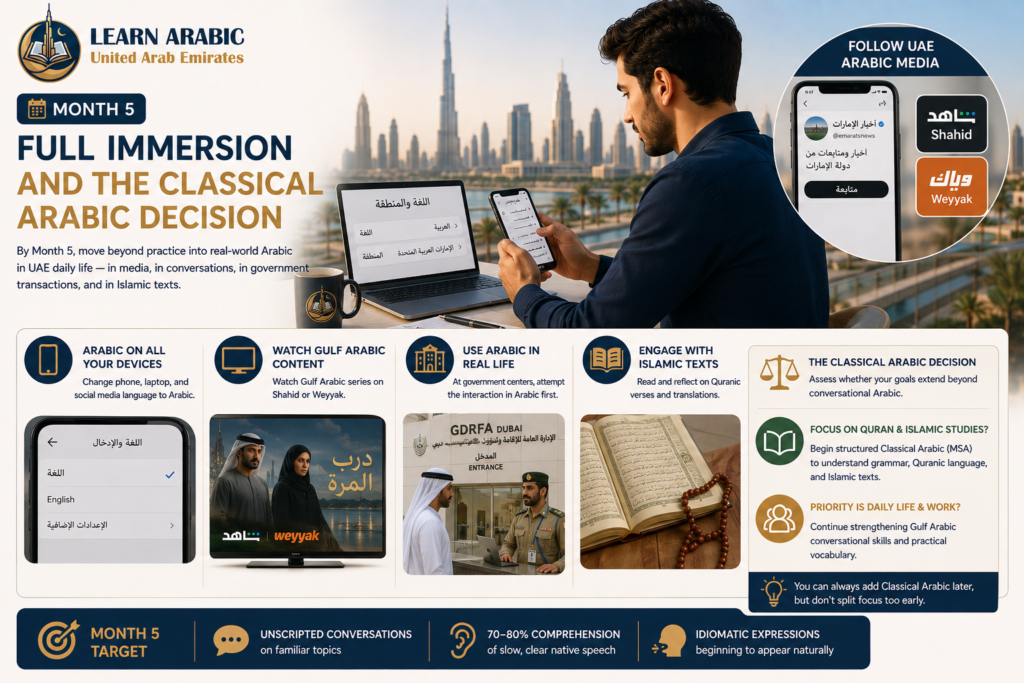
By Month 5, anyone serious about how to learn Arabic in 6 months in the UAE should be moving beyond controlled practice into real-world Arabic as it exists in UAE daily life: in media, in conversations, in government transactions, and — for Muslim learners — in Islamic texts.
Change your phone, laptop, and social media language settings to Arabic. Follow UAE-based Arabic creators and local news accounts. Watch Gulf Arabic series on Shahid or Weyyak — Gulf dialect is what you will hear most in daily UAE life, so Gulf-produced content is more immediately useful than Egyptian or Levantine media at this stage. When you visit a government service centre — GDRFA, Dubai Municipality, AMER — attempt the interaction in Arabic first. The real-world pressure of a genuine transaction produces language retrieval that no role-play exercise replicates.
Month 5 is also the right point to assess whether your goals extend beyond conversational Arabic.
Month 5 target: unscripted conversations on familiar topics; 70–80% comprehension of slow, clear native speech; idiomatic expressions beginning to appear naturally.
Month 6 — Consolidation and Making the Language Stick
Month 6 is an integration month. Everything built over five months is tested, consolidated, and put to work in sustained real-world use. Speak in Arabic for five to ten minutes each morning on a different topic — your plans, a news story, an opinion. Speaking on unfamiliar topics forces retrieval beyond rehearsed phrases, and that retrieval pressure is where fluency consolidates.
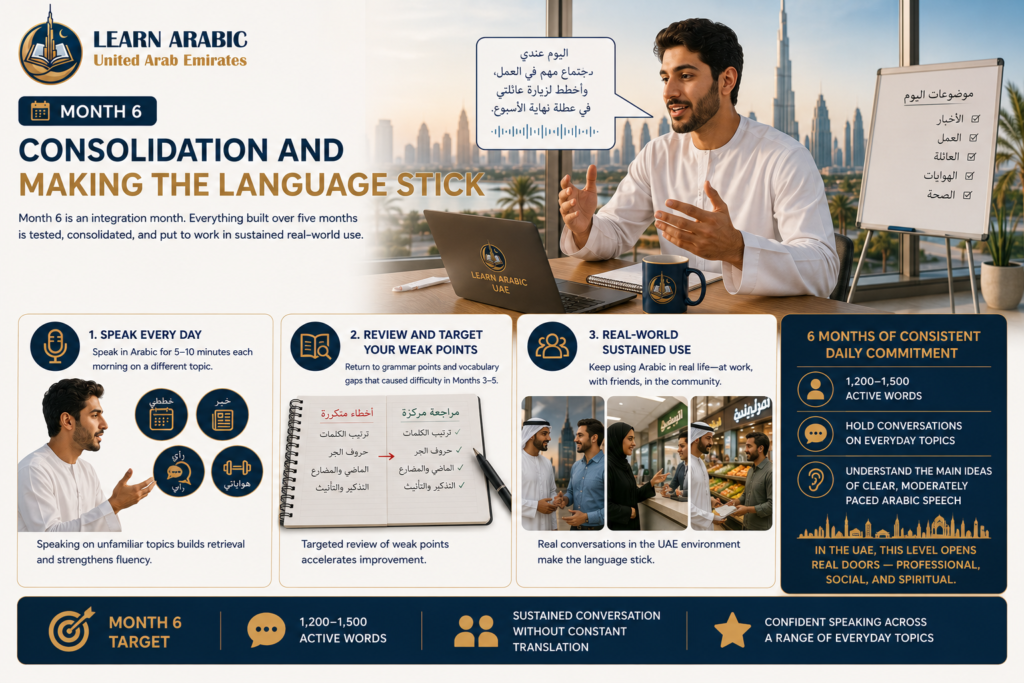
Return systematically to the grammar points and vocabulary gaps that caused repeated difficulty in Months 3–5. These are consistent patterns, not random weaknesses — targeted review of known weak points produces faster improvement than repeating material that is already strong.
A learner who has followed this plan with genuine daily commitment reaches Month 6 with approximately 1,200–1,500 active words, the ability to hold conversations on everyday topics without significant pausing, and the capacity to understand the main ideas of clear, moderately paced Arabic speech. In the UAE, that level opens real doors — professional, social, and spiritual.
Month 6 target: 1,200–1,500 active words; sustained conversation without constant translation; confident speaking across a range of everyday topics.
What “Arabic in 6 Months” Actually Means in the UAE?
The first step for anyone asking how to learn Arabic in 6 months in the UAE is setting an honest target. Six months of structured daily study — one to two hours per day — consistently produces learners who can hold everyday conversations, read basic Arabic text, and understand the main ideas of clear, moderately paced speech.
That is not native fluency. But practical, functional Arabic — the kind that lets you read a government form, follow a khutbah, order food confidently, or understand a Quranic verse without opening a translation — is a realistic six-month outcome.
Two groups arrive at this question from very different directions. Expat professionals want daily functional Arabic: the ability to communicate with Emirati colleagues, navigate government services, and build genuine rapport in a country where speaking even basic Arabic earns immediate respect. Muslim learners want Arabic as a gateway to the Quran, the Hadith, and Islamic scholarship — to pray with khushu, understand what they are reciting, and access classical texts directly. The foundation is identical for both groups for the first three months. Months 4 and 5 diverge, and this guide marks exactly where and why.
The Most Common Mistakes UAE Learners Make — By Month
Every stage of learning Arabic comes with different challenges. Knowing the most common mistakes before you reach them helps you stay on track and make steady progress throughout your six-month journey.
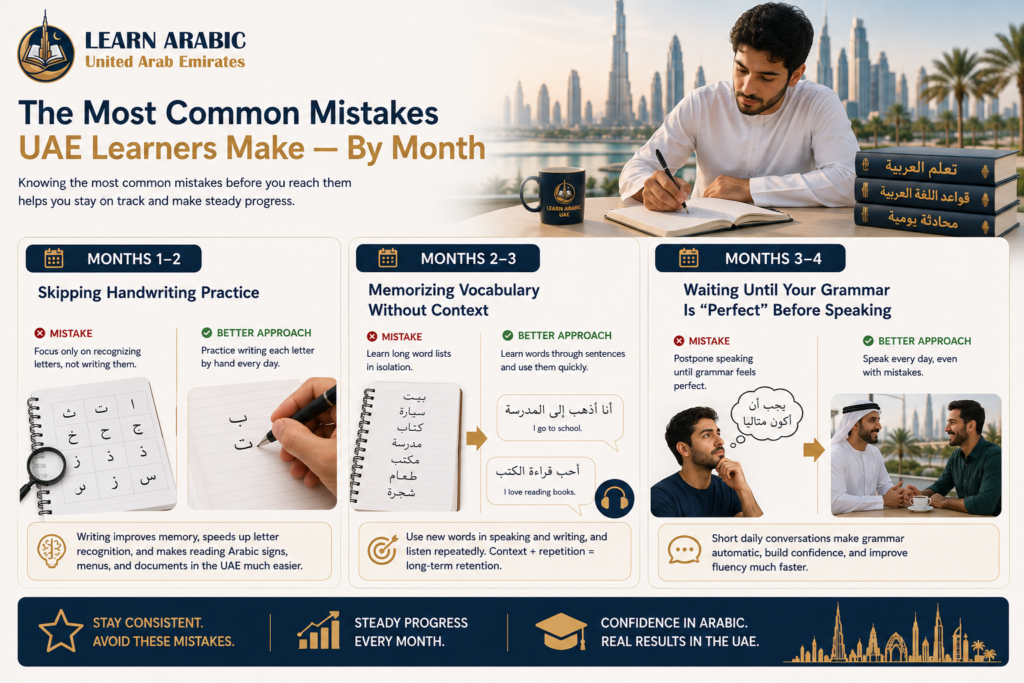
Months 1–2: Skipping Handwriting Practice
Many beginners focus only on recognizing Arabic letters without practicing how to write them. Writing each letter by hand improves memory, speeds up letter recognition, and makes reading Arabic signs, menus, and documents in the UAE much easier.
Months 2–3: Memorizing Vocabulary Without Context
Learning long word lists may feel productive, but isolated vocabulary is easy to forget. Instead, learn new words through complete sentences and use them in speaking or writing as soon as possible. Repeated exposure through listening also strengthens long-term retention.
Months 3–4: Waiting Until Your Grammar Is “Perfect” Before Speaking
Many learners postpone speaking because they fear making mistakes. In reality, speaking is what helps grammar become automatic. Even short daily conversations build confidence and improve fluency much faster than studying grammar alone.
Months 4–5: Focusing on Gulf Arabic Before Building an MSA Foundation
Gulf Arabic is useful for everyday communication in the UAE, but learning it without a foundation in Modern Standard Arabic (MSA) often limits long-term progress. Building your grammar through MSA first makes it much easier to understand and use Gulf Arabic naturally later. Modern Standard Arabic courses can provide the structured foundation needed to develop this grammar before moving further into Gulf Arabic.
Months 5–6: Stopping Structured Learning Too Early
Once basic conversations become comfortable, many learners reduce their study time or stop taking lessons altogether. However, this is the stage where consistent guidance helps refine pronunciation, strengthen grammar, and develop the confidence needed for more advanced conversations.
See Our Classroom Environment in Action
Experience a sneak peek into our live sessions. Watch the video below to see our specialized instructors interacting with students, breakdown complex texts, and cultivate an engaging, respectful learning environment.
Master Arabic in the UAE
Experience world-class Arabic language training designed for students and professionals in the Emirates.
Book Your Free TrialReady to Start Your 6-Month Arabic Journey in the UAE?
If you want to learn Arabic in 6 months in the UAE, having a clear plan is only the first step. Consistent instruction can help you build the right foundation, correct pronunciation mistakes early, and stay on track as your Arabic develops.
Whether your goal is to communicate more confidently in everyday UAE life, build a strong Modern Standard Arabic foundation, or understand the Quran beyond translation, Learn Arabic UAE offers structured courses designed around different learning goals and levels.
Our Arabic courses
- Arabic Course in the UAE
- Arabic Intensive Course
- Arabic Classes for Beginners (Learn Arabic from Scratch)
- Madinah Arabic Course
- Arabic Classes for Adults
- Self-Paced Arabic Course
- Arabic Speaking Classes
- Learn to Write Arabic Course
- Arabic Grammar Course
- Learn Arabic Alphabet Course
- Modern Standard Arabic (MSA) Course
- Quranic Arabic Course
- Fusha Arabic Course
- Classical Arabic Course
- Emirati Arabic Course
- Gulf Arabic Course
- Learn Saudi Arabic
- Business Arabic Course UAE
- Arabic Language Classes for Professionals in UAE
Start your Arabic learning journey with Learn Arabic UAE and turn the UAE’s Arabic-speaking environment into a real advantage.

Master Arabic in the UAE
Experience world-class Arabic language training designed for students and professionals in the Emirates.
Book Your Free TrialConclusion
Six months of daily, structured Arabic study will not make you indistinguishable from a native speaker. What it will do — for any learner in the UAE following this plan honestly — is give you something real: a working alphabet, 1,200–1,500 active words, functional grammar, and the ability to hold authentic conversations in the language spoken in every government office, masjid, and marketplace around you.
For expat professionals, that means professional credibility and social access that English alone never provides. For Muslim learners, it means approaching the Quran and six centuries of Islamic scholarship on your own terms — without waiting for a translation to tell you what Allah said.
The greatest barrier to learning Arabic in 6 months in the UAE is not the language. It is the assumption that the language is impossible — an assumption that dissolves within the first thirty days of honest daily effort. The UAE has already placed the immersion environment around you. The only question is whether you use it.
FAQs About How to Learn Arabic in 6 Months in the UAE
Is it realistic to learn Arabic in 6 months in the UAE?
Practical conversational fluency — holding everyday conversations, reading basic Arabic text, understanding the main ideas of clear native speech — is a realistic six-month target with one to two hours of daily structured study. Living in the UAE accelerates this timeline because daily immersion reinforces every lesson automatically. Native-level mastery is a longer journey; functional Arabic is not.
Should I learn Gulf Arabic or Modern Standard Arabic first in the UAE?
Start with Modern Standard Arabic for its grammar, script, and wide comprehensibility — then layer Gulf Arabic for daily UAE conversational use from Month 5 onward. Learners who start with Gulf dialect alone plateau early because they lack the grammatical foundation to construct new sentences beyond memorised phrases.
Can I really use the UAE environment to speed up my Arabic learning?
Yes — significantly. Changing your phone to Arabic, reading bilingual UAE road signs, listening to Arabic radio on your commute, speaking with Emirati colleagues, and attempting government service interactions in Arabic all reinforce structured study in ways that compress the learning timeline. Most UAE-based learners waste this advantage by defaulting to English in every interaction.
How many hours per day do I need to learn Arabic in 6 months?
One to two hours of focused daily study is the effective range. Daily consistency matters more than session length — twenty minutes of daily review produces better long-term retention than a three-hour session once a week, because the brain consolidates language patterns during sleep, and daily exposure gives memory more consolidation opportunities.
Do I need a teacher, or can I learn Arabic alone in the UAE?
Self-study produces genuine results for alphabet recognition, reading comprehension, and vocabulary building. For pronunciation accuracy and speaking fluency, a qualified teacher provides real-time error correction that no app replicates. The most common UAE learner pattern is relying on apps for Months 1–3, then stalling when conversation is attempted. Starting structured instruction in Month 1 prevents that stall entirely.




Leave a Reply