 Learn Arabic
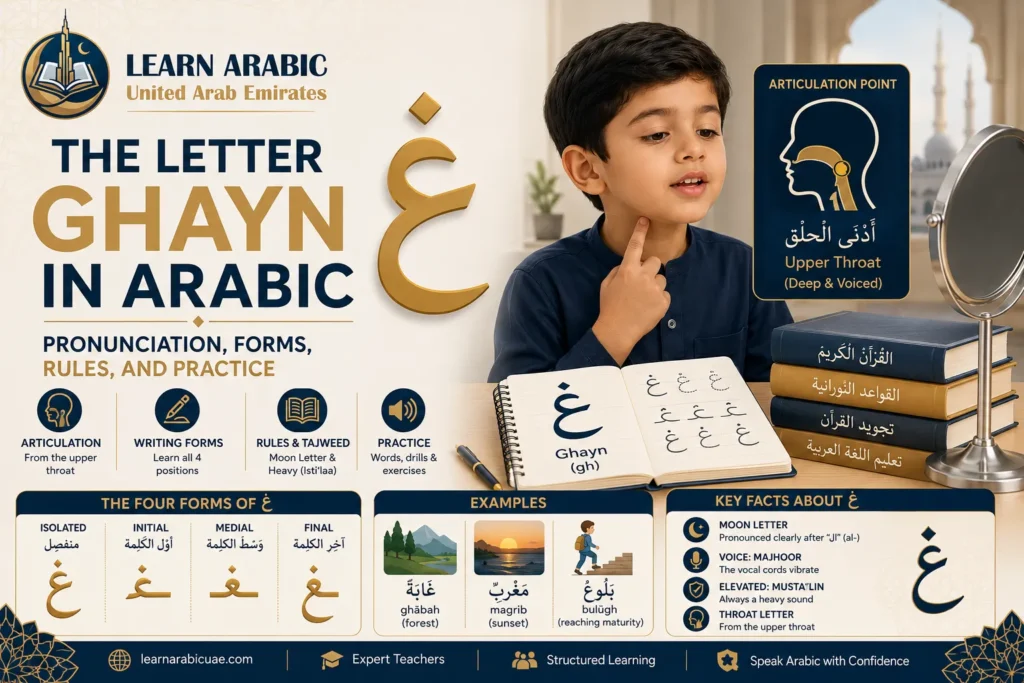
Every Arabic learner reaches a moment where the alphabet stops being shapes on a page and starts becoming a living sound system. The letter Ghayn in Arabic غ is often where that shift happens — because Ghayn demands something English never asks of you: a voiced, buzzing sound produced deep in the upper throat, with no English equivalent to fall back on.
Ghayn is the 19th letter of the Arabic alphabet. It appears in the Quran, in the call to prayer, in the name of the city Baghdad, in hundreds of everyday words. Getting it right is not a refinement for advanced students — it is a foundation skill that every Arabic learner, at every level, needs to build correctly from the start.
This guide covers the letter Ghayn in Arabic غ completely: what it is, how it looks in all four written positions, how to pronounce it from its exact articulation point, how it behaves with every vowel mark, its rules in Tajweed, and the most common mistakes beginners make — with clear corrections for each.
What Is the Letter Ghayn in Arabic غ?
The letter Ghayn in Arabic غ is the 19th letter of the 28-letter Arabic alphabet, positioned between Ayn ع and Faa ف. Its name is “Ghayn” — but like all Arabic letters, the name is never what you read. When Ghayn appears inside a word, you produce only its consonant sound: a soft, continuous, buzzing “gh” from the back of the throat.
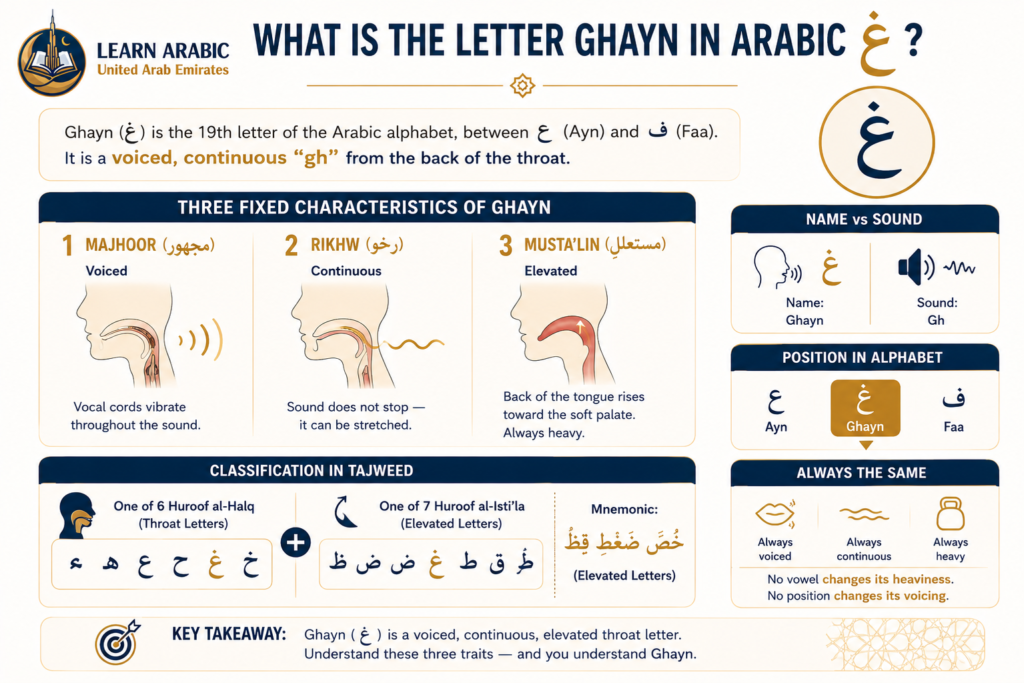
In classical Arabic phonetics, Ghayn carries three fixed characteristics:
- Majhoor (مجهور — voiced): the vocal cords vibrate throughout the entire sound
- Rikhw (رِخو — continuous): the sound does not stop — it can be stretched, unlike a stopped consonant like Baa or Taa
- Musta’lin (مستعلٍ — elevated): the back of the tongue rises toward the soft palate, giving Ghayn a permanently heavy resonance — regardless of its vowel
These three features together define what Ghayn is and how it must always be produced. No vowel changes its heaviness. No position in a word changes its voicing. Ghayn is what it is, every single time it appears.
The letter Ghayn in Arabic غ is one of six huroof al-halq (throat letters) in Tajweed and one of the seven huroof al-isti’la (elevated letters), encoded in the classical mnemonic خُصَّ ضَغْطٍ قِظْ. This dual classification — throat origin, always heavy — is the single most important thing to understand about Ghayn before approaching any other aspect of the letter.
Read also: The Arabic letter ha ح – The Complete Guide to Pronunciation, Writing, and Mastery
How to Identify the Letter Ghayn غ?
The letter Ghayn غ and the letter Ayn ع share an almost identical base shape. This is the most common source of reading confusion among beginners, and it does not go away on its own — it has to be trained out.
The only visual difference between them is a single dot:
- Ayn ع — the curved base shape, no dot
- Ghayn غ — the identical curved base shape, one dot above
That dot changes everything: the sound, the articulation point, the meaning of every word the letter appears in. Training your eye to check above the curve before reading the letter is the single most effective habit you can build for accurate Arabic reading.
Three things to anchor Ghayn identification:
Shape: a rounded, open curve — the same base as Ayn ع Dot: one dot directly above the curve — the only marker that distinguishes the two letters Sound: a voiced, buzzing friction from the back of the throat — nothing like the sound of Ayn.
The Four Written Forms of the Letter Ghayn غ
Arabic is a connected script, and Ghayn is a fully connecting letter — it joins smoothly to the letters on both its right and left sides.
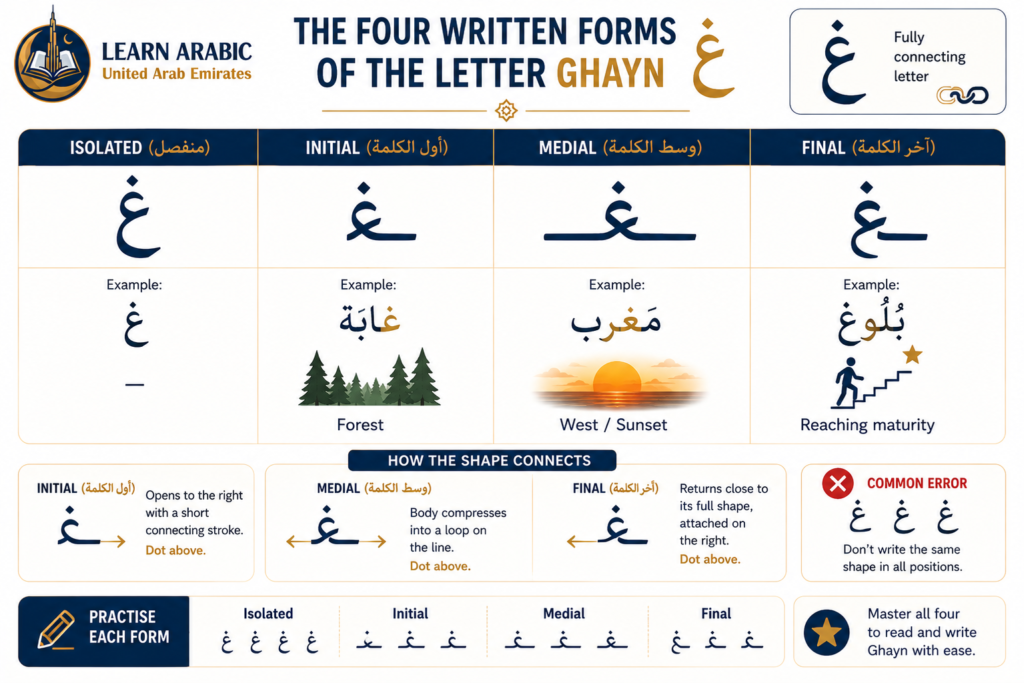
This means it never forces a break inside a word, and it takes four distinct shapes depending on its position.
| Position | Form | Example | Meaning |
| Isolated (منفصل) | غ | غ | — |
| Initial / Start of word (أول الكلمة) | غـ | غَابة | Forest |
| Medial / Middle of word (وسط الكلمة) | ـغـ | مَغرِب | West / Sunset |
| Final / End of word (آخر الكلمة) | ـغ | بُلُوغ | Reaching maturity |
The core rounded curve of the letter remains recognisable in every position. What changes is how the entry and exit strokes connect to neighbouring letters:
- Initial form: the curve opens rightward with a short connecting stroke to the next letter — the dot stays above
- Medial form: the body compresses into a compact loop sitting on the writing line — dot still clearly above
- Final form: the curve returns close to its full isolated shape, attached on the right to the letter before it
A common beginner error is writing Ghayn the same way regardless of position. Practise each form separately. Once all four are automatic, spotting Ghayn inside real words becomes effortless.
If you want structured letter-by-letter writing practice, the Arabic writing course at Learn Arabic UAE works through all positional forms with instructor guidance and real-time correction.

How to Pronounce the Letter Ghayn غ?
The makhraj of the letter Ghayn in Arabic غ is adna al-halq — the section of the throat closest to the mouth, where the throat meets the back of the tongue. This is the exact same makhraj shared by the letter Kha خ.
To produce Ghayn correctly: raise the back of your tongue toward the soft palate, narrowing — but not fully closing — the airway. Push air through that gap continuously while keeping your vocal cords vibrating the entire time. The result is a soft, buzzing, continuous friction sound.
The physical test: place two fingers lightly on your throat while producing the sound. You should feel clear vibration for Ghayn. If you feel nothing, you are producing Kha, not Ghayn.
Read also: Arabic Alphabet for Kids
Ghayn غ vs. Kha خ — The Voicing Test
These two letters are produced from the exact same place in the throat. The difference is entirely about the vocal cords.
| Feature | Ghayn غ | Kha خ |
| Makhraj | Adna al-halq (upper throat) | Adna al-halq (upper throat) |
| Voicing | Majhoor — vocal cords vibrate | Mahmoos — breath only, no vibration |
| Sound quality | Soft buzzing, gargling quality | Dry, raspy — like “ch” in Scottish “loch” |
| Throat test | Vibration felt | No vibration |
This voicing distinction is the entire difference. The mouth position, tongue placement, and airway shape are identical. Only the vocal cords change. Practise switching between the two sounds back and forth while keeping your fingers on your throat — the vibration on/off contrast becomes physically obvious very quickly.
Ghayn غ vs. Ayn ع — Shape and Sound
These two letters look nearly identical in writing but are phonetically unrelated.
| Feature | Ayn ع | Ghayn غ |
| Dot | None | One dot above |
| Makhraj | Wasat al-halq (middle of the throat) | Adna al-halq (lower throat, near the tongue) |
| Tongue involvement | None — a tight constriction with no tongue | Back of tongue rises toward soft palate |
| Sound quality | Tight, pinched, controlled constriction | Open, continuous, buzzing friction |
The only thing Ayn and Ghayn share is their base written shape. Their sounds, their articulation points, their phonetic categories — all different.
Why the English “G” Is Not a Substitute?
The English hard “g” in “go” is a plosive — airflow is completely blocked by the back of the tongue and then released in a burst. It lasts a fraction of a second. Ghayn is a fricative — the airway narrows but never closes, and air flows continuously, producing a sustained buzzing sound. You can hold Ghayn out for several seconds. You cannot do the same with the English “g.”
The closest real-world references for English speakers:
- The French uvular “r” — as heard in the word Paris
- The soft Spanish “g” — as in agua
Neither is identical to Ghayn, but both point toward the right region and the right type of sound.
Step Inside Our Classrooms
Don’t just take our word for it—see our community in action. Click below to watch real, live snippets from our recent classes and experience our engaging teaching style firsthand!
Master Arabic in the UAE
Experience world-class Arabic language training designed for students and professionals in the Emirates.
Book Your Free TrialThe Letter Ghayn غ With Each Vowel Mark
Once you can produce the basic Ghayn (غ) sound correctly, the next step is learning how it changes with different vowel marks. The consonant itself stays the same, while the vowel determines how the syllable sounds. The table below shows Ghayn with the three short vowels, Sukoon, Shaddah, and the three long vowels, with examples to help you recognize and practise each form.
| Ghayn Form | Pronunciation | How It Sounds | Example | Meaning |
| غَ Fatha | Gha | Short a sound | غَابَة — Ghābah | Forest |
| غُ Dammah | Ghu | Short u sound | غُرُوب — Ghurūb | Sunset |
| غِ Kasrah | Ghi | Short i sound | غِطَاء — Ghitāʾ | Cover |
| غْ Sukoon | Gh | No vowel follows | مَغْرِب — Maghrib | West / Sunset |
| غّ Shaddah | Doubled Gh | Ghayn is doubled and held longer | أَغَرّ — agharr | Noble / distinguished |
| غَا Long Fatha | Ghā | Long ā — about 2 counts | غَافِر — Ghāfir | The Forgiver |
| غُو Long Dammah | Ghū | Long ū — about 2 counts | يَغُوصُونَ — Yaghūṣūna | They dive |
| غِي Long Kasrah | Ghī | Long ī — about 2 counts | غِيبَة — Ghībah | Backbiting |
Remember: The vowel mark changes the vowel that follows Ghayn, but the basic articulation of غ remains the same.
Looking to sharpen your formal Arabic grammar alongside letter mastery? The Arabic Grammar Course builds systematic grammar knowledge from the ground up, with structured lessons and native-teacher instruction.

Ghayn غ in Tajweed and the Quran
Ghayn (غ) has a distinctive place in Tajweed, combining a specific articulation point with permanent heaviness and voicing that must be maintained during Quranic recitation.
Read also: How to Learn Khaleeji Arabic in the UAE? – Practical Steps for Real-Life Fluency
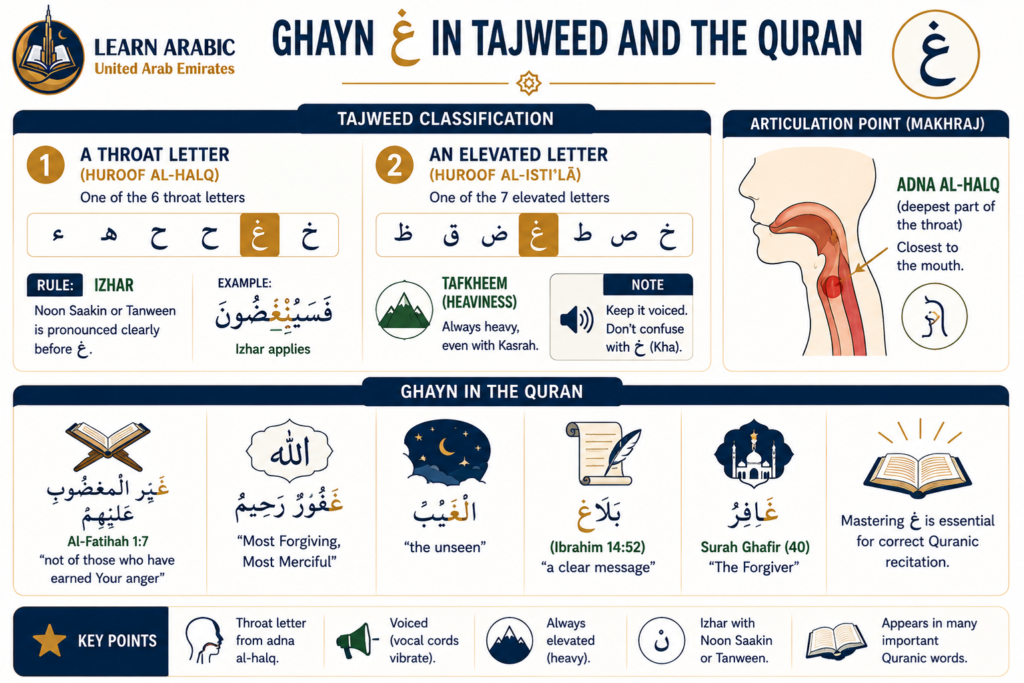
Tajweed Classification
Ghayn (غ) has two important permanent Tajweed characteristics:
1. A Throat Letter (Huroof al-Halq)
Ghayn is one of the six throat letters: ء، ه، ع، ح، غ، خ. It is pronounced from adna al-halq, the part of the throat closest to the mouth.
When Ghayn follows Noon Saakin or Tanween, the rule of Izhar applies, so the Noon or Tanween is pronounced clearly rather than merged.
Example:
فَسَيُنْغِضُونَ — the Noon Saakin is followed by Ghayn, so Izhar applies.
2. An Elevated Letter (Huroof al-Istiʿlā)
Ghayn is one of the seven elevated letters memorised by the phrase خُصَّ ضَغْطٍ قِظْ. It is therefore pronounced with Tafkheem (heaviness).
Ghayn remains heavy regardless of the vowel that follows it, including Kasrah. It should never be deliberately softened into a light sound.
A common mistake is confusing Ghayn with the lighter, unvoiced Kha (خ) during fast recitation. Keep the vocal-cord vibration clear when producing Ghayn.
Ghayn in the Quran
Ghayn appears frequently in the Quran and in many important Quranic words and expressions.
- غَيْرِ الْمَغْضُوبِ عَلَيْهِمْ — “not of those who have earned Your anger” (Al-Fatihah 1:7). The letter Ghayn appears twice in this verse.
- غَفُورٌ رَحِيمٌ — “Most Forgiving, Most Merciful.” A frequently recurring Quranic description of Allah.
- الْغَيْب — “the unseen,” a central Quranic concept.
- بَلَاغ — “a clear message” (Ibrahim 14:52).
- Surah Ghafir (40) — named after غَافِر, meaning “The Forgiver,” from the root غ-ف-ر.
Because Ghayn occurs in many frequently recited Quranic words, mastering its makhraj, voicing, and heaviness is essential for accurate Quranic recitation.
The Letter Ghayn غ in Words and Sentences
Practise Ghayn in different positions within words, then apply the sound in complete sentences.
Word-Level Examples
These examples show how Ghayn appears at the beginning, middle, and end of Arabic words.
| Position | Arabic | Pronunciation | Meaning |
| Beginning | غَابَة | Ghābah | Forest |
| Beginning | غَرِيب | Gharīb | Strange |
| Middle | مَغْفِرَة | Maghfirah | Forgiveness |
| Middle | مَغْرِب | Maghrib | West / Sunset |
| Middle | صَغِير | Ṣaghīr | Small |
| End | بُلُوغ | Bulūgh | Maturity |
| End | فَرَاغ | Farāgh | Emptiness |
| End | بَلَاغ | Balāgh | Message |
Sentence Examples
These short sentences help you practise Ghayn naturally in connected Arabic speech.
| Arabic | English |
| غَسَلْتُ يَدِي | I washed my hand. |
| بَلَغَ أَحْمَدُ الْبَيْتَ | Ahmed reached the house. |
| غَفَرَ اللهُ لِمَنِ اسْتَغْفَرَ | May Allah forgive whoever seeks forgiveness. |
How to Write the Letter Ghayn غ?
Writing Ghayn follows one fixed rule of Arabic script that applies to every letter: draw the full body of the letter first, add the dot last. Dots are never added mid-stroke.
Steps for the isolated form غ:
- Begin slightly above the baseline at the top-right of the curve
- Draw downward and to the left in one smooth, continuous stroke
- Let the pen dip just below the baseline before curling back upward and to the left
- Close the shape — the curve should feel rounded and full, not shallow
- Return to place a single dot directly above the centre of the curve
For the initial form غـ: after completing the curve, extend a short horizontal connecting stroke to the right to join the next letter. The dot goes above after the stroke is complete.
For the medial form ـغـ: the body compresses into a small loop sitting on the writing line. It enters from the right, produces the compact loop, and exits to the left. Dot above.
For the final form ـغ: enter from the right, draw the fuller curve similar to the isolated form, and let the base curve downward — do not add an exit stroke. Dot above.
Three critical writing rules:
- The dot must be centred above the curve — not shifted to either side
- If the curve is too shallow, the letter looks like Raa ر — draw the full depth
- Without the dot, Ghayn becomes Ayn — a completely different letter in meaning and sound
Make this summer count with the Summer Arabic Programme for Kids, an engaging programme that helps children build practical Arabic reading and speaking skills during the school break.

Exercises to Practise the Letter Ghayn غ
The following exercises move from simple recognition to writing, reading, and Quranic practice to help you master Ghayn step by step.
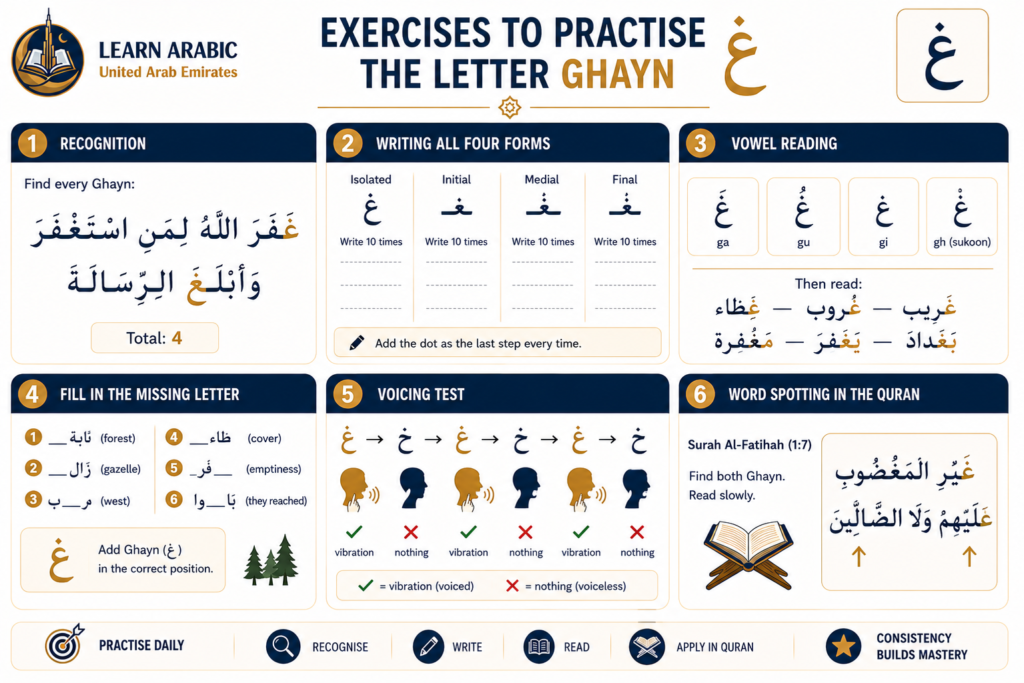
Exercise 1 — Recognition
Scan the sentence below and find every Ghayn: غَفَرَ اللهُ لِمَنِ اسْتَغْفَرَ وَأَبْلَغَ الرِّسَالَةَ You should find four.
Exercise 2 — Writing All Four Forms
Write each form ten times, separately:
- غ (isolated)
- غـ (initial — as in غَيم)
- ـغـ (medial — as in مَغرِب)
- ـغ (final — as in بَلاغ)
After writing, add the dot as the last step every time.
Exercise 3 — Vowel Reading
Read each combination aloud slowly, maintaining throat vibration throughout:
- غَ / غُ / غِ / غْ
Then read these words without pausing between them: غَريب — غُروب — غِطاء — بَغداد — يَغفِر — مَغفِرة
Exercise 4 — Fill in the Missing Letter
Complete each word by adding Ghayn غ in the correct position:
- __ابة (forest)
- __زال (gazelle)
- م__رب (west)
- __طاء (cover)
- فَرا__ (emptiness)
- بَل__ُوا (they reached)
Exercise 5 — Voicing Test
Alternate between Ghayn and Kha with two fingers on your throat:
- غ → خ → غ → خ → غ → خ
You should feel: vibration — nothing — vibration — nothing. If both produce vibration, you are producing two voiced sounds — Kha must be voiceless. If neither produces vibration, you are producing two unvoiced sounds — retrain Ghayn with the buzzing sensation until it vibrates consistently.
Exercise 6 — Word Spotting in the Quran
Open Surah Al-Fatihah (1:7) and locate both instances of Ghayn. Read the verse slowly, ensuring each Ghayn is heavy, voiced, and clearly distinct from any surrounding letters. This is the single most practical exercise a learner can do — because Al-Fatihah is recited in every unit of every prayer.
See Our Classroom Environment in Action
Experience a sneak peek into our live sessions. Watch the video below to see our specialized instructors interacting with students, breakdown complex texts, and cultivate an engaging, respectful learning environment.
Master Arabic in the UAE
Experience world-class Arabic language training designed for students and professionals in the Emirates.
Book Your Free TrialMaster Arabic Pronunciation With Learn Arabic UAE
You now have a complete picture of the letter Ghayn in Arabic غ: its definition, its four forms, its articulation point, its vowel combinations, its Tajweed classification, and every common mistake with its correction. The next stage is practising with a qualified teacher who can hear your pronunciation in real time and correct it before errors become habits.
At Learn Arabic UAE, our courses are built for exactly this: structured, expert-led learning that moves you from individual letters to confident reading, accurate recitation, and strong grammar foundations — at your pace, from wherever you are.
Your first class is free. Book your trial today and hear the correct sound of Ghayn from a native Arabic teacher.
Our Arabic courses
- Arabic Course in the UAE
- Arabic Intensive Course
- Arabic Classes for Beginners (Learn Arabic from Scratch)
- Madinah Arabic Course
- Arabic Classes for Adults
- Self-Paced Arabic Course
- Arabic Speaking Classes
- Learn to Write Arabic Course
- Arabic Grammar Course
- Learn Arabic Alphabet Course
- Modern Standard Arabic (MSA) Course
- Quranic Arabic Course
- Fusha Arabic Course
- Classical Arabic Course
- Emirati Arabic Course
- Gulf Arabic Course
- Learn Saudi Arabic
- Business Arabic Course UAE
- Arabic Language Classes for Professionals in UAE

Master Arabic in the UAE
Experience world-class Arabic language training designed for students and professionals in the Emirates.
Book Your Free TrialConclusion
The letter Ghayn in Arabic غ is the 19th letter of the Arabic alphabet. It is voiced, continuous, always heavy, and always produced from the upper throat — never from the lips, the tongue tip, or the middle of the mouth. Its written shape is identical to Ayn ع except for one dot above the curve, and its makhraj is identical to Kha خ except for full vocal cord voicing.
Three facts remain true about Ghayn in every context, without exception: it vibrates (voiced), it stays heavy (mufakhkham), and it connects fully on both sides (no word break). These three facts together are the foundation of every other rule, every vowel combination, and every Tajweed application covered in this guide.
Mastering the letter Ghayn in Arabic غ is not a milestone for advanced learners — it is a foundation skill that shapes how accurately you read, how correctly you recite, and how clearly you are understood every time you speak Arabic.
FAQs
What is the letter Ghayn in Arabic غ?
The letter Ghayn in Arabic غ is the 19th letter of the Arabic alphabet. It produces a voiced uvular fricative — a soft, buzzing sound generated from the upper throat — with no direct equivalent in English. It is one of the six throat letters and one of the seven permanently heavy (mufakhkham) letters in the Arabic phonetic system.
How is the letter Ghayn غ different from Ayn ع?
Ghayn غ and Ayn ع share an identical base written shape. The only visual difference is that Ghayn has one dot above the curve; Ayn has none. Phonetically, they are completely different: Ayn is produced from the middle of the throat with a tight constriction, while Ghayn is produced further forward with the back of the tongue rising toward the soft palate, creating a buzzing friction. They are not related sounds.
Is the letter Ghayn غ the same as the English “G”?
No. The English hard “g” is a stop consonant — airflow is fully blocked and then released instantly. Ghayn is a fricative — the airway narrows but stays open, and air flows continuously with a buzzing quality. You can hold Ghayn for two seconds; you cannot do the same with the English “g.” The closest approximations are the French uvular “r” or the soft Spanish “g” in agua.
Why is Ghayn غ always pronounced heavy, even with Kasrah?
Ghayn belongs to the seven huroof al-isti’la (elevated letters), encoded in the mnemonic خُصَّ ضَغْطٍ قِظْ. Every letter in this group carries permanent tafkheem (heaviness) because producing the letter physically requires the back of the tongue to rise toward the palate — a fixed articulatory position that no vowel can override. Unlike many Arabic letters whose heaviness shifts with context, Ghayn is always heavy.
How do I tell Ghayn غ and Kha خ apart?
Both letters are produced from the same makhraj — adna al-halq, the part of the throat nearest the mouth. The entire difference is voicing. Ghayn is majhoor (voiced): the vocal cords vibrate, producing a buzzing quality. Kha is mahmoos (unvoiced): only breath passes through, producing a dry, raspy sound similar to the “ch” in “loch.” Touch your throat while producing each: vibration confirms Ghayn; silence confirms Kha.
How many forms does the letter Ghayn غ have?
The letter Ghayn has four written forms: isolated (غ), initial/beginning of word (غـ), medial/middle of word (ـغـ), and final/end of word (ـغ). Ghayn is a fully connecting letter, meaning it joins to letters on both sides and never forces a break inside a word. The dot always stays above the curve regardless of which form is used.
Where does the letter Ghayn غ appear in Surah Al-Fatihah?
Ghayn appears twice in verse 7 of Surah Al-Fatihah: غَيْرِ الْمَغْضُوبِ عَلَيْهِمْ — “not of those who have earned Your anger.” Because this surah is recited in every unit of every prayer, mastering the correct heavy, voiced pronunciation of Ghayn in this verse is one of the most practically important Tajweed skills for any Muslim learning to pray in Arabic.
Related Articles
Learn Arabic




Leave a Reply