 Learn Arabic
If you’ve ever tried to say a word like “lemon” or “night” in Arabic and wondered exactly how the sound is formed, you’ve already met the letter ل — called lām. It is one of the most common letters in the entire Arabic language, and one of the most approachable for English speakers because its core sound maps almost perfectly onto the English “L.”
But lām is more than just a familiar sound. It changes shape across four written positions, behaves differently depending on the vowel marking above or below it, plays a starring role in Arabic grammar through the definite article ال, and even doubles itself inside some of the most important words in the language. Understanding all of this — not just the sound in isolation — is what separates a learner who can recognize the letter from one who can actually read and write Arabic.
This guide covers every dimension of lām: pronunciation with all five harakat, the four written forms, real practice words, grammar rules, common mistakes, and a structured path forward.
What Is the Arabic Letter Lam (ل)?
The Arabic letter ل, called lām, is the 23rd letter of the Arabic alphabet. In the traditional Arabic letter order (abjad), it sits between كاف (kāf) and ميم (mīm). Its numerical value in the abjad system is 30.
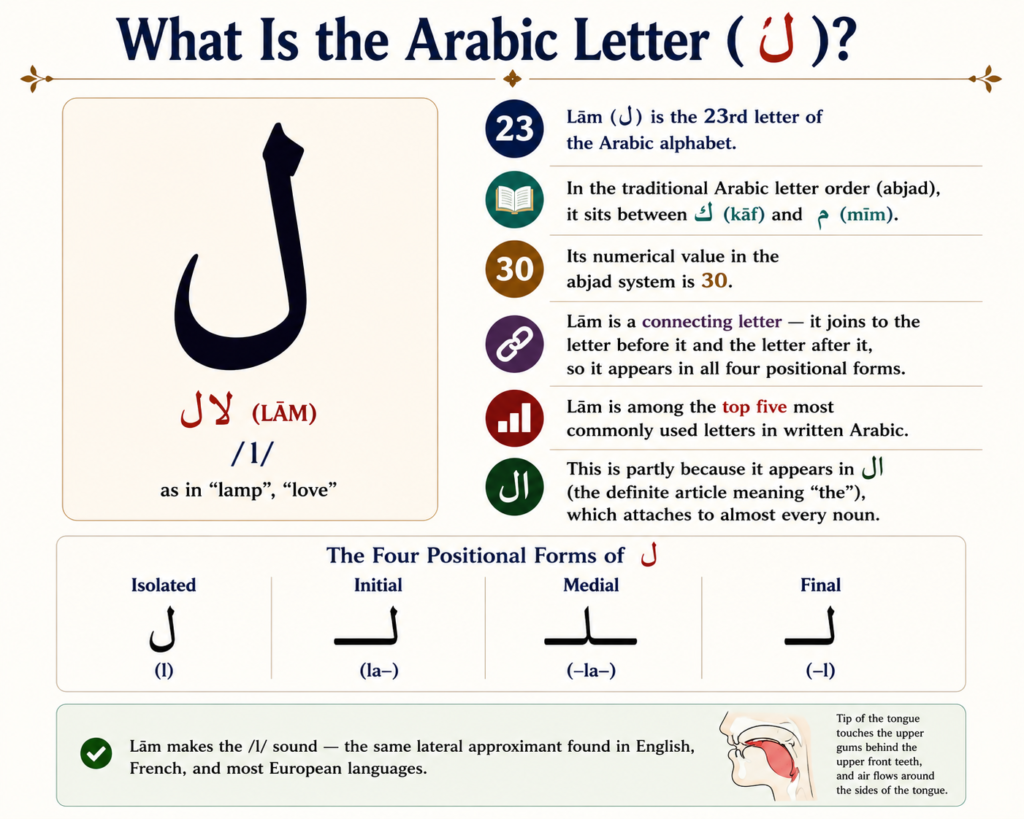
Lām is a connecting letter — it joins to the letter before it and the letter after it, which means it appears in all four positional forms. This sets it apart from letters like و (wāw) and ر (rā’), which only connect on one side.
In terms of frequency, lām is among the top five most commonly used letters in written Arabic. This is partly because it appears in ال (the definite article equivalent to “the” in English), which attaches to almost every noun in the language. If you open any Arabic text — a news article, a Quranic verse, a street sign — you will see ل dozens of times per page.
Its sound equivalent in the International Phonetic Alphabet is /l/, the same lateral approximant found in English, French, and most European languages.
How to Pronounce the Arabic Letter Lam (ل)?
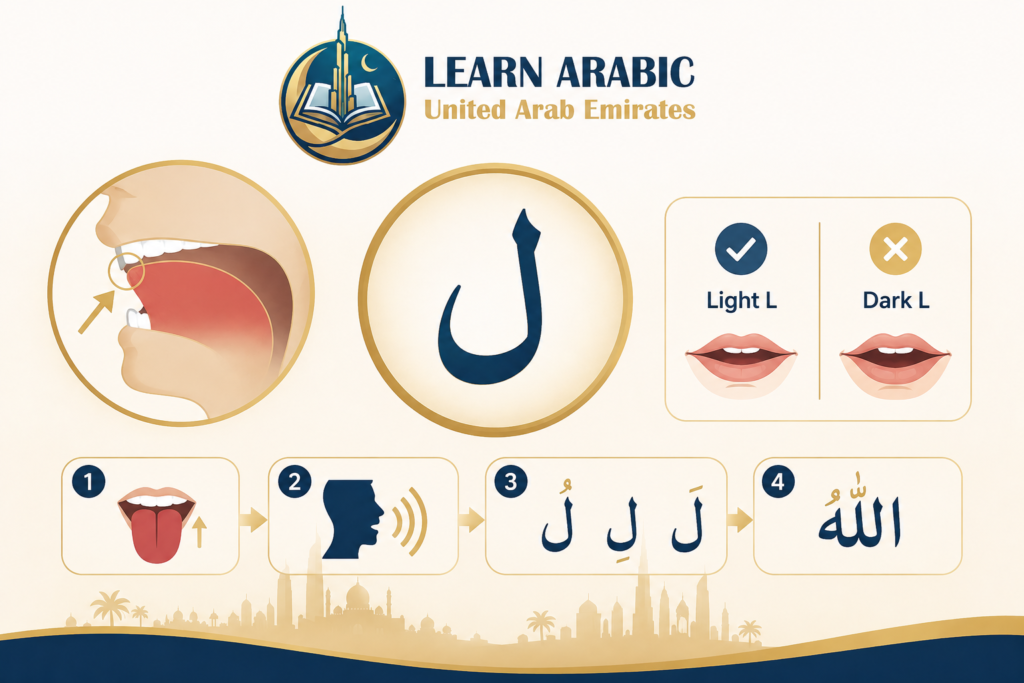
Pronouncing ل (Lām) correctly depends on placing the tongue in the right position and allowing the sound to flow naturally. For most uses, Lām has a clear sound that is relatively familiar to English-speaking learners.
1. Position the Front and Side of Your Tongue
To produce ل, raise the front part and edge of your tongue toward the gum area behind the upper front teeth. The tongue makes contact while air continues to flow around its sides.
Keep the movement relaxed rather than pressing the tongue too firmly.
2. Produce a Clear Lām Sound
Release the sound while keeping your voice active. In its regular, non-emphatic pronunciation, ل is similar to the clear or “light L” heard in English words such as:
lamp — lemon — lion
Practice the basic sound several times:
ل — ل — ل
Then add the three short vowels:
لَ — لِ — لُ
3. Avoid an English “Dark L”
English speakers sometimes use a darker L sound, particularly at the end of words such as ball or full. This involves raising the back of the tongue and can make Arabic ل sound unnecessarily heavy.
How to fix it: Keep the articulation toward the front of the mouth and practice words in which ل occurs in different positions.
4. Remember the Important Exception
Although ل is generally pronounced with a light or clear quality, there is an important exception in the pronunciation of ل in the name of Allah (الله). Depending on the vowel immediately before it, the Lām in الله may be pronounced with a heavier or lighter quality.
For general Arabic pronunciation practice, begin by mastering the regular clear ل, then study this special pronunciation rule separately.
Learners who need Arabic for their careers can develop these skills further through the Arabic Courses for Professionals at Learn Arabic UAE, which provide a structured path for improving practical Arabic language skills.
Boost Your Professional Arabic Skills in the UAE with a FREE Trial Class

Pronouncing Lām (ل) with Harakat
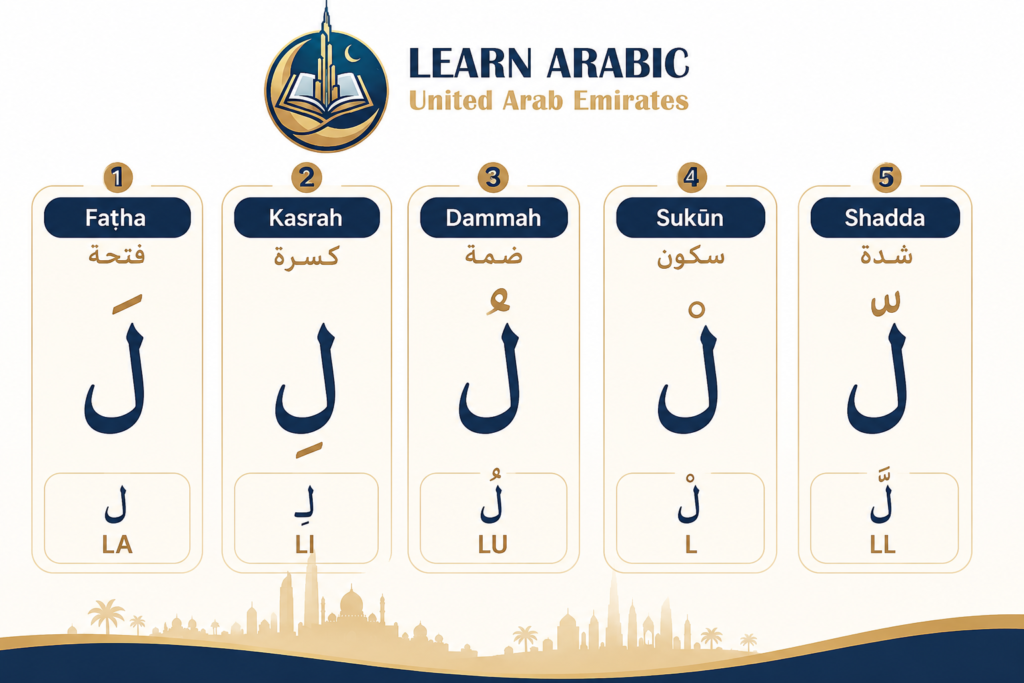
Arabic uses vowel and pronunciation marks called harakat (حركات) to show how letters should be read. Practicing ل (Lām) with Fatḥa, Kasrah, Dammah, Sukūn, and Shadda helps learners recognize and pronounce the letter correctly in different Arabic words.
1. Lām with Fatḥa (فتحة)
Fatḥa (َ) is a small diagonal mark written above the letter. It gives Lām a short “a” sound.
لَ = LA
Read it as: L + Fatḥa = LA
Examples:
- لَيْل (layl) — Night
- لَوْز (lawz) — Almonds
- لَيْمُون (laymūn) — Lemon
Practice لَ with a short, clear vowel while keeping the Lām sound light and forward.
2. Lām with Kasrah (كسرة)
Kasrah (ِ) is written below the letter and gives Lām a short “i” sound.
لِ = LI
Read it as: L + Kasrah = LI
A common example is لِـ, which can function as a preposition meaning “for” or “to.”
For example:
لِمَنْ؟ (liman?) — For whom?
Keep the vowel short rather than stretching it into a long “ee” sound.
3. Lām with Dammah (ضمة)
Dammah (ُ) is a small curl-shaped mark written above the letter. It gives Lām a short “u” sound.
لُ = LU
Read it as: L + Dammah = LU
Example:
- لُعْبَة (luʿba) — Toy
Practice repeating لُ several times while keeping the vowel short and rounded.
4. Lām with Sukūn (سكون)
Sukūn (ْ) indicates that the letter has no vowel after it. A letter carrying Sukūn is called sākin (ساكن).
لْ = L
For example:
هَلْ (hal) — Is / Do…?
Here, لْ closes the syllable without adding another vowel.
Another example is:
- دُلْفِين (dulfīn) — Dolphin
The Lām carries Sukūn, so it is pronounced directly after دُ without an additional vowel.
5. Lām with Shadda (شدة)
Shadda (ّ) indicates that the consonant is doubled. When ل carries Shadda, it is pronounced as a doubled Lām, giving the consonant slightly more duration.
Examples of Lām with Shadda and different vowels include:
| Form | Transliteration |
| لَّ | lla |
| لِّ | lli |
| لُّ | llu |
A particularly important example occurs in الله (Allāh), where Lām carries Shadda. Its pronunciation also follows a special rule: the Lām is pronounced with a heavier quality when preceded by Fatḥa or Dammah, and with a lighter quality when preceded by Kasrah.
Regularly practicing لَ — لِ — لُ — لْ — لّ will help you recognize and pronounce Lām more confidently in Arabic words and sentences.
Read also: The Arabic Letter م (Meem) – Pronunciation, Writing, and Examples
Common Arabic Words with the Letter Lam (ل)
Reading lām inside real words is what moves pronunciation from conscious effort to automatic habit. The words below include lām at the beginning, middle, and end of words — because the sound stays consistent across all positions.
| Arabic | Transliteration | Meaning | Lām Position |
| لَيْلٌ | layl | Night | Beginning + End |
| لُعْبَةٌ | luʿba | Toy | Beginning |
| لَوْزٌ | lawz | Almonds | Beginning |
| لَيْمُون | laymūn | Lemon | Beginning |
| ذَيْلٌ | dhayl | Tail | End |
| بُرتُقَال | burtuqāl | Orange | End |
| دُلْفِين | dulfīn | Dolphin | Middle |
Practice method: Read each word three times slowly, paying attention to the mouth position. Then read it at natural speed. Then cover the transliteration and read only from the Arabic.
If you want to go deeper into Arabic alphabet reading with full audio support and teacher feedback, the Arabic alphabet course at Learn Arabic UAE is designed exactly for this stage.
Learn Arabic Letters Easily in the UAE with a FREE Trial Class

Step Inside Our Classrooms
Don’t just take our word for it—see our community in action. Click below to watch real, live snippets from our recent classes and experience our engaging teaching style firsthand!
Master Arabic in the UAE
Experience world-class Arabic language training designed for students and professionals in the Emirates.
Book Your Free TrialHow to Write the Arabic Letter ل in All Four Forms?
The Arabic letter ل (Lām) changes its written form depending on its position within a word. Because Lām is a connecting letter, it can connect to letters on both sides when the surrounding letters allow connection. Learning all four forms makes it easier to recognize and write ل naturally in Arabic words.
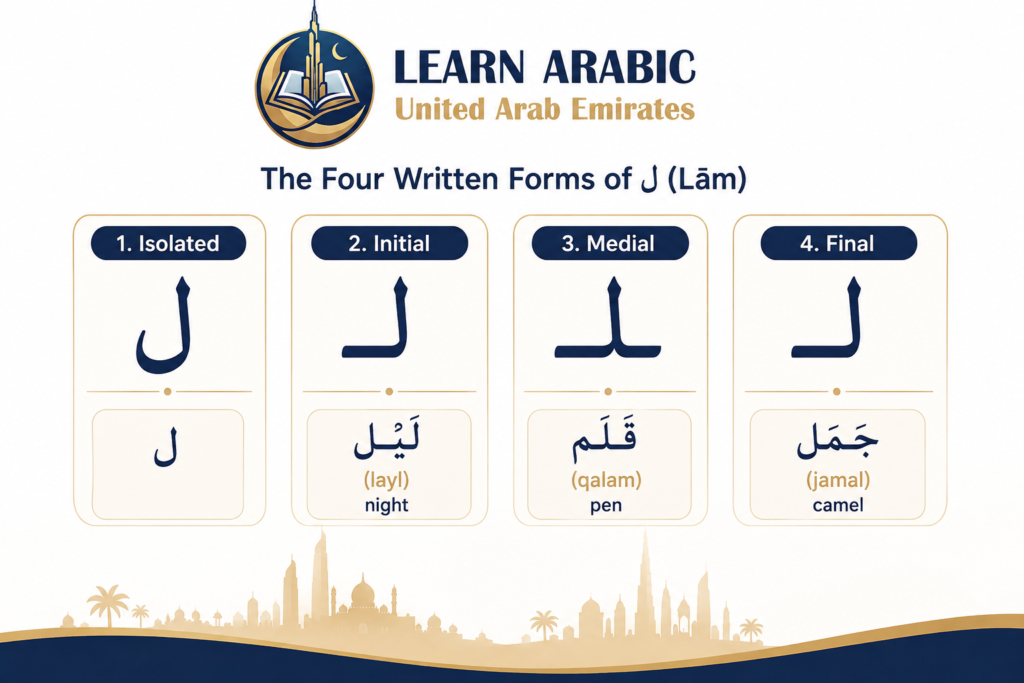
The table below shows how ل appears when it is isolated or positioned at the beginning, middle, or end of a word.
| Position | Form | Example |
| Isolated | ل | ل |
| Initial | لـ | لَيْل |
| Medial | ـلـ | قَلَم |
| Final | ـل | جَمَل |
1. Isolated Form — ل
The isolated form ل is used when Lām stands alone or does not connect to another letter.
It has a tall vertical stroke followed by a curved lower section:
ل
2. Initial Form — لـ
When ل appears at the beginning of a connected word, it joins to the following letter on its left.
For example:
لَيْل (layl) — night
Here, the first ل appears in its initial form.
Read also: The Arabic Letter ن (Nūn) – Pronunciation, Writing, Forms, and Examples
3. Medial Form — ـلـ
When ل appears between connecting letters, it can join on both sides.
For example:
قَلَم (qalam) — pen
Here, ل occurs in the middle of the word and connects with the surrounding letters.
4. Final Form — ـل
When ل appears at the end of a word, it may connect to the preceding letter on its right.
For example:
جَمَل (jamal) — camel
Here, ل appears in its final form.
How to Practice Writing the Arabic Letter Lam (ل)?
Practicing ل (Lām) separately helps learners become familiar with its tall vertical shape, curved base, and connected forms before using it naturally in complete Arabic words.
Practice the Basic Stroke
Begin at the top of the tall vertical stroke and move downward before forming the curved lower part of ل. Pay attention to the height of the letter, as Lām extends noticeably above the baseline.
Practice the Four Forms
Write each form several times until you can produce it comfortably:
ل — لـ — ـلـ — ـل
Focus on how the connecting strokes change depending on the position of the letter.
Practice ل in Complete Words
Once you are comfortable with the four forms, practice writing words containing ل at the beginning, middle, and end. This will help you move from memorizing individual shapes to writing ل naturally in connected Arabic words.
The Grammatical Role of Lām in Arabic
The letter ل (Lām) is not only important for pronunciation and writing; it also plays an essential grammatical role in Arabic. One of its most common uses is as part of the definite article ال (al-), which is attached to nouns to make them definite.
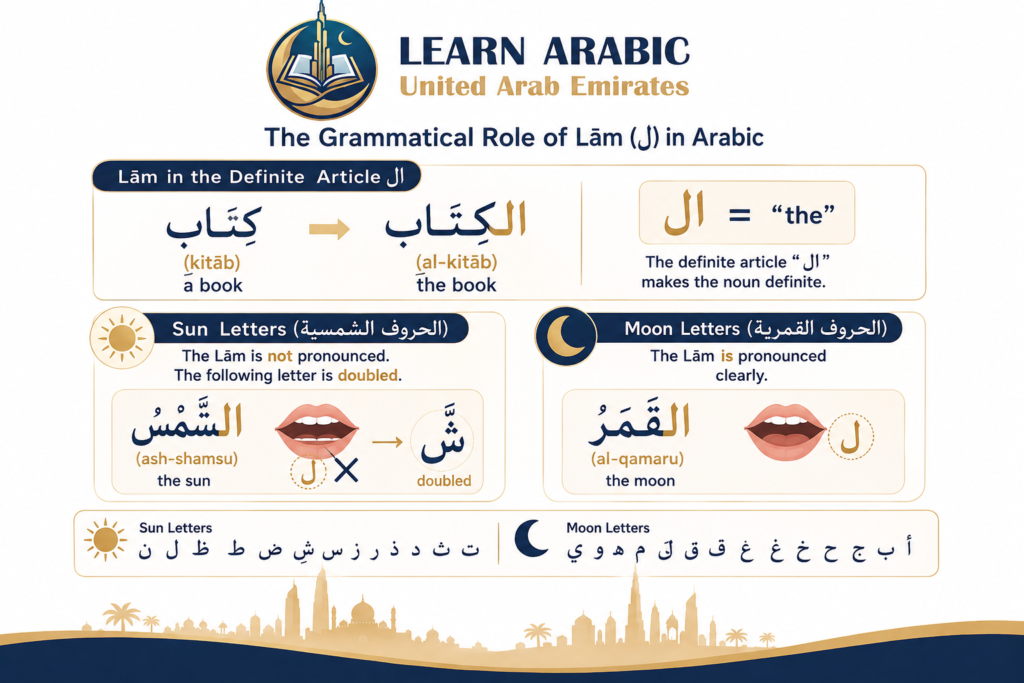
Lām in the Definite Article ال
The Arabic definite article ال is equivalent to “the” in English. It is attached directly to the beginning of a noun.
For example:
- كِتَاب (kitāb) — a book
- الكِتَاب (al-kitāb) — the book
The pronunciation of the ل in ال depends on the letter that comes immediately after it. This introduces one of the most important pronunciation rules in Arabic: Sun Letters (الحروف الشمسية) and Moon Letters (الحروف القمرية).
With Moon Letters, the Lām is pronounced clearly. With Sun Letters, the Lām is not pronounced; instead, the following consonant is doubled in pronunciation.
Common Mistakes When Pronouncing and Writing ل (Lām)
Even learners who speak languages with an “L” sound make specific errors with Arabic lām. Knowing what they are before they become habits saves significant correction time later.
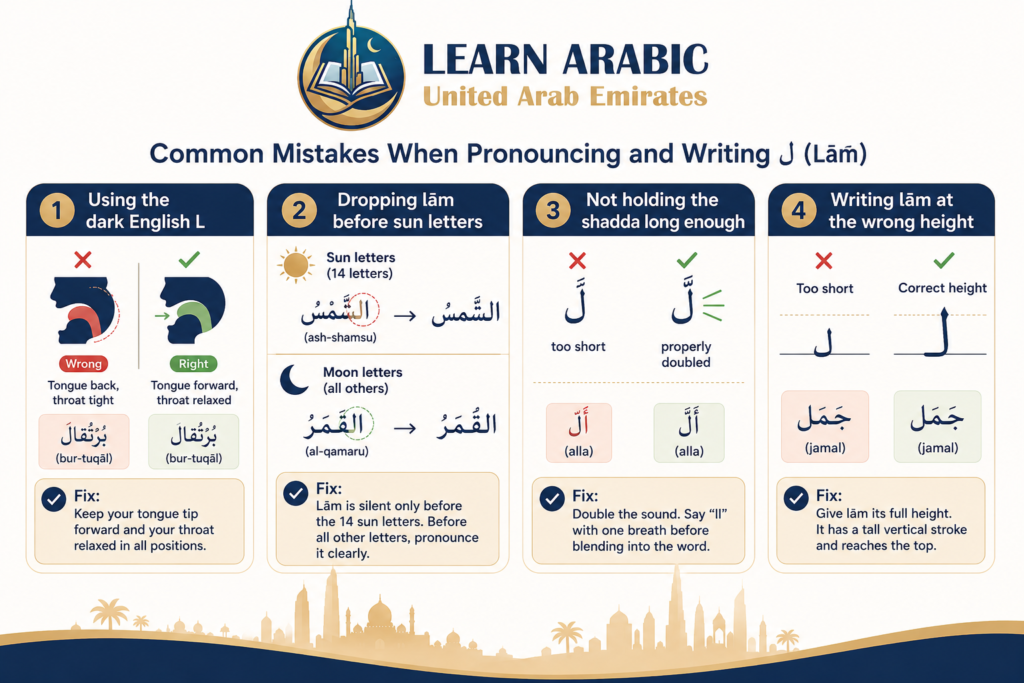
Mistake 1 — Using the dark English L
As explained earlier, English speakers naturally produce a dark, back-of-throat L at the end of syllables. This creeps into Arabic pronunciation in words like بُرتُقَال or دُلْفِين. Fix: consciously keep your tongue tip forward and your throat relaxed every time lām appears, regardless of its position in the word.
Mistake 2 — Dropping lām before sun letters
Learners who learn the sun-letter rule sometimes overapply it and drop lām before moon letters too. The rule is specific: lām is silent only before the 14 sun letters. Before all other letters — including another lām — it is fully pronounced.
Mistake 3 — Not holding the shadda long enough
Lām mushaddad (لّ) must be noticeably doubled. A common mistake is to pronounce it exactly like a single lām. Practice by saying the letter twice with one breath — “ll” — before blending it into the full word. The difference is clearly audible in words like الله and أَلَّ.
Mistake 4 — Writing lām at the wrong height
In handwriting, students often write lām too short, making it look like other letters. Lām has a distinctly tall vertical stroke. When practicing handwriting, give lām its full height — it should be one of the tallest letters on the line.
Read also: How to Speak Arabic Language in the UAE? – A Step-by-Step Guide for Beginners
See Our Classroom Environment in Action
Experience a sneak peek into our live sessions. Watch the video below to see our specialized instructors interacting with students, breakdown complex texts, and cultivate an engaging, respectful learning environment.
Continue Learning Arabic with Learn Arabic UAE
Learning letters one by one is the right starting point — but the real progress happens when you start seeing how they connect into words, sentences, and real conversations.
Whether you are a complete beginner working through the alphabet or a professional who needs formal Arabic for business or academic purposes, structured learning with qualified teachers accelerates your progress dramatically compared to self-study alone.
Learn Arabic UAE offers courses designed for every level and goal — from alphabet fundamentals to advanced reading, writing, and professional communication. Classes are live, interactive, and led by experienced instructors who give you real pronunciation feedback, not just content to watch.
[Book a Free Trial Lesson Today]
Our Arabic courses
- Arabic Course in the UAE
- Arabic Intensive Course
- Arabic Classes for Beginners (Learn Arabic from Scratch)
- Madinah Arabic Course
- Arabic Classes for Adults
- Self-Paced Arabic Course
- Arabic Speaking Classes
- Learn to Write Arabic Course
- Arabic Grammar Course
- Learn Arabic Alphabet Course
- Modern Standard Arabic (MSA) Course
- Quranic Arabic Course
- Fusha Arabic Course
- Classical Arabic Course
- Emirati Arabic Course
- Gulf Arabic Course
- Learn Saudi Arabic
- Business Arabic Course UAE
- Arabic Language Classes for Professionals in UAE
Master Arabic in the UAE
Experience world-class Arabic language training designed for students and professionals in the Emirates.
Book Your Free Trial
Conclusion
The Arabic letter lām (ل) is one of the most important and most frequently encountered letters in the Arabic language. Its sound — a clean, forward light L — is familiar to English speakers, but mastering it means going beyond the basic sound. You need to read it accurately with all five harakat, recognize and produce its four written forms, understand its unique behavior in the definite article ال, and avoid the specific pronunciation errors that affect learners at every level.
The practice words, the vowel breakdowns, and the grammar rules in this guide give you a solid working foundation. But lām, like every Arabic letter, reveals its full character when you encounter it in real text, in real conversation, and with a teacher who can correct the subtle things that a guide cannot catch.
Arabic is a language worth learning properly — and lām is one of the letters that shows you why.
Frequently Asked Questions
What is the Arabic letter ل called?
The Arabic letter ل is called lām. It is the 23rd letter of the Arabic alphabet, one of the most frequently used consonants in the language, and the second letter of the definite article ال.
How do you pronounce ل in Arabic?
Place the near edge of your tongue (adna al-ḥāfa) lightly against your upper molars (ḍawāḥik) and release a voiced stream of air. The result is the light English “L” sound — as in “lamp” or “lemon.” Always use the light L, never the dark L found in words like “ball.”
How many written forms does the Arabic letter ل have?
Lām has four written forms: isolated (ل), initial (لـ), medial (ـلـ), and final (ـل). The shape changes based on the letter’s position in the word, but the pronunciation stays the same across all four forms.
What is lām mushaddad and how is it pronounced?
Lām mushaddad (لّ) is lām with a shadda — a doubling marker. It means you pronounce the lām twice in one smooth movement, holding the tongue position slightly longer before releasing. The most well-known example is in the word الله (Allāh), where the lām is doubled after a fatḥa or dammah.
Is lām a sun letter or a moon letter?
Lām is a moon letter (حرف قمري). When the definite article ال is added to a word beginning with lām, both lāms are pronounced clearly. For example: اللَّيْل = al-layl (the night) — you hear both lāms.
What is the difference between lām in ال before sun letters and moon letters?
Before a moon letter, the lām in ال is fully pronounced: al-kitāb (the book). Before a sun letter, the lām assimilates and becomes silent — the following letter doubles instead: ash-shams (the sun), not al-shams. This rule applies to 14 specific sun letters and must be memorized for correct Arabic pronunciation.




Leave a Reply