 Learn Arabic
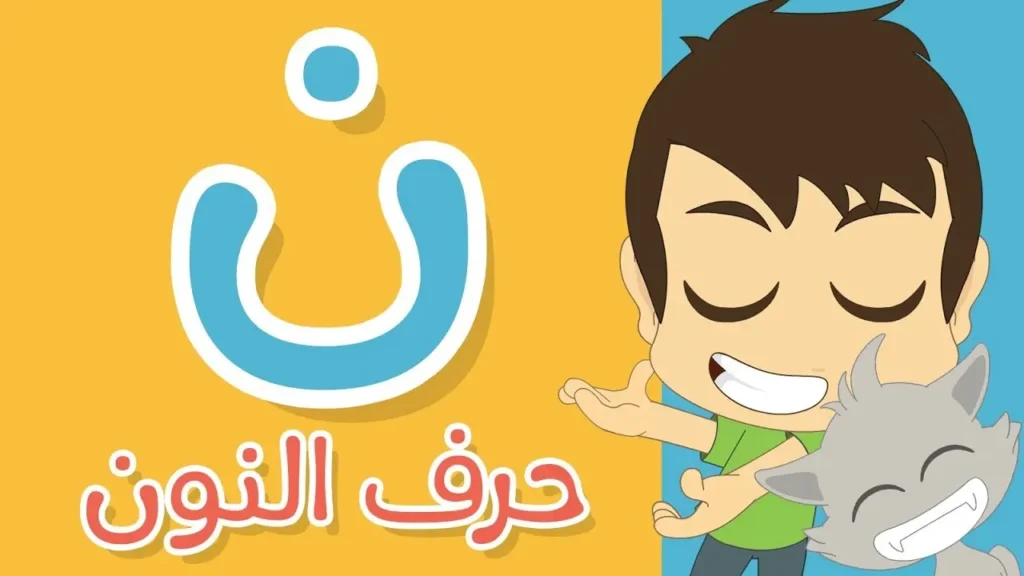
Learning the Arabic alphabet is the first step toward reading, writing, and speaking Arabic with confidence. Among the 28 letters of the Arabic alphabet, ن is one of the most familiar for English speakers because it represents the same basic /n/ sound found in English words such as “name,” “no,” and “night.”
If you are searching for The Arabic Letter ن (Nūn), you may want to know more than its pronunciation. Learning this letter also means understanding its different written forms, how it connects to other Arabic letters, where it appears in common words, and how its sound can change in certain grammatical and Quranic contexts.
This guide explains everything beginners need to know about ن, commonly called Nūn or Noon, with practical examples to help you recognize, pronounce, write, and use the letter correctly.
What Is the Arabic Letter ن (Nūn)?
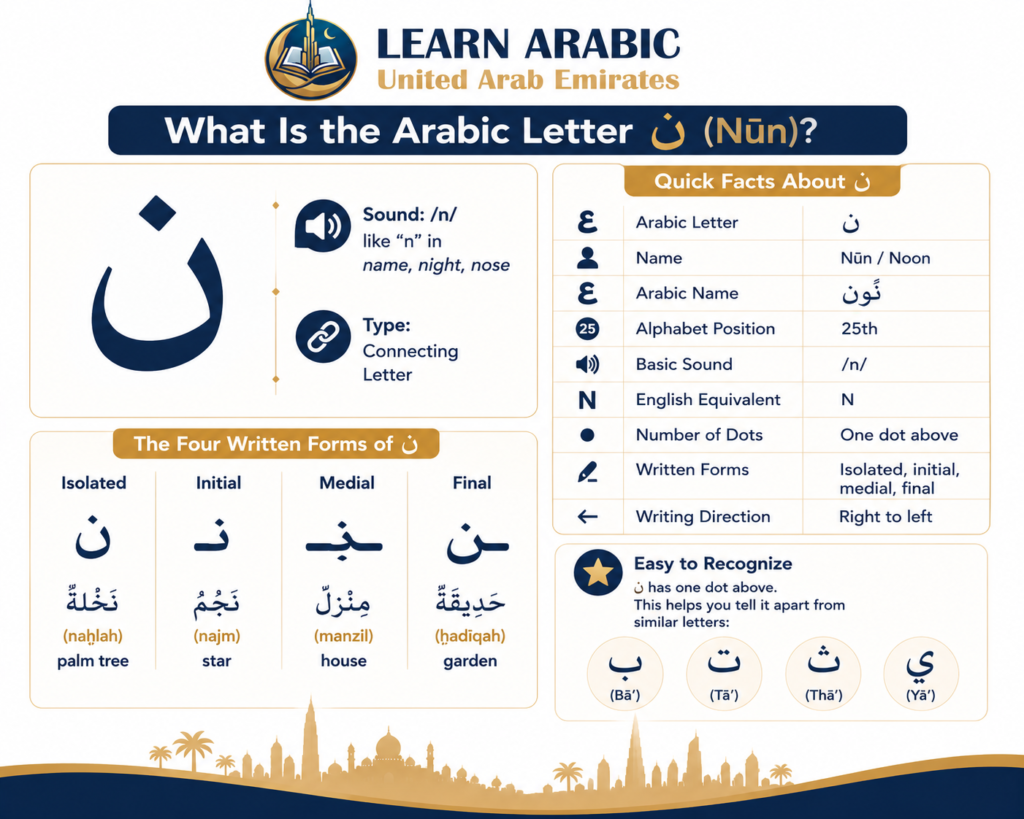
The Arabic letter ن, called Nūn (نون), is the 25th letter of the Arabic alphabet. It represents the /n/ sound, which is very similar to the English “n” in words such as name, night, and nose. Because the sound is familiar, Nūn is generally straightforward for English-speaking learners to pronounce.
ن is also a connecting letter, meaning its written shape changes depending on whether it appears alone or at the beginning, middle, or end of a word. Learning these different forms is essential for recognizing Nūn in connected Arabic writing.
Quick Facts About ن
The table below summarizes the main features of ن (Nūn) that beginners should remember.
| Property | Details |
| Arabic Letter | ن |
| Name | Nūn / Noon |
| Arabic Name | نُون |
| Alphabet Position | 25th |
| Basic Sound | /n/ |
| English Equivalent | N |
| Number of Dots | One dot above |
| Written Forms | Isolated, initial, medial, final |
| Writing Direction | Right to left |
One of the most recognizable features of ن is its single dot above the letter. Paying attention to this dot is especially important when learning to distinguish Nūn from other Arabic letters with related shapes, particularly ب، ت، ث، and ي.
A structured Arabic grammar course for kids can help learners move from recognizing letters to understanding how they function in complete sentences.
Make Arabic Grammar Easy for Kids in the UAE with a FREE Trial Class

How to Pronounce The Arabic Letter ن (Nūn)?
The pronunciation of ن is one of the easier aspects of learning the Arabic alphabet for English speakers. It produces the familiar /n/ sound heard in words such as “name,” “number,” “noon,” and “never.”
To pronounce ن, place the tip of your tongue against the area just behind your upper front teeth. Air passes through the nasal passage while the mouth remains relatively open. In phonetic terms, Nūn is an alveolar nasal consonant.
Try saying:
- نَ — na
- نِ — ni
- نُ — nu
- نْ — n
The basic sound remains /n/, while the short vowel changes the syllable.
For beginners, it is useful to compare the Arabic sound with familiar English words. Say the n in “name,” then practice نَ in نَجْم (najm, star).
How to Write the Arabic Letter ن (Nūn)?
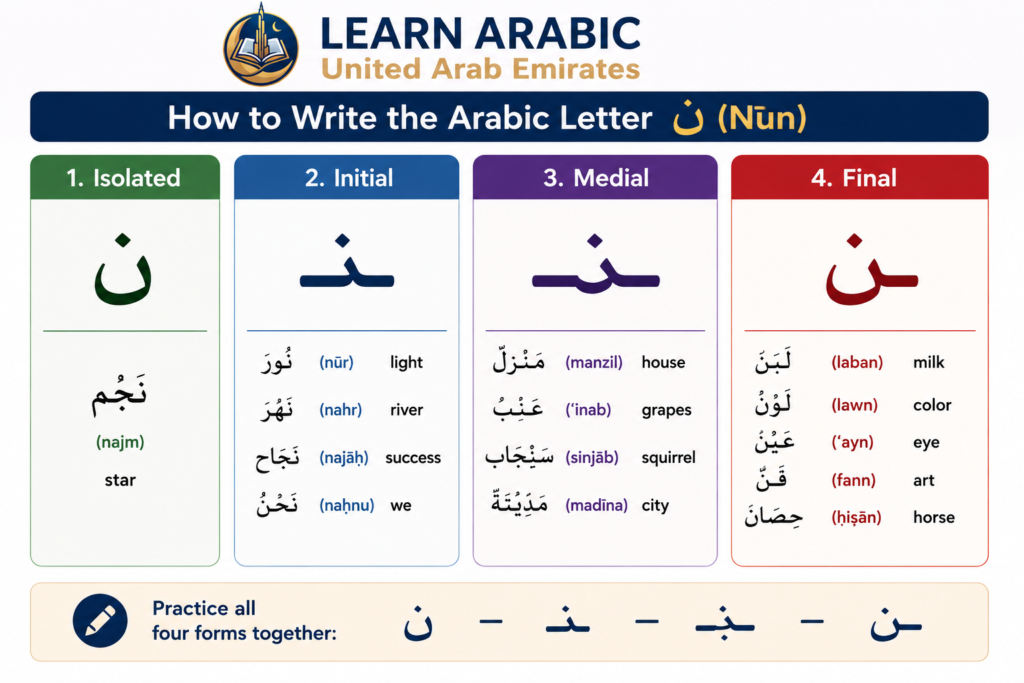
One of the most important things to learn aboutThe Arabic Letter ن (Nūn) is that its written shape changes depending on its position within a word. Because Nūn is a connecting letter, it can join to letters on both sides when the surrounding letters allow connection.
The Four Written Forms of ن
The table below shows the four main forms of ن (Nūn) and how they appear in Arabic writing.
| Position | Form | Example |
| Isolated | ن | ن |
| Initial | نـ | نُور |
| Medial | ـنـ | مَنْزِل |
| Final | ـن | لَبَن |
1. Isolated Form — ن
The isolated form ن is used when Nūn stands alone or when it cannot connect to the letter before it.
Its shape resembles a small curved bowl with one dot above it:
ن
The dot is an essential part of the letter and should always be included when writing Nūn.
2. Initial Form — نـ
When ن appears at the beginning of a word and connects to the following letter, it takes its initial form:
نـ
Examples:
- نَجَاح (najāḥ) — Success
- نَهْر (nahr) — River
- نُور (nūr) — Light
- نَحْنُ (naḥnu) — We
Notice how the connecting stroke allows ن to flow directly into the following letter.
3. Medial Form — ـنـ
When ن appears in the middle of a word and connects on both sides, it usually takes its medial form:
ـنـ
Examples:
- عِنَب (ʿinab) — Grapes
- مَنْزِل (manzil) — House
- سِنْجَاب (sinjāb) — Squirrel
- مَدِينَة (madīna) — City
The medial form is more compact than the isolated form, but the single dot above ن remains an important identifying feature.
4. Final Form — ـن
When ن appears at the end of a word and connects to the preceding letter, it takes its final form:
ـن
Examples:
- لَبَن (laban) — Milk
- لَوْن (lawn) — Color
- عَيْن (ʿayn) — Eye
- فَنّ (fann) — Art
- حِصَان (ḥiṣān) — Horse
When practicing the final form, always remember the single dot above ن, as the dot is an essential part of the letter.
Practice all four forms together:
ن — نـ — ـنـ — ـن
Arabic Words That Contain the Letter ن
One of the best ways to learn ن is to practice it in real Arabic vocabulary rather than memorizing the letter by itself.
Here are some useful examples:
| Arabic | Transliteration | Meaning | Position of ن |
| نَجَاح | najāḥ | Success | Initial |
| نَهْر | nahr | River | Initial |
| نُور | nūr | Light | Initial |
| نَحْنُ | naḥnu | We | Initial & final |
| عِنَب | ʿinab | Grapes | Medial |
| مَنْزِل | manzil | House | Medial |
| مَدِينَة | madīnah | City | Medial |
| لَبَن | laban | Milk | Final |
| لَوْن | lawn | Color | Final |
| عَيْن | ʿayn | Eye | Final |
These examples also show why learning the four shapes of Nūn is important. The letter remains ن, but its visual form changes according to its position and its connections.
For younger learners, structured Arabic courses for kids can provide a more organized way to develop vocabulary, pronunciation, and communication skills.
Make Arabic Learning Easy and Fun for Kids in the UAE with a FREE Trial Class

Read also: The Arabic Letter م (Meem) – Pronunciation, Writing, and Examples
Step Inside Our Classrooms
Don’t just take our word for it—see our community in action. Click below to watch real, live snippets from our recent classes and experience our engaging teaching style firsthand!
Master Arabic in the UAE
Experience world-class Arabic language training designed for students and professionals in the Emirates.
Book Your Free TrialThe Letter ن With Common Arabic Vowels
After learning the basic shapes, practice Nūn with the three short vowels.
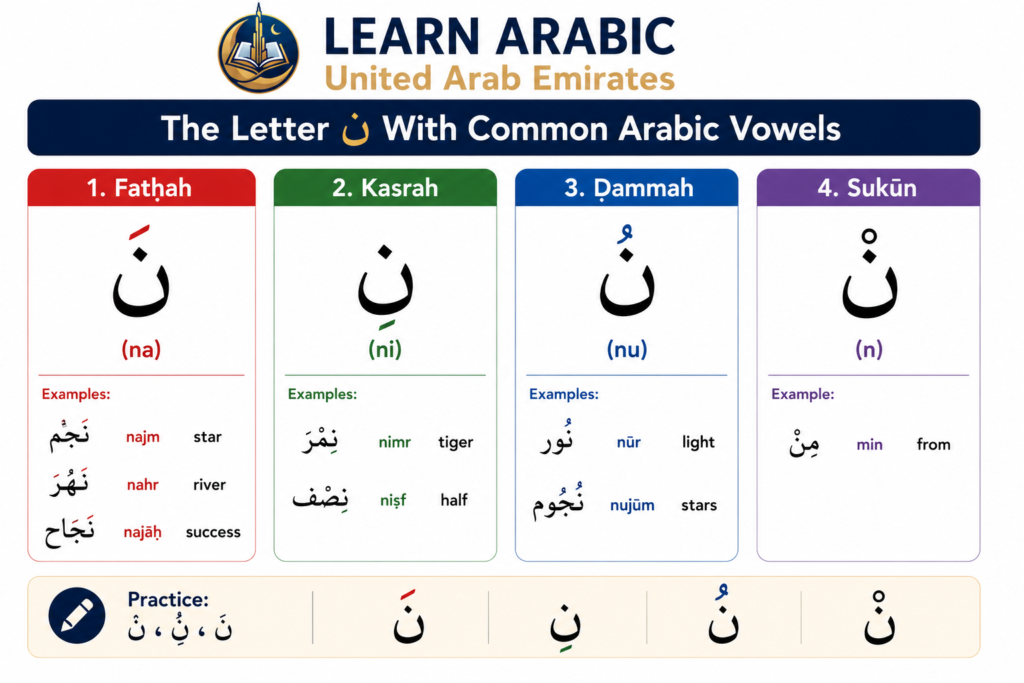
Nūn with Fatḥah: نَ
نَ is pronounced na.
Examples:
- نَجْم — najm — star
- نَهْر — nahr — river
- نَجَاح — najāḥ — success
Nūn with Kasrah: نِ
نِ is pronounced ni.
Examples:
- نِمْر — nimr — tiger
- نِصْف — niṣf — half
Nūn with Ḍammah: نُ
نُ is pronounced nu.
Examples:
- نُور — nūr — light
- نُجُوم — nujūm — stars
Nūn with Sukūn: نْ
نْ represents Nūn without a short vowel.
You can see it in:
مِنْ — min — from
Practicing نَ، نِ، نُ، نْ repeatedly can help beginners connect the written letter with its sound.
Nūn in Arabic Grammar
The importance of Nūn goes beyond vocabulary. The letter appears in several important grammatical patterns.
Tanwīn: The Hidden N Sound
One interesting feature for Arabic learners is Tanwīn. Tanwīn is not the written letter ن, but it produces an “n” sound at the end of an indefinite noun or adjective.
The three main forms are:
- ٌ — -un
- ً — -an
- ٍ — -in
For example:
- قَلَمٌ — qalamun — a pen
- قَلَمًا — qalaman — a pen
- قَلَمٍ — qalamin — of/from a pen
Tanwīn is connected to Arabic case endings and is especially important when learners begin studying formal Arabic.
Although the sound is similar to a final Nūn, remember that Tanwīn is represented by vowel marks rather than by writing ن itself.
Read also: How to Speak Arabic Language in the UAE? – A Step-by-Step Guide for Beginners
Nūn in Quranic Recitation and Tajweed
For students interested in reading the Quran, learning ن becomes even more important.
Nūn appears in several fundamental Tajweed rules, particularly when dealing with Nūn Sākinah (نْ) and Tanwīn. These rules determine how the N sound is pronounced when it comes before particular Arabic letters.
The major categories include:
- Iẓhār — clear pronunciation
- Idghām — assimilation
- Iqlāb — changing the N sound before ب
- Ikhfā’ — partial concealment with nasalization
For example, Quranic text frequently contains forms such as مِنْ, where the final Nūn has a sukūn. Understanding these rules requires listening practice as well as learning the written symbols. Quranic examples can be observed directly in Quranic text, including verses where Nūn Sākinah and Tanwīn occur.
Learners should distinguish between ordinary Arabic pronunciation and specialized Tajweed rules. Everyday Arabic does not require applying every Tajweed rule in the same way as Quranic recitation.
Common Mistakes When Learning ن
Although Nūn is relatively easy for English speakers to pronounce, learners can still encounter several difficulties.
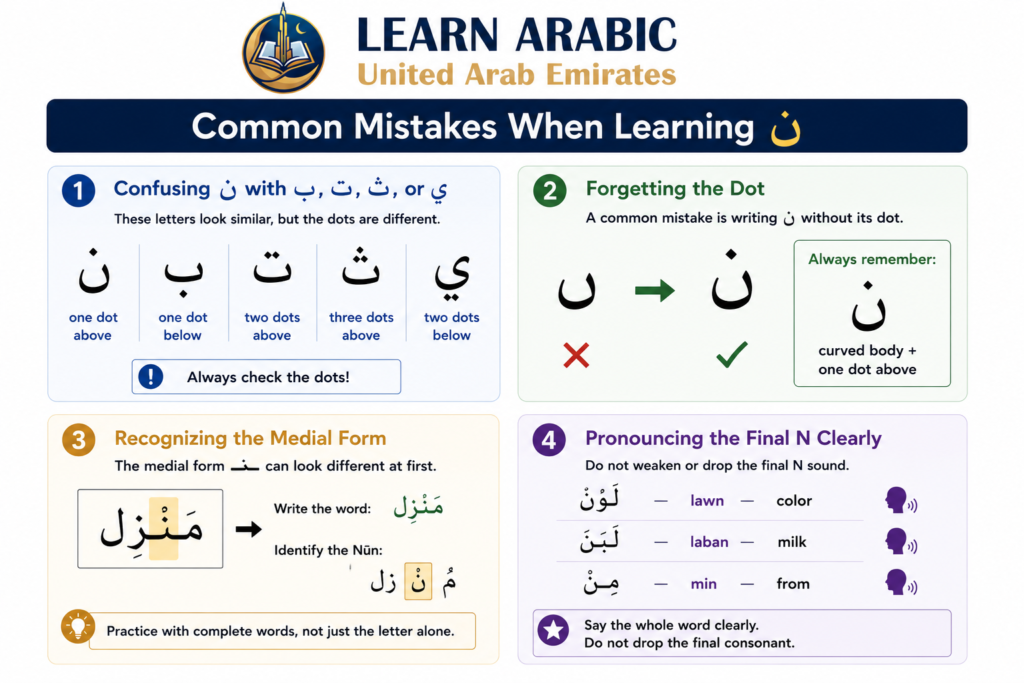
Confusing ن with ب, ت, ث, or ي
These letters can share similar basic shapes in some positions, but their dots differ.
- ن — one dot above
- ب — one dot below
- ت — two dots above
- ث — three dots above
- ي — two dots below in its usual written form
Paying attention to the dots is essential when reading handwritten Arabic.
Forgetting the Dot
A common beginner mistake is writing the curved body of Nūn but forgetting its dot.
Always remember:
ن = curved body + one dot above
Recognizing the Medial Form
The medial form ـنـ can initially look different from ن. The solution is repeated exposure to complete words rather than memorizing the isolated letter alone.
Try writing:
مَنْزِل
Then identify the Nūn:
مَ نْ زِل
Pronouncing the Final N Clearly
Learners may sometimes weaken the final N sound in words such as:
لَوْن — lawn
لَبَن — laban
مِنْ — min
Practice saying the complete word clearly without dropping the final consonant.
For learners who want additional speaking practice, Arabic conversation lessons for kids can help connect individual letters and words to actual communication.
Get Your Kids Speaking Arabic with Confidence in the UAE with a FREE Trial Class

How to Practice the Arabic Letter ن?
The fastest way to become comfortable with The Arabic Letter ن (Nūn) is to combine pronunciation, writing, reading, and vocabulary practice.
Practice the four forms
Write each form repeatedly:
ن — نـ — ـنـ — ـن
Then write complete words containing each form.
Read aloud
Choose simple words such as:
- نُور — light
- نَهْر — river
- نَجْم — star
- عِنَب — grapes
- لَبَن — milk
Read each word slowly, then at a natural speed.
Build your vocabulary
Instead of studying Nūn alone, learn groups of useful words containing the letter. This helps you recognize its shape in real Arabic text and improves vocabulary at the same time.
Practice Arabic conversation
Once you can recognize Nūn in individual words, begin using those words in short sentences.
Combine letters with grammar
As your Arabic improves, learning the letter should not stop at pronunciation and handwriting. Understanding how Arabic words are formed and how sentences work will make your reading more accurate.
See Our Classroom Environment in Action
Experience a sneak peek into our live sessions. Watch the video below to see our specialized instructors interacting with students, breakdown complex texts, and cultivate an engaging, respectful learning environment.
Continue Your Arabic Learning with Learn Arabic UAE
Learning ن (Nūn) is an important step in building a strong Arabic foundation, but becoming confident in the language requires moving beyond individual letters. Learners need regular practice with vocabulary, pronunciation, reading, writing, grammar, and real Arabic sentences to turn alphabet knowledge into practical communication skills.
At Learn Arabic UAE, students can follow a structured learning path with experienced Arabic teachers who help them progress from recognizing letters like ن to reading words, forming sentences, and communicating more confidently in Arabic. With courses designed for different ages and learning goals, students can continue developing their Arabic skills in a clear and practical way.

Our Arabic courses
- Arabic Course in the UAE
- Arabic Intensive Course
- Arabic Classes for Beginners (Learn Arabic from Scratch)
- Madinah Arabic Course
- Arabic Classes for Adults
- Self-Paced Arabic Course
Master Arabic in the UAE
Experience world-class Arabic language training designed for students and professionals in the Emirates.
Book Your Free TrialConclusion
Learning The Arabic Letter ن (Nūn) is an important step for anyone beginning to read and speak Arabic. Nūn is the 25th letter of the Arabic alphabet and has a familiar /n/ sound that makes pronunciation relatively accessible to English speakers.
However, mastering Nūn involves more than knowing its sound. Learners should recognize its four written forms, understand how it connects to neighboring letters, practice it with Arabic vowels, and learn to identify it in common vocabulary.
The letter also introduces students to important aspects of Arabic grammar and pronunciation, including Tanwīn and the sun-letter behavior of الـ. For Quran learners, Nūn is particularly significant because of its role in Tajweed rules involving Nūn Sākinah and Tanwīn.
The best approach is consistent practice. Write ن, read words containing it, pronounce the sound aloud, and gradually use those words in complete Arabic sentences. With regular practice and structured learning, recognizing and using ن will become a natural part of your Arabic reading and communication skills.
Read also: How to Learn Quran for Kids in the UAE – 7 Practical Steps for Parents
Frequently Asked Questions
What is ن in Arabic?
ن is the Arabic letter Nūn (Noon). It is the 25th letter of the Arabic alphabet and represents the /n/ sound, similar to the English letter N.
How do you pronounce ن in Arabic?
The letter ن is pronounced like the English N in words such as “name,” “night,” and “noon.” The sound is produced by placing the tip of the tongue near the area behind the upper front teeth while allowing air to pass through the nasal passage.
What are the four forms of ن?
The four common written forms are:
Isolated: ن
Initial: نـ
Medial: ـنـ
Final: ـن
Its exact appearance depends on its position and the letters surrounding it.
What words begin with ن?
Some common Arabic words beginning with ن include:
نُور — nūr — light
نَهْر — nahr — river
نَجْم — najm — star
نَجَاح — najāḥ — success
نَحْنُ — naḥnu — we
Is ن a sun letter?
Yes. ن is one of the Arabic sun letters. When الـ comes before a word beginning with Nūn, the ل is assimilated in pronunciation, as in النَّاس (an-nās).
What is the relationship between ن and Tanwīn?
Tanwīn is not the written letter ن, but it produces an n sound at the end of an indefinite noun or adjective. It appears as ٌ، ً، ٍ and is associated with Arabic grammatical case endings.
Why is ن important in Tajweed?
Nūn Sākinah and Tanwīn are involved in several important Tajweed rules, including Iẓhār, Idghām, Iqlāb, and Ikhfā’. Learning these rules helps students pronounce Quranic Arabic accurately.




Leave a Reply