 Learn Arabic
You’ve probably seen a name like Khalifa bin Zayed bin Sultan Al Nahyan and wondered where it starts and where it ends. Understanding how Arabic names are structured isn’t just trivia. It changes how you fill out a form, address someone correctly, or read a name in a UAE government document.
Arabic names follow a paternal chain rather than the Western first-middle-last pattern. Each part carries information, such as who someone’s ancestors were, where their family originated, or what they’re known for. When you know the five components, even a long name becomes easy to read.
This guide breaks down each part: Ism, Nasab, Nisba, Laqab, and Kunya. It also shows how the structure changes by country.
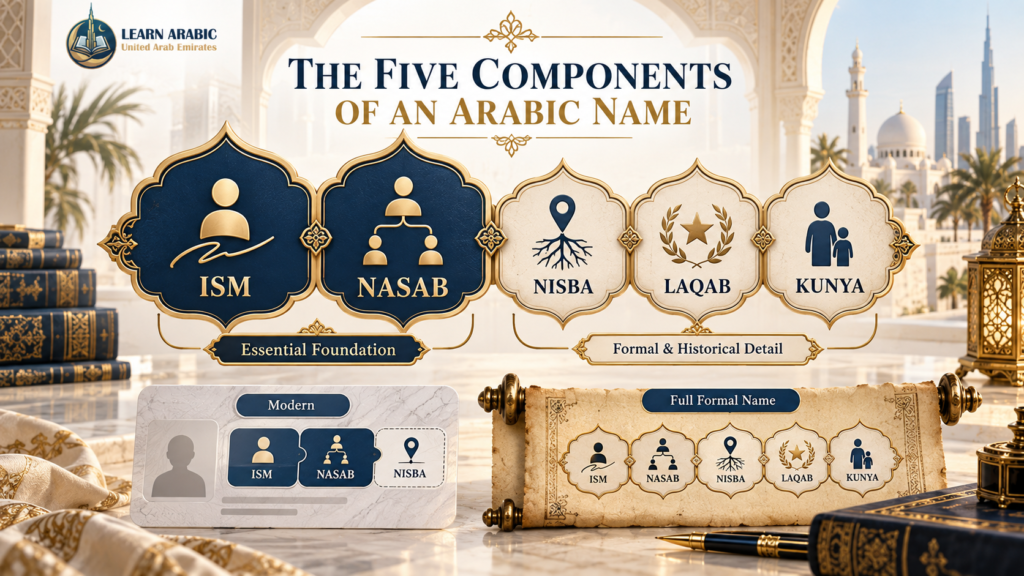
The Five Components Of An Arabic Name
A full Arabic name is a formal name built from up to five parts: Ism, Nasab, Nisba, Laqab, and Kunya. Each part answers a different question: who is this person, whose son or daughter are they, where are they from, what are they known for, and who is their eldest child.
Not every name uses all five. Modern usage typically keeps two or three; the rest survive mainly in historical and formal contexts. The two most essential parts, the ones you’ll meet in almost every name, are the Ism and the Nasab.
1. Ism – The Given Name
The Ism اسم is the personal name, the equivalent of a Western first name. It’s the only part of an Arabic name that is truly and permanently a person’s own.
Many “Ism” names carry direct meaning: Ahmad and Muhammad both mean “praiseworthy,” Fatima means “to abstain,” Qamar means “moon.” Others come straight from the Quran or the names of prophets, which is why the same handful of names, Muhammad, Ali, Yousef, Maryam, recur across the Arab world.
2. Nasab – The Paternal Chain
The Nasab نَسَب is the lineage element, built from ibn (son of) or bint (daughter of) plus the father’s name, and sometimes the grandfather’s and great-grandfather’s names after that.
This is the part that makes Arabic names run long. Ali ibn Muhammad ibn Yusuf al-Qurashi tells you Ali’s father was Muhammad and his grandfather was Yusuf, before the Nisba even starts. In official Gulf records, this chain can extend five or six generations back.
Learning to read a Nasab chain is one of the more useful skills for anyone dealing with Arabic-language documents in the UAE. It’s also one of the cultural building blocks we cover early on in Learn Arabic UAE’s beginner track. It is not just vocabulary, but rather how names and titles actually work in daily life.
3. Nisba – Where The Family Is From
The Nisba نسبة is an adjective formed by adding “-i” (male) or “-iyya” (female) to a place, tribe, or profession, usually preceded by the definite article al-.
Al-Masri means “the Egyptian,” al-Baghdadi means “from Baghdad,” al-Najjar means “the carpenter.” A large share of today’s Arab family surnames started life as a Nisba, a description that stuck across enough generations to become inherited.
4. Laqab – The Epithet
A Laqab لقب is a descriptive title tied to a person’s character or accomplishments, historically most common among rulers and scholars.
The honorable companion and the second of the Rightly-Guided Caliphs, Umar ibn al-Khattab عمر بن الخطاب, carried the Laqab al-Farooq الفاروق (“the one who distinguishes right from wrong”); the caliph Harun al-Rashid’s هارون الرشيد Laqab meant “the rightly guided.” In everyday modern use, Laqabs are rare outside of political and religious titles.
5. Kunya – The Honorific By Child
The Kunya كُنية uses Abu (“father of”) or Umm (“mother of”) plus the name of the eldest son, or, if there is no son, the eldest daughter.
A man named Mahmoud whose eldest son is Ahmad becomes Abu Ahmad in daily address; his wife becomes Umm Ahmad. Some Kunyas are symbolic rather than literal. For instance, a childless person may still be given one, such as “father of good deeds,” as a mark of respect rather than a statement of parentage.
Getting comfortable with honorifics like Kunya is exactly the kind of nuance that separates textbook Arabic from Arabic you can actually use in conversation with Emirati colleagues or neighbors. It’s a small detail that makes a real difference in how natural you sound.
Read Also: Arabic Numerals – The True Origin Of The World’s Most-Used Number System
How Country Affects The Number Of Names In Official Records
The five-part classical structure is a framework, not a fixed rule. Each country’s civil registry keeps a different number of elements.
Lebanon typically records three: given name, father’s given name, and family name. Jordan usually records four: given name, father’s name, grandfather’s name, and family name.
Gulf Countries And The Ibn/Bin Chain
In the UAE and across the Gulf, the Nasab chain using ibn ابن or bin بن (both meaning “son of”) stays common in formal and public-facing names, even where a fixed family surname also exists.
Mohammed bin Salman bin Abdulaziz Al Saud shows the pattern clearly: given name, then two generations of Nasab, then the family name. The same structure appears in Khalifa bin Zayed bin Sultan Al Nahyan, a name every UAE resident will recognize.
Read also: How Long to Learn Arabic in the UAE?
Why Family’s Arab Names Became Fixed Surnames
Inherited family surnames, in the fixed Western sense, are a relatively recent addition to Arabic naming. For most of Arabic history, a person was identified by Ism plus Nasab plus, sometimes, a Nisba. The Nasab reset with every generation, since a father’s name isn’t inherited by his grandchildren.
Fixed surnames spread across the region during the late nineteenth and early twentieth centuries, often as a requirement of colonial or state administration, the same era that produced Turkey’s 1934 Ottoman Surname Law.
Egypt, Syria, Iraq, and Lebanon moved toward standard family-surname registration over this period; some Gulf states still run a hybrid system, recording both a family name and a full Nasab chain side by side.
This is the mechanism behind a pattern you’ll notice constantly: most modern Arab surnames are simply an old Nisba (al-Masri المصري, al-Halabi الحلبي), Laqab, or Kunya-style form (Abu-Lughod أبو الجود) that a state registry made permanent at a particular point in time.
Read Also: How Many Phonemes Are In Arabic?
Common Mistakes Non-Arabic Speakers Make With Arabic Names
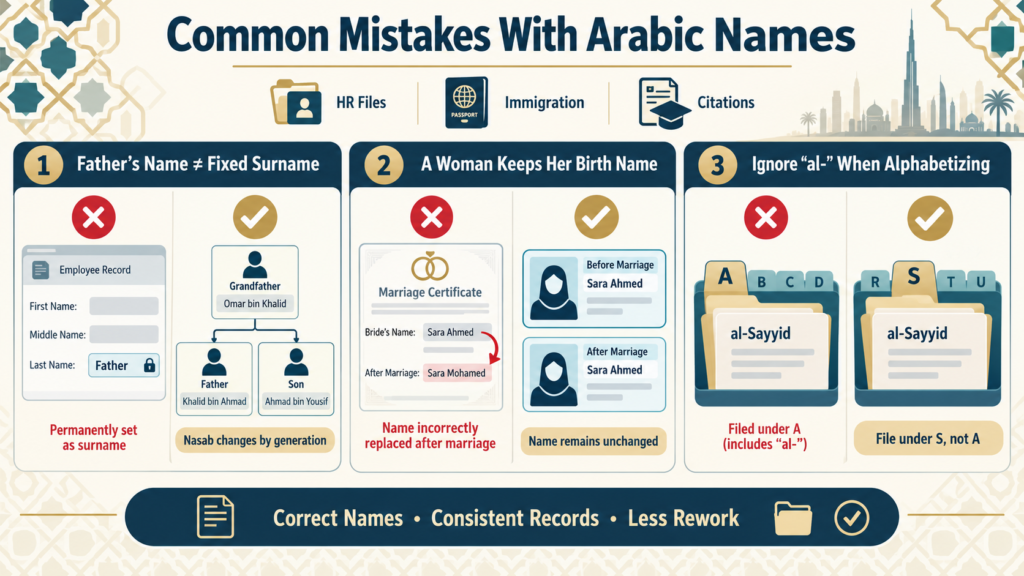
Three mistakes are common in HR files, immigration paperwork, and academic citations. Knowing them in advance saves rework later.
The first common mistake is treating the father’s name as a fixed surname, but it isn’t. It changes every generation exactly like a Nasab does, so recording it as a permanent “last name” misfiles the person in their children’s records.
The second recurrent mistake is assuming a woman’s name changes after marriage. In Arabic naming convention, a woman keeps the name she was born with for life; her children take the father’s Nasab, not a shared “family surname” created by the marriage.
The third frequent mistake is alphabetizing by the first written word. Major libraries generally file al-Sayyid under S, not A, since al- is treated as an article rather than part of the searchable name.
It is a rule most general databases don’t apply, which is exactly why the same person can turn up under two different letters in two different systems.
Read Also: Common Mistakes New Arabic Learners Make (And How To Fix Them)
Step Inside Our Classrooms
Don’t just take our word for it—see our community in action. Click below to watch real, live snippets from our recent classes and experience our engaging teaching style firsthand!
Master Arabic in the UAE
Experience world-class Arabic language training designed for students and professionals in the Emirates.
Book Your Free TrialStart Reading And Speaking Arabic With Confidence
Understanding how Arabic names are structured is one piece of a much bigger picture: the culture, grammar, and daily conversation that make the language make sense.
Learn Arabic UAE puts you in front of live instructors who teach Modern Standard Arabic and Gulf dialect side by side with the cultural context behind it, names, titles, and the everyday etiquette that textbooks skip. You’ll be reading names, addressing people correctly, and holding real conversations faster than studying vocabulary lists alone.
If you would like to understand Arabic names and cultural conventions more naturally, explore Learn Arabic UAE’s guided lessons and practise them with supportive, real-time instruction.
Our Arabic courses
- Arabic Course in the UAE
- Arabic Intensive Course
- Arabic Classes for Beginners (Learn Arabic from Scratch)
- Madinah Arabic Course
- Arabic Classes for Adults
- Self-Paced Arabic Course
- Arabic Speaking Classes
- Learn to Write Arabic Course
- Arabic Grammar Course
- Learn Arabic Alphabet Course
- Modern Standard Arabic (MSA) Course
- Quranic Arabic Course
- Fusha Arabic Course
- Classical Arabic Course
- Emirati Arabic Course
- Gulf Arabic Course
- Learn Saudi Arabic
- Business Arabic Course UAE
- Arabic Language Classes for Professionals in UAE
Our Arabic Courses for Kids
- Arabic Course for Kids
- Arabic Conversation Course for Kids
- Arabic Qaida Course for Kids
- Beginner Arabic Course for Kids
- Arabic Grammar Course for Kids
- Teen Arabic Summer Course
- UAE Kindergarten Arabic Classes

Conclusion
Arabic names are structured around five possible elements: Ism, Nasab, Nisba, Laqab, and Kunya, but most people you meet will use only two or three of them day to day.
The Nasab chain (ibn/bin plus ancestor names) explains why Arabic names run long, the Nisba explains where most modern surnames actually came from, and the Kunya explains why someone might be called “Abu Ahmad” instead of their own given name.
The number of names on a document depends heavily on the country: three in Lebanon, four in Jordan, and often a full ibn/bin chain across the Gulf, including the UAE. Once you can separate these parts, a name like Khalifa bin Zayed bin Sultan Al Nahyan stops looking like a wall of words and starts reading like a short family history.
Frequently Asked Questions
What Is A Nasab In Arabic Names?
The Nasab is the lineage part of an Arabic name, built with ibn (“son of”) or bint (“daughter of”) followed by the father’s name, and sometimes the grandfather’s name after that. It’s the element responsible for making Arabic names run several words long.
Is The Father’s Name Treated As A Surname In Arabic?
No. The father’s name in an Arabic name is part of the Nasab, and it changes with every generation rather than passing down unchanged. Only a family’s actual surname, when one exists, stays fixed across generations.
Do Arab Women Change Their Name When They Marry?
No, women in Arab naming conventions keep the name they were born with for life, since a name reflects paternal lineage rather than marital status. Any change in how she’s addressed socially, such as being called “wife of,” doesn’t alter her legal or formal name.
What’s The Difference Between “Al” And “Aal” In Names Like Al Saud?
Al- (ال) is simply the Arabic definite article, meaning “the,” and appears in Nisba surnames like al-Masri. Aal (آل) is a separate word meaning “house of” or “family of,” used in dynastic names like Al Saud and Al Nahyan, and it is never hyphenated the way al- often is.
Why Do Some Arabic Names Look So Long Compared To Western Names?
Long Arabic names come from stacking multiple Nasab generations, son of, son of, son of, sometimes alongside a Nisba and Kunya as well. Everyday use typically drops most of this chain, but formal and legal documents, especially in the Gulf, often preserve it in full.
Related Articles
Learn Arabic



Leave a Reply