 Learn Arabic
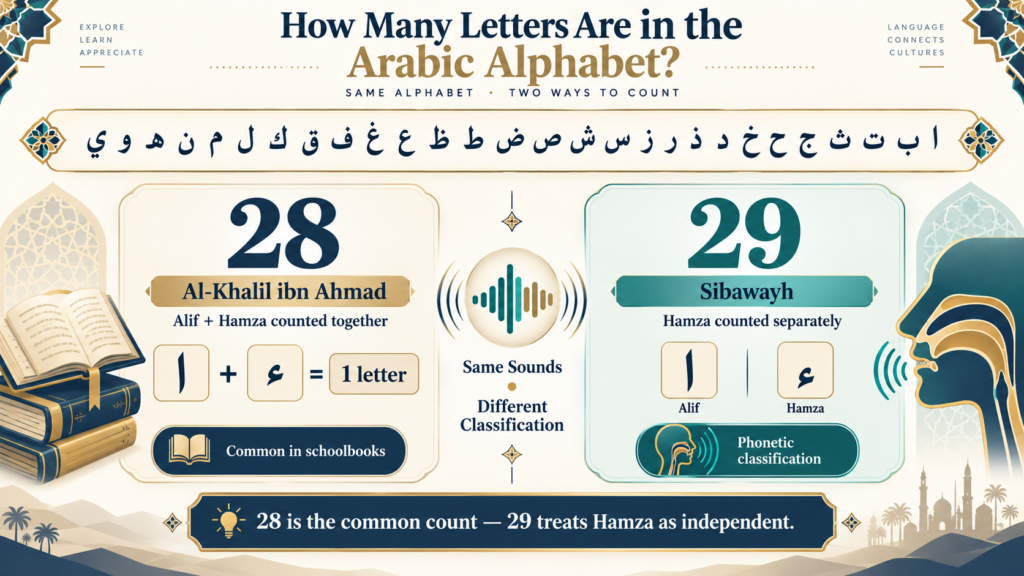
How many letters in the Arabic alphabet? Ask ten people this question, and most will say 28. Ask a classical Arabic grammarian, and you might get 29. Both answers are correct. The difference comes down to a linguistic decision made over a thousand years ago about a single letter: the hamza.
The short answer to how many letters in the Arabic alphabet is 28 according to the majority view, and 29 according to a group of early grammarians who treat the hamza as fully independent from the alif. Neither number is a mistake. They reflect two different ways of classifying the same set of sounds.
This article explains why the count varies and how the letters are grouped by origin. In addition, it shows how they came to be ordered the way they are today, and when children are ready to start learning them.
1. The 28-Letter View – Al-Khalil Ibn Ahmad’s Position
When exploring how many letters in the Arabic alphabet, Al-Khalil ibn Ahmad—the grammarian credited with founding Arabic prosody and lexicography—held that the alif and the hamza should be counted as one letter.
Under this view, the hamza is treated as a form of the alif rather than a separate character, which brings the total to 28. This is the count you’ll see in most schoolbooks, dictionaries, and everyday references, which is why most learners encounter 28 first.
2. The 29-Letter View – Sibawayh’s Position
If you examine how many letters in the Arabic alphabet traditions exist among classical scholars, Sibawayh, the author of the foundational grammar text Al-Kitab, took the opposite position: the hamza is an independent letter, distinct from the soft alif (alif layyinah), because the two are pronounced from completely different points in the mouth and throat.
Under Sibawayh’s classification, the alphabet totals 29 letters. Many specialists in Arabic phonetics consider this the more linguistically accurate position, since it’s based on where each sound is physically produced rather than how it’s written.
Understanding both counts matters if you’re comparing course materials or teaching resources; a curriculum built around 29 letters isn’t wrong; it’s simply following the older, more phonetically precise tradition.
At Learn Arabic UAE, lessons make this kind of nuance clear from the start, so learners aren’t confused when they see the alphabet counted differently across sources.
Read also: Does Arabic Have Grammatical Gender? 9 Easy Rules You Need To Know
3. The Difference Between Alif And Hamza
A core factor in deciding how many letters in the Arabic alphabet system is the distinction between alif and hamza. The soft alif (alif layyinah) is produced from al-jawf (the open space of the mouth and throat), while the hamza is produced from the deepest part of the throat (aqsa al-halq). Because the two sounds come from entirely different articulation points, grammarians like Sibawayh treat them as two separate letters.
Abu Amr al-Dani, in his work Naqt al-Masahif, stated plainly that the letters “from alif to ya” number 29, the set upon which all Arabic speech turns. He noted that the alif is placed first because it visually represents the hamza that so often precedes it in speech.
Step Inside Our Classrooms
Don’t just take our word for it—see our community in action. Click below to watch real, live snippets from our recent classes and experience our engaging teaching style firsthand!
Master Arabic in the UAE
Experience world-class Arabic language training designed for students and professionals in the Emirates.
Book Your Free Trial4. The 22 Semitic Letters And Their Shared Characteristics
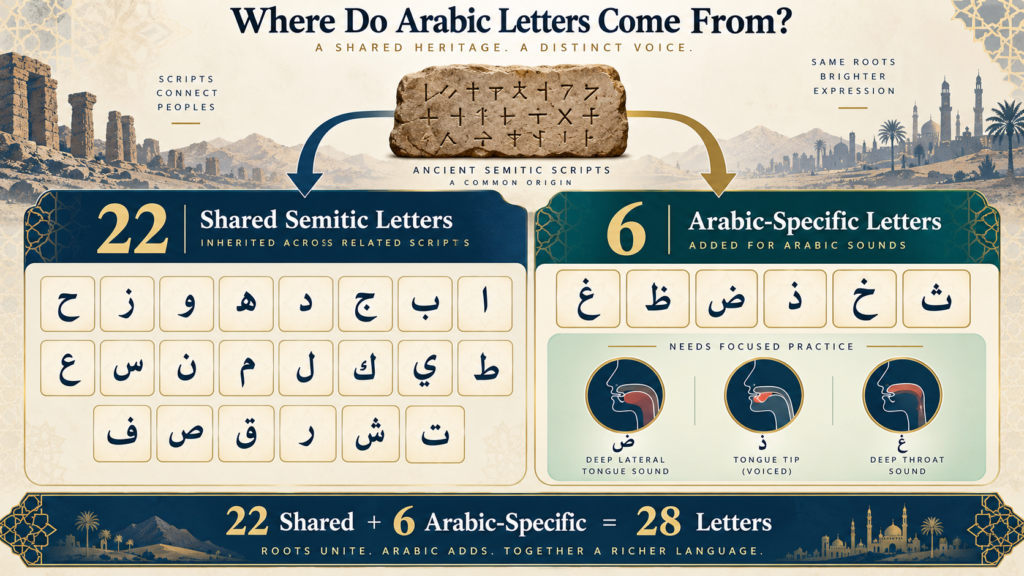
Beyond asking how many letters are in the Arabic alphabet, it is essential to understand their origins. Twenty-two of the Arabic alphabet’s letters correspond to the older Semitic alphabet shared across the region’s ancient scripts: alif, ba, jim, dal, ha, waw, zay, ha (ح), ta (ط), ya, kaf, lam, mim, nun, sin, ain, fa, sad, qaf, ra, shin, and ta (ت). Knowing this split matters for learners, as these shared letters often map to sounds that exist in other languages.
5. The 6 Letters That Are Unique To Arabic
In addition to the basic Semitic set, evaluating how many letters in the Arabic alphabet developed reveals six letters added specifically to capture unique Arabic sounds: tha (ث), kha (خ), dhal (ذ), dad (ض), dha (ظ), and ghain (غ).
This is part of why classical scholars have long described Arabic as unusually rich in distinct sounds compared to related languages; the alphabet expanded specifically to keep pace with the language’s phonetic range.
Knowing this split matters for learners: the 22 shared letters often map to sounds that exist in other languages, while the 6 Arabic-specific letters, particularly dad, dhal, and ghain, are usually the ones that take the longest for non-native speakers to pronounce accurately.
A structured course that isolates these six letters for focused practice, rather than teaching all 28 in one uniform pass, tends to produce faster, more accurate pronunciation.
This is the approach used in Learn Arabic UAE’s beginner track, where the Arabic-only letters get dedicated practice time instead of being grouped in with the rest of the alphabet.
Read also: Arabic Broken Plurals – 2 Categories Of Jam’ Al-Taksir
6. The Hijai Order Of The Arabic Alphabet That Is Used Today
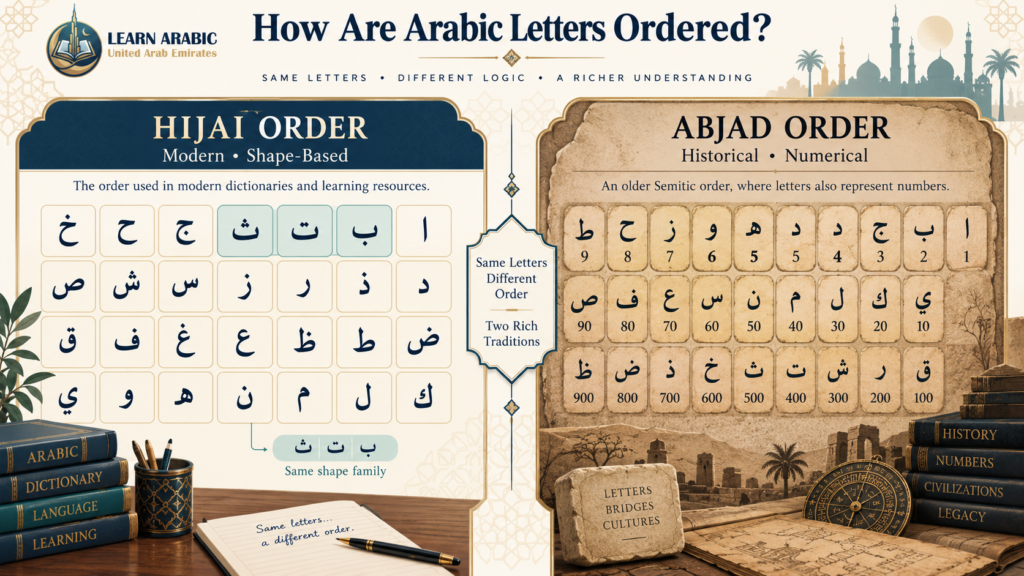
When learning how many letters in the Arabic alphabet resources contain, you will also encounter how they are ordered. The Hijai order used in modern dictionaries, indexes, and everyday teaching- alif, ba, ta, tha, jim, ha, kha, dal, dhal, ra, zay, sin, shin, sad, dad, ta, dha, ain, ghain, fa, qaf, kaf, lam, mim, nun, ha, waw, ya- was established by the grammarian Nasr ibn Asim al-Laythi, working under commission from the governor Al-Hajjaj ibn Yusuf al-Thaqafi.
This is called the hijai order specifically to distinguish it from the older abjad order. It groups letters by the similarity of their written shapes, which is why letters that look alike on the page, such as ba, ta, and tha, sit next to each other. This grouping made it easier for scholars and students to learn to write, since visually similar letters were taught as a set.
7. The Abjad Order Of The Arabic Alphabet And Its Uses
Another perspective on how many letters in the Arabic alphabet studies involve is the older abjad order. This Semitic-derived sequence was historically used to assign numerical values to letters (a system still referenced in classical Arabic poetry, numerology, and some religious texts). It doesn’t follow the shape-based logic of the hijai order; it follows the older Semitic sequence.
If you’ve seen Arabic letters used to represent numbers in a historical or religious text, that’s the abjad system at work, not the alphabetical order used in modern dictionaries.
Read also: Masculine And Feminine Nouns In Arabic – 8 Simple And Proven Rules You Need To Know
See Our Classroom Environment in Action
Experience a sneak peek into our live sessions. Watch the video below to see our specialized instructors interacting with students, breaking down complex texts, and cultivating an engaging, respectful learning environment.
Master Arabic in the UAE
Experience world-class Arabic language training designed for students and professionals in the Emirates.
Book Your Free TrialWhen Should Children Start Learning The Arabic Alphabet?
If you are asking about the age that is appropriate to begin learning at, and the methods that actually work, Here’s the answer to your question.
Timing and method both affect how quickly a child moves from recognizing letters to reading them.
1. Best Age to Begin Learning The Arabic Alphabet
Most children can begin recognizing Arabic letters around age three. At this age, children can typically distinguish shapes, printed letters, and numbers visually, even before they’re able to reproduce the sounds themselves. The early stage relies on visual and sensory recognition rather than pronunciation.
By age four or five, letter recognition sharpens noticeably, and children are generally ready to connect a letter’s shape to its sound using visual teaching tools such as illustrated and color-coded letter books.
For adult learners starting from zero, the same core sequence applies in compressed form: shape recognition first, sound production second, blending into words third.
2. Methods That Work Best When Learning The Arabic Alphabet
A common mistake in early Arabic instruction is relying on a single method- flashcards alone or worksheets alone- until the child loses interest.
Rotating between formats keeps engagement up: illustrated books, modeling clay for letter shapes, matching games, coloring sheets for each letter, and simple songs that pair a letter’s sound with a repeating rhythm.
Group settings add a further advantage: children tend to pick up letter sounds faster when they see peers actively participating in the same activity, which is one reason structured group classes often outperform solo drilling at this stage.
This is the model behind Learn Arabic UAE’s children’s program: varied activities, peer engagement, and a pace matched to the age group rather than a fixed worksheet schedule.
Read also: The 10 Most Used Sentences In Arabic – Easy Expressions You Need To Know
Start Your Child’s Arabic Journey The Right Way
Knowing how many letters are in the Arabic alphabet is the first step; teaching them in the right order, at the right age, with the right methods is what actually gets a child reading.
Learn Arabic UAE builds each class around exactly that: age-appropriate pacing, dedicated practice for Arabic’s unique sounds, and interactive methods that keep children engaged instead of memorizing by rote.
If you want to experience this balanced approach, book a free trial class with Learn Arabic UAE and see how interactive, age-appropriate learning can make the Arabic alphabet easier and more enjoyable.
Our Arabic courses
- Arabic Course in the UAE
- Arabic Intensive Course
- Arabic Classes for Beginners (Learn Arabic from Scratch)
- Madinah Arabic Course
- Arabic Classes for Adults
- Self-Paced Arabic Course
- Arabic Speaking Classes
- Arabic Grammar Course
- Learn Arabic Alphabet Course
- Arabic Course for Kids
- Beginner Arabic Course for Kids
Master Arabic in the UAE
Experience world-class Arabic language training designed for students and professionals in the Emirates.
Book Your Free TrialConclusion
The Arabic alphabet is most commonly counted at 28 letters, based on Al-Khalil ibn Ahmad’s view that the alif and hamza form one letter. A smaller but respected tradition, following Sibawayh, counts 29 letters by treating the hamza as fully independent, a distinction rooted in where each sound is physically produced in the mouth and throat.
Twenty-two of these letters trace back to a shared Semitic script, while six were added specifically for sounds unique to Arabic. However you count it, the letters are the entry point to reading and speaking the language, and the age and method used to introduce them shape how quickly that skill develops.
Whether you’re teaching a three-year-old their first letters or starting Arabic as an adult, the Arabic alphabet number isn’t just a trivia fact. It’s the foundation the rest of the language is built on.
Frequently Asked Questions
Is The Arabic Alphabet 28 Or 29 Letters?
Both counts are used, depending on how the hamza is classified. The 28-letter count treats the hamza and alif as one letter (Al-Khalil ibn Ahmad’s view); the 29-letter count treats the hamza as fully independent (Sibawayh’s view), based on their different points of articulation.
Why Is The Hamza Sometimes Not Counted Separately?
The hamza is often folded into the alif because, in writing, it’s frequently carried on an alif-shaped seat. Scholars who count 28 letters follow this written convention rather than the phonetic distinction between the two sounds.
What Are The Six Letters Unique To Arabic?
The six letters added specifically within Arabic, beyond the shared Semitic set, are tha (ث), kha (خ), dhal (ذ), dad (ض), dha (ظ), and ghain (غ). These represent sounds not present in the base 22-letter Semitic alphabet.
Who Created The Standard Order Of The Arabic Alphabet?
The hijai order used in dictionaries and modern teaching today was established by the grammarian Nasr ibn Asim al-Laythi, commissioned by Al-Hajjaj ibn Yusuf al-Thaqafi. It groups letters by similarity in written shape.
At What Age Should A Child Start Learning The Arabic Alphabet?
Most children can begin recognizing Arabic letters around age three through visual and sensory methods, with clearer letter-sound connections typically developing by age four or five using illustrated books, games, and songs.



Leave a Reply