 Learn Arabic

If you’ve ever tried to learn Arabic grammar, you probably know the feeling. The word endings keep changing, and the “beginner” lessons you find online often skip the basics.
No wonder so many people give up before they can read a single full sentence. And finding a free Arabic grammar course that actually teaches you something? That can feel harder than the grammar itself.
We spent the time looking so you don’t have to. The best free options we found are the US Foreign Service Institute (FSI) Arabic courses and two classic books, Al-Ajurrumiyyah and An-Nahw Al-Wadih. Pair them with two free tools, Quran.com and Anki, and you’ll have everything you need to start practising.
Why put so much effort into grammar? Because in Arabic, one small vowel can change the meaning of a whole sentence. In Surah Yusuf (12:2), Allah tells us the Quran came down in Arabic so we can understand it.
Keep reading to find out which free course suits you best and how to use them together in a simple plan. You’ll also learn the signs that it’s time to get help from a teacher. Pick one course by the end, and you can start learning today.
1. FSI Arabic Courses: A Free Arabic Grammar Course With Audio
The FSI courses were first made to train US diplomats. Later, the US government gave them to the public for free. You don’t need to sign up, and there is no paid version. You can download the Arabic courses from the free FSI Arabic course library.
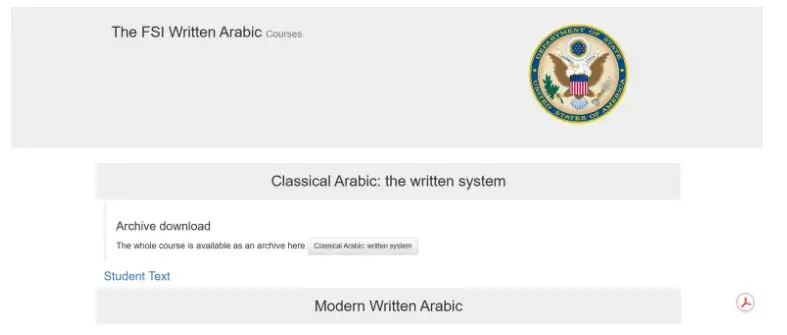
Each course comes with full textbooks you can download for free. The main course, Modern Written Arabic, has more than 60 lessons with audio. It teaches you to read the formal Arabic used in news, books, and speeches.
A short starter course on the Arabic writing system comes first, so you learn the letters before you read. If you want a quick overview before you begin, this guide on how many letters are in the Arabic alphabet explains the basics in simple English.
FSI doesn’t teach grammar through long lists of rules. Instead, you read and hear short sentences, then practise them in exercises. Step by step, you see the same patterns again and again. This way, the grammar slowly becomes a habit.
The courses do have weak spots. The audio is full of drills and can feel slow. The pages look like old typed copies, and a few audio files are missing. The lessons also stay the same no matter how fast or slow you learn.
FSI works best if you prefer lessons in English and want to read formal Arabic with audio support.
2. Al-Ajurrumiyyah: A Free Self-Study Arabic Grammar Course
Al-Ajurrumiyyah has been the first grammar course for Arabic students for about 700 years. It was written by Ibn Ajurrum, a scholar from Morocco who died in 1323. Today, you can study it for free online, with no sign-up and no fees.
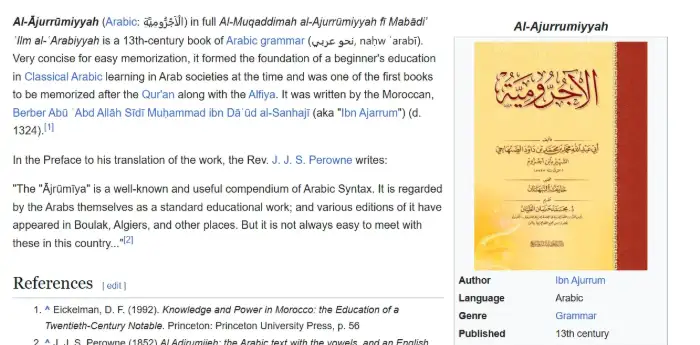
Start with the free audio recording on LibriVox. It reads the full Arabic text aloud, along with an English translation first published in 1852. The whole recording runs about one hour and is split into short parts, so you can listen to a few chapters at a time.
For a teacher’s explanation in English, read this free explanation of Al-Ajurrumiyyah. It is based on the notes of Ahmad bin Zayni Dahlan, a well-known scholar and former mufti of Makkah. It walks through the rules one at a time, in plain English.
The text is split into short chapters, and each one works as a lesson. You start with the three kinds of words. Next, you learn the signs that show a word’s role in a sentence. Then you move on to the main rules for nouns and verbs.
To take it as a course, study one chapter at a time. Listen to the audio, read along in the text, and use the English explanation when you get stuck. Then write two or three example sentences for each rule before you move on.
Pick this course if you can read Arabic and want the same grammar path scholars have followed for centuries.
If your goal is the Quran, this guide to the best books to learn Quranic Arabic shows what to read next, ranked by level.
3. An-Nahw Al-Wadih: A Free Self-Study Grammar Course Built On Examples
An-Nahw Al-Wadih means “Clear Grammar.” It was written by Ali Al-Jarim and Mustafa Amin, two Egyptian experts, for school students in Egypt. The book is written in Arabic. Many school and public libraries keep copies, so you can often borrow it for free. Printed copies are also cheap if you’d rather own one.
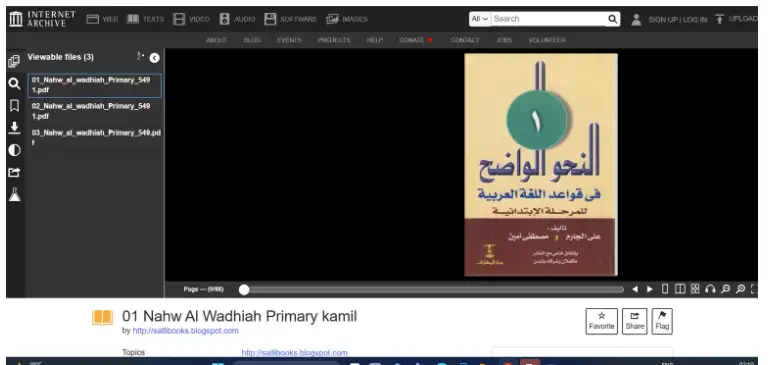
The series comes in two sets. The first set has three books for primary school. The second set has three books for secondary school. You can start with the first primary book and move up one book at a time as your grammar grows.
Each lesson follows the same simple shape. It starts with a few example sentences. Then it gives the rule in plain words. It ends with exercises so you can practise right away. Because you see the rule in use before you read it, it makes sense faster.
This clear method is why the book is used in schools far beyond Egypt, including by learners whose first language isn’t Arabic.
Its early lessons cover rules you will use every day, such as how nouns change for male and female. This guide to masculine and feminine nouns in Arabic explains that rule in English with clear examples.
To take it as a course, study one lesson a day. Read the examples aloud, learn the rule, and then do every exercise in writing.
The main weak spot is checking your answers. Not every lesson comes with an answer key, so you may not always know if your work is right. Pick An-Nahw Al-Wadih if you can read Arabic and learn best from examples and practice.
Step Inside Our Classrooms
Don’t just take our word for it—see our community in action. Click below to watch real, live snippets from our recent classes and experience our engaging teaching style firsthand!
Master Arabic in the UAE
Experience world-class Arabic language training designed for students and professionals in the Emirates.
Book Your Free TrialFree Tools That Help You Practise Arabic Grammar
A course or a book teaches you the rules. Practice tools help you keep them in your memory. Two free tools are worth adding to any study plan.
The first is Quran.com. It shows the full Quran with every vowel marked. It also lets you listen to many reciters. This makes it a great place to see grammar in real sentences.
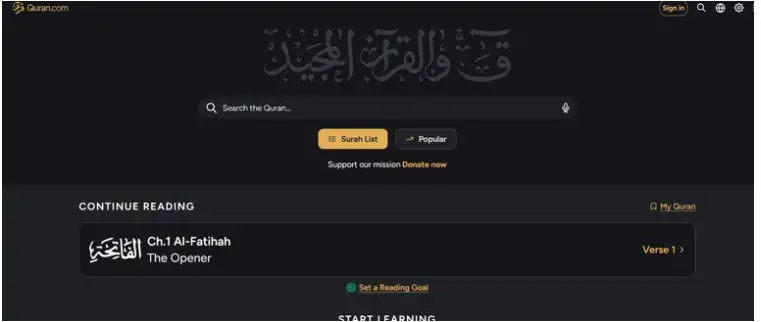
For example, look at Surah Al-Fatihah (1:2). It begins with al-hamdu lillah. The word al-hamdu ends with a “u” sound because it is the main subject of the sentence. You can find patterns like this on every page.
The second tool is Anki, a free flashcard app. Anki doesn’t teach you grammar. Instead, it helps you remember the grammar you learn from your course. It does this by showing you each card again just before you are likely to forget it.
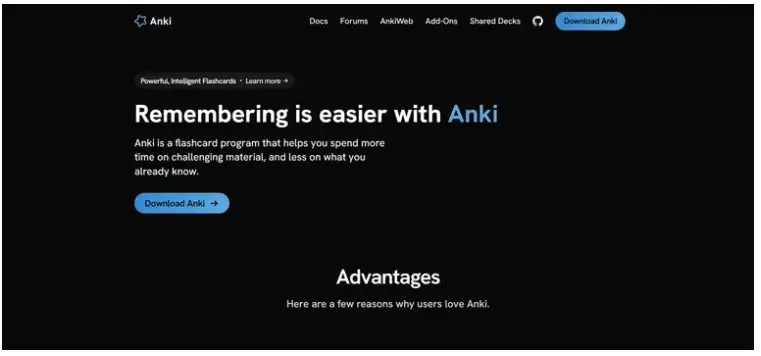
You can make cards for anything you want to keep in your head. For example, put a word on the front, like kātib, and its pattern and meaning on the back: “fāʿil, writer.”
You can also make cards for case endings, verb forms, and short example sentences. Anki works with Arabic letters and audio, so you can add vowels and recordings too.
You can also download free card sets that other learners have shared. Check them before you study, though, because some have mistakes in the vowels.
Anki is free on computers, Android phones, and the web. The iPhone app costs a one-time fee. Ten minutes of review each day works far better than one long session each week.
Free Arabic Grammar Options Compared Side By Side
Each free option helps with a different part of Arabic grammar. The table below shows what each one is, who it suits, and what it is missing.
| Free Option | What It Is | Language | Best For | What It Lacks |
| FSI Arabic courses | Full course with books and audio | English | Reading formal Arabic with audio | Old design, same pace for all |
| Al-Ajurrumiyyah | Short classic grammar book | Arabic | The path scholars took | Needs a guide to explain it |
| An-Nahw Al-Wadih | School grammar series | Arabic | Learning from examples and exercises | No answer key for every lesson |
| Quran.com | Quran text with vowels and audio | Arabic with English translation | Seeing grammar in real sentences | Not a course |
| Anki | Flashcard app | Any language | Remembering rules and patterns | You make the cards yourself |
If you’re new to Arabic, start with FSI, since it is the only full course here taught in English. Once you can read Arabic with vowels, move on to Al-Ajurrumiyyah or An-Nahw Al-Wadih, depending on whether you prefer a classic text or lots of exercises.
Keep Quran.com and Anki alongside whichever course you choose, because they help you practise and remember what you learn.
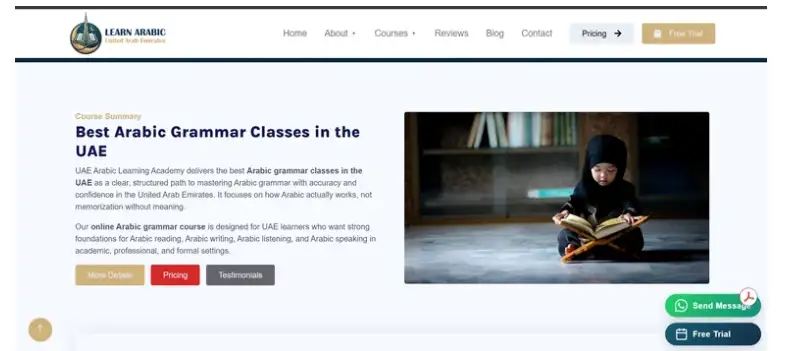
If you’d like a teacher to guide you through these rules in order, the Arabic grammar classes at UAE Arabic Learning Academy take you from the basics one level at a time.
What A Free Arabic Grammar Course Should Teach You
Arabic grammar has two main parts. Nahw explains how words work inside a sentence. Sarf explains how each word is built. A good course teaches both.
Nahw: How Words Work In A Sentence
Nahw is the study of how words act in a sentence and how their endings change. Look at the sentence kataba al-ṭālibu al-darsa. It means “The student wrote the lesson.”
The word for “student” ends with a “u” sound. That is because the student is the one doing the action. The word for “lesson” ends with an “a” sound. That is because the lesson is the thing receiving the action.
Arabic nouns have three main endings. A “u” ending (called rafʿ) is often used for the doer. An “a” ending (called naṣb) is often used for the thing an action happens to. An “i” ending (called jarr) often comes after small words like “in” or “on.”
Some words show their role in other ways. For example, a word that means “two of something” ends in -āni in the rafʿ position. It ends in -ayni in naṣb and jarr.
Working out each word’s job and ending is called iʿrāb. In English, we call it parsing.
Verbs follow rules too, and their form changes with time. This guide to tenses in Arabic shows how past, present, and future verbs are built.
Sarf: How Arabic Words Are Built
Sarf is the study of how Arabic words are made. Most Arabic words come from a root of three letters. The root holds the basic meaning. Set patterns then add to that meaning.
Take the root k-t-b, which is linked to writing. Put it into the pattern fāʿil, and you get kātib, which means “writer.” Put it into mafʿūl, and you get maktūb, which means “written.” Put it into mafʿal, and you get maktab, which means “office” or “desk.”
Once you know a few patterns, you can guess the meaning of many new words. You can also tell quickly if a word is a noun or a verb.
This matters a lot for nahw. You can’t give a word the right ending until you know what kind of word it is. So learning nahw without sarf often turns into guessing.
The fix is simple. Learn a few common patterns early, even while you are still on your first grammar lessons. Five or six patterns are enough to start.
A Simple Free Study Plan For Arabic Grammar
Free lessons work best when you follow a clear order. This four-step plan shows you what to do first, what to do next, and how to know when you are ready to move on.
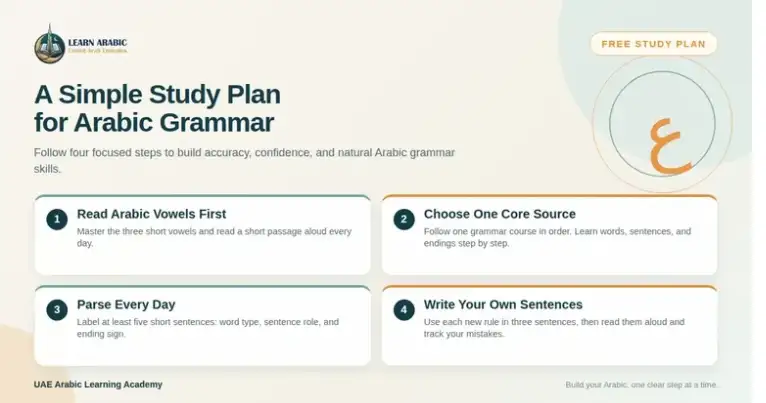
Step 1: Learn To Read Arabic Vowels First
In Arabic, grammar lives in the short vowels. If you can’t read those vowels, you can’t learn the rules that depend on them. So your first goal is to read words with vowels without stopping to think.
Start with the letters and the three short vowels. This guide to Arabic short vowels explains the fatḥa, ḍamma, and kasra with clear examples. Once you know them, read a few short lines out loud every day.
Here is an easy way to track your progress. Pick one short passage. Read it out loud each morning and time yourself. Write the time in a notebook.
Over a few weeks, your time should drop. You should also make fewer mistakes. When you can read the passage smoothly and correctly, you are ready for grammar.
Don’t rush this step. A learner who reads well moves through grammar much faster than a learner who still sounds out every word.
Step 2: Learn The Core Rules From One Source
Now choose one main source for grammar rules and finish it. Choose FSI if you prefer English and audio. Choose Al-Ajurrumiyyah or An-Nahw Al-Wadih if you can already read Arabic.
The biggest mistake here is jumping between sources. A learner starts four free courses and reads lesson one in each. Then they never reach lesson ten. Each source uses its own order and its own terms, so mixing them causes confusion.
Make one simple rule for yourself. You can only start a new source after you finish the one you are on. If something is unclear, you may look it up somewhere else. Then go straight back to your main source.
Learn the basics in this order. First, learn the three kinds of words. Next, learn the two kinds of sentences. Then learn the three endings. Leave long lists of advanced rules until later.
Step 3: Parse A Few Sentences Every Day
Reading lessons is not enough on its own. Grammar is a skill, and skills grow with practice. The best practice is parsing, which means labelling every word in a sentence.
A good rule is to parse at least five sentences for every hour of lessons. For each word, write down three things. Write its type (noun, verb, or small word). Write its job in the sentence. Then write the sign that shows its ending.
Short, clear sentences are best for this. Verses from Quran.com work well because every vowel is shown. A good first verse is Surah Al-Ikhlas (112:1), which has only four words
. You can also practise with everyday phrases, like the ones in this list of the 10 most used sentences in Arabic.
Keep all your parsed sentences in one notebook. After a month, look back at your first pages. You will spot mistakes you couldn’t see before. That is a clear sign of real progress.
Over time, you will also parse faster. Words you once had to think about will start to feel obvious.
Step 4: Use Each Rule In Your Own Sentences
The last step is to build your own sentences. Each time you learn a new rule, write three sentences that use it. Then read them out loud and say every ending clearly.
This step turns grammar from something you know into something you can use. It also shows your weak spots fast. You may know a rule on paper but forget it as soon as you speak.
Keep a short list of the mistakes you make most often. Check your sentences against the rule in your book before you read them aloud. Look at the list before each study session so you can watch for those mistakes.
Start with simple sentences about your day. For example, write about what you ate, where you went, or who you met. Then make them longer as you learn more rules.
Little by little, you will need your book less. That is the moment grammar starts to feel natural.
Where Free Arabic Grammar Study Falls Short
Free lessons can teach you a lot. Still, there are two things they can’t give you, and both affect how fast you improve.
No One Checks Your Mistakes
Free courses and books explain rules well. But they can’t hear you read, and they can’t look at your parsing. If you learn a rule the wrong way, nothing stops you.
This matters more in Arabic than in many other languages. One wrong vowel at the end of a word can change the meaning of a whole sentence.
If you repeat the same mistake for weeks, it turns into a habit. Habits are much harder to fix than new mistakes.
Some learners try to check their work with translation apps or AI chatbots. These can help you understand a rule again. But they often leave out vowels, or they give answers that are close but not quite right. A beginner can’t always tell the difference.
The best fix is to have a skilled reader look at your work, even for a short time each week. A few minutes of feedback can save you many hours of study in the wrong direction.
No Plan Built Around Your Goal
Free courses follow one fixed path for everyone. But learners have very different goals.
One person wants to understand the Quran. Another needs Arabic for work in the UAE. A parent may want to help a child do well in school exams.
Each goal needs a different focus. Quran readers need classical grammar and lots of reading with vowels. Workers need Modern Standard Arabic for emails and meetings. Students need the topics that come up on their school tests.
A free course can’t know which learner you are. So you may spend weeks on topics you don’t need. At the same time, you may skip the ones you do need.
A teacher can test your level, learn your goal, and plan lessons around both. If you want to compare the cost of guided lessons with your study time, look at the pricing plans at UAE Arabic Learning Academy. You can choose the number of lessons that fits your time and budget.

See Our Classroom Environment in Action
Experience a sneak peek into our live sessions. Watch the video below to see our specialized instructors interacting with students, breakdown complex texts, and cultivate an engaging, respectful learning environment.
Master Arabic in the UAE
Experience world-class Arabic language training designed for students and professionals in the Emirates.
Book Your Free TrialBook Your Free Trial Grammar Class At UAE Arabic Learning Academy
Learning grammar is easier with a teacher who knows your goal and guides each lesson. At UAE Arabic Learning Academy, you learn Arabic grammar step by step in live classes built just for you.
Here is what you get when you study with us:
- Native Arabic-speaking teachers, including tutors from Al-Azhar and teachers who have memorised the whole Quran.
- One-to-one lessons that move at your own speed and focus on your goal.
- Class times all day and night, so lessons fit around work or school.
- Lessons that match UAE school standards for students who want better grades.
- A certificate when you pass your final test.
- The choice to switch to a new tutor if the match doesn’t feel right.
- More than 10 years of experience teaching Arabic and Quran.
You can start with a free trial class. It costs nothing, and you don’t have to sign up for anything after it. Your tutor will check your level and suggest a clear plan for your goal.

Our Arabic courses
Grammar is only one part of what we teach. Our Arabic courses also cover reading, writing, speaking, Modern Standard Arabic, Quranic Arabic, and Business Arabic, with classes for kids, adults, and complete beginners.
- Arabic Grammar Course
- Arabic Course in the UAE
- Arabic Speaking Classes
- Arabic Intensive Course
- Arabic Classes for Beginners (Learn Arabic from Scratch)
- Self-Paced Arabic Course
- Arabic Speaking Classes
- Learn to Write Arabic Course
Conclusion
Learning Arabic grammar for free is possible, and the best path depends on who you are. Here is a quick way to choose where to begin.
If you are new to Arabic and prefer English, start with the FSI Arabic courses. They give you full lessons and lots of audio, so you can build your reading, listening, and grammar together.
If you can already read Arabic and want to understand the Quran, start with Al-Ajurrumiyyah. Pair it with daily reading on Quran.com, so you see every rule inside real verses.
If you learn best by doing exercises, start with An-Nahw Al-Wadih. Its clear examples and practice at the end of each lesson will keep you moving.
If you have only a few minutes a day, pick one course and pair it with Anki. Ten minutes of flashcards each day will keep the rules fresh in your mind. Add longer lessons when you have more time.
No matter which path you pick, keep both parts of grammar in mind. Nahw shows you how each word works in a sentence. Sarf shows you how words are built. Together, they help you read with confidence instead of guessing.
FAQs
Many learners have the same questions before they start learning Arabic grammar. Here are short, clear answers to the ones we hear most often.
Is Arabic Grammar Hard To Learn?
Arabic grammar is hard at first, but it follows clear rules. Most of its patterns repeat often. Once you learn the three endings and a few word patterns, it gets much easier.
Can I Learn Arabic Grammar For Free If I Can’t Read Arabic Yet?
Yes, but you need to learn to read the Arabic letters and vowels first. FSI is the best free starting point because it teaches in English. You can begin grammar once you read short lines smoothly.
How Long Does It Take To Learn Basic Arabic Grammar?
Most learners understand basic Arabic grammar after a few months of daily study. The exact time depends on how well you read and how often you practise. Short daily sessions work better than long weekly ones.
How Many Minutes A Day Should I Study Arabic Grammar?
Twenty to thirty minutes a day is enough for steady progress. Spend part of it on new rules and part on practice. Even ten minutes of review is better than skipping a day.
Should I Learn Arabic Grammar Or Speaking First?
It depends on your goal. If you want to read the Quran or books, start with grammar. If you mostly need to talk with people, start with speaking and add grammar step by step.
Is Quranic Arabic Grammar Different From Modern Arabic Grammar?
No, the core grammar is the same. Quranic Arabic and Modern Standard Arabic share the same endings and word patterns. Quranic Arabic uses more classic words and some older sentence styles.
Do Free Arabic Grammar Courses Give Certificates?
Most fully free Arabic grammar options don’t give certificates. FSI and the classic books are for learning, not for formal proof. If you need a certificate, choose a programme that tests your level first.
Can Children Use Free Arabic Grammar Courses?
Children can use some free tools, but most free grammar courses are made for adults. Kids learn best with short lessons, games, and lots of examples. A teacher who works with children can adjust the pace for them.



Leave a Reply