 Learn Arabic
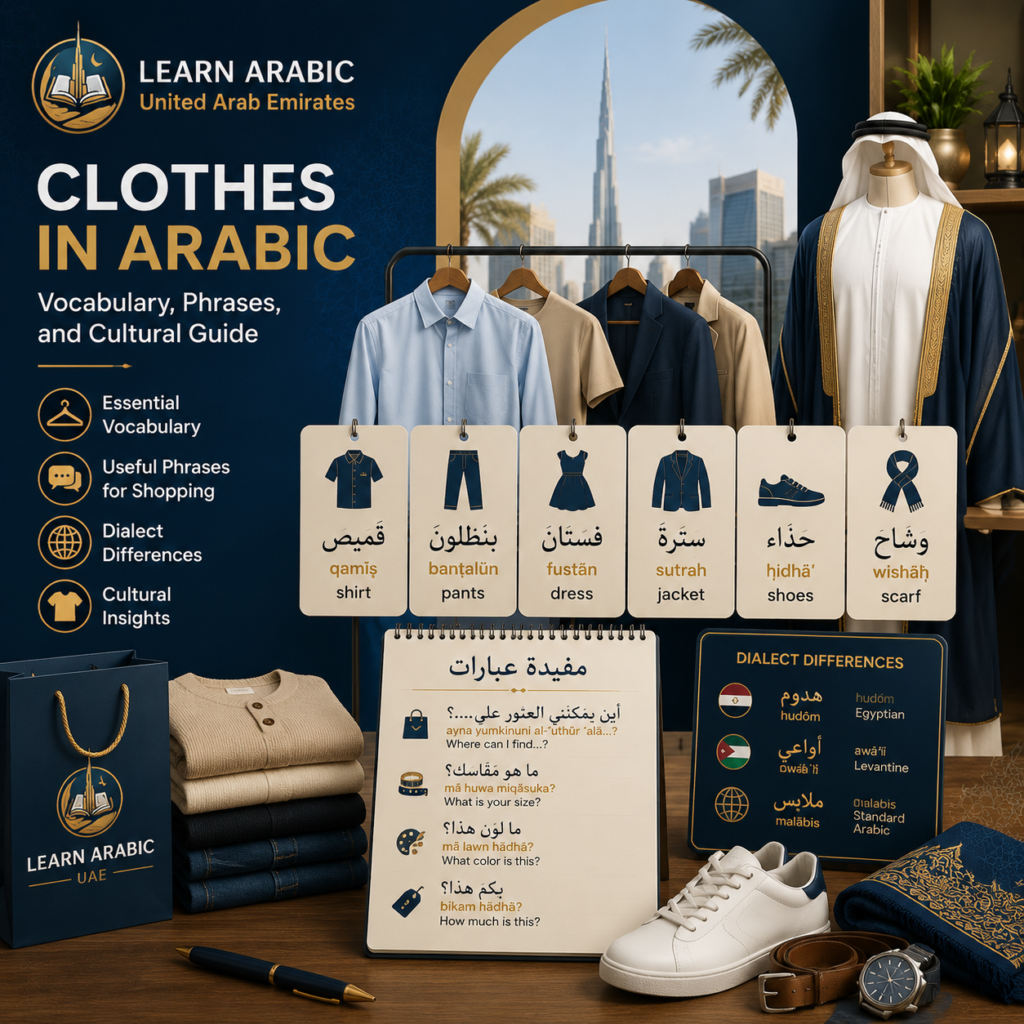
You walk into a clothing store in Dubai, point at a shirt, and the salesperson asks something in Arabic. You smile and nod — but you have no idea what they said. Sound familiar? Learning clothes in Arabic is one of the most practical vocabulary topics you can tackle, and it pays off immediately in shopping, travel, and everyday conversation.
This guide covers everything: the Arabic word for clothes, common garments, traditional dress, dialect differences, shopping phrases, and the grammar rules that trip up most learners.
How Do You Say Clothes in Arabic?
The most common word for clothes in Arabic is ملابس (malābis). You will also hear ثياب (thiyāb), which carries a slightly more formal or classical feel and appears frequently in Quranic and literary Arabic.
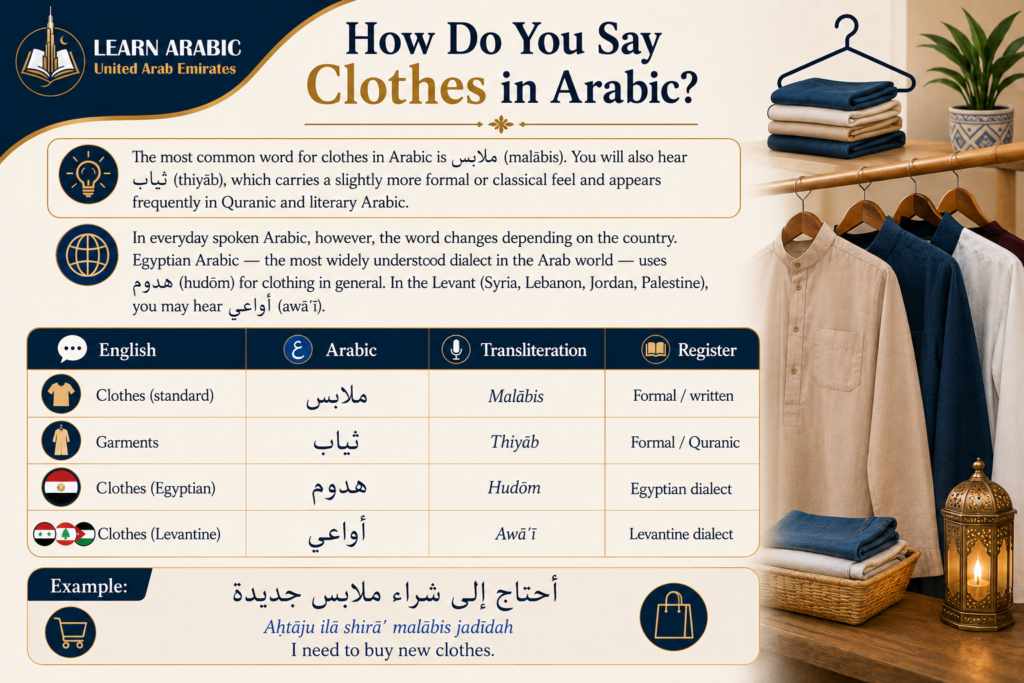
In everyday spoken Arabic, however, the word changes depending on the country. Egyptian Arabic — the most widely understood dialect in the Arab world — uses هدوم (hudōm) for clothing in general. In the Levant (Syria, Lebanon, Jordan, Palestine), you may hear أواعي (awāʿī).
| English | Arabic | Transliteration | Register |
| Clothes (standard) | ملابس | Malābis | Formal / written |
| Garments | ثياب | Thiyāb | Formal / Quranic |
| Clothes (Egyptian) | هدوم | Hudōm | Egyptian dialect |
| Clothes (Levantine) | أواعي | Awāʿī | Levantine dialect |
Example:
أحتاج إلى شراء ملابس جديدة Aḥtāju ilā shirāʾ malābis jadīdah — I need to buy new clothes.
The practical rule: use ملابس in any formal or written context, and adjust to the local dialect word once you know who you’re speaking with. If you want to practice using these words in real conversation, Learn Arabic UAE’s Arabic Speaking Course builds exactly this kind of contextual fluency through live dialogue practice.
Build Your Arabic Speaking Skills with a FREE Trial Class

Essential Vocabulary for Describing Clothes in Arabic
Before jumping into specific garments, you need the descriptive words that appear in almost every clothing conversation. These are the words you use when shopping, complaining about a fit, or describing an outfit.
| English | Arabic | Transliteration |
| Fabric | قماش | Qumāsh |
| Color | لون | Lawn |
| Size | مقاس | Miqās |
| New | جديد / جديدة | Jadīd / Jadīdah |
| Old | قديم / قديمة | Qadīm / Qadīmah |
Examples:
- ما هو مقاسك؟ — Mā huwa miqāsuka? — What is your size?
- هذا القماش ناعم جداً — Hādhā al-qumāsh nāʿim jiddan — This fabric is very soft.
- ما لون هذا القميص؟ — Mā lawn hādhā al-qamīṣ? — What color is this shirt?
One grammar point to learn early: the adjectives جديد and قديم change form based on the gender of the noun they describe. A masculine noun takes جديد; a feminine noun takes جديدة. So you say بنطلون جديد (new pants) but سترة جديدة (new jacket). This adjective-noun agreement pattern runs through all of Arabic clothing vocabulary.
Common Clothes in Arabic: The Words You’ll Use Every Day
These are the words that appear in shopping, daily conversation, Fusha Arabic texts, and Egyptian dialect alike.
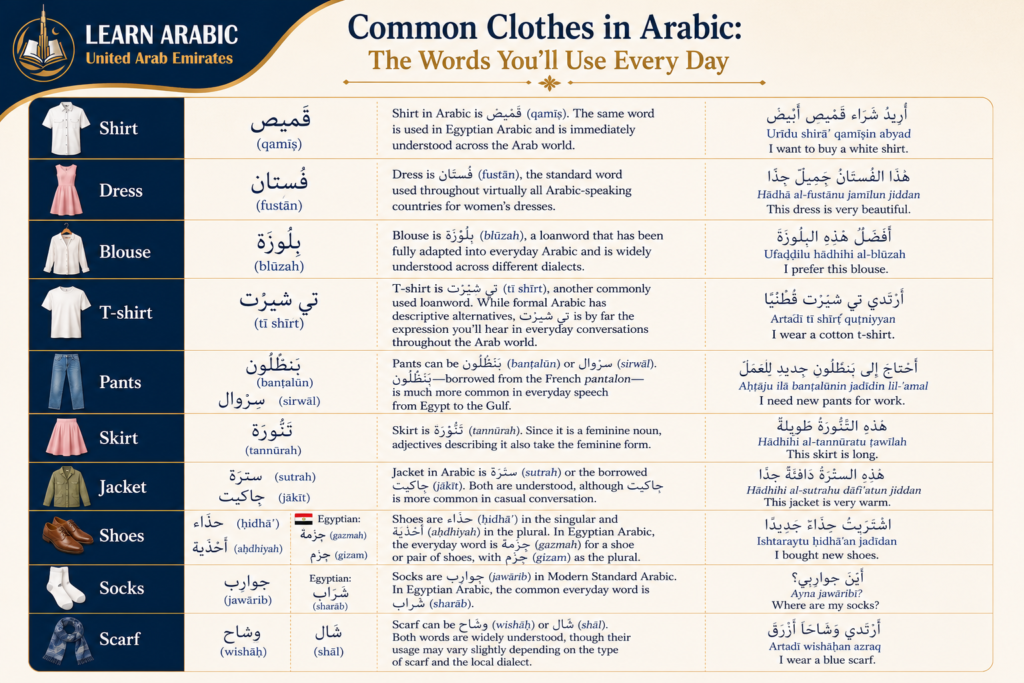
Shirt
Shirt in Arabic is قميص (qamīṣ). The same word is used in Egyptian Arabic and is immediately understood across the Arab world.
أريد شراء قميص أبيض — Urīdu shirāʾ qamīṣin abyaḍ — I want to buy a white shirt.
Dress
Dress is فستان (fustān), the standard word used throughout virtually all Arabic-speaking countries for women’s dresses.
هذا الفستان جميل جداً — Hādhā al-fustānu jamīlun jiddan — This dress is very beautiful.
Blouse
Blouse is بلوزة (blūzah), a loanword that has been fully adapted into everyday Arabic and is widely understood across different dialects.
T-shirt
T-shirt is تي شيرت (tī shīrt), another commonly used loanword. While formal Arabic has descriptive alternatives, تي شيرت is by far the expression you’ll hear in everyday conversations throughout the Arab world.
Pants
Pants can be بنطلون (banṭalūn) or سروال (sirwāl). بنطلون—borrowed from the French pantalon—is much more common in everyday speech from Egypt to the Gulf.
أحتاج إلى بنطلون جديد للعمل — Aḥtāju ilā banṭalūnin jadīdin lil-ʿamal — I need new pants for work.
Skirt
Skirt is تنورة (tannūrah). Since it is a feminine noun, adjectives describing it also take the feminine form.
هذه التنورة طويلة — Hādhihi al-tannūratu ṭawīlah — This skirt is long.
Jacket
Jacket in Arabic is سترة (sutrah) or the borrowed جاكيت (jākīt). Both are understood, although جاكيت is more common in casual conversation.
هذه السترة دافئة جداً — Hādhihi al-sutrahu dāfiʾatun jiddan — This jacket is very warm.
Shoes
Shoes are حذاء (ḥidhāʾ) in the singular and أحذية (aḥdhiyah) in the plural. In Egyptian Arabic, the everyday word is جزمة (gazmah) for a shoe or pair of shoes, with جِزَم (gizam) as the plural.
Socks
Socks are جوارب (jawārib) in Modern Standard Arabic. In Egyptian Arabic, the common everyday word is شراب (sharāb).
Scarf
Scarf can be وشاح (wishāḥ) or شال (shāl). Both words are widely understood, though their usage may vary slightly depending on the type of scarf and the local dialect.
See Our Classroom Environment in Action
Experience a sneak peek into our live sessions. Watch the video below to see our specialized instructors interacting with students, breakdown complex texts, and cultivate an engaging, respectful learning environment.
Master Arabic in the UAE
Experience world-class Arabic language training designed for students and professionals in the Emirates.
Book Your Free TrialComplete Clothing Vocabulary Chart
Use this quick-reference chart to review the essential Arabic words for clothing, footwear, and accessories. You’ll find both formal vocabulary and the everyday expressions native speakers use most often.
| English | Arabic | Transliteration |
| Clothes | ملابس | Malābis |
| Garments | ثياب | Thiyāb |
| Shirt | قميص | Qamīṣ |
| Dress | فستان | Fustān |
| Pants | بنطلون / سروال | Banṭalūn / Sirwāl |
| Skirt | تنورة | Tannūrah |
| Blouse | بلوزة | Blūzah |
| T-shirt | تي شيرت | Tī Shīrt |
| Sweater | كنزة / بلوفر | Kanzah / Bilōvar |
| Jacket | سترة / جاكيت | Sutrah / Jākīt |
| Coat | معطف | Miʿṭaf |
| Shorts | شورت | Short |
| Suit (male) | بدلة | Badlah |
| Suit (female) | تايير | Tayyīr |
| Tie | كرافتة | Karavattah |
| Shoes | حذاء / جزمة | Ḥidhāʾ / Gazmah |
| Socks | جوارب / شراب | Jawārib / Sharāb |
| Hat | قبعة | Qubbaʿah |
| Scarf | وشاح / شال | Wishāḥ / Shāl |
| Belt | حزام | Ḥizām |
| Gloves | قفازات | Qafāzāt |
| Bag | حقيبة | Ḥaqībah |
| Backpack | حقيبة ظهر | Ḥaqībat Ẓahr |
| Sandals | صندل | Ṣandal |
| Boots | بوت | Būt |
| Pajamas | بيجاما | Bijāmah |
| Swimsuit | بدلة سباحة | Badlat Sibāḥah |
| Tracksuit | بدلة رياضية | Badlah Riyāḍiyyah |
Traditional Arab Clothes in Arabic
Traditional Arab clothing is not just vocabulary — it carries cultural, religious, and regional identity. Knowing these words helps you understand conversations, news, and social contexts across the Arab world.
The Thobe — ثوب
The ثوب (thawb) is a long, loose garment worn by men across much of the Arab world. In the UAE and Gulf countries, it is often called كندورة (kandūrah). It is typically worn with a head covering called a غترة (ghutrah), held in place by an عقال (ʿiqāl) — the black cord seen on men throughout the Gulf.
The Abaya — عباية
The عباية (ʿabāyah) is a full-length outer garment worn by women across many Arab countries. Traditionally black, contemporary designs now appear in varied fabrics, colors, and cuts. It functions as both a modest outer layer and a fashion statement in modern Gulf culture.
The Hijab — حجاب
The حجاب (ḥijāb) is a headscarf worn by many Muslim women. It covers the hair and neck while leaving the face visible. Style, color, and fabric vary widely by country, culture, and personal preference. In Gulf Arabic, a light headscarf draped over the head and shoulders is specifically called a شيلة (shaylah).
The Jalabiya — جلابية
The جلابية (jalābiyyah) is a loose, long garment worn by men and women in Egypt, Sudan, and other parts of the Arab world. Simple versions serve daily wear; embroidered versions appear at celebrations.
The Bisht — بشت
The بشت (bisht) is a formal cloak worn by men over the thobe at weddings, graduation ceremonies, official meetings, and religious events. It is typically made from fine woven fabric with decorative embroidery along the edges — its presence immediately signals a formal occasion.
The Niqab — نقاب
The نقاب (niqāb) is a face covering worn by some Muslim women, leaving only the eyes visible. Its use varies significantly by country, community, and personal choice.
Understanding these garments at this level — not just the names but their social function — is the kind of cultural knowledge that makes Arabic feel like a living language rather than a word list.
Learn Arabic UAE’s Fusha Arabic course includes the cultural and formal vocabulary that connects classical usage to modern everyday Arabic.
Start Learning Fusha Arabic in the UAE with a FREE Trial Class Useful Arabic Phrases for Shopping for Clothes
Vocabulary alone won’t carry you through a real shopping situation. These phrases are the ones you will actually need, whether you’re in a mall in Riyadh, a market in Cairo, or a boutique in Beirut.
| English | Arabic | Transliteration |
| How much is this? | كم سعر هذا؟ | Kam siʿr hādhā? |
| I want a larger size. | أريد مقاساً أكبر | Urīdu miqāsan akbar |
| I want a smaller size. | أريد مقاساً أصغر | Urīdu miqāsan aṣghar |
| Do you have another color? | هل عندك لون آخر؟ | Hal ʿindaka lawn ākhar? |
| Can I try it on? | هل يمكنني تجربته؟ | Hal yumkinunī tajribatah? |
| This is expensive. | هذا غالي | Hādhā ghālī |
| This is suitable. | هذا مناسب | Hādhā munāsib |
| Where is the fitting room? | أين غرفة القياس؟ | Ayna ghurfat al-qiyās? |
| I’m looking for a dress. | أبحث عن فستان | Abḥathu ʿan fustān |
| Do you have this in black? | هل عندك هذا باللون الأسود؟ | Hal ʿindaka hādhā bil-lawn al-aswad? |
A practical note: the phrase أريد مقاساً أكبر (I want a larger size) uses the comparative form أكبر, meaning “bigger.” The comparative in Arabic is formed with the pattern أفعل — so أكبر (bigger), أصغر (smaller), أغلى (more expensive). Learn this pattern and you unlock dozens of useful comparisons in one step.
How to Say “I Am Wearing” in Arabic?
Knowing clothing words is one thing — being able to say what you’re wearing is another. Arabic uses the active participle form of the verb لبس (to wear) to describe current clothing.
- لابس (lābis) — wearing (masculine speaker or about a male)
- لابسة (lābsah) — wearing (feminine speaker or about a female)
Examples:
- أنا لابس بنطلون — Ana lābis banṭalōn — I am wearing pants. (masculine)
- أنا لابسة فستان — Ana lābsah fustān — I am wearing a dress. (feminine)
- أنا لابس جزمة زرقة — Ana lābis gazmah zarʾah — I’m wearing blue shoes. (Egyptian dialect, masculine)
The masculine/feminine distinction here is not optional — it tells the listener who is speaking or being described. This grammatical gender agreement is one of the first structural habits to build in Arabic.
Learn Arabic UAE’s Saudi Arabic Course covers Gulf dialect usage alongside standard Arabic structure, so learners develop both registers at once.
Begin Your Saudi Arabic Learning Journey with a FREE Trial Class

Common Mistakes When Using Arabic Clothing Vocabulary
Even after learning the words, many beginners make small grammar mistakes when talking about clothes in Arabic. Understanding these common errors will help you speak more naturally and avoid habits that are difficult to correct later.
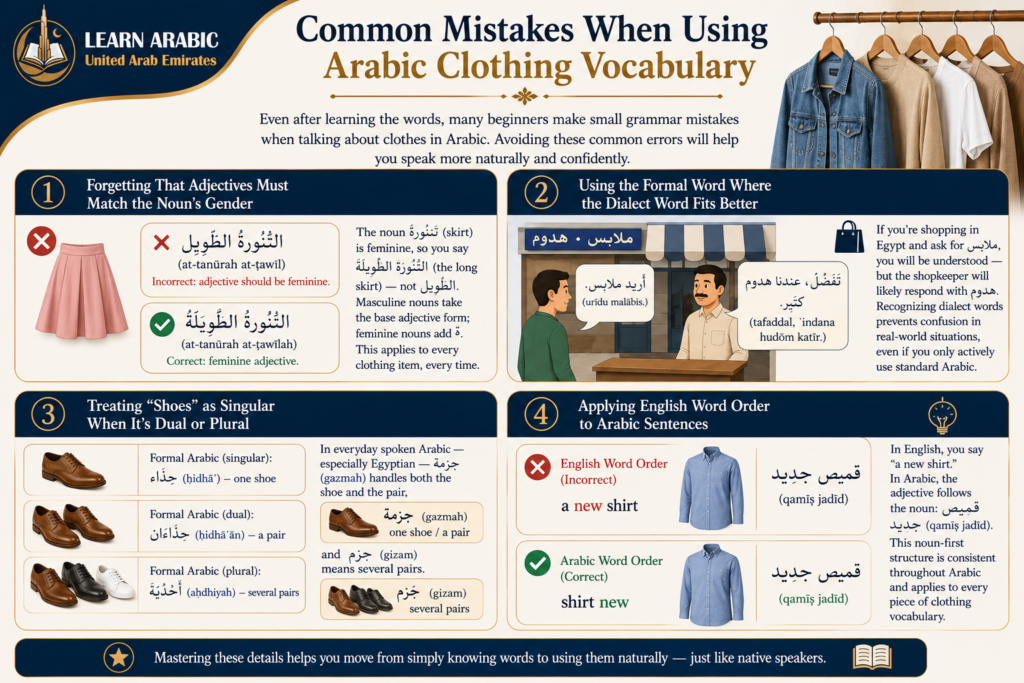
1. Forgetting That Adjectives Must Match the Noun’s Gender
The noun تنورة (skirt) is feminine, so you say التنورة الطويلة (the long skirt) — not الطويل. Masculine nouns take the base adjective form; feminine nouns add ة. This applies to every clothing item, every time.
2. Using the Formal Word Where the Dialect Word Fits Better
If you’re shopping in Egypt and ask for ملابس, you will be understood — but the shopkeeper will likely respond with هدوم. Recognizing dialect words prevents confusion in real-world situations, even if you only actively use standard Arabic.
3. Treating “Shoes” as Singular When It’s Dual or Plural
The word حذاء refers to a single shoe in formal Arabic. A pair is expressed as حذاءان (ḥidhāʾān) in formal Arabic, but in everyday spoken Arabic — especially Egyptian — جزمة (gazmah) handles both the shoe and the pair, and جزم (gizam) means several pairs. Memorize the colloquial alongside the formal.
4. Applying English Word Order to Arabic Sentences
In English, you say “a new shirt.” In Arabic, the adjective follows the noun: قميص جديد (qamīṣ jadīd). This noun-first structure is consistent throughout Arabic and applies to every piece of clothing vocabulary.
Step Inside Our Classrooms
Don’t just take our word for it—see our community in action. Click below to watch real, live snippets from our recent classes and experience our engaging teaching style firsthand!
Master Arabic in the UAE
Experience world-class Arabic language training designed for students and professionals in the Emirates.
Book Your Free TrialStart Speaking Arabic Confidently with Learn Arabic UAE
Memorizing a vocabulary list is a starting point, not a destination. What converts words into real communication is practice — using them in sentences, hearing them back, and getting corrected when you make the kinds of mistakes described above.
At Learn Arabic UAE, our native Arabic tutors teach you to use vocabulary like clothes, shopping phrases, and descriptive adjectives in actual spoken contexts — not just isolated drills.
- Live one-on-one and small group classes tailored to your level and goals
- Qualified native tutors with experience teaching Modern Standard Arabic and Gulf dialect
- Practical, conversation-focused curriculum covering vocabulary, grammar, and pronunciation together
- Courses for all ages and levels — from absolute beginners to advanced learners
- Free trial lesson — try a class before committing
Whether your goal is shopping confidently in the Gulf, understanding Saudi Arabic, or building a foundation in Fusha, we have a course that fits.
[Book your free trial lesson today →]

Our Arabic courses
- Arabic Course in the UAE
- Arabic Intensive Course
- Arabic Classes for Beginners (Learn Arabic from Scratch)
- Madinah Arabic Course
- Arabic Classes for Adults
- Self-Paced Arabic Course
- Arabic Speaking Classes
- Learn to Write Arabic Course
- Arabic Grammar Course
- Learn Arabic Alphabet Course
- Modern Standard Arabic (MSA) Course
- Quranic Arabic Course
- Fusha Arabic Course
- Classical Arabic Course
- Emirati Arabic Course
- Gulf Arabic Course
- Learn Saudi Arabic
- Business Arabic Course UAE
- Arabic Language Classes for Professionals in UAE
Master Arabic in the UAE
Experience world-class Arabic language training designed for students and professionals in the Emirates.
Book Your Free TrialConclusion
Clothes in Arabic is a vocabulary topic that pays off immediately in daily life. Start with the words you’ll use most: ملابس (malābis) for clothes in general, قميص (qamīṣ) for shirt, فستان (fustān) for dress, بنطلون (banṭalūn) for pants, حذاء or جزمة for shoes, and معطف (miʿṭaf) for coat.
Then add the cultural layer — ثوب, عباية, حجاب, and بشت — so that traditional Arab clothing vocabulary feels natural rather than foreign. Pair those words with the shopping phrases and the gender-agreement rules, and you have everything you need to navigate clothing conversations across the Arab world.
The next step is speaking. Vocabulary learned in context and practiced aloud moves from passive recognition to active use far faster than any word list alone can achieve.
Frequently Asked Questions
Here are answers to some of the most common questions learners ask about Arabic clothing vocabulary. These quick explanations will help reinforce what you’ve learned and clear up common points of confusion.
How do you say clothes in Arabic?
The standard Arabic word for clothes is ملابس (malābis), used in formal and written contexts. In Egyptian Arabic, the common word is هدوم (hudōm). In some Levantine dialects, you may hear أواعي (awāʿī). All three are correct in their respective registers.
What is the Arabic word for shirt?
Shirt in Arabic is قميص (qamīṣ). It is used across virtually all Arabic-speaking countries and dialects. For example, قميص جديد means “a new shirt.”
What is the Arabic word for dress?
Dress in Arabic is فستان (fustān). It refers to women’s dresses and is widely understood throughout the Arab world.
How do you say “I am wearing” in Arabic?
Use the active participle لابس (lābis) for a male speaker and لابسة (lābsah) for a female speaker. So: أنا لابس قميص (I am wearing a shirt, said by a man) and أنا لابسة فستان (I am wearing a dress, said by a woman).
What are traditional Arab clothes called in Arabic?
Traditional garments include ثوب (thawb) — the long men’s robe — عباية (ʿabāyah) for women, حجاب (ḥijāb) for the headscarf, جلابية (jalābiyyah), بشت (bisht) for the formal cloak, and عقال (ʿiqāl) for the cord that holds the men’s head covering in place.
Does clothing vocabulary differ between Arabic dialects?
Yes, significantly. Modern Standard Arabic uses ملابس for clothes, but Egyptian Arabic uses هدوم and Levantine dialects may use أواعي. For shoes, standard Arabic has حذاء while Egyptian dialect uses جزمة. Standard Arabic words are understood everywhere; dialect words help you sound natural with specific communities.
Related Articles
Learn Arabic

Leave a Reply