 Learn Arabic

Arabic is traditionally known as “the Language of Ḍād” (Lughat al-Ḍād), a name that reflects the distinctive status of the letter ض in Arabic linguistic tradition. That letter is ض (Ḍād) — and the Arabic language itself is traditionally called Lughat al-Ḍād (لغة الضاد), “the language of Ḍād,” because classical scholars considered this sound unique to Arabic among all world languages.
Whether you’re a beginner learning the Arabic alphabet, a student of Quranic recitation, or someone exploring the phonetics of Arabic, Ḍād is one of the most important — and most misunderstood — letters in the script.
Letter Ḍād (ض) in Arabic: Definition and Position
The ضLetter Dadh in Arabic – is the fifteenth letter of the Arabic alphabet in the modern hijā’ī (هجائي) order used in dictionaries and textbooks. In the older abjadī (أبجدي) sequence, it is the twenty-sixth letter and has a numerical value of 80.
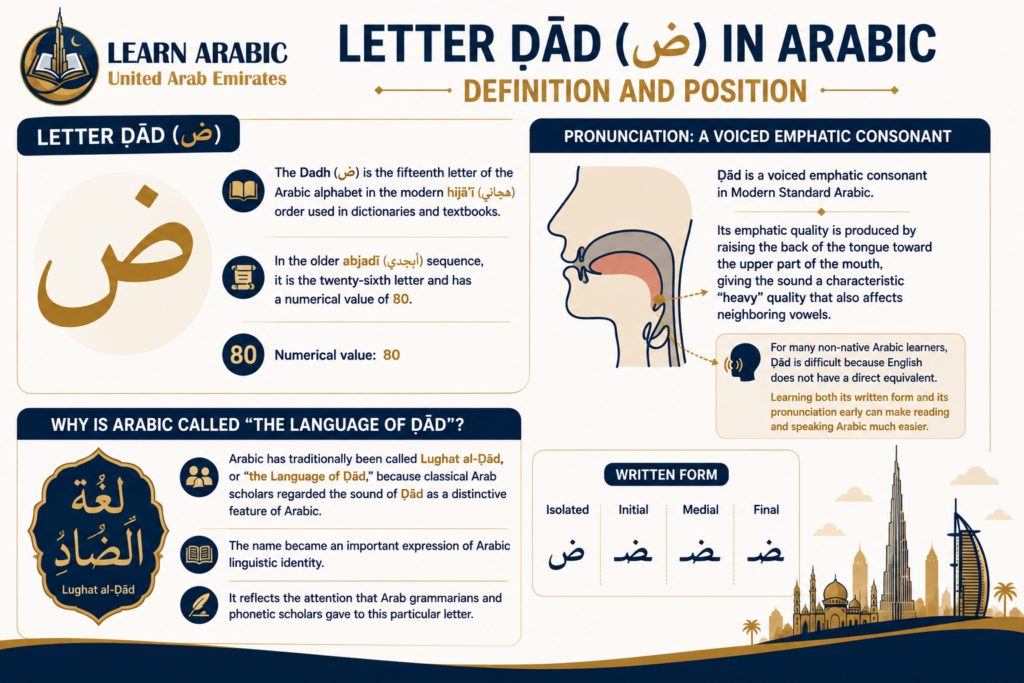
Ḍād is a voiced emphatic consonant in Modern Standard Arabic. Its emphatic quality is produced by raising the back of the tongue toward the upper part of the mouth, giving the sound a characteristic “heavy” quality that also affects neighboring vowels.
For many non-native Arabic learners, Ḍād is difficult because English does not have a direct equivalent. Learning both its written form and its pronunciation early can make reading and speaking Arabic much easier.
Why Is Arabic Called “the Language of Ḍād”?
Arabic has traditionally been called Lughat al-Ḍād, or “the Language of Ḍād,” because classical Arab scholars regarded the sound of Ḍād as a distinctive feature of Arabic.
The name became an important expression of Arabic linguistic identity and reflects the attention that Arab grammarians and phonetic scholars gave to this particular letter.
Read also: How to Learn Arabic in 7 Days in the UAE? – A Practical Day-by-Day Plan
How Is the Letter Ḍād (ض) Pronounced?
This is where Ḍād becomes genuinely complex — because it has two historically distinct pronunciations, and understanding the difference matters practically for anyone learning Quranic recitation.
Modern Standard Arabic Pronunciation
In Modern Standard Arabic (MSA) and in most contemporary spoken dialects — including Egypt, the Levant, Morocco, Algeria, and the Hejaz region of Saudi Arabia — Ḍād is pronounced as a voiced emphatic stop transcribed phonetically as /dˤ/. Think of it as a “heavy D” with the back of the tongue raised, producing a resonant, deep sound distinct from a plain /d/.
If your goal is to speak MSA fluently or communicate in formal Arabic contexts, this is the pronunciation you will be taught. Our Arabic Fusha (Modern Standard Arabic) courses cover this pronunciation in systematic detail from the foundational level.
Classical Arabic and Quranic Pronunciation
The original articulation of ضLetter Dadh in Arabic – the one described by the classical grammarians and used in Quranic recitation — is phonetically transcribed as /ɮˤ/: a voiced emphatic lateral fricative. This is an entirely different sound: the airflow passes along the sides of the tongue rather than stopping completely, producing a sound that has no equivalent in English or in modern colloquial Arabic.
The Prophet Muhammad (ﷺ) is reported to have articulated Ḍād from both sides of the tongue — a detail recorded by scholars of tajweed and confirmed by the classical grammarians including Sībawayhi (d. 180 AH), who located the articulation point at “the first edge of the tongue and the molars adjacent to it.”
This classical pronunciation is preserved in Quranic recitation and studied through the science of tajweed. It is one of the reasons tajweed instruction requires a qualified teacher — the sound must be heard, demonstrated, and corrected live, not learned from text alone.
For learners studying the Gulf dialect, this merger is a practical phonological feature to understand, not a mistake to correct. Our Gulf Arabic courses address regional pronunciation norms including this merger explicitly.

How to Pronounce Ḍād (ض) Step by Step?
If you’re learning Ḍād for the first time, don’t try to reproduce a complex phonetic description immediately. Start with the basic features and build the sound gradually.
Step 1: Start with the Voice
ضLetter Dadh in Arabic – is a voiced consonant. Your vocal cords should vibrate when you produce the sound.
You can check this by placing your fingers lightly against your throat while saying the sound. You should feel vibration.
Step 2: Add the Emphatic Quality
Raise the back of your tongue toward the upper part of the mouth while maintaining the voiced consonant.
The result should feel deeper and heavier than an ordinary د (dāl).
Step 3: Compare ض with د
Say:
د — ض
The first sound is a plain d. The second is the emphatic ḍ.
The goal is not simply to make the second sound louder. The difference comes from the place and shape of articulation and the emphatic quality of the consonant.
Step 4: Practice with Arabic Words
Once you can produce the sound by itself, practice it in familiar words:
- ضَرَبَ — ḍaraba — he struck
- ضَعِيف — ḍaʿīf — weak
- أَرْض — arḍ — earth / land
- رَضِيَ — raḍiya — he was pleased
- مَرِيض — marīḍ — sick
Start slowly, then gradually move toward normal speech.
Step 5: Practice the Classical Articulation Separately
If your goal is Quranic recitation, don’t assume that mastering the modern MSA pronunciation automatically gives you the classical tajweed articulation.
The classical articulation requires attention to the side of the tongue and the upper molars, and it is best learned through listening and direct correction from a qualified instructor.
Read also: Can I Learn Arabic in 3 Months in the UAE?
Step Inside Our Classrooms
Don’t just take our word for it—see our community in action. Click below to watch real, live snippets from our recent classes and experience our engaging teaching style firsthand!
Master Arabic in the UAE
Experience world-class Arabic language training designed for students and professionals in the Emirates.
Book Your Free TrialArticulation Point (Makhraj) of Ḍād
Classical scholars of Arabic phonetics — the science of makharij al-ḥurūf — were meticulous in locating exactly where each letter originates in the vocal tract.
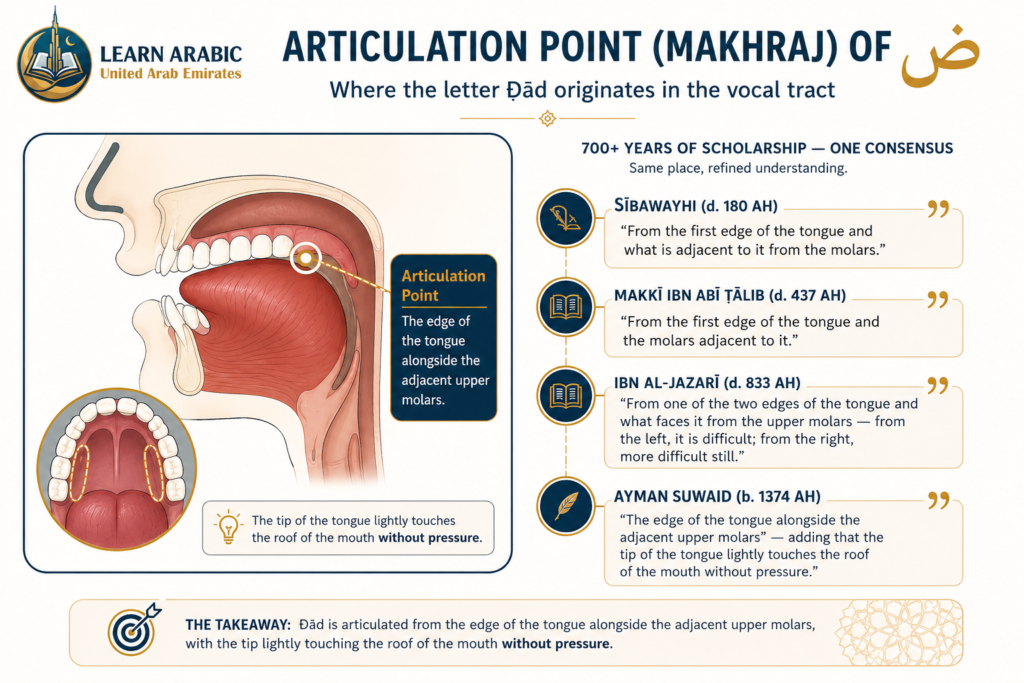
For Ḍād, the consensus across centuries of scholarship is remarkably consistent:
- Sībawayhi (d. 180 AH): “From the first edge of the tongue and what is adjacent to it from the molars.”
- Makkī ibn Abī Ṭālib (d. 437 AH): “From the first edge of the tongue and the molars adjacent to it.”
- Ibn al-Jazarī (d. 833 AH): “From one of the two edges of the tongue and what faces it from the upper molars — from the left, it is difficult; from the right, more difficult still.”
- Ayman Suwaid (b. 1374 AH): “The edge of the tongue alongside the adjacent upper molars” — adding that the tip of the tongue lightly touches the roof of the mouth without pressure, a detail absent from earlier descriptions.
The progression across these descriptions reveals something important: Ḍād’s articulation point was never disputed, but its precise mechanics continued to be refined over 700 years of scholarship. The addition by Ayman Suwaid about tongue-tip contact is the most practically useful detail for modern learners attempting to produce the classical sound correctly.
Read also: Diwani Arabic Calligraphy – History, Types, and Artistic Legacy
The Four Written Forms of Ḍād (ض)
Like all Arabic letters, ض changes shape depending on its position within a word. The four forms are:
| Position | Form | Example |
| Isolated | ض | — |
| Initial (word-beginning) | ضـ | ضَرَبَ (he struck) |
| Medial (word-middle) | ـضـ | رَضِيَ (he was satisfied) |
| Final (word-end) | ـض | رِياض (gardens) |
One key point for beginners: unlike letters such as ر, ز, and و, the letter ض connects on both sides — it joins to the letter before and after it in a word. This connecting behavior applies in both its initial, medial, and final forms.
If your goal is accurate Arabic pronunciation, particularly for formal Arabic or Quranic reading, structured phonetics training can help you hear and reproduce the distinction correctly. Our Arabic courses for adults include pronunciation practice for adult learners.

Arabic Words and Roots Containing Ḍād (ض)
Understanding a letter deeply includes knowing how it functions inside the Arabic root system. The ضLetter Dadh in Arabic – appears in dozens of high-frequency roots across Quranic and Modern Standard Arabic vocabulary.
| Root | Transliteration | Core Meaning | Common Words |
| ض-ر-ب | ḍ-r-b | To strike / to set an example | ضَرَبَ (he struck), يَضْرِبُ (he strikes), ضَرْب (striking) |
| ض-ع-ف | ḍ-ʿ-f | Weakness / doubling | ضَعِيف (weak), ضِعْف (double), ضَعُفَ (he became weak) |
| ر-ض-ي | r-ḍ-y | Satisfaction / contentment | رَضِيَ (he was satisfied), مَرْضِيّ (approved), رِضَا (contentment) |
| ف-ر-ض | f-r-ḍ | Obligation / to impose | فَرَضَ (he obligated), فَرْض (religious duty), مَفْرُوض (obligatory) |
| ض-م-ن | ḍ-m-n | Guarantee / to include | ضَمِنَ (he guaranteed), ضَمَان (guarantee), ضِمْن (within) |
| أ-ر-ض | ʾ-r-ḍ | Earth / ground | أَرْض (earth/land), أَرَاضِي (lands) |
| ض-ح-ك | ḍ-ḥ-k | Laughter | ضَحِكَ (he laughed), ضَحْكَة (a laugh), ضَحَّاك (someone who laughs much) |
| ح-ض-ر | ḥ-ḍ-r | Presence / attendance | حَضَرَ (he attended), حَاضِر (present), حُضُور (presence) |
| ع-ر-ض | ʿ-r-ḍ | To present / width | عَرَضَ (he presented), عَرْض (width/offer), عَارِض (presenting) |
| ف-ي-ض | f-y-ḍ | Abundance / overflow | فَاضَ (it overflowed), فَيْض (abundance), أَفَاضَ (he elaborated) |
Ḍād (ض) in the Quran
ضLetter Dadh in Arabic – appears in some of the most-recited Quranic vocabulary, including words every Muslim encounters daily in Salah:
- الضَّالِّين (al-ḍāllīn) — “those who have gone astray” — appears in Surah al-Fātiḥah, recited in every rakah of prayer
- وَضَرَبَ اللَّهُ مَثَلًا — “And Allah has set forth a parable” — a recurring Quranic formula
- رَضِيَ اللَّهُ عَنْهُمْ — “Allah is pleased with them” — appears multiple times in the Quran
The word الضَّالِّين alone makes correct Ḍād pronunciation a matter of daily Quranic accuracy: The word الضَّالِّين (al-ḍāllīn) appears in every recitation of Sūrat al-Fātiḥah, making correct Ḍād pronunciation especially important for Quranic recitation.
Common Mistakes Learners Make with Ḍād (ض)
Most errors with ض are predictable — and preventable with the right instruction.
Here are the four most common:
Mistake 1: Pronouncing ض as a Plain English “D”
The most frequent error among English speakers is treating ض like a standard /d/ sound. The result is a letter that sounds technically similar but lacks the emphatic quality that distinguishes it and darkens surrounding vowels. Native Arabic listeners will understand, but the pronunciation is incorrect and particularly problematic in Quranic recitation.
Fix: Focus on raising the back of the tongue toward the soft palate while producing the stop. Practice with words containing adjacent /a/ vowels — if the vowel sounds front and bright, the emphatic quality is missing.
Mistake 2: Confusing ض with ظ in Reading
Because both letters share a single dot above a curved or looped base, and because many learners encounter them close together in alphabetical study, visual confusion is extremely common in the early stages.
Fix: Learn the base shape families — ص/ض (rounded bowl) vs.
ط/ظ (looped vertical). Once the base shape is automatic, the dot placement is simple to process.
Mistake 3: Confusing ض with ظ in Writing
Learners who begin producing written Arabic sometimes reverse the two letters or use one shape where the other belongs, especially in medial and final forms where both letters appear compressed.
Fix: Trace the letter families separately in isolation before attempting connected writing. Write ten examples of ص → ض (adding the dot) before writing ten examples of ط → ظ (adding the dot), on separate days.
Mistake 4: Assuming Modern Pronunciation Is Sufficient for Quranic Recitation
Some learners — and some online resources — present the modern /dˤ/ pronunciation of ض as the only pronunciation, without mentioning that Quranic recitation involves a classically distinct articulation. This produces reciters whose Ḍād sounds acceptable in conversation but has not been properly trained for Quran.
Fix: If Quranic recitation is your goal, work with a tajweed-qualified instructor who can demonstrate the classical articulation in real time and provide live correction. No written description fully replaces hearing and producing the sound under qualified supervision.
See Our Classroom Environment in Action
Experience a sneak peek into our live sessions. Watch the video below to see our specialized instructors interacting with students, breakdown complex texts, and cultivate an engaging, respectful learning environment.
Master Arabic in the UAE
Experience world-class Arabic language training designed for students and professionals in the Emirates.
Book Your Free TrialMaster the Arabic Letter Ḍād with Expert Guidance
Learning Arabic pronunciation takes more than memorizing letters and sounds. At Learn Arabic UAE, our experienced instructors help adult learners build a strong foundation in Arabic phonetics, Modern Standard Arabic, and Gulf Arabic through practical, guided lessons tailored to different learning goals and levels.
Whether you want to improve your everyday Arabic, understand formal pronunciation, or develop more accurate Quranic recitation, structured practice can help you build confidence and avoid common pronunciation mistakes. With live instruction and personalized feedback, you can learn to recognize and produce challenging Arabic sounds like Ḍād more accurately.
Our Arabic courses
- Arabic Course in the UAE
- Arabic Intensive Course
- Arabic Classes for Beginners (Learn Arabic from Scratch)
- Madinah Arabic Course
- Arabic Classes for Adults
- Self-Paced Arabic Course
- Arabic Speaking Classes
- Learn to Write Arabic Course
- Arabic Grammar Course
- Learn Arabic Alphabet Course
- Modern Standard Arabic (MSA) Course
- Quranic Arabic Course
- Fusha Arabic Course
- Classical Arabic Course
- Emirati Arabic Course
- Gulf Arabic Course
- Learn Saudi Arabic
- Business Arabic Course UAE
- Arabic Language Classes for Professionals in UAE
Start your Arabic learning journey with Learn Arabic UAE

Master Arabic in the UAE
Experience world-class Arabic language training designed for students and professionals in the Emirates.
Book Your Free TrialConclusion
The letter Ḍād (ض) is more than a letter — it is the phonetic identity of the Arabic language itself. It sits at the fifteenth position in the modern alphabet, carries a numerical value of 80 in the abjad system, and gave Arabic its classical name: Lughat al-Ḍād.
Its pronunciation carries two distinct traditions — the modern /dˤ/ used in MSA and everyday speech, and the classical /ɮˤ/ preserved in Quranic recitation — each appropriate to its context. Its articulation point, debated and refined across 700 years of scholarship, remains one of the most precisely documented in the entire Arabic phonological tradition.
For learners, the practical priorities are clear: learn to recognize ض in all four written forms, understand the distinction from ظ in both shape and sound, and if Quranic recitation is your goal, seek live instruction for the classical pronunciation. No text alone can train the ear for Ḍād — it has to be heard.
Frequently Asked Questions About Letter Ḍād (ض) in Arabic
What is the ض Letter Dadh in Arabic?
ضLetter Dadh in Arabic – is the fifteenth letter of the Arabic alphabet in modern hijā’ī order and the twenty-sixth in the classical abjadī sequence. It is a voiced emphatic consonant with a numerical value of 80 in the abjad system, and it gave Arabic its traditional name Lughat al-Ḍād — the language of Ḍād.
How is ض pronounced in Modern Standard Arabic vs. Quranic Arabic?
In Modern Standard Arabic, ض is pronounced as /dˤ/ — a voiced emphatic stop, similar to a heavy “D.” In Quranic recitation following classical rules, it is pronounced as /ɮˤ/ — a voiced emphatic lateral fricative where air passes along the sides of the tongue. The two sounds are phonetically distinct and require separate training.
What is the articulation point (makhraj) of ض?
The makhraj of ض is the first lateral edge of the tongue against the upper molars. Most reciters produce it from the left side; production from the right side is rarer and considered more difficult. Ibn al-Jazarī documented this asymmetry in the 9th century AH, and it remains the standard description in tajweed scholarship today.
What is the difference between ض and ظ?
In writing, ض has a rounded bowl base (shared with ص) plus one dot above, while ظ has a looped vertical base (shared with ط) plus one dot above. In classical pronunciation, ض is produced at the lateral edge of the tongue against the upper molars, while ظ is produced at the tip of the tongue against the upper front teeth. In many Gulf and Iraqi dialects, both letters have merged into a single sound /ðˤ/.
Why is Arabic called “the language of Ḍād”?
Classical Arab grammarians called Arabic Lughat al-Ḍād because they considered the Ḍād sound exclusive to Arabic — no other known language contained this articulation in its phonological system. The name became a marker of Arabic’s distinctiveness and, by extension, a symbol of its status as the language of the Quran.
Can I learn the correct pronunciation of ض on my own?
Letter recognition and the modern MSA pronunciation of ض can be developed independently with structured study. The classical Quranic pronunciation, however, requires live instruction — the /ɮˤ/ sound has no equivalent in English and must be demonstrated and corrected by a qualified teacher. Self-study alone consistently produces inaccurate articulation that becomes habitual and difficult to correct later.




Leave a Reply