 Learn Arabic
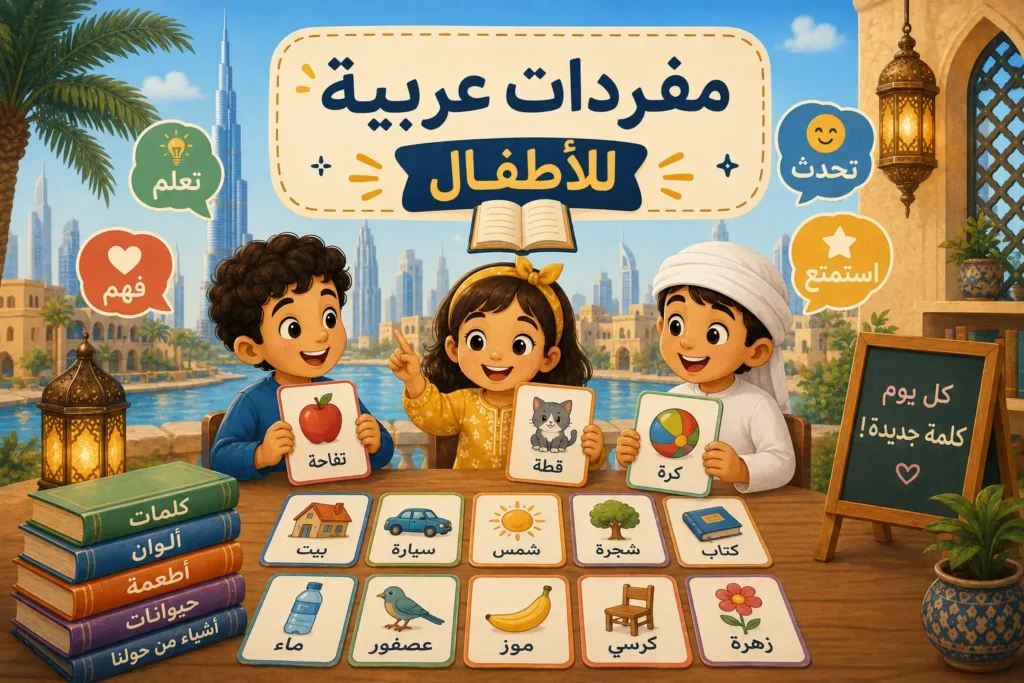
Most children who struggle with Arabic don’t struggle because the language is too hard. They struggle because they were handed too many words at once, in the wrong order, with no connection to their actual lives.
Arabic vocabulary for kids works differently when it’s organized — not by alphabet order or textbook chapter, but by the things a child sees, touches, and talks about every single day.
This guide takes a different approach. Rather than giving you a flat list of 100 words and wishing you luck, it breaks Arabic vocabulary into 10 focused word groups that build on each other logically, with practical retention strategies and age-by-age guidance woven throughout.
1. Greetings And Everyday Expressions One Of The Essential Arabic Vocabulary for Kids
Before nouns and numbers comes the social glue of any language — the phrases children hear and use dozens of times a day. Starting here gives kids an immediate sense of accomplishment because they can actually use what they’ve learned from day one.
| Arabic | Transliteration | English |
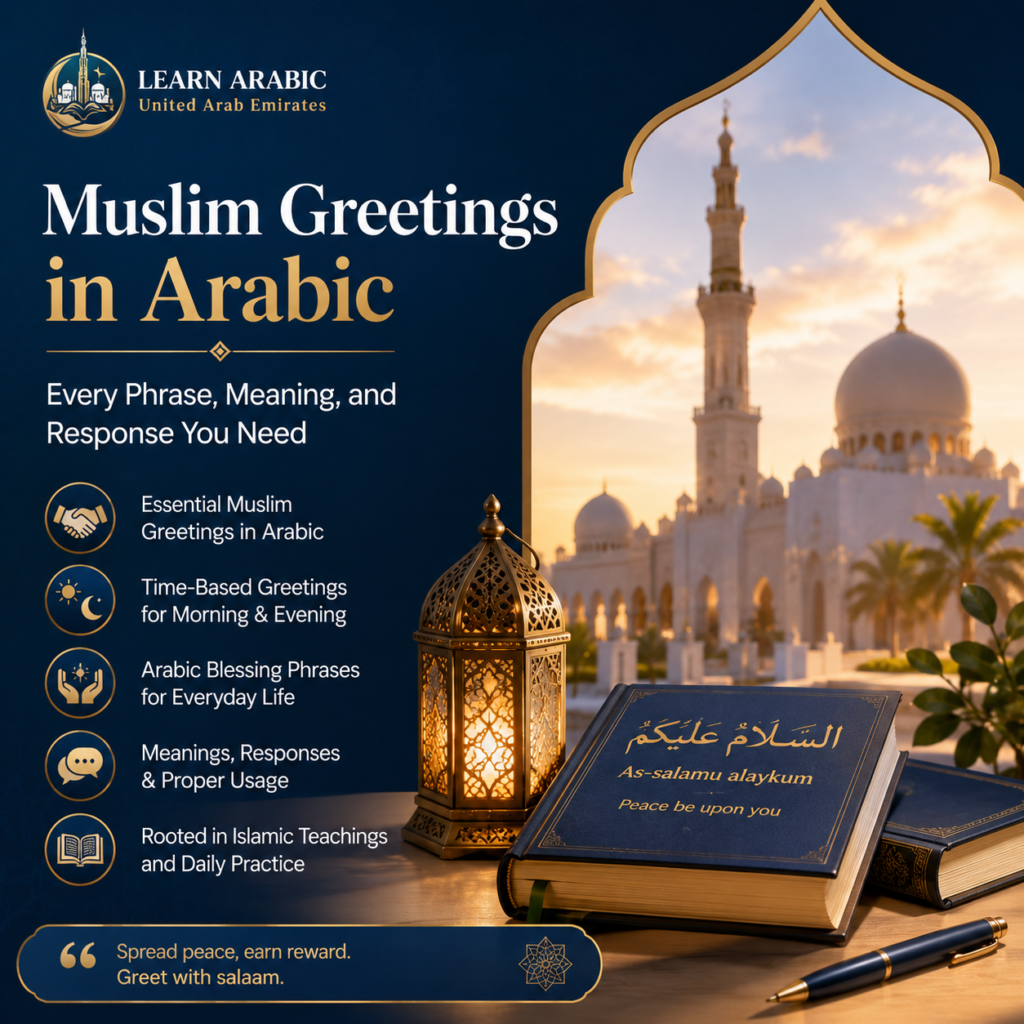
| السلام عليكم | As-salamu alaykum | Peace be upon you |
| مَرْحَبًا | Marhaban | Hello |
| صَبَاحُ الخَيْر | Sabahul khayr | Good morning |
| مَسَاءُ الخَيْر | Masa’ul khayr | Good evening |
| شُكْرًا | Shukran | Thank you |
| مِنْ فَضْلِك | Min fadlik | Please |
| آسِف | Aasif | Sorry |
| إِلَى اللِّقَاء | Ila al-liqa’ | Goodbye |
Don’t just recite these — use them. Make a family rule that greetings at home happen in Arabic, even just for a week. Children who hear Sabahul khayr every morning without fail will internalize it without a single flashcard.
Start speaking Arabic with a FREE trial session

2. Family Members In Arabic
Family words are among the first vocabulary any child needs, because family members are the most recurring characters in a child’s world. These words also introduce children to the Arabic pattern of masculine and feminine word pairs — أَب (father) and أُمّ (mother) being the clearest example.
| Arabic | Transliteration | English |
| أَب | Ab | Father |
| أُمّ | Umm | Mother |
| أَخ | Akh | Brother |
| أُخْت | Ukht | Sister |
| جَدّ | Jadd | Grandfather |
| جَدَّة | Jadda | Grandmother |
| عَمّ | Amm | Paternal uncle |
| خَالَة | Khala | Maternal aunt |
Understanding family members in Arabic also opens the door to simple possessive sentences — “هَذَا أَبِي” (Hatha abi — “This is my father”) — which moves children from vocabulary into real communication surprisingly quickly.
Step Inside Our Classrooms
Don’t just take our word for it—see our community in action. Click below to watch real, live snippets from our recent classes and experience our engaging teaching style firsthand!
Master Arabic in the UAE
Experience world-class Arabic language training designed for students and professionals in the Emirates.
Book Your Free Trial3. Colors In Arabic
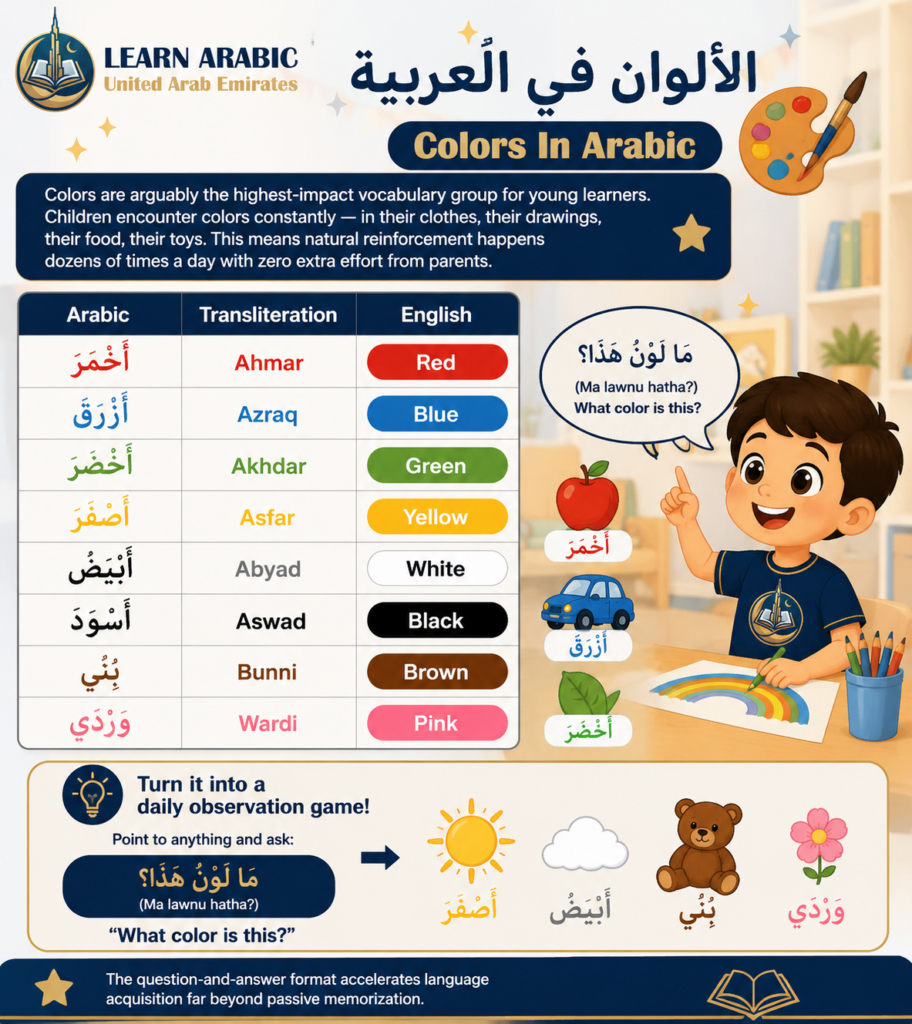
Colors are arguably the highest-impact vocabulary group for young learners. Children encounter colors constantly — in their clothes, their drawings, their food, their toys. This means natural reinforcement happens dozens of times a day with zero extra effort from parents.
| Arabic | Transliteration | English |
| أَحْمَر | Ahmar | Red |
| أَزْرَق | Azraq | Blue |
| أَخْضَر | Akhdar | Green |
| أَصْفَر | Asfar | Yellow |
| أَبْيَض | Abyad | White |
| أَسْوَد | Aswad | Black |
| بُنِّي | Bunni | Brown |
| وَرْدِي | Wardi | Pink |
Once a child knows five or six colors, turn it into a daily observation game. Point to anything and ask: “مَا لَوْنُ هَذَا؟” (Ma lawnu hatha? — “What color is this?”). The question-and-answer format accelerates language acquisition far beyond passive memorization.
4. Numbers 1–10 In Arabic
Numbers unlock an entirely new dimension of the language — counting objects, ages, prices, and quantities. More importantly, Arabic numbers from 1 to 10 are genuinely learnable in a single week of short daily practice.
| Arabic | Transliteration | English |
| وَاحِد | Wahid | One |
| اِثْنَان | Ithnan | Two |
| ثَلَاثَة | Thalatha | Three |
| أَرْبَعَة | Arba’a | Four |
| خَمْسَة | Khamsa | Five |
| سِتَّة | Sitta | Six |
| سَبْعَة | Sab’a | Seven |
| ثَمَانِيَة | Thamaniya | Eight |
| تِسْعَة | Tis’a | Nine |
| عَشَرَة | Ashara | Ten |
Counting games work beautifully here — stairs, apples in a bowl, cars on the street. Any repeated counting activity done in Arabic turns a vocabulary lesson into a reflex.
5. Animals In Arabic
Animals captivate children in every language and culture, making this group naturally motivating. The vocabulary is also phonetically diverse, which helps children practice a broader range of Arabic sounds than the earlier groups cover.
| Arabic | Transliteration | English |
| قِطَّة | Qitta | Cat |
| كَلْب | Kalb | Dog |
| أَسَد | Asad | Lion |
| فِيل | Feel | Elephant |
| قِرْد | Qird | Monkey |
| أَرْنَب | Arnab | Rabbit |
| سَمَكَة | Samaka | Fish |
| طَائِر | Ta’ir | Bird |
| بَقَرَة | Baqara | Cow |
| دَجَاجَة | Dajaja | Chicken |
Illustrated animal books, cartoon clips, and zoo visits all naturally reinforce this group without any formal study session required. A child who can name ten animals in Arabic and use them in a simple sentence — “هَذَا أَسَد” (Hatha asad — “This is a lion”) — has already moved well beyond basic vocabulary.
Master Arabic in the UAE
Experience world-class Arabic language training designed for students and professionals in the Emirates.
Book Your Free Trial6. Fruits and Food In Arabic
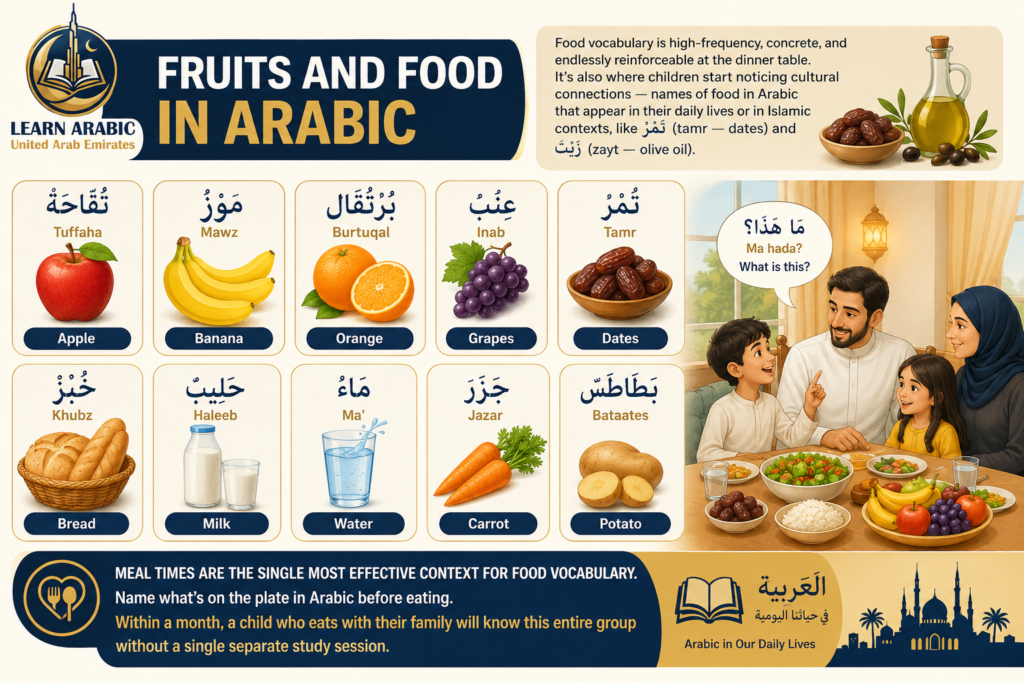
Food vocabulary is high-frequency, concrete, and endlessly reinforceable at the dinner table. It’s also where children start noticing cultural connections — names of food in Arabic language that appear in their daily lives or in Islamic contexts, like تَمْر (tamr — dates) and زَيْت (zayt — olive oil).
| Arabic | Transliteration | English |
| تُفَّاحَة | Tuffaha | Apple |
| مَوْز | Mawz | Banana |
| بُرْتُقَال | Burtuqal | Orange |
| عِنَب | Inab | Grapes |
| تَمْر | Tamr | Dates |
| خُبْز | Khubz | Bread |
| حَلِيب | Haleeb | Milk |
| مَاء | Ma’ | Water |
| جَزَر | Jazar | Carrot |
| بَطَاطَس | Bataates | Potato |
Meal times are the single most effective context for food vocabulary. Name what’s on the plate in Arabic before eating. Within a month, a child who eats with their family will know this entire group without a single separate study session.
7. Body Parts In Arabic
Body vocabulary is both practical and physical — children learn it through movement, touch, and songs. The famous children’s song “Head, Shoulders, Knees and Toes” has an Arabic equivalent that introduces this group through rhythm and action rather than memorization.
| Arabic | Transliteration | English |
| رَأْس | Ra’s | Head |
| عَيْن | ‘Ayn | Eye |
| أُذُن | Udhun | Ear |
| أَنْف | Anf | Nose |
| فَم | Fam | Mouth |
| يَد | Yad | Hand |
| رِجْل | Rijl | Leg / Foot |
| كَتِف | Katif | Shoulder |
| رُكْبَة | Rukba | Knee |
| بَطْن | Batn | Stomach |
An important practitioner note: vocabulary of body parts in Arabic is one of the few groups that genuinely benefits from kinesthetic repetition. Touch the body part while saying the word — this multi-sensory approach creates stronger neural connections than audio or visual input alone.
Start Arabic alphabet course with a FREE trial class

Read Also: Daily Routine In Arabic For Kids
8.School Vocabulary and Everyday Objects in Arabic
School and classroom objects are naturally present in a child’s daily environment for several hours a day, making passive vocabulary reinforcement both constant and effortless.
This category also serves as a bridge to broader educational vocabulary in Arabic, helping children build the foundational word bank they need to understand classroom instructions and participate confidently in Arabic learning.
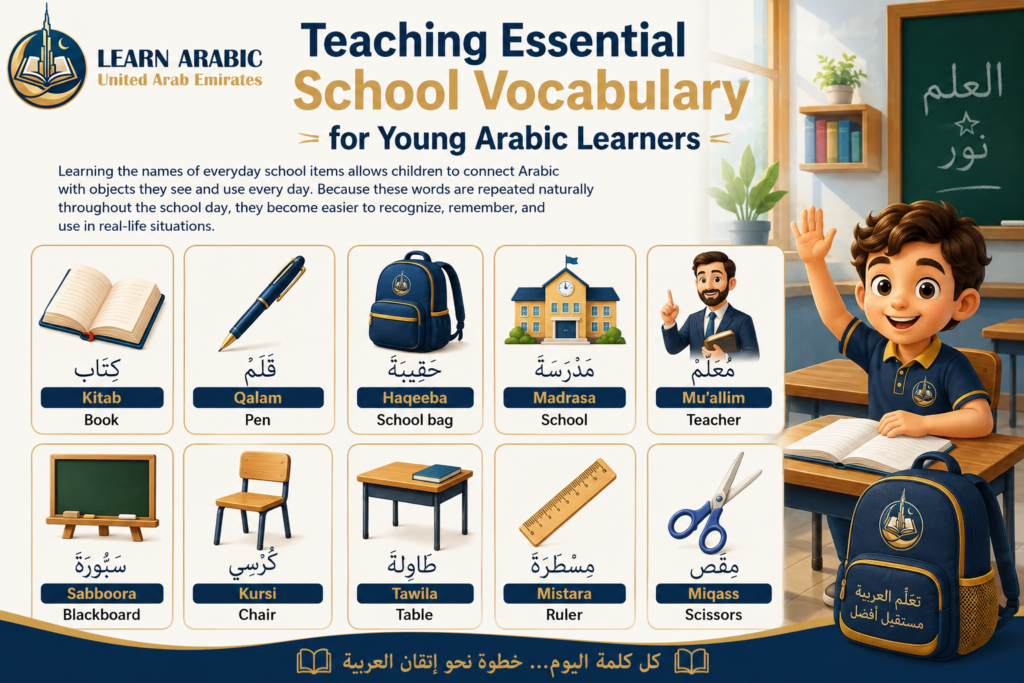
A. Teaching Essential School Vocabulary for Young Arabic Learners
Learning the names of everyday school items allows children to connect Arabic with objects they see and use every day. Because these words are repeated naturally throughout the school day, they become easier to recognize, remember, and use in real-life situations.
| Arabic | Transliteration | English |
| كِتَاب | Kitab | Book |
| قَلَم | Qalam | Pen |
| حَقِيبَة | Haqeeba | School bag |
| مَدْرَسَة | Madrasa | School |
| مُعَلِّم | Mu’allim | Teacher |
| سَبُّورَة | Sabboora | Blackboard |
| كُرْسِي | Kursi | Chair |
| طَاوِلَة | Tawila | Table |
| مِسْطَرَة | Mistara | Ruler |
| مِقَص | Miqass | Scissors |
B. Reinforcing School Vocabulary Through Daily Practice
Children who encounter this vocabulary in structured Arabic classes for kids alongside their regular school routine benefit from dual exposure. Hearing and using the same words both at home and during lessons reinforces memory naturally and significantly improves long-term vocabulary retention.
Read Also: 10 Interesting Easy Arabic Stories For Kids
9. Describing Words “Adjectives” In Arabic
Once a child has nouns from the earlier groups, adjectives are the next logical step. They transform single-word recognition into descriptive communication: not just كِتَاب (kitab — book), but كِتَاب كَبِير (kitab kabeer — big book).
| Arabic | Transliteration | English |
| كَبِير | Kabeer | Big |
| صَغِير | Sagheer | Small |
| جَمِيل | Jameel | Beautiful |
| سَرِيع | Saree’ | Fast |
| بَطِيء | Balee’ | Slow |
| سَاخِن | Sakhin | Hot |
| بَارِد | Barid | Cold |
| لَذِيذ | Latheeth | Delicious |
| جَدِيد | Jadeed | New |
| قَدِيم | Qadeem | Old |
The real value of adjectives is that they create combination practice. A child who knows colors, animals, and adjectives can say: “قِطَّة بَيْضَاء صَغِيرَة” (Qitta bayda’ sagheera — “A small white cat”). That’s a genuine sentence, and it feels like real Arabic.
Read also: Arabic Writing Practice In The UAE

Read Also: How to Teach Kids Arabic in the UAE?
10. Common Arabic Verbs for Kids (Action Words)
Verbs are what turn a vocabulary collection into a language. Children who learn even ten high-frequency verbs can begin building simple sentences almost immediately — because every sentence needs an action.
| Arabic | Transliteration | English |
| يَأْكُل | Ya’kul | He eats |
| يَشْرَب | Yashrab | He drinks |
| يَلْعَب | Yal’ab | He plays |
| يَكْتُب | Yaktub | He writes |
| يَقْرَأ | Yaqra’ | He reads |
| يَذْهَب | Yathhab | He goes |
| يَنَام | Yanam | He sleeps |
| يَرْكُض | Yarkud | He runs |
| يُحِب | Yuhibb | He loves |
| يُسَاعِد | Yusa’id | He helps |
A practical classroom observation: children learn verbs fastest when they act them out. Call the verb, the child performs the action.
يَرْكُض — the child runs.
يَنَام — the child pretends to sleep. Physical association makes Arabic action words memorable within a single session.
Read Also: Top 10 Funny Arabic Activity for Kids in the UAE
How to Move Your Child From Word Lists to Real Arabic Sentences?
Learning isolated vocabulary is the starting line, not the finish. The goal — for any child, at any age — is to string words together into meaningful communication. That transition happens faster than most parents expect, provided the vocabulary groups above are introduced in context rather than as standalone drills.
A child who knows Muslim greetings in Arabic, family words, a verb or two, and a handful of adjectives can already form sentences like:
- “أُمِّي جَمِيلَة” (Ummi jameela — “My mother is beautiful”)
- “أَنَا أُحِبُّ التُّفَّاحَة” (Ana uhibbu at-tuffaha — “I love apples”)
- “هَذَا كَلْب كَبِير” (Hatha kalb kabeer — “This is a big dog”)
Once a child reaches this point, they need conversational practice — not more word lists. That’s precisely where guided instruction from qualified teachers makes a measurable difference.
For parents looking to give their child a structured path that goes beyond memorized vocabulary toward genuine speaking ability, exploring learn Arabic phrases as part of a formal lesson sequence accelerates this transition considerably.
Read Also: 10 Steps To Learn Egyptian Arabic for Kids
See Our Classroom Environment in Action
Experience a sneak peek into our live sessions. Watch the video below to see our specialized instructors interacting with students, breakdown complex texts, and cultivate an engaging, respectful learning environment.
Master Arabic in the UAE
Experience world-class Arabic language training designed for students and professionals in the Emirates.
Book Your Free TrialRead Also: The Best 10 Arabic Books For Kids
Build Your Child’s Arabic Vocabulary with Learn Arabic UAE
Learn Arabic UAE offers structured, expert-led Arabic courses across the UAE, designed for learners from complete beginners through to advanced levels. For children specifically, the curriculum is built to match developmental stages — short sessions, visual learning, and age-appropriate pacing that keeps young learners engaged rather than overwhelmed.
What separates a genuine language program from a vocabulary app or YouTube playlist is the presence of a qualified teacher who can hear your child, correct their pronunciation in real time, and adapt to how that specific child learns.
Parents across the UAE have found that children who start with Arabic classes for kindergarten build foundational pronunciation habits that carry them confidently through school Arabic. For older children, a dedicated how to learn Arabic in the UAE guide provides the structured sequence that self-study cannot replicate.
Learn Arabic UAE’s full course offering includes:
- Arabic Course in the UAE
- Arabic Classes for Beginners
- Arabic Classes for Adults
- Quranic Arabic Course
- Emirati Arabic Course
- Gulf Arabic Course
- Business Arabic Course UAE
- Arabic Grammar Course
- Learn Arabic Alphabet Course
- Modern Standard Arabic (MSA) Course
- Self-Paced Arabic Course
[image: marketing visual]
Book a trial class for your child today →

Conclusion
Arabic vocabulary for kids is most effective when it follows a deliberate sequence: greetings first, then family, then the concrete nouns that fill a child’s daily world — colors, numbers, animals, food, body parts, school objects — before moving into describing words and verbs that bring everything together into real sentences.
The ten groups in this guide aren’t arbitrary. Each one builds on what came before, and together they give a child enough raw material to communicate meaningfully in Arabic well before they’ve finished a traditional curriculum. What matters most isn’t how many words a child knows — it’s how quickly they can use what they know to say something real.
For children in the UAE, the advantage of being surrounded by Arabic every day is significant. With the right vocabulary foundation and structured guidance from qualified teachers, that surrounding environment becomes an accelerator rather than background noise.
Learn Arabic for kids in the UAE works best when home vocabulary practice and structured classroom learning reinforce each other — and this list is a strong place to begin.
Frequently Asked Questions
What is arabic vocabulary for kids and where should children start?
Arabic vocabulary for kids refers to the high-frequency, concrete words most relevant to a child’s daily life — colors, numbers, animals, family members, and everyday objects. Children should begin with greetings and family words, as these provide immediate practical use and early exposure to Arabic’s masculine-feminine word structure.
How many Arabic words should a child learn per day?
Five new words per day is the most effective pace for children aged 4–10. This keeps sessions short enough to maintain focus, provides enough daily repetition to build genuine retention, and prevents the overwhelm that comes from trying to memorize long lists in one sitting.
At what age should kids begin learning Arabic vocabulary?
Children can begin absorbing Arabic words through songs and daily expressions from age 3–4. Structured vocabulary learning with reading and writing typically begins around age 5–6. However, children at any age can begin — older children often retain new vocabulary faster because they can apply logical memory strategies.
What is the best way to help kids remember Arabic vocabulary?
The most effective approach combines visual anchors (pictures, real objects), brief daily repetition (5–10 minutes), and contextual use (naming things in the environment). Simply put, words that a child encounters in context — at the dinner table, during play, on a walk — are retained far longer than words learned from a list and never used again.
Are Arabic classes in the UAE suitable for non-Arabic speaking children?
Yes. Reputable providers offering arabic classes for kids in the UAE design their programs specifically for children from non-Arabic backgrounds, with curriculum that begins from zero, uses English for instruction where needed, and progresses at a pace matched to the child’s age and prior exposure.
Do children need to learn the Arabic alphabet before building vocabulary?
Not necessarily at the very start. Children can begin building spoken vocabulary through listening and repetition before reading. However, learning the Arabic alphabet early — within the first few months — significantly accelerates vocabulary retention because children can read new words independently rather than relying solely on audio input.




Leave a Reply