 Learn Arabic

If you’re a beginner and planning to learn Arabic grammar, the good news is that you don’t need to memorize every rule of classical Arabic grammar before you can write and speak correctly. You need to know which rules actually show up in everyday sentences, and how to apply them without hesitating.
This article walks through the building blocks: letters and word types. It also shows you sentence structure and the endings that trip up most new learners, in the order they actually matter. Each section focuses on one part of the system, so you can work through it step by step instead of trying to absorb the whole subject at once.
By the end of this article, you’ll know exactly what to study first, what to leave for later, and how to check your own progress.
The Building Blocks For Arabic Grammar
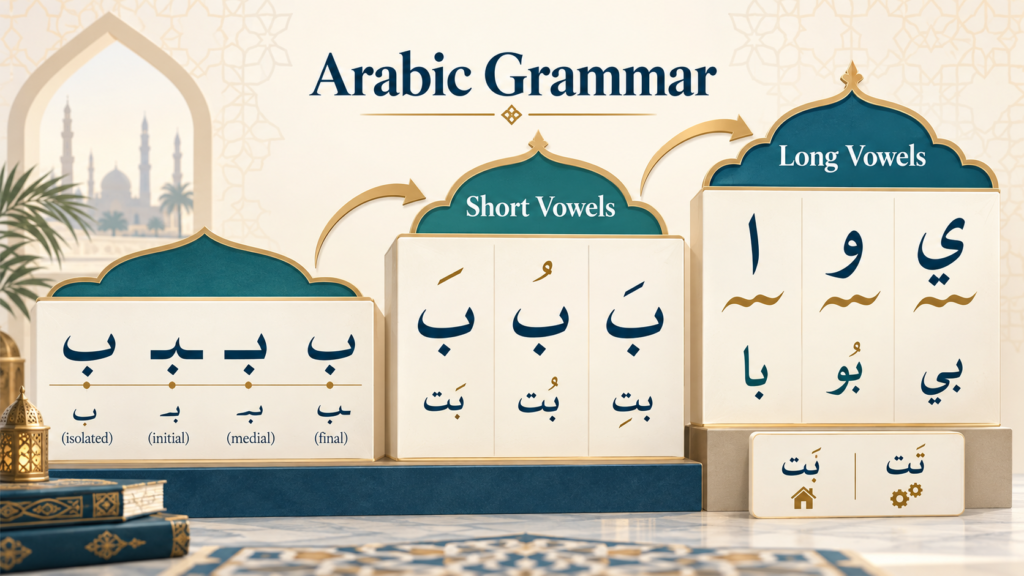
Arabic grammar for beginners starts below the level of words, at the level of sounds. Every Arabic letter has a name, a sound, and a shape that changes depending on whether it sits at the start, middle, or end of a word.
Getting this right early prevents reading errors later, since a single misplaced dot or missed vowel can change a word’s entire meaning.
a. Short Vowels (Harakat)
The three short vowels, damma ضمة (ُ), fatha فتحة (َ), and kasra كسرة (ِ), sit above or below a letter and control how a word is pronounced and, often, its grammatical role in the sentence. In classical Arabic grammar, these marks (harakat حركات) are what actually carry the grammatical information.
The same three consonants can be a subject, an object, or something else entirely depending on which harakah sits on the final letter.
b. Long Vowels (Madd)
Long vowels extend a sound using alif ا, waw و, or ya ي. For example, the difference between a short “a” sound and one held for two beats. These aren’t decorative; they distinguish words that would otherwise look identical and are one of the first things a reader learns to recognize automatically.
Learn Arabic UAE structures its beginner track specifically around this letter-and-vowel foundation before introducing sentence grammar, since skipping it tends to slow learners down later rather than saving them time now.
Read Also: Arabic Grammar For Quran
The Three Word Types In Classical Arabic Grammar
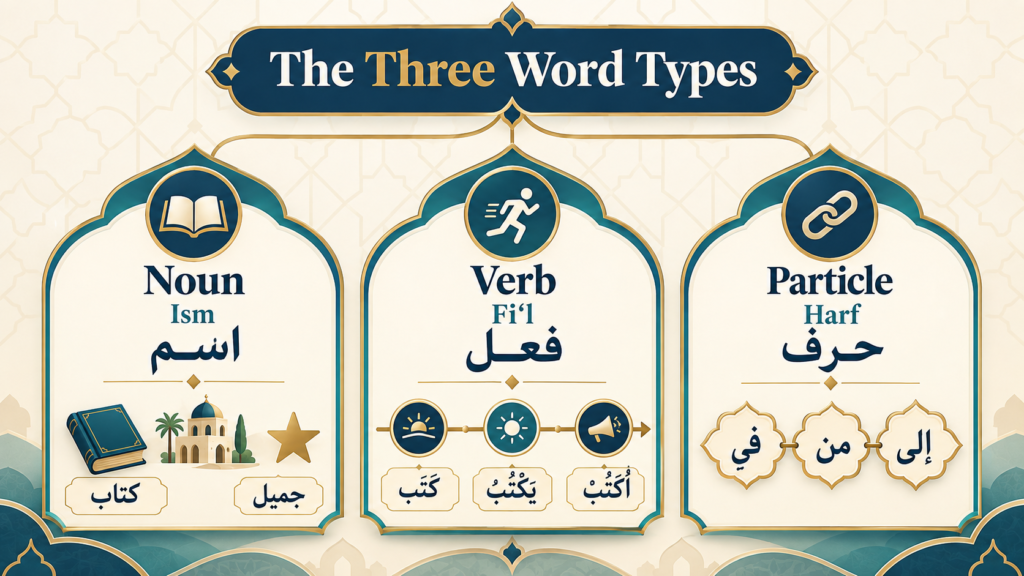
Every word in Arabic grammar for beginners falls into exactly one of three categories. Knowing which category a word belongs to is the first question you ask before you can analyze any sentence, because each category behaves differently.
1. Noun (Ism)
A noun (ism) اسم is any word that names a person, object, place, or quality: كتاب (book), محمد (Muhammad), جميل (beautiful). Nouns are the largest category and the ones most affected by the mabni/mu’rab distinction covered further below.
2. Verb (Fi’l) And Its Tenses
A verb (fi’l) فعل expresses an action tied to a specific time. Classical Arabic grammar recognizes three verb forms: ماض past (كتب — “he wrote,” an action that happened and finished), مضارع present (يكتب — “he writes/is writing,” an ongoing or future action), and أمر imperative (اكتب — “write,” a command).
Each form changes shape at the start and end of the word, which is why recognizing the pattern matters more than memorizing individual verbs.
3. Particle (Harf)
A particle (harf) حرف carries no independent meaning of its own; words like في (in), من (from), and إلى (to) only make sense attached to a noun or verb.
Particles are usually the shortest words in a sentence and, conveniently, the ones with the fewest exceptions to memorize.
Once you can sort a sentence into these three categories at a glance, the rest of Arabic sentence structure becomes much easier to follow. The sentence types below assume you can already do this.
Read Also: Arabic Long Vowels – The Complete Guide To ا و ي
Building Your First Sentences According To Arabic Grammar
Classical Arabic grammar recognizes two main sentence structures, and telling them apart quickly is one of the first real skills a beginner needs.
a. Nominal Sentences (Jumla Ismiyya)
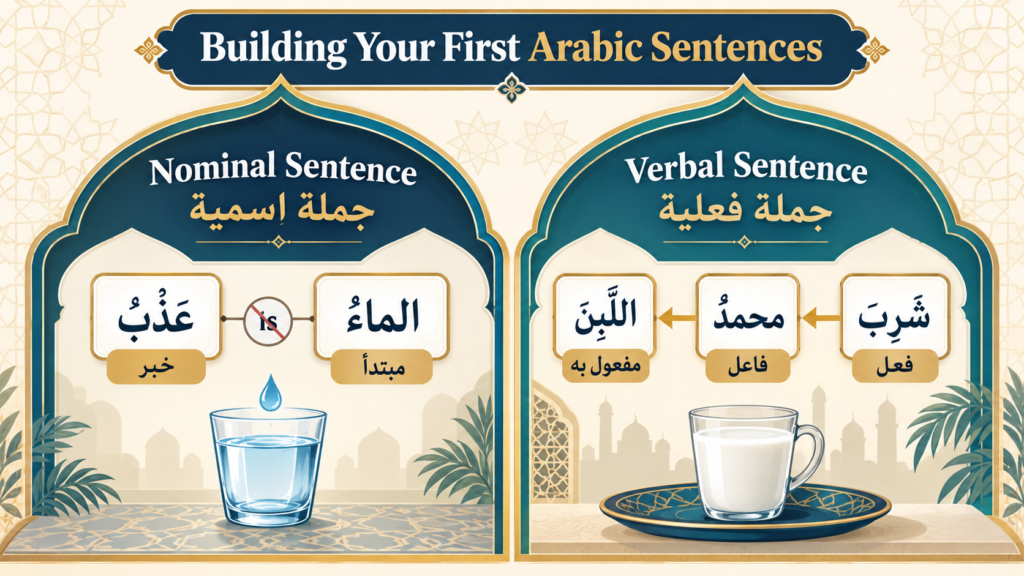
A nominal sentence جملة اسمية starts with a noun and consists of a subject (mubtada) مبتدأ and a predicate (khabar) خبر. For example, الماءُ عذْبٌ (“The water is sweet”). There’s no verb required; the two nouns simply describe a state or fact about each other.
Many learners coming from English assume every sentence needs a verb like “is” or “are.” Arabic doesn’t work that way. The relationship between subject and predicate is implied by their position and endings alone.
If you’re building study habits around real sentences rather than isolated rules, Learn Arabic UAE’s beginner course walks through dozens of nominal-sentence examples drawn from everyday speech, which tends to make the pattern stick faster than rule memorization alone.
b. Verbal Sentences (Jumla Fi’liyya)
A verbal sentence جملة فعلية starts with a verb فعل, followed by its subject (fa’il) فاعل, and often an object (maf’ul bih) مفعول به.
For example, شَرِبَ محمدٌ اللبنَ (“Muhammad drank the milk”). The verb comes first, which is the opposite word order from English and one of the more noticeable early adjustments for new learners.
A practical rule worth internalizing: whenever you spot a verb at the start of a clause, you should immediately expect a subject to follow it. That expectation alone resolves a large share of beginner reading confusion.
Read Also: Arabic Short Vowels
Mabni vs. Mu’rab – The Rule That Prevents Most Beginner Mistakes
Classical Arabic grammar divides words into two groups based on whether their ending changes: mabni مَبني(fixed) and mu’rab مُعرَب(inflected).
This single distinction explains most of the spelling and ending mistakes beginners make, and it’s worth learning before almost anything else.
Fixed Words (Mabni)
Mabni words keep the same ending regardless of their position in the sentence. This includes particles (من, في, لن), the past-tense verb (ذهب), the imperative verb (اذهب), and demonstrative or relative pronouns.
For these words, you only need to know their role in the sentence. The ending never moves.
Changing Words (Mu’rab) And I’rab Markers
Mu’rab words change their final vowel or letter depending on their grammatical position. The clearest example is a name like خالد: جاء خالدٌ (Khalid came, damma), رأيتُ خالدًا (I saw Khalid, fatha), سلّمتُ على خالدٍ (I greeted Khalid, kasra).
The consonants never move; only the final marking does, and that marking is what signals the word’s function.
A common mistake beginners make is applying a fatha to a plural subject that should carry a damma, or writing a sound masculine plural (jam’ mudhakkar salim جمع مذكر سالم) with a ya’ in a position that calls for a waw.
These errors are rarely about vocabulary. They come from not checking which i’rab marker the word’s position actually requires.
Read Also: Connecting Arabic Letters Practice
A Practical Learning Routine For Arabic Grammar
During the journey of learning Arabic grammar, memorizing the rules is not enough. You need to apply what you have learnt.
A routine that tends to work: study one rule at a time, apply it to short, clear sentences, check your answer, then apply the same rule to a longer or less obvious sentence before moving on.
Common Mistakes Beginners Make
Beginners often slow their progress by studying advanced rules too early or learning grammar without enough practical application. Avoiding the following mistakes will help you build a stronger foundation and use Arabic grammar more confidently.
1. Trying to master rare or highly technical Nahw topics before the basics are solid, rather than focusing on the errors that actually show up in normal writing
2. Memorizing i’rab rules without practicing them on real sentences, which makes the knowledge hard to recall under pressure
3. Skipping the mabni/mu’rab distinction and guessing at word endings instead of checking sentence position first
How Long It Takes To See Results
Learners commonly aim for the basics of Arabic sentence grammar within about three months of steady daily practice, with simple daily conversation becoming manageable within six months, timelines that assume consistent short sessions rather than occasional long ones. Progress tends to track practice frequency more closely than total hours studied.
If you’d rather follow a structured timeline than build one from scratch, Learn Arabic UAE’s live classes are paced around these same milestones, with an instructor checking your sentence-building in real time instead of leaving you to self-correct.
Read also: Can I Learn Arabic in 3 Months in the UAE?
Free Online Resources For Learning Arabic Grammar For Beginners
Beginners can strengthen their Arabic grammar without immediately committing to a paid course.
The following free channels and apps offer accessible explanations, visual examples, and flexible practice covering essential rules, sentence structure, and common grammatical patterns.
1. The Learn Clear Arabic With Nesma YouTube Channel
The Learn Clear Arabic with Nesma YouTube channel provides a free, structured grammar series for beginners. Its short, accessible lessons explain essential topics such as parts of speech, grammatical cases, gender agreement, plurals, and prepositions, helping learners build their Arabic knowledge gradually from the basics.
2. The Learn Arabic With Khasu YouTube Channel
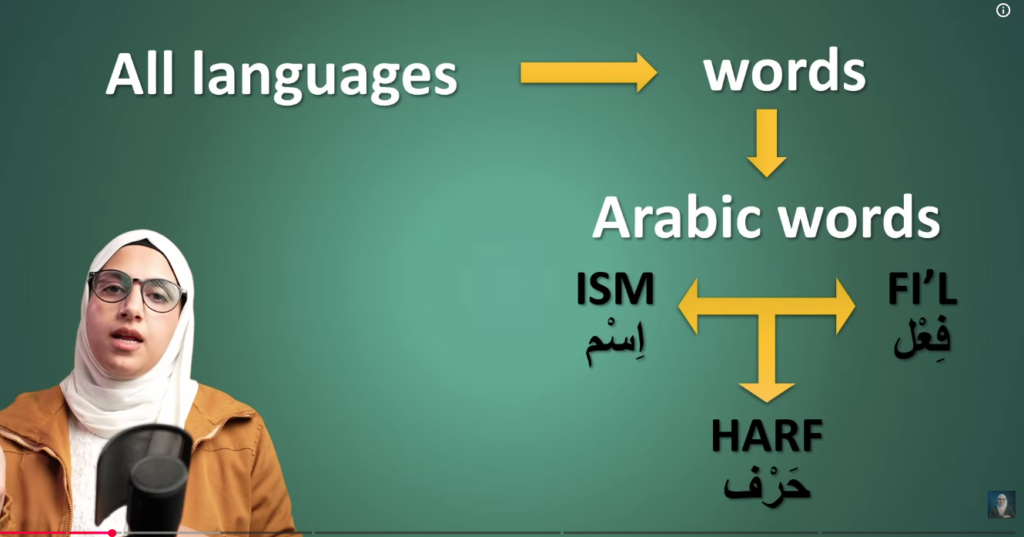
The Learn Arabic with Khasu YouTube channel provides a clear, beginner-friendly introduction to Arabic grammar. Its visual explanations, translated examples, and focus on essentials such as subjects and predicates help learners understand sentence structure quickly and practically.

3. The Arabic Grammar Learning App
The Arabic Grammar Learning app gives beginners convenient access to grammar explanations, reference tables, and textbook-based lessons on their phones.
It can support self-paced study and quick revision of both literary and conversational Arabic grammar.
Read also: How long to learn Arabic in the UAE?
Step Inside Our Classrooms
Don’t just take our word for it—see our community in action. Click below to watch real, live snippets from our recent classes and experience our engaging teaching style firsthand!
Master Arabic in the UAE
Experience world-class Arabic language training designed for students and professionals in the Emirates.
Book Your Free TrialStart Learning Arabic Grammar The Structured Way
Reading about Arabic grammar for beginners only takes you so far. The fastest progress comes from applying each rule with feedback, in a class built for people starting from zero.
Learn Arabic UAE‘s beginner program takes you from letters and vowels through nominal and verbal sentences with a live instructor correcting your work at each stage, so mistakes get caught before they turn into habits.
If you are ready to build a reliable foundation, explore Learn Arabic UAE’s beginner lessons and take the next step at a pace that suits you.
Our Arabic courses
- Arabic Course in the UAE
- Arabic Intensive Course
- Arabic Classes for Beginners (Learn Arabic from Scratch)
- Madinah Arabic Course
- Arabic Classes for Adults
- Self-Paced Arabic Course
- Arabic Speaking Classes
- Learn to Write Arabic Course
- Arabic Grammar Course
- Learn Arabic Alphabet Course
- Modern Standard Arabic (MSA) Course
- Quranic Arabic Course
- Fusha Arabic Course
- Classical Arabic Course
- Emirati Arabic Course
- Gulf Arabic Course
- Learn Saudi Arabic
- Business Arabic Course UAE
- Arabic Language Classes for Professionals in UAE
Our Arabic Courses for Kids
- Arabic Course for Kids
- Arabic Conversation Course for Kids
- Arabic Qaida Course for Kids
- Beginner Arabic Course for Kids
- Arabic Grammar Course for Kids
- Teen Arabic Summer Course
- UAE Kindergarten Arabic Classes

Conclusion
Arabic grammar for beginners comes down to a manageable set of building blocks: letters and vowels, the three word types, two sentence structures, and the mabni/mu’rab distinction that governs word endings.
You don’t need to master every corner of classical Arabic grammar to write and speak correctly. You need to recognize these patterns reliably and apply them to real sentences.
Start with the basics covered here, practice on short sentences before long ones, and check your work against the i’rab rules rather than guessing. Consistency in short daily sessions will move you further than occasional long study sessions.
Frequently Asked Questions
Do I Need To Memorize The Entire Nahw System To Write Correctly?
No, you don’t need to memorize the entire Nahw system to write correctly. Most everyday writing only depends on a limited set of rules covering word endings, sentence types, and common verb forms. Rare or highly technical grammar points can wait until you’ve mastered the basics.
What’s The Difference Between A Nominal And A Verbal Sentence?
A nominal sentence starts with a noun and states a fact about a subject and predicate, while a verbal sentence starts with a verb followed by its subject. Recognizing which one you’re reading tells you what to expect next in the sentence.
Why Do Arabic Word Endings Change?
Arabic word endings change because mu’rab words carry their grammatical role, subject, object, and so on, in their final vowel or letter, a system called i’rab. Mabni words, by contrast, keep one fixed ending no matter their role.
How Long Does It Take To Learn Basic Arabic Grammar?
Most learners reach a working grasp of basic Arabic grammar within about three months of steady daily practice, with simple conversational use following within roughly six months. Consistency matters more than the total number of hours studied.
What’s The Most Common Grammar Mistake Beginners Make?
The most common mistake is applying the wrong i’rab marker because the word’s sentence position wasn’t checked first, such as using a fatha where a damma is required. Checking a word’s role before marking its ending prevents most of these errors.



Leave a Reply